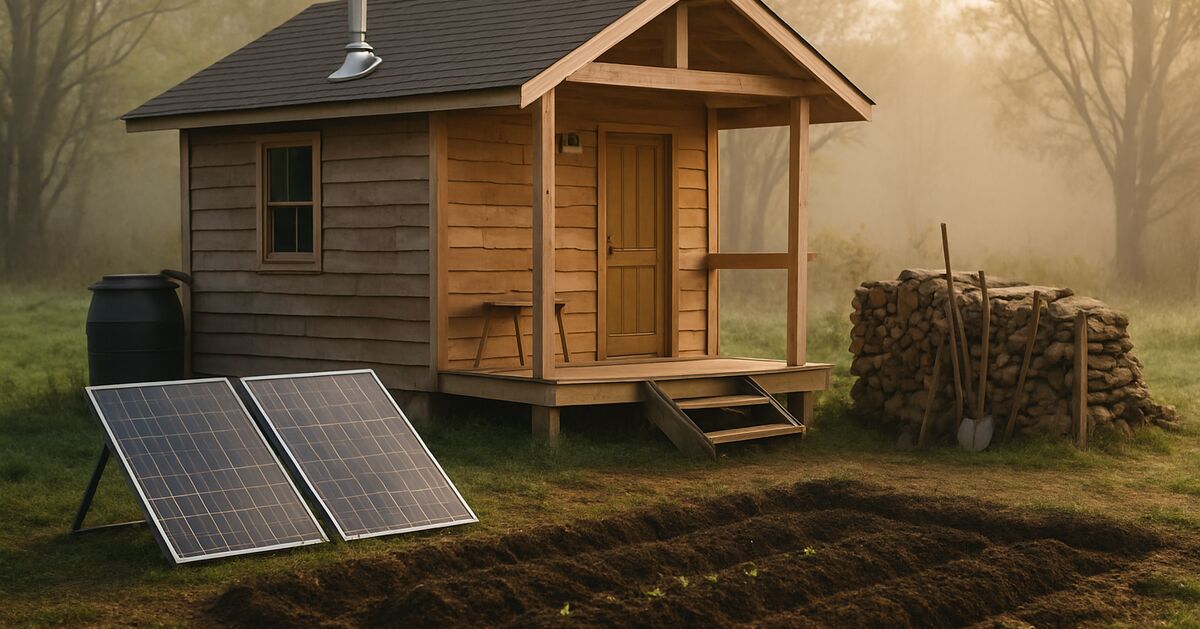
Nobody's first six months off-grid look like the photos. There's no golden-hour shot of you sipping coffee on a porch you haven't built yet, next to a garden that hasn't produced anything, powered by a system you're still troubleshooting. The real first six months are about sequencing: figuring out what has to happen before what, and resisting the urge to do everything at once.
This isn't a packing list. It's a timeline, based on the sequencing logic that tends to make sense when the romance wears off and the work begins. The goal is to help you avoid two failure modes worth planning around: burning out in month two, or spending money in the wrong order and having to redo it.
Before you move: the planning window matters more than people admit
If you have any lead time at all before you're living on the property full-time, use it. Arriving with no water, no shelter, and no plan means solving all three at once under weather pressure, which is a hard position to start from.
In the weeks or months before the move, focus on three things you can research or arrange remotely:
Water source confirmation. Is there a well, a spring, a creek, or are you hauling and catching rain? Don't assume. Get this answered before you commit to a site for your cabin or trailer.
Access. Can a delivery truck reach the property in the season you're moving? A driveway that's fine in July can be impassable mud in March.
Legal and permitting basics. Septic, greywater, and building requirements are set locally, so check with your county before assuming what applies. Sort out what you're required to do versus what you're choosing to do, so you're not caught off guard later.
This is also the time to start assembling your core toolkit rather than buying it piece by piece under pressure once you're on site. A well-thought-out starting kit, covered in my guide to the off-grid tool kit you actually need on day one, saves you from the expensive habit of buying a tool the day you desperately need it, at whatever price the nearest hardware store charges.
Month one: shelter, water, and safety, in that order
The first month is about survival infrastructure, not homesteading. It's tempting to start on a garden bed or a chicken coop because those feel productive and hopeful. Resist it. Nothing else matters if you don't have reliable shelter, a way to get water, and a plan for injuries.
Shelter doesn't need to be your final cabin. A well-insulated trailer, a wall tent with a good stove, or a small temporary structure is completely legitimate for month one. What matters is that it keeps you dry and holds heat. If you're heading into a cold season, prioritize insulation immediately rather than treating it as a later upgrade. Even a temporary structure benefits from the same principles covered in my piece on insulating an off-grid cabin so it holds heat and stays cool: air sealing and insulating the ceiling first, since that's where you lose the most heat, then walls, then floor.
Water in month one is often about establishing a routine, not a permanent system. Maybe that's hauling jugs from town, maybe it's a rain catchment barrel under a temporary roofline, maybe it's a hand pump on an existing well. Whatever it is, get it dialed in early because everything else, cooking, hygiene, laundry, depends on it.
Safety is easy to skip in month one, and the downside if something goes wrong is severe. You're likely doing more physical labor than you're used to, with more sharp tools, in a place where an ambulance may take far longer to arrive than in town. Before you're swinging an axe or running a chainsaw daily, have a real first-aid kit on site, not the glovebox version. My guide on building an off-grid first-aid kit for when help is hours away walks through what actually belongs in it, and it's worth doing this in week one, not week twelve.
Also in month one: figure out communication. If you're used to relying on your phone and you suddenly have no signal, that's a bigger adjustment than people expect, especially for emergencies. Look at this early rather than discovering the gap during a crisis. My post on staying reachable off-grid when there's no cell signal at all covers the realistic options, from repeaters to satellite messengers.
Month two: power, in modest amounts
By month two, thinking about electricity beyond a couple of solar lanterns is a reasonable next step. This is where a lot of new homesteaders overspend or underspend, because they try to design their "forever system" before they understand their actual usage.
A more honest approach: start smaller than you think you need. A portable power station or a modest panel-and-battery setup can run lights, charge tools and phones, and run a laptop, without the complexity and cost of a full rooftop array. Living with a smaller system for a couple of months teaches you your real consumption patterns, which is far more useful than any calculator. If you haven't already worked through the tradeoffs, it's worth reading about whether a portable power station or a full solar system fits your life before committing to hardware, since reversing that decision later is expensive.
This is also when internet access tends to come up, especially if anyone in the household works remotely or you want basic connectivity for weather, research, or ordering parts. If you're going to run something like Starlink, plan its power draw into your system from the start rather than bolting it on later. My breakdown of Starlink's setup, power draw, and real-world speeds off-grid is useful reading before you buy hardware, since the dish's power appetite surprises a lot of new users.
Keep your month-two power goals modest: lighting, phone and tool charging, maybe a laptop, maybe a small fridge. Expanding to run larger loads, freezers, power tools, well pumps, is a month four to six conversation, once you understand your actual daily and seasonal usage.
Month three: water systems get real
By the third month, hauling water or relying on an improvised catchment tends to wear thin, and it's a sensible point to consider a real system: a proper cistern, a filtration setup, or a developed spring line.
If you're filtering surface or rain water, understand the difference between gravity filters and pump filters before buying either. They solve different problems, gravity systems are simpler and require no power but are slower, pump filters are faster but add a mechanical point of failure, and my comparison of gravity water filters versus pump filters breaks down which is more trustworthy for which situation.
If rain catchment is your main source, month three is a good time to move from an improvised barrel to a properly sized and covered system, with first-flush diversion and mosquito-proof screening. My guide to collecting and storing rainwater safely covers sizing, roof material considerations, and the contamination risks that catch new homesteaders off guard.
This is also a sensible point to address greywater, since by month three you likely have a working kitchen and some kind of bathing setup generating wastewater that needs somewhere sensible to go rather than pooling near your door. The basics of greywater handling for an off-grid cabin aren't complicated, but skipping them creates a mud and odor problem that's unpleasant to fix retroactively.
Month four: the kitchen and the bathroom stop being improvised
Cooking on a single burner or an open fire is fine for a few weeks, but by month four a kitchen you can cook real meals on without losing your evening starts to matter. This is worth doing properly rather than continuing to patch together whatever was fastest to set up in week one.
Month four is also a reasonable point to replace whatever bathroom stopgap was in place, a bucket system, a pit, a borrowed neighbor's bathroom, with a composting toilet. Composting toilets vary a lot in price, capacity, and how much maintenance they demand, and it's worth understanding which types are actually worth the money for your household size before buying one.
Month five: livestock, if you're doing it, and the garden's real test
Many new homesteaders want chickens or goats from week one, and the advice to wait feels frustrating. But animals need reliable shelter, a secure water source, and predator-proofing before they arrive, not after, and month five is a realistic point to have those pieces in place if you started planning in month one.
Start smaller than your ambitions. A few laying hens are a far more forgiving first animal than goats or pigs, which have more complex housing, feed, and health needs. Whatever you choose, make sure their water doesn't depend on a system that's still unreliable for you, if your own water setup has hiccups, don't add animals that depend on it working every single day without fail.
By month five your first garden season is also showing you what actually grows in your soil, your microclimate, and your water situation, which is more informative than any seed catalog. This is the point to start planning your first real preservation season rather than scrambling in September. A full year-round food plan for growing and storing well is worth reading now, so you can plant with the harvest and storage plan already in mind, not as an afterthought.
Month six: heating for the season you haven't faced yet
If you started in spring or summer, month six is often your first real test of your heating setup, and it's better to have this sorted before the first cold snap than during it. Wood stoves, rocket mass heaters, and propane each have real tradeoffs in cost, labor, and reliability, and the right choice depends heavily on your climate and how much time you have for wood processing. It's worth comparing options honestly in my piece on heating a small off-grid space before you're relying on whatever you improvised in month one.
What tends to go wrong
A few patterns show up again and again in the first six months, and knowing them ahead of time helps you dodge them.
Doing everything simultaneously. It's tempting to build the cabin, dig the garden, fence for animals, and install solar all in the same six weeks. Something always suffers, usually sleep or safety.
Underestimating water needs. Water use for animals, gardens, and laundry adds up quickly and is easy to underestimate, so build in margin. Build in margin.
Buying the "forever" system too early. Power systems, water systems, and even garden layouts benefit from a season of real use before you lock in a permanent design.
Skipping the boring safety stuff. First-aid kits, communication plans, and basic fire safety aren't exciting, but they're the difference between a bad afternoon and a genuine emergency when help is far away.
A realistic six-month scorecard
By the end of six months, a reasonable target is: reliable shelter that holds heat, a dependable water source with real filtration, a modest but functioning power system, a working kitchen, a sane bathroom solution, and one season of garden data. That's plenty. Livestock, expanded power, and a permanent cabin build are entirely reasonable to still be in progress.
If you're just getting oriented, my gear guides organized by category are a good place to start matching your plan to real products rather than guessing, and the full blog archive has deeper dives on most of the systems mentioned here. If you want to know more about how this publication approaches these topics, my about page explains the philosophy, and if you've got a specific situation you're weighing, reach out, plenty of readers do, and specific questions often make for better answers than general ones.
The first six months off-grid are rarely glamorous. They're mostly about sequencing decisions correctly and giving each system, water, power, shelter, food, its own honest season to prove itself before you build on top of it. Go slower than feels satisfying, and you'll end up faster than the people who rushed.
Claim audit: 18 consequential claims checked against the article's sources; unsupported wording revised where it could not be substantiated.
Claim-by-claim audit (18 checked)
“It's a timeline, based on the sequencing logic that tends to make sense when the romance wears off and the work begins.” (rewritten to what the article can stand behind)
“The goal is to help you avoid two failure modes worth planning around: burning out in month two, or spending money in the wrong order and having to redo it.” (rewritten to what the article can stand behind)
“Arriving with no water, no shelter, and no plan means solving all three at once under weather pressure, which is a hard position to start from.” (rewritten to what the article can stand behind)
“Septic, greywater, and building requirements are set locally, so check with your county before assuming what applies.” (rewritten to what the article can stand behind)
“**Safety** is easy to skip in month one, and the downside if something goes wrong is severe.” (rewritten to what the article can stand behind)
“You're likely doing more physical labor than you're used to, with more sharp tools, in a place where an ambulance may take far longer to arrive than in town.” (rewritten to what the article can stand behind)
“By month two, thinking about electricity beyond a couple of solar lanterns is a reasonable next step.” (rewritten to what the article can stand behind)
“This is where a lot of new homesteaders overspend or underspend, because they try to design their "forever system" before they understand their actual usage.” (reasoning shown in the article)
“Living with a smaller system for a couple of months teaches you your real consumption patterns, which is far more useful than any calculator.” (reasoning shown in the article)
“By the third month, hauling water or relying on an improvised catchment tends to wear thin, and it's a sensible point to consider a real system: a proper cistern, a filtration setu…” (rewritten to what the article can stand behind)
“They solve different problems, gravity systems are simpler and require no power but are slower, pump filters are faster but add a mechanical point of failure, and my comparison of …” (reasoning shown in the article)
“Cooking on a single burner or an open fire is fine for a few weeks, but by month four a kitchen you can cook real meals on without losing your evening starts to matter.” (rewritten to what the article can stand behind)
“Month four is also a reasonable point to replace whatever bathroom stopgap was in place, a bucket system, a pit, a borrowed neighbor's bathroom, with a composting toilet.” (rewritten to what the article can stand behind)
“But animals need reliable shelter, a secure water source, and predator-proofing before they arrive, not after, and month five is a realistic point to have those pieces in place if …” (reasoning shown in the article)
“A few laying hens are a far more forgiving first animal than goats or pigs, which have more complex housing, feed, and health needs.” (cited → smallfarms.oregonstate.edu)
“It's tempting to build the cabin, dig the garden, fence for animals, and install solar all in the same six weeks.” (rewritten to what the article can stand behind)
“Water use for animals, gardens, and laundry adds up quickly and is easy to underestimate, so build in margin.” (rewritten to what the article can stand behind)
“By the end of six months, a reasonable target is: reliable shelter that holds heat, a dependable water source with real filtration, a modest but functioning power system, a working…” (rewritten to what the article can stand behind)
Before you go
One useful off-grid email a week.
Practical gear rundowns, honest how-tos, and plain-English guides from someone doing the homework in the open.
I am building a place for off-grid people to swap real answers: a forum by topic, classifieds for gear and services, and real estate for off-grid land and homes. It is new, so the early members shape what it becomes. A free account lets you post in all three.
No ER ten minutes away means you have to be your own triage nurse. Here's how to tell a bad bee sting from the real emergency, and what to actually stock.
In many off-grid disasters, the fire or flood itself isn't the decisive factor, it's the hour you waited too long to leave. Here's how to set real, numeric triggers before you need them.
Tax sale and sheriff's auction land looks like a bargain, but redemption periods, hidden liens, and unseen parcels turn a lot of cheap acreage into an expensive lesson. Here's how to vet a listing before you bid.