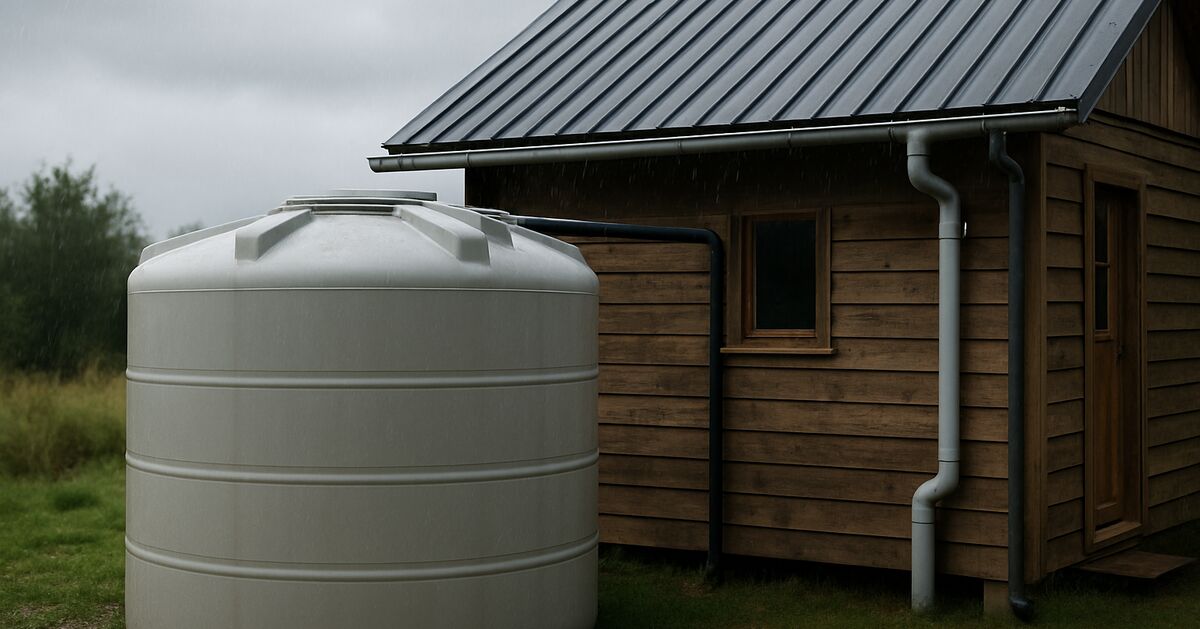
Rain is free, it falls whether you're ready for it or not, and depending on your roof area and local rainfall it may supply a meaningful share of household water if you catch it properly. But "catching water" and "catching safe water you can drink and bathe in without worry" are two very different projects. The gap between them is where most rainwater systems succeed or fail.
This guide walks through the whole chain: roof, gutters, first-flush diversion, storage, filtration, and long-term maintenance. It's written for people planning a real off-grid water supply, not a rain barrel for the garden.
Why rainwater makes sense off-grid
If you're not on a municipal line, your water options are basically a drilled well, a hauled-in supply, a spring, or rainwater catchment. Wells are excellent when the water table cooperates, but drilling can run into real money if you hit rock or have to go deep, and pumping a well requires steady power, which ties your water supply to your electrical system. If you're still working out your electrical setup, it's worth reading about how much solar you actually need to live off-grid before you commit to a pump-dependent water plan, since well pumps are often the single largest load in an off-grid home.
Rainwater sidesteps a lot of that. Rules vary by state and county, so check local requirements, but catchment doesn't depend on geology, and gravity can do a surprising amount of the work if your tank sits above your point of use. The tradeoff is that it depends on weather, so you need enough storage to bridge dry spells, and you need to treat it properly because anything that lands on a roof picks up dust, bird droppings, pollen, and whatever else blew through the area.
Start with the roof
Your roof is the collection surface, so its material matters more than it might seem.
Metal roofing (standing seam, in particular) is the gold standard for potable catchment. It sheds water quickly, doesn't harbor much bacteria, and doesn't leach much of anything if it's properly coated.
Asphalt shingles work but shed small amounts of grit and petroleum residue, especially when new. Many people still use shingle roofs for catchment, but add more filtration and are more cautious about drinking the water untreated.
Wood shakes and treated wood are a poor choice for potable catchment because of chemical treatments and moss growth.
Older roofs with lead flashing or lead paint should be avoided or have that flashing replaced before you use the roof for drinking water. Lead from old flashing can leach into runoff, which is why catchment guidance treats it as a contamination source to remove.
If you're building or re-roofing specifically for water collection, standing seam metal is worth the extra upfront cost. It pays for itself in water quality and in gutter longevity.
Gutters, screens, and keeping debris out
Standard gutters work, but they need continuous mesh screening, not just leaf guards at the downspout. Fine mesh (around 1/8 inch) keeps out leaves, needles, and most insects while still letting water through in a heavy storm. Without screening, gutters turn into compost bins, and that organic matter is exactly what feeds bacteria growth in your tank.
Slope matters too. Gutters need enough pitch to actually drain, since flat runs let debris and standing water collect and start to smell; check your gutter manufacturer's slope spec.
Clean gutters twice a year at minimum, more often if you're under conifers or oaks that drop needles and tannin-heavy leaves.
The first-flush diverter is not optional
In my view this is one of the most important and most often skipped pieces of a rainwater system.
A first-flush diverter is a simple device, usually a vertical pipe with a ball or valve, that captures the first several gallons of runoff from each rain event and routes it away from your storage tank. That initial flow carries the roof dust, bird droppings, dead insects, and atmospheric grit that accumulated since the last rain. Once the diverter chamber fills, the ball floats up and seals it off, and clean water starts flowing to the tank.
A rough rule of thumb is to divert about 10 gallons of first flush for every 1,000 square feet of roof area, though dustier or more heavily wooded sites should divert more. Skipping this step doesn't just add sediment, it also lets roof debris and bird droppings, which can carry pathogens, wash straight into your storage tank.
Diverters need to be drained after each rain event (many are self-draining through a small weep hole) and cleaned periodically, since the diverted debris settles at the bottom.
Choosing and sizing your storage tank
Tank material and sizing are where most of your budget goes, so it's worth getting right the first time.
Materials:
Polyethylene (poly) tanks are a widely available and commonly recommended choice. They're UV-stabilized, food-grade, relatively inexpensive, and available from a few hundred to tens of thousands of gallons. Look for tanks specifically rated for potable water storage, not agricultural or non-potable tanks, since the plastics and liners differ.
Steel tanks with liners are durable and often cheaper per gallon at large sizes, but the liner is a wear item that eventually needs replacement.
Concrete cisterns, often buried, are extremely durable and naturally opaque to light (which limits algae growth), but installation cost is higher and repairs are harder if cracks develop.
Fiberglass tanks are durable and hold up well to UV, but cost more than poly at comparable sizes.
Sizing depends on your roof's collection area, your local rainfall, and your household's usage. A rough back-of-envelope calculation: one inch of rain on 1,000 square feet of roof yields about 600 gallons (accounting for some collection losses). From there, multiply by your average monthly rainfall and compare it against your household's actual draw, factoring in dry months where you'll be living off stored water rather than fresh catch.
Households aiming for full water independence often need large storage, and sizing it against your longest dry stretch is what sets the number, not a standard figure. If one tank needs cleaning or repair, having a second tank means you're not without water in the meantime.
Tanks should always be opaque or kept in the dark (buried, shaded, or wrapped) since sunlight through a translucent tank promotes algae growth even in otherwise clean water. Tanks should also sit on a stable, level, well-compacted pad, since thousands of gallons of water is a lot of weight, and an uneven base can crack a tank or cause it to fail at a seam.
Filtration and disinfection: the part you can't skip
Even with a clean metal roof and a well-maintained first-flush diverter, stored rainwater should not be treated as automatically drinkable. Here's a practical treatment train, in order:
Sediment pre-filter (5 to 20 micron) removes grit and fine particles before water reaches finer filtration. This protects downstream filters from clogging prematurely.
Carbon filtration improves taste and odor and removes some organic compounds, though it doesn't address pathogens on its own.
UV disinfection is a common approach for off-grid rainwater systems because it treats water without adding chemicals and draws relatively little power. This is another place where your electrical planning connects to your water plan. A small UV unit is a modest, steady load, and it's worth accounting for it explicitly whether you're running a 12V, 24V, or 48V battery bank, since undersizing the system that powers your water disinfection is a mistake with real consequences.
Chlorination or ozone treatment are alternatives to UV, particularly useful as backups or for shock-treating a tank after any contamination event or after seasonal cleaning.
Reverse osmosis is optional but a nice final polish if you want bottled-water-quality drinking water, especially if your roof is asphalt shingle rather than metal.
For non-potable uses (irrigation, flushing toilets, washing tools), the sediment filter alone is often sufficient. Reserve your full treatment train for water destined for drinking, cooking, and bathing.
Testing and maintenance
Get your water tested at least once a year, more often in the first year of a new system while you're learning how it behaves through different seasons. A basic potability test checking for coliform bacteria and E. coli is usually available through local extension offices or independent labs; call for current pricing. If you're on a well as a backup or supplement, it's worth testing that too, since combined systems sometimes have cross-contamination risks at the point where lines join.
Inspect your tank's interior yearly if possible. Sediment naturally settles at the bottom even with good pre-filtration, and it should be pumped out or the tank drained and cleaned every few years. Check inlet screens and overflow lines for clogs, and confirm your first-flush diverter is draining properly after storms rather than staying full.
Common mistakes worth avoiding
Skipping the first-flush diverter to save money. It's one of the cheaper components in the whole system and it keeps the dirtiest runoff of each storm out of your tank.
Using a translucent tank in direct sun. Algae blooms are ugly, taste bad, and can clog filters fast.
Undersizing storage for the dry season. Rainwater systems fail people not in the wet months but in the two or three months when nothing falls. Size for your driest stretch, not your average.
Forgetting the power draw of UV and pumps. A rainwater system that depends on pumping and UV treatment is also an electrical system, and it needs to be part of your overall power planning, not an afterthought.
Ignoring old lead flashing or paint. This is a genuine health risk and an easy one to miss on an older roof.
Connecting rainwater and well or municipal lines without a backflow preventer. Cross-connection lets untreated water flow back into a potable line, and many jurisdictions have backflow prevention rules, so check yours.
Bringing it all together
A safe, reliable rainwater system is really a chain of unglamorous components working together: a clean roof, screened gutters, a diverter that actually gets emptied, opaque storage sized for your driest month, and a filtration and disinfection train matched to how you'll use the water. None of these pieces are exotic or expensive on their own. The system fails when one link gets skipped to save time or money early on, and it usually shows up as a smell, a stain, or a bad test result months later.
If you're just starting to plan your full off-grid water and power setup, my start here page organizes gear guides by category so you can compare tanks, filtration setups, and pumps side by side rather than researching each in isolation. And if you want more on how water systems interact with solar and battery planning, the blog has a growing library of related guides. Questions about your specific site, roof, or climate are always welcome through my contact page, and you can read more about how this publication approaches these topics on my about page.
Done right, rainwater catchment isn't a compromise system you tolerate until you can drill a well. For a lot of off-grid properties, it's simply the best water source available, clean, gravity-friendly, and entirely under your own control.
The rest of the shortlist
Recommended off-grid gear
Affiliate disclosure: Some links on this site are affiliate links, including Amazon links: as an Amazon Associate I earn from qualifying purchases. Buying through one costs you nothing extra, and it never changes what I recommend.
Products appear here only when they match this article's subject. Selection is based on documented specs and owner reports, never on compensation; pages with no relevant gear carry none.
The Alexapure emergency water bank sold through Emergency Essentials, for storing a large volume of water before a storm or outage; check the current spec sheet.
The My Patriot Supply water filtration collection, including gravity filters, pitchers, treatment tablets and storage, for households planning emergency drinking water.
Why it's here: Here as a category rather than a pick, because water is the system where a second, independent method earns its cost.
A case of 64 Ready Hour emergency drinking water pouches, for vehicle kits, bug-out bags and short-term water storage; check the current spec sheet for shelf life.
Claim audit: 19 consequential claims checked against the article's sources; unsupported wording revised where it could not be substantiated.
Claim-by-claim audit (19 checked)
“Rain is free, it falls whether you're ready for it or not, and depending on your roof area and local rainfall it may supply a meaningful share of household water if you catch it pr…” (rewritten to what the article can stand behind)
“Rules vary by state and county, so check local requirements, but catchment doesn't depend on geology, and gravity can do a surprising amount of the work if your tank sits above you…” (rewritten to what the article can stand behind)
“**Metal roofing** (standing seam, in particular) is the gold standard for potable catchment.” (cited → rainwaterharvesting.tamu.edu)
“**Asphalt shingles** work but shed small amounts of grit and petroleum residue, especially when new.” (cited → rainwaterharvesting.tamu.edu)
“**Older roofs with lead flashing or lead paint** should be avoided or have that flashing replaced before you use the roof for drinking water.” (cited → rainwaterharvesting.tamu.edu)
“Lead from old flashing can leach into runoff, which is why catchment guidance treats it as a contamination source to remove.” (rewritten to what the article can stand behind)
“Gutters need enough pitch to actually drain, since flat runs let debris and standing water collect and start to smell; check your gutter manufacturer's slope spec.” (rewritten to what the article can stand behind)
“In my view this is one of the most important and most often skipped pieces of a rainwater system.” (rewritten to what the article can stand behind)
“A rough rule of thumb is to divert about 10 gallons of first flush for every 1,000 square feet of roof area, though dustier or more heavily wooded sites should divert more.” (cited → rainwaterharvesting.tamu.edu)
“Skipping this step doesn't just add sediment, it also lets roof debris and bird droppings, which can carry pathogens, wash straight into your storage tank.” (rewritten to what the article can stand behind)
“**Polyethylene (poly) tanks** are a widely available and commonly recommended choice.” (rewritten to what the article can stand behind)
“A rough back-of-envelope calculation: one inch of rain on 1,000 square feet of roof yields about 600 gallons (accounting for some collection losses).” (cited → rainwaterharvesting.tamu.edu)
“Households aiming for full water independence often need large storage, and sizing it against your longest dry stretch is what sets the number, not a standard figure.” (rewritten to what the article can stand behind)
“Tanks should always be opaque or kept in the dark (buried, shaded, or wrapped) since sunlight through a translucent tank promotes algae growth even in otherwise clean water.” (cited → rainwaterharvesting.tamu.edu)
“Even with a clean metal roof and a well-maintained first-flush diverter, stored rainwater should not be treated as automatically drinkable.” (cited → rainwaterharvesting.tamu.edu)
“**UV disinfection** is a common approach for off-grid rainwater systems because it treats water without adding chemicals and draws relatively little power.” (rewritten to what the article can stand behind)
“A basic potability test checking for coliform bacteria and E. coli is usually available through local extension offices or independent labs; call for current pricing.” (rewritten to what the article can stand behind)
“It's one of the cheaper components in the whole system and it keeps the dirtiest runoff of each storm out of your tank.” (rewritten to what the article can stand behind)
“Cross-connection lets untreated water flow back into a potable line, and many jurisdictions have backflow prevention rules, so check yours.” (rewritten to what the article can stand behind)
Before you go
One useful off-grid email a week.
Practical gear rundowns, honest how-tos, and plain-English guides from someone doing the homework in the open.
I am building a place for off-grid people to swap real answers: a forum by topic, classifieds for gear and services, and real estate for off-grid land and homes. It is new, so the early members shape what it becomes. A free account lets you post in all three.
No ER ten minutes away means you have to be your own triage nurse. Here's how to tell a bad bee sting from the real emergency, and what to actually stock.
In many off-grid disasters, the fire or flood itself isn't the decisive factor, it's the hour you waited too long to leave. Here's how to set real, numeric triggers before you need them.
Tax sale and sheriff's auction land looks like a bargain, but redemption periods, hidden liens, and unseen parcels turn a lot of cheap acreage into an expensive lesson. Here's how to vet a listing before you bid.