A lot of off-grid planning goes into panels and batteries, and almost none goes into the number stamped on the side of them: 12, 24, or 48 volts. That single decision, made early, quietly determines how thick your copper needs to be, which inverters and charge controllers you can buy, how easily you can expand later, and whether your fuse box turns into a rat's nest of oversized cable. Get it wrong and you don't get a do-over without re-wiring the whole system.
This isn't a topic with one right answer. It's a topic with a right answer for your situation. Let's work through the actual engineering reason voltage matters, then match it to real cabin, RV, and homestead scenarios.
Why voltage matters at all: it's about current, not power
Here's the core physics that explains everything else in this article. Power (watts) equals volts times amps. If you need to deliver a fixed amount of power, say 2,000 watts to run a well pump, a couple of laptops, and a chest freezer, then raising the voltage lowers the current (amps) needed to deliver it.
Why do you care about amps? Because amps are what wire gauge and fuse size are built around. Higher current needs fatter cable, bigger lugs, bigger breakers, and more careful (expensive) connections. Voltage drop over distance is also a function of current: double the amps and you roughly double the voltage drop over the same wire, which means dimmer lights, slower pumps, and inverters that fault out under load.
So the practical version: a 12V system moving real power needs shockingly thick wire, a 48V system moving the same power can use wire you'd barely notice.
A concrete example: delivering 3,000 watts at 12V takes about 250 amps. That's 4/0 welding cable territory, expensive lugs, and very unforgiving mistakes (a dropped wrench across those terminals will weld itself in place). The same 3,000 watts at 48V takes about 62.5 amps, which is a completely different, much cheaper, much safer wiring job.
The three voltages and where each one earns its keep
12V systems are the right call for small, low-power setups: a single overhead light circuit, a small camper or teardrop trailer, a shed, a tiny cabin running LED lights and a laptop charger, or a backup system for a sump pump. The appeal is that 12V gear is everywhere, cheap, and simple. Automotive-style accessories, cigarette lighter ports, and small inverters are all designed around it. If your total daily draw is under roughly 1,500 to 2,000 watt-hours and you're not running anything with a serious motor or heating element, 12V keeps things simple and inexpensive.
The catch: 12V falls apart fast as loads grow. Trying to run a 3,000 watt inverter off a 12V bank means enormous current, thick cable, and battery terminals that need to be treated like high-voltage industrial equipment. Large inverters are commonly offered at 24V or 48V rather than 12V, because the current a 12V bank would have to supply makes the wiring impractical.
24V systems are the classic middle ground, and they're underused by beginners who default to 12V out of habit. A 24V bank handles a small-to-medium cabin, a full-size RV or skoolie with real appliances, or a homestead with modest but genuine daily loads (a fridge, some lighting, power tools, a laptop or two, maybe a small water pump). At the same power draw, current is half of what a 12V system would need, which means smaller cable, smaller breakers, and less voltage drop over longer runs, useful if your battery bank isn't sitting three feet from your panel.
24V generally gives you more mid-size charge controller and inverter options than 12V, so it is worth comparing model ranges at each voltage before buying.
48V systems are where most serious, whole-home off-grid setups land, and for good reason. If you're running a refrigerator, well pump, power tools, an electric water heater element, or anything resembling normal household appliance use, 48V keeps your current low enough that standard, affordable cable and breakers do the job. A 5,000 watt draw at 48V is only about 104 amps, entirely manageable with readily available cable sizes. That same load at 12V would require battery cable thicker than a garden hose and terminal lugs the size of a fist.
Many lithium battery modules and larger split-phase or whole-home inverters are offered at 48V, so check the voltage options for the gear tier you are shopping. If you're comparing a modest solar setup to a full whole-home system, this is one of the underlying reasons the equipment looks so different between the two, something covered in more detail in my piece on portable power stations vs a full solar system.
Matching voltage to your actual daily energy use
The honest way to pick voltage isn't "go as high as possible," it's matching voltage to the power level you'll actually be pulling, now and in a realistic future. A good rule of thumb many system designers use:
Under about 2,000 watt-hours per day and under 1,500 watts of peak inverter load: 12V is fine and keeps cost down.
Roughly 2,000 to 5,000 watt-hours per day, or peak loads up to about 3,000 watts: 24V is the sweet spot.
Above 5,000 watt-hours per day, or any load that gets near or above 4,000 to 5,000 watts (well pumps, electric cooking, workshop tools, multiple large appliances): 48V is the practical choice.
If you haven't actually worked out your daily watt-hour needs yet, that calculation comes first, before voltage, before battery brand, before anything else. My guide on figuring out how much solar you actually need walks through that math in detail, and it's worth doing before you buy a single battery.
The expansion trap: why "start small" can bite you
Here's a mistake that comes up again and again in off-grid forums: someone starts with a 12V system because their initial needs are modest, a few lights, a laptop, a small fridge. Two years later they've added a well pump, a proper freezer, and a shop full of power tools, and now they're stuck. Expanding a 12V system to handle serious loads doesn't mean adding a few panels, it often means ripping out the wiring, replacing the charge controller, buying a new inverter, and sometimes buying entirely new batteries, because you can't easily mix voltage architectures.
This is the single best argument for sizing voltage around your five-year plan, not your day-one plan. If there's any real chance you'll add a well pump, workshop, larger fridge, or move from a weekend cabin to full-time living, building at 24V or 48V from the start can avoid replacing the controller, inverter, and cabling later. Price out 24V or 48V gear against 12V, since the difference is often small compared with replacing an entire system later.
That said, don't over-build either. A 48V system for a single-circuit tool shed is needless complexity and cost. Match the architecture to a realistic future, not an imagined maximal one.
Battery bank wiring: how voltage actually gets built
Battery banks reach their target voltage by wiring individual cells or batteries in series, and reach their capacity target by wiring strings in parallel. A 12V system might be one battery, or several 12V batteries wired in parallel to add capacity. A 24V system typically wires two 12V batteries in series, or uses a purpose-built 24V battery. A 48V system commonly wires four 12V batteries in series, or increasingly, uses lithium battery modules built natively for 48V operation, which is now common in the better lithium iron phosphate (LiFePO4) products on the market.
Series wiring for voltage has a real practical requirement: all batteries in a series string need to be closely matched in age, capacity, and state of charge, or the weakest battery drags down the whole string and ages faster under the strain. This is one more reason many people building a 48V bank now choose a single larger lithium battery, or matched modules from the same manufacturer designed to be stacked, rather than assembling four random 12V batteries in series. Mixing battery ages or brands within a series string is a common and avoidable mistake that shortens the life of the whole bank.
Inverter and charge controller compatibility
Voltage isn't just about the batteries, it has to match every other major component in the system. Your charge controller, whether PWM or MPPT, is rated for a specific battery voltage (some are auto-sensing or multi-voltage, most are not). Your inverter is built for one battery voltage input. Mixing and matching here isn't an option, a 24V inverter cannot run on a 12V bank, full stop. This means the voltage decision has to be made before you shop for any of these components, not after.
If you're just starting to research equipment, my start-here gear guides break down charge controllers, inverters, and battery options by category, which is a useful way to see what's actually available at each voltage before committing to a bank size.
A few honest tradeoffs worth naming
Higher voltage isn't free of downsides. 48V inverters and charge controllers can cost more upfront, though the thinner cable and smaller lugs a lower current allows will offset part of that. Working on 48V DC carries more serious shock and arc risk than 12V, so check your local electrical rules on who may do the work and use careful practice, insulated tools, one hand in your pocket, disconnects before you touch anything.
There's also less plug-and-play 48V gear for casual RV or car use. If you want to charge phones from a cigarette-lighter style port or run small 12V accessories directly, a 48V main bank means you'll need a DC-DC converter step-down for those circuits, an extra component and extra cost that a straight 12V system doesn't need.
Putting it together
If there's one honest takeaway here, it's that voltage is a wiring and equipment-compatibility decision as much as it is a power decision. Small and simple stays at 12V. Genuinely livable off-grid cabins and RVs do well at 24V. Whole-home systems with real appliances, tools, and pumps belong at 48V, and building there from the start avoids an expensive rebuild down the line.
Before locking in a number, sit down with your actual daily watt-hour needs and your realistic five-year plan, not just what's running today. That's the math that should drive the decision, not which voltage happened to be on sale. If you want to dig through more specific gear recommendations at each voltage tier, my full blog archive has deeper dives on individual components, and you're always welcome to get in touch with specific questions about your setup. You can also read more about how this publication approaches these recommendations on my about page.
Whatever you land on, the goal is the same: a system sized honestly to your real loads, wired safely, and built so it can grow without a teardown.
The rest of the shortlist
Recommended off-grid gear
Affiliate disclosure: Some links on this site are affiliate links, including Amazon links: as an Amazon Associate I earn from qualifying purchases. Buying through one costs you nothing extra, and it never changes what I recommend.
Products appear here only when they match this article's subject. Selection is based on documented specs and owner reports, never on compensation; pages with no relevant gear carry none.
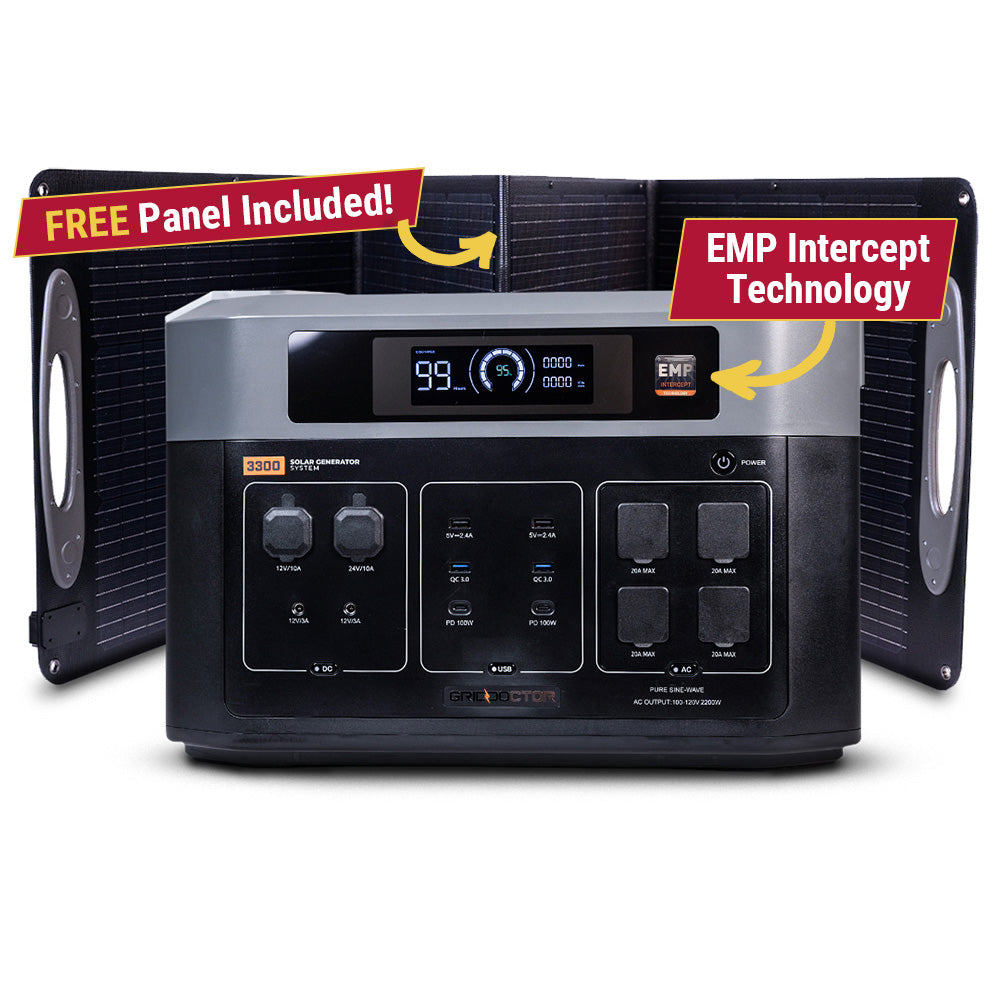
The Grid Doctor 3300 solar generator system sold with EMP shielding, a large portable power station for home backup and off-grid use; check the current spec sheet for details.
Why it's here: Listed with its EMP shielding as a stated feature, not a verified one. Judge it on the power specs first.
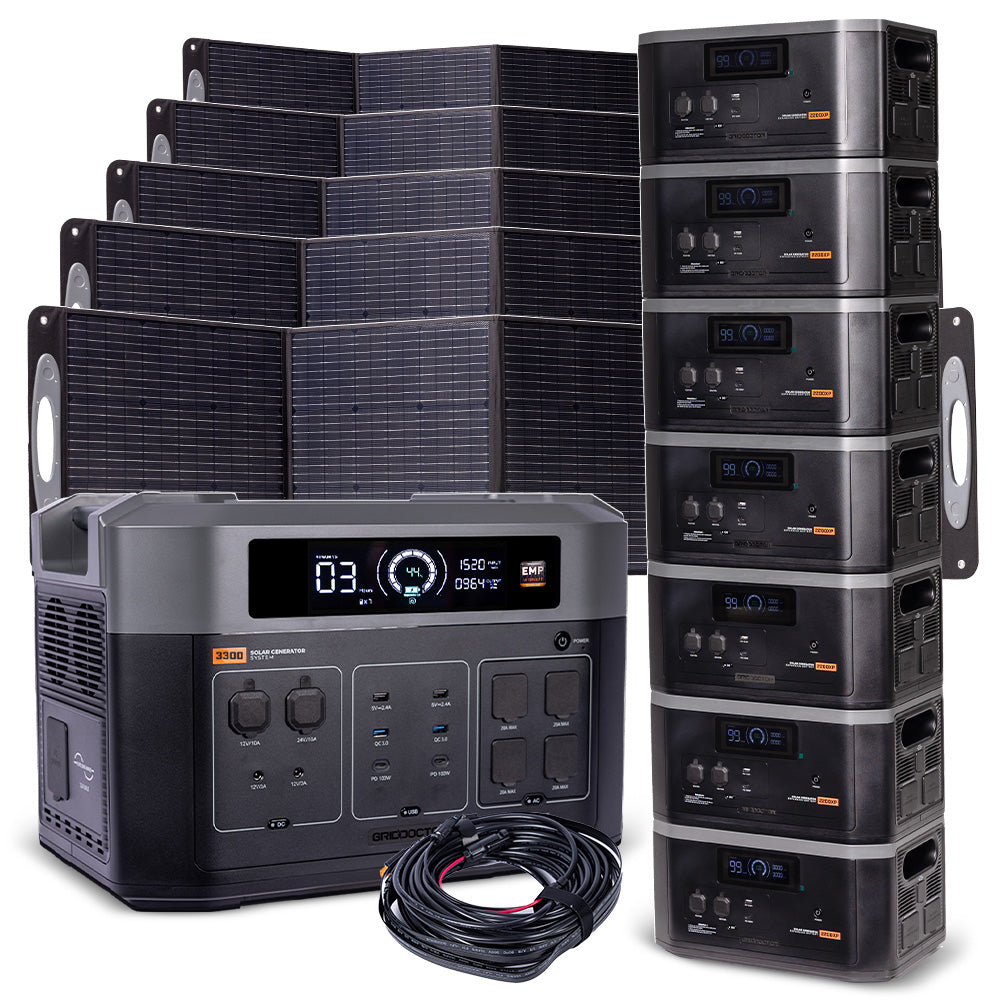
The Grid Doctor 3300 Power Tower, a large portable power station for home backup and off-grid systems; check the current spec sheet for capacity and output details.
Why it's here: Listed so form factor is part of the decision: this capacity class in a shape that stands rather than sits.
Claim audit: 18 consequential claims checked against the article's sources; unsupported wording revised where it could not be substantiated.
Claim-by-claim audit (18 checked)
“Voltage drop over distance is also a function of current: double the amps and you roughly double the voltage drop over the same wire, which means dimmer lights, slower pumps, and i…” (cited → victronenergy.com)
“A concrete example: delivering 3,000 watts at 12V takes about 250 amps.” (reasoning shown in the article)
“Large inverters are commonly offered at 24V or 48V rather than 12V, because the current a 12V bank would have to supply makes the wiring impractical.” (rewritten to what the article can stand behind)
“24V generally gives you more mid-size charge controller and inverter options than 12V, so it is worth comparing model ranges at each voltage before buying.” (rewritten to what the article can stand behind)
“Many lithium battery modules and larger split-phase or whole-home inverters are offered at 48V, so check the voltage options for the gear tier you are shopping.” (rewritten to what the article can stand behind)
“A 5,000 watt draw at 48V is only about 104 amps, entirely manageable with readily available cable sizes.” (reasoning shown in the article)
“Above 5,000 watt-hours per day, or any load that gets near or above 4,000 to 5,000 watts (well pumps, electric cooking, workshop tools, multiple large appliances): 48V is the pract…” (reasoning shown in the article)
“Expanding a 12V system to handle serious loads doesn't mean adding a few panels, it often means ripping out the wiring, replacing the charge controller, buying a new inverter, and …” (reasoning shown in the article)
“If there's any real chance you'll add a well pump, workshop, larger fridge, or move from a weekend cabin to full-time living, building at 24V or 48V from the start can avoid replac…” (rewritten to what the article can stand behind)
“Price out 24V or 48V gear against 12V, since the difference is often small compared with replacing an entire system later.” (rewritten to what the article can stand behind)
“Battery banks reach their target voltage by wiring individual cells or batteries in series, and reach their capacity target by wiring strings in parallel.” (cited → victronenergy.com)
“Series wiring for voltage has a real practical requirement: all batteries in a series string need to be closely matched in age, capacity, and state of charge, or the weakest batter…” (cited → victronenergy.com)
“Mixing battery ages or brands within a series string is a common and avoidable mistake that shortens the life of the whole bank.” (cited → victronenergy.com)
“Your charge controller, whether PWM or MPPT, is rated for a specific battery voltage (some are auto-sensing or multi-voltage, most are not).” (cited → extension.arizona.edu)
“Mixing and matching here isn't an option, a 24V inverter cannot run on a 12V bank, full stop.” (cited → extension.arizona.edu)
“48V inverters and charge controllers can cost more upfront, though the thinner cable and smaller lugs a lower current allows will offset part of that.” (rewritten to what the article can stand behind)
“Working on 48V DC carries more serious shock and arc risk than 12V, so check your local electrical rules on who may do the work and use careful practice, insulated tools, one hand …” (rewritten to what the article can stand behind)
“If you want to charge phones from a cigarette-lighter style port or run small 12V accessories directly, a 48V main bank means you'll need a DC-DC converter step-down for those circ…” (reasoning shown in the article)
Before you go
One useful off-grid email a week.
Practical gear rundowns, honest how-tos, and plain-English guides from someone doing the homework in the open.
I am building a place for off-grid people to swap real answers: a forum by topic, classifieds for gear and services, and real estate for off-grid land and homes. It is new, so the early members shape what it becomes. A free account lets you post in all three.
No ER ten minutes away means you have to be your own triage nurse. Here's how to tell a bad bee sting from the real emergency, and what to actually stock.
In many off-grid disasters, the fire or flood itself isn't the decisive factor, it's the hour you waited too long to leave. Here's how to set real, numeric triggers before you need them.
Tax sale and sheriff's auction land looks like a bargain, but redemption periods, hidden liens, and unseen parcels turn a lot of cheap acreage into an expensive lesson. Here's how to vet a listing before you bid.