

Transition & First-Year
Getting Started Off Grid
A practical, no-nonsense look at what it actually takes to live off the grid, from power and water to food storage, mistakes to avoid, and honest trade-offs.
Read more about Getting Started Off Grid →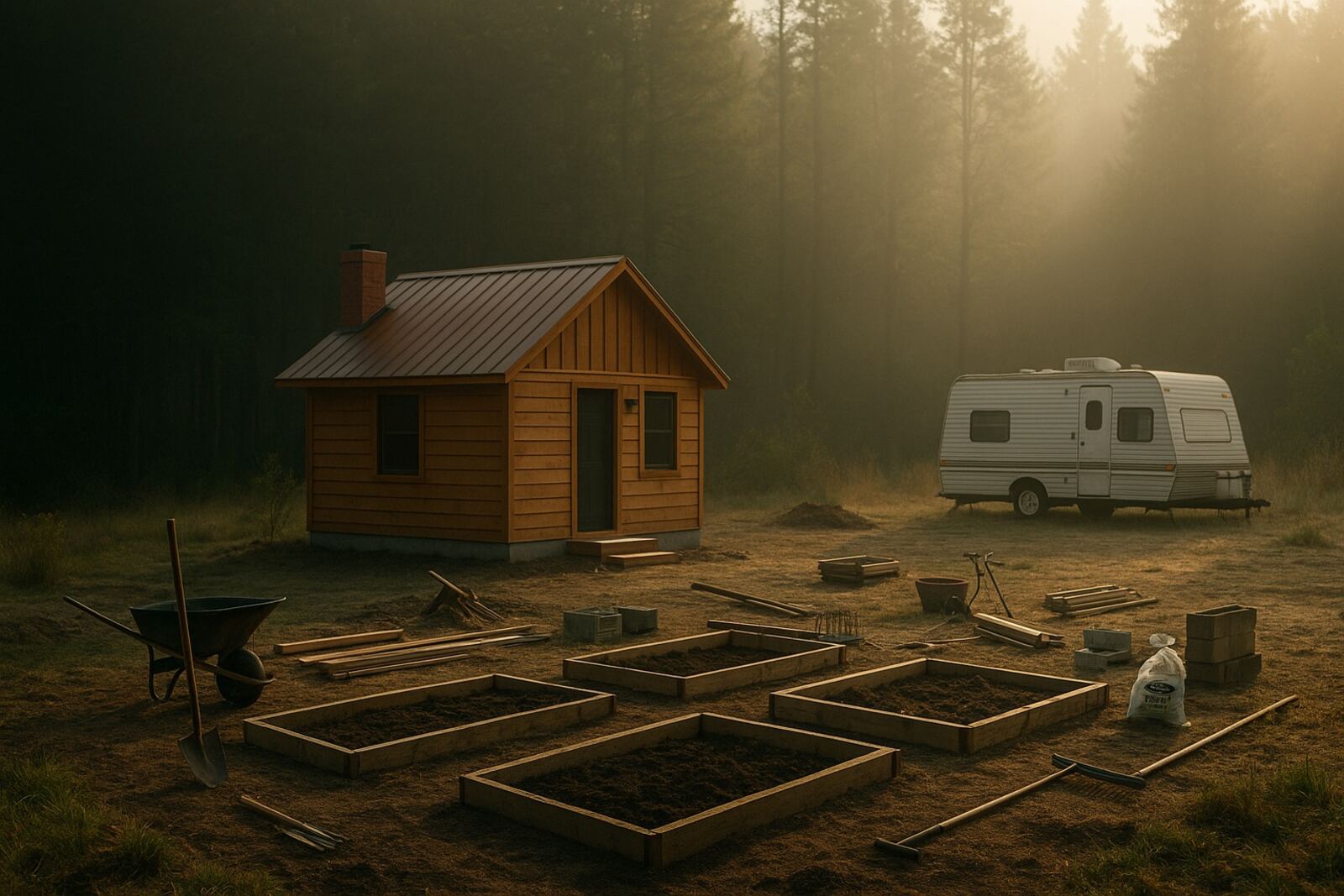
What the first year off-grid is really like: honest timelines, the mistakes that come up again and again, easing in instead of leaping, and the stories nobody puts in the brochure.
A practical, no-nonsense look at what it actually takes to live off the grid, from power and water to food storage, mistakes to avoid, and honest trade-offs.
Read more about Getting Started Off Grid →
Well drillers, electricians, excavators. Your first year off-grid means hiring strangers for jobs you can't do yourself, often with no reviews and no backup. Here's how to vet, pay, and manage them.
Read more about The first-year contractor gauntlet: hiring help without →
Land doesn't care about your budget spreadsheet or your Pinterest board. It cares whether you can fix a pump at 9pm. Here's how to close the skills gap before it closes on you.
Read more about The first-year skills gap: what you don't know until land →
The first month off-grid isn't about homesteading dreams, it's about triage. Here's the actual order of operations that keeps your first 30 days from turning into your worst 30 days.
Read more about The moving-in checklist: what to do the first 30 days on →
Before you sell the house and haul everything to the property, run your systems through a real 90-day trial. Here's how to structure it so the failures show up now, not in January.
Read more about The 90-day shakedown: testing your off-grid systems before →The truth going in: the first year off-grid is slower, more expensive, and more emotionally uneven than almost anyone expects going in, and that is completely normal rather than a sign you chose wrong. If you can hold two ideas at once, that this is genuinely worth doing and that month four will probably be harder than month one, you are starting from a more realistic place than a lot of first year attempts do.
The arc tends to follow a rough shape. The first month or two run on adrenaline. You are setting up systems, meeting neighbors, figuring out where the water shuts off, and everything feels like an adventure because it is new. Somewhere around month three or four, the novelty wears off and the actual workload becomes visible. This is usually when a system fails for the first time, whether that is a pump, a battery bank, or just your own energy, and it coincides with whatever season is hardest where you live. Many people describe a real low point here, less about any single problem and more about the cumulative weight of doing everything yourself for the first time.
By months six through nine, if you have been paying attention, you start building real competence. You know your property's quirks, you have a rhythm for chores, and small failures stop feeling like emergencies. The last stretch of the year is usually about consolidation: fixing the things you rigged in a hurry, and making honest decisions about what to keep, change, or abandon. Very few people finish year one with the exact setup they started with, and that is a feature of the process, not a failure of planning. If you want a broader sense of what to expect before you commit to a timeline, /start-here is a good place to orient yourself first.
If there is one piece of advice that consistently separates people who thrive from people who burn out, it is this: do not go from a suburban house to full off-grid living in one move. Ease in. A hybrid setup, or a slow transition where you rent nearby, camp on the land, or keep one foot on the grid for a season or two, gives you real information before you have made irreversible commitments.
Practically, this can look like several different on-ramps. Some people rent a small place in the nearest town for the first year while they build or renovate on their land during the day, so they are never staring down a broken system at 2am with nowhere warm to retreat to. Others camp on the property in a trailer or tiny cabin through a full four seasons before building anything permanent, which tells you things about wind, sun exposure, water flow, and road access that no amount of research can. Still others stay connected to grid power or municipal water for a year or two while they build out solar or a well, treating the grid as a safety net rather than an all-or-nothing choice.
The value of easing in is not caution for its own sake. It is that off-grid systems are interdependent in ways that are hard to predict from a spreadsheet. You do not really know your power needs until you have lived through a low-sun week. You do not know your water needs until you have hauled it by hand a few times. A hybrid period lets these lessons cost you inconvenience instead of a failed foundation or a winter you were not ready for. Think of the first year less as building your forever setup and more as a long, structured experiment that happens to include some permanent progress along the way.
The biggest one is trying to do everything at once. Water system, power system, garden, animals, income change, social life rebuild, all in the same six months. Each of these is a real project with its own learning curve, and stacking them means none of them gets your full attention, which is how small mistakes turn into expensive ones. The fix is not heroic effort, it is sequencing, which I will get into below.
The second mistake is underestimating time as much as, or more than, money. Most first-timers budget carefully for equipment and materials and then are blindsided by how many hours everything takes. Splitting firewood, fixing a frozen line, driving forty minutes for a part, these all eat entire days that a spreadsheet never accounted for. If you are still working a job, even part time, this time deficit compounds fast. It is worth reading through practical budgeting resources like those in /blog/category/money-finance, but remember that a realistic budget for this life includes a time line item, not just a dollar one.
The third mistake is assuming city or suburban competence transfers directly. Being handy, organized, or good at your job does not automatically make you good at diagnosing why a solar charge controller is throwing an error code, or knowing when a well pump sound means something is actually wrong. These are learnable skills, but they take real time to build, and the gap between "I am generally capable" and "I know this specific system" is a recurring source of surprise in the first year.
A quieter mistake worth naming is underestimating the emotional side of the transition. Isolation, decision fatigue, and the loss of casual social contact are common enough that they deserve real attention rather than being brushed off as something to just push through. The resources in /blog/category/mental-health-isolation exist because this part of the transition is just as real as the technical side, even though it gets talked about far less.
The practical fix for decision fatigue is simple to state and hard to follow: pick an order and stick to it, instead of working on whatever feels urgent that day. Off-grid life presents you with dozens of legitimate, competing priorities at every moment, and without a sequence, you end up making twenty half-decisions instead of finishing five real ones.
A sequence that works for a lot of people goes roughly like this. Shelter and safety first, meaning a place that is actually weathertight and warm enough, even if it is small or temporary. Water second, since almost everything else depends on having a reliable source, even a modest one. Power third, sized to your real needs rather than your imagined future needs. Only after those three are functioning does it make sense to invest heavily in food production, animals, or workshop projects, because those are the categories most tolerant of a slow start and most punishing of being rushed.
Within each category, resist the pull to perfect one thing before the basics of the next are in place. A gorgeous, fully organized garden means little if your water system cannot support it through August. The goal in year one is "functional and good enough," not "finished," across all the essentials, rather than "excellent" in one area while others are neglected. Write your sequence down somewhere you will actually see it, and when a new idea or project tempts you out of order, ask whether it is solving a real problem you have right now or just a distraction from the harder, less exciting task in front of you.
It also helps to accept that some decisions are genuinely reversible and low stakes, and do not deserve the deliberation you are giving them. Which brand of hand tool to buy, what to plant in a small test bed, how to arrange a temporary kitchen, these do not need research spirals. Save your decision-making energy for the handful of choices each month that are actually expensive or hard to undo.
Here is the idea worth internalizing early: building in a way back is not evidence that you do not believe in this, it is evidence that you are planning like someone who intends to succeed long term. People who keep a genuine exit ramp, whether that is a lease they have not given up, a skill or remote income they maintain, or simply enough savings to leave without financial disaster, tend to make calmer, better decisions than people who have burned every bridge.
This matters for a psychological reason as much as a practical one. When leaving is not truly an option, every hard week starts to feel like an existential threat rather than a rough patch, and that pressure leads to worse decisions, not better commitment. People who know they could leave if they truly needed to are often the ones who end up staying, because they are not making choices from a place of trapped desperation.
Concretely, this can mean not selling your previous home outright in year one, keeping a professional certification or client relationship current, maintaining health insurance and some liquid savings, or simply giving yourself an agreed pause point, such as a full year, before making any irreversible commitment like severing all ties to your old location. None of this is hedging against failure. It is what allows you to take real risks in the areas that matter, like trying an unconventional building method or an ambitious garden plan, because you are not simultaneously risking your entire financial and housing stability on every decision.
The most useful thing you can take from people who did not stay off-grid long term is rarely "they failed," it is usually "here is the specific thing that wore them down, and here is what they wish they had done differently."" Treat these stories as data, not cautionary tales to fear.
Common threads show up again and again. People who moved before testing whether they actually enjoyed the daily labor, not just the idea of it. People who underestimated how much they relied on casual social contact and hit a wall of isolation they had not planned for. People who took on a mortgage-sized financial commitment for land before living nearby long enough to know if the location suited them. People who tried to convince a reluctant partner or teenager rather than getting real buy-in before the move.
The people who adjusted successfully, rather than leaving entirely, usually made one meaningful change rather than a total overhaul. They scaled back an overambitious plan, brought in grid power for one specific need, moved closer to a town for the social contact, or simply extended their timeline and stopped treating year one as a test they were failing. Going back, when it happens, is not the opposite of this lifestyle working, it is often just evidence that the fit was wrong at that specific time, in that specific place, with that specific plan, and a different version of the same goal might have worked fine. None of that makes the attempt a waste. It is simply more of the same real information that this whole first year is designed to give you.
People often describe a real shift somewhere between month nine and the eighteen month mark, once they have lived through a full cycle of seasons and built genuine competence with their specific systems, rather than just general knowledge.
Yes, and it usually shows up around month three or four when the novelty has worn off and the workload is fully visible. Wanting to quit in that window is common and does not reliably predict whether you will actually leave.
If you can manage it, spending real time on or near the land first, through renting, camping, or an extended visit across different seasons, gives you far better information than research alone and helps you avoid the most expensive version of the "wrong location" mistake.
Questions & answers
One useful off-grid email a week: practical gear rundowns, honest how-tos, and plain-English guides. No spam, unsubscribe anytime.
I respect your inbox. See my privacy policy and affiliate disclosure.
New here, or not sure where this fits? Start here walks through the whole thing in order.