The short version: a common planning range is 10 to 20 gallons per person per day for genuinely conservation-minded living, or 30 to 50+ gallons per person per day if you want something closer to normal town-water comfort. Multiply that by household size and by how many days you want to survive without any water coming in (your "days of autonomy"), and you have your storage target in gallons. Everything else on this page is the reasoning behind that number, and the same math drives the calculator above.
Typical daily water use per person, off-grid vs on-grid
City water systems make it easy to forget how much water actually flows through a household. The average grid-connected American uses somewhere around 80 to 100 gallons per person per day once you count long showers, running the tap while brushing teeth, half-full dishwasher loads, and lawn irrigation. Off-grid use tends to run well below that, partly by necessity and partly by habit, because every gallon has to be hauled, pumped, filtered, or caught by hand at some point.
- Minimal / conservation mode: 10 to 20 gallons per person per day. This covers drinking, quick low-flow showers or wipe-downs, hand washing, cooking, and basic dish washing, with laundry done less often or off-site. Many long-term off-gridders settle here once they've adjusted their habits.
- Comfortable / near-normal mode: 30 to 50+ gallons per person per day. This allows for regular showers, a washing machine, a dishwasher, and some garden or livestock watering without constant rationing anxiety.
- Bare survival / emergency mode: as low as 1 to 2 gallons per person per day for drinking and minimal hygiene only, useful as a floor number when sizing emergency backup storage, not a target for daily living.
The gap between these numbers is almost entirely about fixtures and habits: low-flow showerheads versus standard ones, navy showers versus long hot ones, hand-washing dishes in a basin versus running a tap continuously, and whether laundry happens at home or elsewhere. If you're not sure which bracket describes you, it's worth tracking your actual use for a week before you build a system around a guess.
Sizing daily and weekly need from household size
Once you've picked a per-person gallons/day number, the household math is simple multiplication, but a few adjustments matter:
- Base daily need: gallons per person per day multiplied by number of people. A family of four at 15 gallons/day conservation use needs 60 gallons/day; the same family at 40 gallons/day comfortable use needs 160 gallons/day.
- Weekly need: daily need multiplied by 7, which is useful for planning hauling trips, generator/pump run schedules, or catchment collection cycles rather than sizing the tank itself.
- Non-household draws: animals, gardens, and greenhouses often get left out of the first calculation and then blow the budget. A couple of goats or a small flock of chickens can add several gallons a day; a vegetable garden in a dry climate can add tens of gallons a day in peak summer. Add these as separate line items rather than folding them into "per person."
- Guests and surge use: if you host visitors, work crews, or seasonal help, build in a buffer of 10 to 20 percent above your steady-state number so a full house doesn't instantly trigger a crisis.
This is also where it pays to separate "potable" water (drinking, cooking) from "non-potable" water (toilet flushing, irrigation, laundry), since many off-grid systems route rainwater or pond water to non-potable uses and reserve well or filtered water for drinking. If your setup does this, size each stream separately rather than lumping everything into one number.
How many days of storage (autonomy) you actually need
Daily use tells you the flow rate; days of autonomy tells you the size of the buffer. This is the number that trips people up, often by picking something too small because tanks are expensive and space is limited. The right number depends on what kind of interruption you're protecting against:
- Rainwater-dependent systems in dry climates: plan for 30 to 90 days of storage to bridge a dry season between rains, especially if your catchment area is small or your region has a genuine dry season rather than scattered showers year-round.
- Well-fed systems with a working pump: often 1 to 3 days of storage is enough, since the well refills itself continuously; storage here is mainly a buffer against pump or power failure, not against the well running dry.
- Hauled water: storage should cover the gap between hauling trips plus a safety margin, commonly 7 to 14 days, so a missed trip, a broken-down truck, or bad weather doesn't turn into an emergency.
- Backup for any system: even well-fed and rainwater properties benefit from at least 3 to 7 days of emergency reserve in case of pump failure, power outage, contamination event, or freeze-up, held separately from the main working tank if possible.
The pattern across all of these is the same: storage days should match your worst realistic gap, not your best-case scenario. If your well has ever gone down for a week, plan for a week. If your dry season regularly stretches to two months with no meaningful rain, plan for two months. Talking to neighbors who've lived through a full year on the same land or same aquifer is usually more useful than any generic rule of thumb.
Tank sizing and types
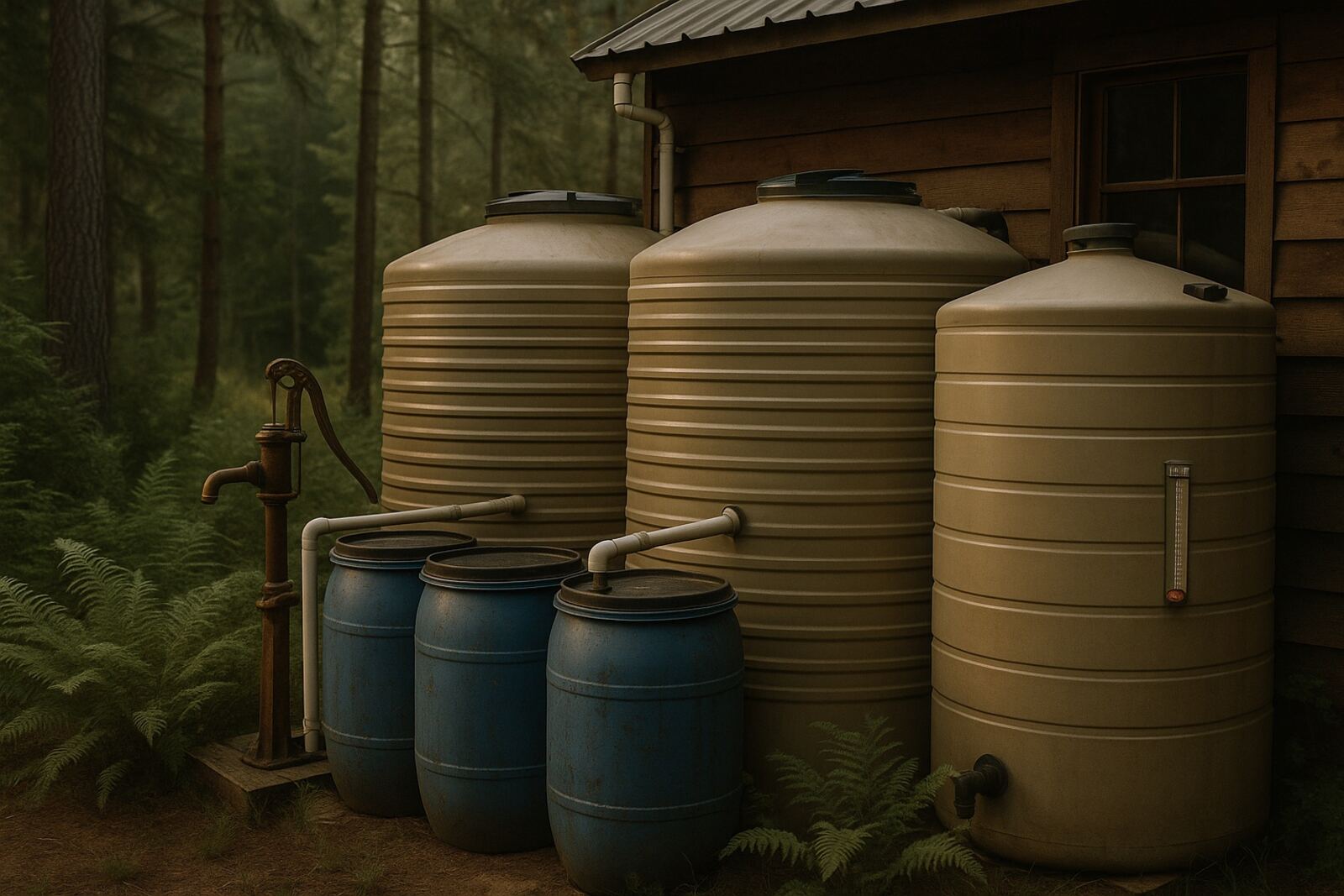
Once you know your target gallons (daily use times days of autonomy), you're choosing hardware to hold it. The main categories:
- Poly (plastic) tanks: the most common choice for both potable and non-potable storage, ranging from small 50-gallon barrels up to 10,000+ gallon cisterns. Food-grade, UV-stabilized poly tanks are lightweight relative to their capacity, relatively inexpensive, and easy to plumb, but need UV protection or opaque coloring to prevent algae growth if exposed to sunlight.
- Steel tanks: often used for larger above-ground storage or fire-suppression reserves; durable but heavier and can rust internally without a proper liner, so they're less common for direct potable use.
- Concrete cisterns: typically buried, long-lasting, and good for large volumes (several thousand gallons and up), but expensive to install and harder to inspect or repair once in the ground.
- Bladder / flexible tanks: useful where space is tight or a tank needs to fit under a floor or in a crawlspace, but generally less durable and more vulnerable to punctures than rigid tanks.
- Multiple smaller tanks vs one large tank: splitting storage across two or more tanks adds redundancy (a leak or repair doesn't take your entire supply offline) and can make transport and installation easier, at the cost of more fittings and connections to maintain.
A rough sizing habit: round up to the next standard tank size rather than down, since real-world losses from evaporation, sediment settling, and the "dead space" at the bottom of a tank that a pump can't draw from all eat into usable capacity. A 1,000-gallon tank rarely delivers a full 1,000 usable gallons.
Tying storage to a rainwater catchment or well
Storage doesn't exist in isolation; it has to be sized against whatever is filling it. For rainwater catchment, the rough formula is roof catchment area in square feet times inches of rainfall times a conversion factor of about 0.62 gallons per square foot per inch of rain, adjusted downward by a collection efficiency factor (commonly 75 to 90 percent to account for splash-out, first-flush diversion, and gutter losses). Compare that seasonal or monthly yield against your usage rate to see whether your tank needs to carry you through a specific dry stretch or just smooth out week-to-week variability.
For well-fed systems, the relevant number is the well's sustainable yield in gallons per minute or gallons per hour, compared against peak household demand. A well that recovers slowly relative to a household's peak draw (say, a big morning shower-and-laundry rush) benefits from a storage tank and pressure tank combination that lets the well refill steadily while the household draws from stored water during peak moments, rather than demanding instant high flow directly from the aquifer.
In both cases, storage is the buffer between an uneven supply (rain that falls in bursts, a well that recharges slowly) and a household that wants water on demand. Sizing storage without understanding the supply side usually means either overbuilding (expensive, wasted space) or underbuilding (dry taps at the worst possible time). My tools section has calculators that can help pair catchment area or well yield against your household demand numbers.
Freeze protection and water quality basics
Cold climates add a layer most warm-climate guides skip past. Any tank, pipe, or fitting that can freeze solid can also crack, split, or block flow entirely at the worst possible moment. Common approaches include burying tanks and lines below the local frost line, insulating above-ground tanks and exposed pipe runs, using heat tape on vulnerable sections, and keeping at least some water moving or heated in the coldest stretches rather than letting a whole system sit static. Even a well-insulated system benefits from a plan for what happens if the power goes out during a hard freeze, since insulation slows heat loss but doesn't stop it forever.
On the quality side, off-grid water sources need a bit more vigilance than a municipal hookup, since there's no utility testing it before it reaches your tap. Basic practices worth building into your routine:
- Test well water annually for bacteria (coliform/E. coli) and periodically for nitrates, and test after any flooding, nearby construction, or unexplained taste or odor changes.
- Treat rainwater catchment water intended for drinking with filtration and disinfection (commonly a sediment filter followed by UV treatment or chlorination), since roof surfaces collect bird droppings, dust, and debris.
- Inspect and clean storage tanks periodically, since sediment, algae, and biofilm can build up even in food-grade tanks, especially ones exposed to any light.
- Keep a simple test kit or send samples to a local lab on a regular schedule rather than only testing when something already seems wrong.
For more detail on filtration methods, catchment design, and well maintenance, the water section of the blog covers these topics in more depth than fits here. Between accurate daily-use numbers, a realistic autonomy target, and a tank sized to match your actual supply, an off-grid water system can be built to hold up through the dry spells and downtime that show up sooner or later.
Common questions
How much water storage does a family of four actually need?
At a conservation rate of about 15 gallons per person per day, a family of four uses roughly 60 gallons a day. With 14 days of autonomy as a buffer, that's around 840 gallons of storage; with 30 days, closer to 1,800 gallons. The right target depends on whether you're buffering against a slow well, a dry season, or hauling delays.
Is rainwater alone enough for full-time off-grid living?
It can be, but only if your roof catchment area, local rainfall pattern, and storage capacity are all sized together. A small roof in a low-rainfall region will struggle to keep a household supplied through a long dry season even with a large tank, while a decent-sized roof in a wetter climate can comfortably support a household with a modest tank and good first-flush diversion.
How often should I get my water tested?
Once a year for basic bacteria testing is a reasonable minimum for wells, with additional testing any time you notice a change in taste, smell, or clarity, or after flooding or nearby ground disturbance. Rainwater systems used for drinking benefit from a similar annual check plus consistent day-to-day filtration and disinfection, since the risks come from ongoing exposure rather than a one-time event.