
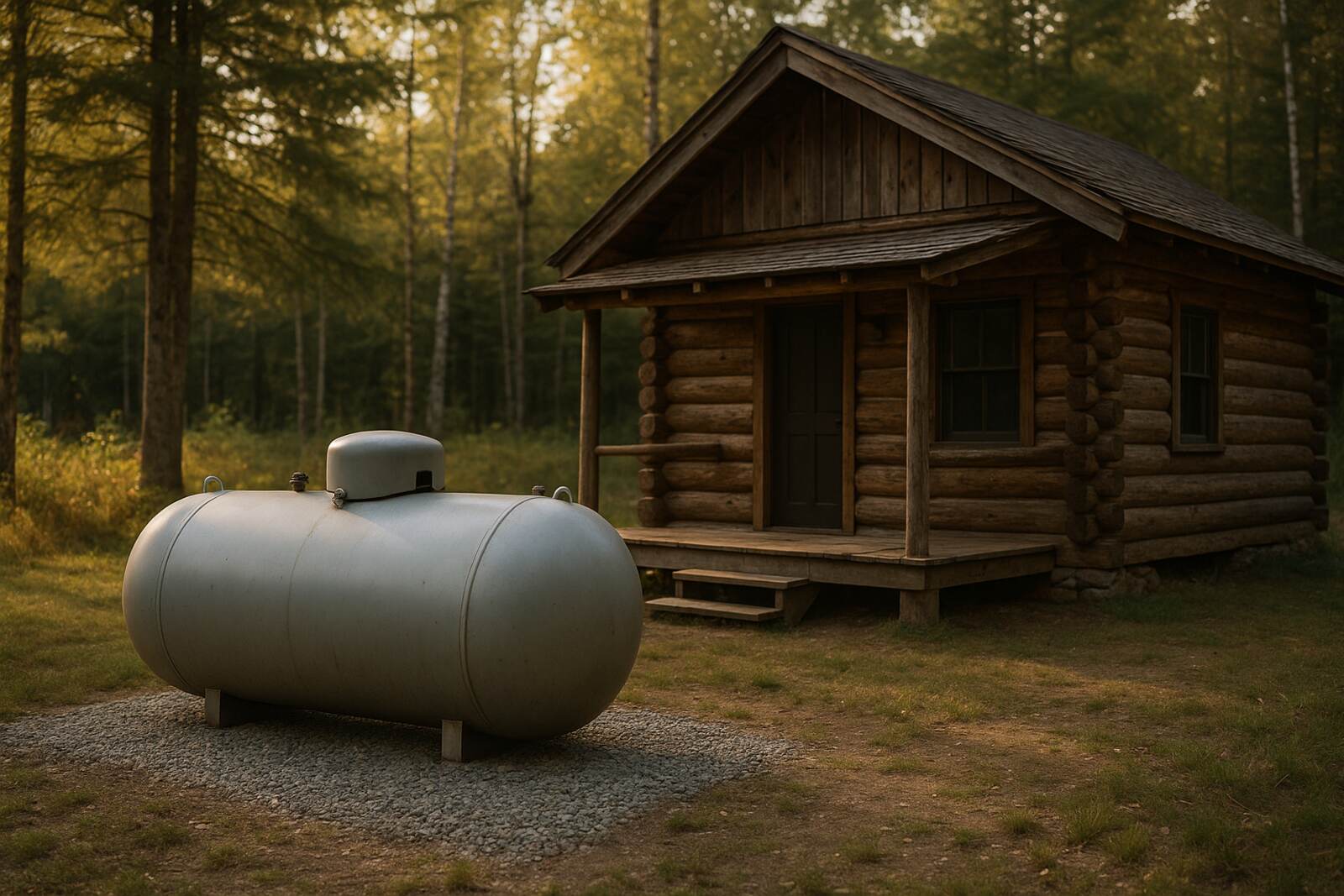
Propane usage & tank calculator
Pick the appliances propane runs in your setup and it estimates gallons per month across the year, the tank size that makes sense, and how often the truck comes.
1. Propane appliances
Typical monthly use for a small household. Uncheck anything that runs on electric or wood instead.
2. Propane heat (winter)
This calculator needs JavaScript turned on. With it off, the guide below walks through the math by hand.
How this calculator works
The formula
Base gallons/month = the sum of checked appliances (range 4, tank water heater 18, on-demand water heater 10, fridge 6, dryer 4, generator 5). Winter heating gallons/month = heater BTU/hr x winter hours per day x 30 / 91,500 BTU per gallon. Annual = summer months x 7 + winter months x 5. Tank tier: winter use up to 12 gal/mo fits a 120 gal tank (96 usable), up to 40 a 250 (200 usable), above that a 500 (400 usable); refills = annual / usable gallons, rounded up.
Worked example
Cooking range (4) plus on-demand water heater (10) is 14 gal/month in summer. A 30,000 BTU heater 6 hours a day adds 30,000 x 6 x 30 / 91,500 = 59 gal, so winter is 73 gal/month. Annual is 14 x 7 + 73 x 5 = 463 gal, which lands on a 500 gal tank and about 2 refills a year.
Assumptions
- 91,500 BTU per gallon of propane; the heater math uses nameplate input BTU, so no efficiency divide
- Fixed monthly appliance figures for a small household (e.g. cooking ~4 gal, tank water heater ~18 gal)
- A 5-month heating season and 7 non-heating months
- Tanks fill to 80%, which is where the usable-gallon figures come from
When it will be wrong
- Appliance figures are typical for a small household; a big family's hot water or cooking can double them
- The flat 5-month heating season misreads very mild or very long winters
- Heater run-hours are the biggest swing factor and are your estimate, not a measurement
- Local codes and suppliers (NFPA 58) govern tank siting, distances, and what sizes can go where
Formula version 1.0, in effect since 2026-08-25. Changes to formulas or assumptions bump this version and are listed in the corrections log.
Where the numbers come from
- Units and Calculators: Energy Conversion (U.S. Energy Information Administration)
- Hydrocarbon Gas Liquids (U.S. Energy Information Administration)
- NFPA 58, Liquefied Petroleum Gas Code (National Fire Protection Association)
These are the exact numbers the calculator on this page runs, stated so you can check them. Planning estimates, not engineering; sizing that matters gets confirmed by a professional against local conditions and code. Spotted a problem with the method? Tell me.
Want the reasoning, not just the number? Lesson 7: Heat: the system that decides your winter in the free course walks through it, and the system planner carries the answer into a whole design.
Propane is a quiet workhorse in many off-grid setups: it cooks, heats water, keeps a fridge cold, and backs up the heat, all without touching the battery bank. This calculator adds up what your particular mix of appliances burns, splits it into a summer picture and a winter picture, and tells you what size tank keeps the delivery truck from becoming a monthly visitor.
What each appliance really burns
The monthly figures behind the checkboxes are honest household averages: a cooking range runs around 3 to 5 gallons a month, a tank-style water heater 15 to 20, an on-demand unit noticeably less because it only burns while water flows, a propane fridge around 5 to 7, and a dryer a few gallons depending on loads. Your numbers will drift with habits, a family of five showers more than a couple, but the totals land close enough to size a tank and a budget.
Heat is the number that changes everything, which is why it gets its own inputs. A 30,000 BTU direct-vent heater running six hours a day burns roughly 60 gallons a month by itself. If propane is your primary winter heat in a cold climate, it will dwarf every appliance combined, and it is worth running the heat loss calculator to see what insulation would do to that line item, and the firewood calculator to price the wood-heat alternative.
Picking the tank: 120, 250, or 500 gallons
Tanks fill to 80 percent so the vapor space can expand, so a "500 gallon" tank holds about 400 usable gallons. The right size is the one where a winter fill lasts comfortably past two months and you need somewhere between one and four deliveries a year. Small 120 gallon tanks suit cooking-and-hot-water households; once propane carries real heating load, a 250 or 500 earns its pad fast.
Two practical notes that matter more than the math. First, owned versus rented: a rented tank locks you into that supplier's per-gallon price, which is often 50 cents to a dollar above market, while an owned tank lets you shop every fill. It usually pays for itself in a few years. Second, remote properties should size up a step, deliveries carry minimums, winter roads cancel trucks, and the tank that never runs dry in February is the one a size bigger than the spreadsheet said.
Where propane fits in the bigger energy picture
The rule that keeps off-grid systems affordable: electricity from batteries for light loads, and combustion for heat loads. Making heat from stored sunshine is brutally expensive per BTU; making it from propane or wood is cheap. That is why the classic setup pairs a modest solar system with propane for cooking, hot water, and backup heat, and why an all-electric off-grid build needs a solar array several times larger. The generator calculator covers the other big propane consumer, and the Heating & Cooking archive digs into the appliance choices themselves.
Common questions
How much propane does an off-grid house use per month?
Cooking alone runs about 4 gallons a month, adding hot water brings a small household to 10 to 20, and a propane fridge adds 5 to 7. Heat changes everything: a 30,000 BTU heater running 6 winter hours a day burns about 60 gallons a month by itself.
What size propane tank should I get?
Match the tank to your winter burn rate: cooking and hot water households do fine on a 120 gallon tank, propane-heated homes want 250 or 500. Tanks fill to 80 percent, so a "500" holds about 400 usable gallons. Size so the truck comes two to four times a year, and remote properties should go a size bigger.
Should I own or rent my propane tank?
Owning usually wins within a few years. A rented tank legally locks you to that supplier's per-gallon price, often 50 cents to a dollar above market, while an owned tank lets you shop every fill. The trade is that you own the maintenance and recertification, which is minor on a modern tank.
Getting a useful answer out of this
Propane usage & tank size returns summer use, winter use, tank that fits, and refills per year. Every one of those is a planning figure rather than a specification: it tells you the size of the problem and roughly what it will take to solve, which is what you need before you can shortlist equipment or ask a supplier a sensible question.
The single most useful habit with any calculator on this site is to run it more than once. Change one input at a time and watch which output moves. That tells you where your design is sensitive, and design sensitivity is far more valuable than a single answer, because it identifies the assumption worth spending real effort to pin down. If a modest change in one input swings the result substantially, that input deserves a measurement rather than an estimate.
It is also worth running the pessimistic version. Off-grid systems are sized by their worst case rather than their average, and a design that only works on the numbers you hoped for is a design that works for part of the year. Put in the colder temperature, the longer run, the larger household, the dimmer month, and see whether the answer is still one you can live with.
What a calculator cannot know
Any tool like this works from the inputs you give it and from published averages for everything else. It does not know your particular site, the way your household actually behaves, the corner your building was cut in, or the ten-year-old equipment already installed that does not match its datasheet. Treat the output as a well-informed starting bracket, not as a specification to order against.
Three things in particular sit outside what any of these tools can see. The first is local rules, which decide what you may build regardless of what the arithmetic says: the laws pages cover those by state, county, and town. The second is the condition and quality of what you install, which is why two identical designs perform differently. The third is how the system is wired and protected, which decides whether it is safe rather than whether it is adequate, and which is the subject of lesson six.
Where a number here comes from a constant or a rule of thumb, the method notes above say so and give the source. That is deliberate: a result you cannot check is a result you should not act on, and the arithmetic here is simple enough to verify by hand on paper if you want to.
Where to take the answer next
A single figure rarely settles anything on its own, because off-grid systems constrain each other. The load list decides the array, the array decides the controller, the battery decides what the inverter can deliver, and the climate at your site decides all of it. The system planner takes one set of inputs and produces a whole coherent plan rather than an isolated number, which is usually the better next step once you have a figure you trust.
For location-specific inputs, the site report gives any address its real 30-year sun, climate, elevation, and distance figures, including the worst-month sun hours that size an off-grid system properly. For the equipment that the result points at, the spec tables list what manufacturers publish, normalized so that units of different sizes can be compared, and each product page works its own numbers through. For what things cost this month, the price index.
And for the reasoning rather than the arithmetic, the free course runs through the decisions in the order they actually arrive, from deciding whether the life suits you through to the first year on the land. Most of the mistakes that calculators cannot prevent are ordering mistakes, made before anyone opened a calculator at all.
More off-grid tools
Solar sizing calculator
Size the panels, battery, inverter, and controller for what you want to run.
Open the tool →Battery bank & runtime
How long your batteries last on a given load, and the usable capacity you really have.
Open the tool →Wire gauge & fuse
The copper wire size and fuse a DC run needs to be safe and hold voltage drop down.
Open the tool →Water storage & usage
How much water your household uses and how big a storage buffer to hold.
Open the tool →Firewood / heating
The heat a space needs, a wood-stove size, and cords of firewood per winter.
Open the tool →Off-grid cost estimator
A realistic budget range for the systems you need, plus the ongoing yearly cost.
Open the tool →Rainwater harvesting
How much rain you can catch from your roof, given your local rainfall.
Open the tool →Chicken flock & coop
Coop and run size, nesting boxes, feed, water, and eggs for your flock.
Open the tool →Generator sizing & fuel
The generator size your loads need, and the gas, propane, or diesel it burns per day.
Open the tool →Heat loss & insulation
What your building really loses, in BTU, cords, propane gallons, and kWh, and what tightening it up saves.
Open the tool →Solar panel tilt angle
The right tilt for your panels by latitude, year-round or adjusted by season.
Open the tool →Wind turbine estimator
What a small wind turbine would honestly produce at your average wind speed.
Open the tool →Micro-hydro potential
Head and flow to watts: what your stream could generate around the clock.
Open the tool →Well pump sizing
The flow, head, pump size, and pressure tank your well setup needs.
Open the tool →Septic & greywater sizing
Tank size and drainfield footprint for your household and soil, before you call the engineer.
Open the tool →Driveway gravel & cost
Yards, tons, truckloads, and dollars for a gravel drive or access road.
Open the tool →Fencing materials & cost
Posts, wire, gates, and a real materials budget for the fence around your acreage.
Open the tool →Garden size & self-sufficiency
How much garden it takes to feed your household at the level you're aiming for.
Open the tool →Food storage planner
The staples, cans, and buckets a real months-long pantry takes, and the shelf space to hold it.
Open the tool →New here, or not sure where this fits? Start here walks through the whole thing in order.