Every off-grid solar conversation eventually runs into the same wall: someone asks "how much solar do I need?" and someone else answers with a number that has nothing to do with the asker's actual life. A cabin that runs a single LED lantern and a phone charger has completely different needs than a family running a chest freezer, a well pump, and a laptop for remote work. There is no universal answer, but there is a reliable method, and it starts with math you can do on the back of an envelope before you spend a dollar.
Start with load, not with panels
The single biggest mistake people make when sizing an off-grid solar system is starting with the panels. They see a package deal for four 100-watt panels and a couple of batteries and assume that's "a solar system" they can plug their life into. It's backward. Panels and batteries are the answer to a question you haven't asked yet: how many watt-hours does your household actually consume in a day?
To find that number, you need to build a load list. Walk through every electrical device you plan to run, note its wattage (usually printed on the device or its power brick), and estimate how many hours a day it actually runs. Multiply watts by hours to get watt-hours per day, then add everything up.
A rough example for a modest off-grid cabin:
LED lighting (8 bulbs at 10W, 4 hours/day): 320 Wh
Laptop (60W, 6 hours): 360 Wh
Phone charging (10W, 3 hours): 30 Wh
Small refrigerator/fridge (compressor-style, averages ~50W, running roughly 8 hours effectively per day): 400 Wh
Water pump (150W, 30 minutes): 75 Wh
Wi-Fi router (10W, 24 hours): 240 Wh
Misc (radio, fans, tools): 200 Wh
That's roughly 1,625 Wh, or about 1.6 kWh, per day. That number is the real foundation of your entire system. Everything else, panel count, battery bank size, inverter rating, gets derived from it.
If you're not sure where to start gathering accurate wattage numbers for your own gear, a simple plug-in watt meter is one of the cheapest, most useful tools you can buy before designing a system. It's worth checking my guide to essential off-grid power gear for recommendations on meters and other diagnostic tools that take the guesswork out of this step.
Why refrigeration and heating change everything
Two categories of load blow up more solar budgets than anything else: refrigeration and anything that generates heat electrically.
A compressor refrigerator or chest freezer set up for off-grid use (ideally a 12V or 24V DC unit designed for efficiency, not a repurposed household fridge) is usually a large daily load, so check the manufacturer's stated daily watt-hour figure or measure it yourself rather than guessing. Because it cycles around the clock, it can easily outweigh lighting, electronics, and communications in a small load list like the one above.
Electric heat is worse. Space heaters, electric water heaters, and electric stoves draw enormous wattage, often 1,000 to 1,500 watts or more, and running any of them for more than short bursts requires a battery bank and panel array sized more like a small business than a cabin. This is why many off-gridders heat with wood, propane, or solar thermal, and reserve electricity for lighting, electronics, refrigeration, and pumps. If your plan currently includes electric heat or an electric water heater, it's worth revisiting that assumption before you size anything else, because those loads can dwarf everything else on your list and drive up panel and battery costs accordingly.
From daily watt-hours to panel wattage
Once you know your daily watt-hour need, you can work out how much solar panel capacity you need to generate it. The key variable here is peak sun hours, the number of hours per day your location receives sunlight intense enough to be equivalent to full solar noon. This is not the same as daylight hours. Peak sun hours vary widely by region and season, so look up a solar resource map or sizing table for your own location rather than assuming a national average.
The rough formula:
Panel wattage needed = Daily watt-hours ÷ peak sun hours ÷ system efficiency factor
That efficiency factor accounts for real-world losses: dirty panels, imperfect angles, wiring resistance, battery charge/discharge inefficiency, and inverter conversion loss. A reasonable planning number is 0.75 (meaning you only capture about 75% of theoretical output).
Using my cabin example (1,625 Wh/day) in a location with 4 peak sun hours:
1,625 ÷ 4 ÷ 0.75 = about 542 watts of solar panel capacity
That's a real number you can shop for, roughly five 100-watt panels or three to four 150-160 watt panels, not a guess pulled from a package deal. If you're comparing panel options, my rundown of solar panels worth considering breaks down the tradeoffs between rigid, flexible, and portable panel types for different setups.
Sizing the battery bank
Panels only produce power when the sun is out. The battery bank is what carries your household through the night and through cloudy stretches, so it needs to be sized around both your daily use and how many days of autonomy you want to plan for.
A common starting point is to size the battery bank for 1.5 to 3 days of autonomy, meaning the batteries can supply your full daily load for that many days with no sun at all. More autonomy means more resilience during storms or winter overcast, but it also means a much bigger (and more expensive) battery bank.
Lithium (LiFePO4) batteries are commonly chosen for off-grid homes for their cycle life and deeper usable discharge; check the manufacturer's rated usable capacity, which is often a large share of nameplate capacity. For my 1,625 Wh/day example with two days of autonomy:
1,625 Wh x 2 days = 3,250 Wh needed, divided by 0.85 usable = about 3,825 Wh of battery capacity
That translates to roughly one 3.5 to 4 kWh lithium battery bank, which is a common size for small cabins and tiny homes. Larger households running freezers, power tools, and multiple bedrooms of electronics often land in the 8 to 15 kWh range.
Lead-acid and AGM batteries are still used by people controlling upfront costs, but they are generally rated for a shallower depth of discharge, so you need more nameplate capacity to get the same usable power; check the manufacturer's depth of discharge rating. That difference matters when comparing sticker prices, so compare cost per usable kWh over the manufacturer's rated cycle life rather than the purchase price alone.
The inverter: sizing for peaks, not averages
The inverter converts your battery's DC power into the AC power most household devices expect, and it needs to be sized around your peak simultaneous load, not your daily average. If you might run a microwave (1,000W), a water pump (150W), and lighting (100W) at the same moment, your inverter needs continuous wattage headroom for that combined draw, plus a surge allowance for motors and compressors, whose startup surge is listed on the appliance or its manual.
A 2,000 to 3,000 watt pure sine wave inverter covers most modest cabins and homesteads comfortably. Larger homes running power tools, well pumps, and multiple appliances simultaneously often need 4,000 watts or more. An undersized inverter can shut down mid-task or trip protection when a motor's startup surge exceeds its rating, which is why peak load matters more than average.
What a realistic system actually looks like
Putting the pieces together, here's roughly what different scales of off-grid living tend to require, understanding that actual needs vary with climate, house size, and habits:
Minimalist cabin or tiny home (lighting, phone/laptop charging, small fridge, no power tools): 400 to 800 watts of solar, 2 to 4 kWh of battery, 1,000 to 2,000 watt inverter.
Modest homestead (above plus water pump, Wi-Fi, small chest freezer, occasional power tools): 800 to 1,500 watts of solar, 5 to 10 kWh of battery, 2,000 to 3,000 watt inverter.
Full-time family homestead (above plus washing machine, workshop tools, larger freezer, home office equipment): 1,500 to 3,000+ watts of solar, 10 to 20+ kWh of battery, 3,000 to 6,000 watt inverter, often paired with a backup generator for extended low-sun stretches.
That last point matters: even a well-designed system usually benefits from a backup generator, not because the solar math is wrong, but because real weather doesn't cooperate with spreadsheets. A string of overcast winter days can drop production well below your planning average, and a generator (or a supplemental setup like a small wind turbine in windy locations) closes that gap without forcing you to ration power during the exact season you need it most.
Common mistakes that blow up the budget
A few patterns show up again and again in off-grid solar planning:
Underestimating refrigeration. People remember to count the TV and forget the fridge runs 24 hours a day, every day, all year.
Ignoring seasonal sun variation. Sizing a system around summer peak sun hours leaves you badly short in December and January, when you may need power most for lighting and heat-adjacent tasks.
Skipping the efficiency factor. Assuming panels will produce their full rated wattage in real-world conditions leads to systems that underperform their spreadsheet promise by 20 to 30 percent.
Buying an inverter sized for average load instead of peak load. This causes nuisance shutdowns exactly when multiple things run at once.
Choosing lead-acid to save money upfront without accounting for the shorter lifespan and lower usable capacity, which often erases the savings within a few years.
If you're still in the planning stages, it's worth spending time with my broader collection of off-grid power guides before buying anything, since sizing decisions ripple into every other part of a homestead, from what appliances you can realistically run to how much backup fuel storage you need on hand.
The honest bottom line
There is no single correct wattage or battery size that fits every off-grid household, and anyone selling you a fixed "off-grid solar kit" without asking about your actual daily use is selling convenience, not accuracy. The math isn't complicated, though: total up your real daily watt-hours, divide by your local peak sun hours and an efficiency factor to size your panels, multiply your daily use by your desired days of autonomy to size your batteries, and size your inverter around your worst-case simultaneous load rather than your average.
Do that work honestly, including the unglamorous parts like refrigeration and winter sun hours, and you'll end up with a system sized for the life you're actually living, not the one in a marketing photo. If you want a second opinion on your numbers before you commit to buying, my contact page is open for exactly that kind of question, and it's a lot cheaper to ask before the panels are on the roof than after.
The rest of the shortlist
Recommended off-grid gear
Affiliate disclosure: Some links on this site are affiliate links, including Amazon links: as an Amazon Associate I earn from qualifying purchases. Buying through one costs you nothing extra, and it never changes what I recommend.
Products appear here only when they match this article's subject. Selection is based on documented specs and owner reports, never on compensation; pages with no relevant gear carry none.
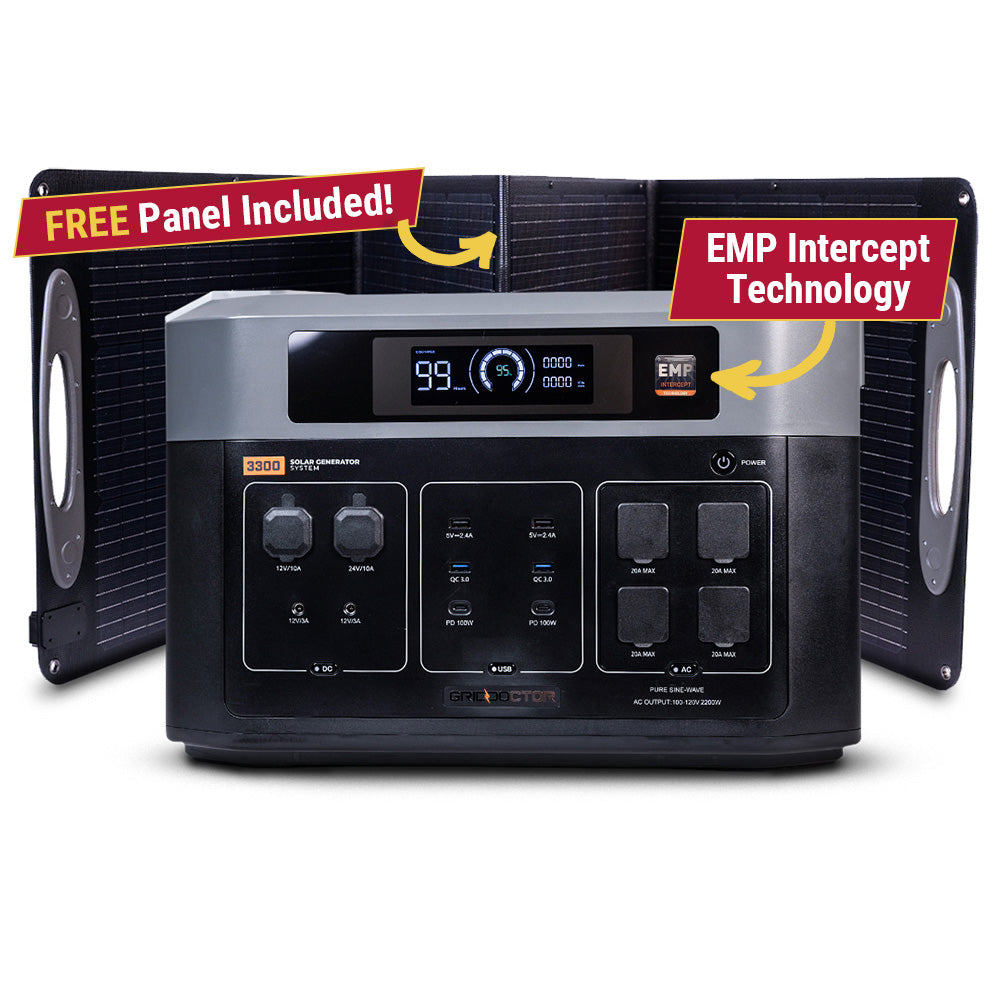
The Grid Doctor 3300 solar generator system sold with EMP shielding, a large portable power station for home backup and off-grid use; check the current spec sheet for details.
Why it's here: Listed with its EMP shielding as a stated feature, not a verified one. Judge it on the power specs first.
The Grid Doctor 3300-watt EMP-shielded solar generator sold through Emergency Essentials, a large power station for home backup and off-grid use; check the current spec sheet.
Why it's here: Listed through a second retailer so availability and pricing on this unit are not down to one storefront.
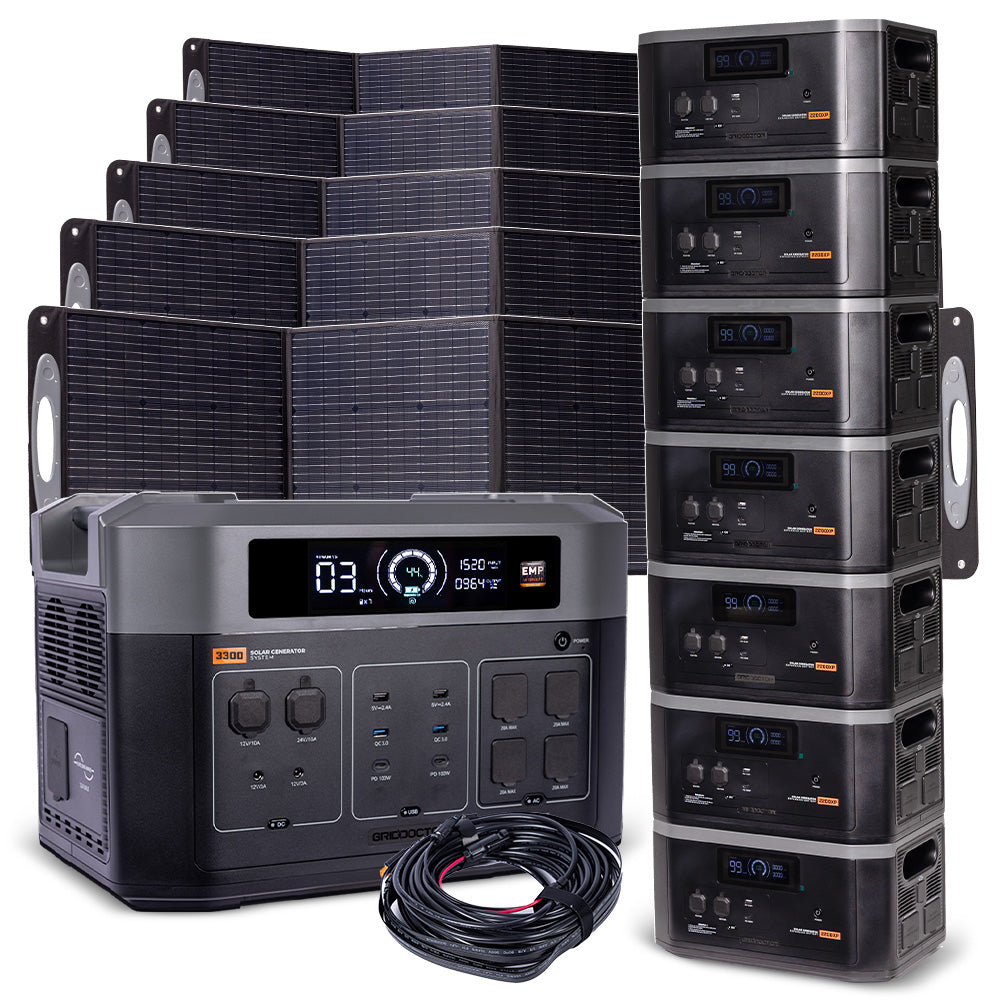
The Grid Doctor 3300 Power Tower, a large portable power station for home backup and off-grid systems; check the current spec sheet for capacity and output details.
Why it's here: Listed so form factor is part of the decision: this capacity class in a shape that stands rather than sits.
Claim audit: 14 consequential claims checked against the article's sources; unsupported wording revised where it could not be substantiated.
Claim-by-claim audit (14 checked)
“A compressor refrigerator or chest freezer set up for off-grid use (ideally a 12V or 24V DC unit designed for efficiency, not a repurposed household fridge) is usually a large dail…” (rewritten to what the article can stand behind)
“Because it cycles around the clock, it can easily outweigh lighting, electronics, and communications in a small load list like the one above.” (rewritten to what the article can stand behind)
“Space heaters, electric water heaters, and electric stoves draw enormous wattage, often 1,000 to 1,500 watts or more, and running any of them for more than short bursts requires a …” (reasoning shown in the article)
“This is why many off-gridders heat with wood, propane, or solar thermal, and reserve electricity for lighting, electronics, refrigeration, and pumps.” (rewritten to what the article can stand behind)
“If your plan currently includes electric heat or an electric water heater, it's worth revisiting that assumption before you size anything else, because those loads can dwarf everyt…” (rewritten to what the article can stand behind)
“Peak sun hours vary widely by region and season, so look up a solar resource map or sizing table for your own location rather than assuming a national average.” (rewritten to what the article can stand behind)
“A reasonable planning number is 0.75 (meaning you only capture about 75% of theoretical output).” (cited → extension.arizona.edu)
“A common starting point is to size the battery bank for 1.5 to 3 days of autonomy, meaning the batteries can supply your full daily load for that many days with no sun at all.” (cited → extension.arizona.edu)
“Lithium (LiFePO4) batteries are commonly chosen for off-grid homes for their cycle life and deeper usable discharge; check the manufacturer's rated usable capacity, which is often …” (rewritten to what the article can stand behind)
“Lead-acid and AGM batteries are still used by people controlling upfront costs, but they are generally rated for a shallower depth of discharge, so you need more nameplate capacity…” (rewritten to what the article can stand behind)
“That difference matters when comparing sticker prices, so compare cost per usable kWh over the manufacturer's rated cycle life rather than the purchase price alone.” (rewritten to what the article can stand behind)
“If you might run a microwave (1,000W), a water pump (150W), and lighting (100W) at the same moment, your inverter needs continuous wattage headroom for that combined draw, plus a s…” (rewritten to what the article can stand behind)
“An undersized inverter can shut down mid-task or trip protection when a motor's startup surge exceeds its rating, which is why peak load matters more than average.” (rewritten to what the article can stand behind)
“Assuming panels will produce their full rated wattage in real-world conditions leads to systems that underperform their spreadsheet promise by 20 to 30 percent.” (reasoning shown in the article)
Before you go
One useful off-grid email a week.
Practical gear rundowns, honest how-tos, and plain-English guides from someone doing the homework in the open.
I am building a place for off-grid people to swap real answers: a forum by topic, classifieds for gear and services, and real estate for off-grid land and homes. It is new, so the early members shape what it becomes. A free account lets you post in all three.
No ER ten minutes away means you have to be your own triage nurse. Here's how to tell a bad bee sting from the real emergency, and what to actually stock.
In many off-grid disasters, the fire or flood itself isn't the decisive factor, it's the hour you waited too long to leave. Here's how to set real, numeric triggers before you need them.
Tax sale and sheriff's auction land looks like a bargain, but redemption periods, hidden liens, and unseen parcels turn a lot of cheap acreage into an expensive lesson. Here's how to vet a listing before you bid.