The hardest part of evacuating an off-grid property isn't packing the truck. It's admitting, in the moment, that the moment has arrived. By the time smoke is visible from your porch or the creek is lapping at the bridge deck, your decision window may already be closing, and the one road off your land does not get safer while you deliberate.
This is the piece nobody wants to plan for, because planning for it means admitting there's a version of events where you lose the place entirely. But the off-gridders who come through a bad season intact are, almost without exception, the ones who had already decided what "time to go" looked like, in writing, before the sky turned orange or the gauge went red. This post is about building that decision ahead of time, so you're not making it for the first time under smoke.
Why "I'll know it when I see it" fails
Normalcy bias, the tendency to discount a threat that hasn't fully arrived, is a commonly described obstacle in evacuation planning, and it is not a character flaw. It's a normal brain doing what brains do: discounting a threat that hasn't fully arrived yet, especially when leaving means abandoning animals, a half finished harvest, or a home you built with your own hands.
The problem is that off-grid properties compound this. You likely have one road in and out, maybe gravel, maybe a single culvert or low-water crossing. You may not have cell signal to check a map at the moment you need it. You almost certainly have animals, fuel, tools, and food that feel irreplaceable, which makes "just leave" feel like a much bigger ask than it is for someone in a subdivision with three exit routes and a corner store.
That's exactly why vague plans ("we'll leave if it gets bad") don't hold up. "Bad" is a feeling, and feelings move the goalposts under stress. What holds up are specific, numeric, pre-agreed triggers that don't require you to make a judgment call in the moment, only to check a number against a line you already drew.
Build your trigger list before fire season, not during it
A trigger is a specific, observable condition tied to a specific action. Not "when it feels dangerous" but "when the creek gauge at the county site hits X feet" or "when the fire is within Y miles and wind is blowing our direction." Write these down. Post them somewhere every adult in the household has seen.
Some examples that map to real off-grid risk categories:
Wildfire
A red flag warning is issued for your county AND there's an active fire within 15-20 miles, regardless of wind direction. That's your "load the truck" trigger, not your "leave now" trigger.
Visible smoke column from your property, or a confirmed fire within line of sight distance. That's "leave now," full stop, no further discussion. The National Interagency Fire Center and most state forestry agencies publish real time fire perimeter maps worth bookmarking before you need them, not during.
If you've done the defensible space work described in our wildfire preparedness piece, your trigger should still assume the work buys you time, not survival. Treat defensible space work as something that may help the structure, and assume it does not make staying to defend the property safe.
Flood and landslide
A specific creek or river gauge level, pulled from NOAA or USGS stream gauge data for your watershed, that you know corresponds to your low-water crossing going under. Write the number down. Check it during a normal rain so you know what "normal" looks like on that gauge.
Sustained rainfall above a threshold your particular slope has shown trouble with before (if you've read your land's flood and landslide history the way we cover in reading the warning signs on off-grid land, you already have a rough sense of what rainfall total has caused problems historically).
Visible cracking, new seepage, or leaning trees on a slope above your structure. Any one of these means you move the vehicle to high ground immediately, whether or not you leave the property yet.
Winter storm isolation
A forecast snow total that exceeds what your road can handle before anyone plows it, especially if that forecast lands on a day you need to be reachable for medical reasons. This dovetails with the planning in our winter isolation piece: the trigger here isn't the snow itself, it's the storm arriving before you've topped off fuel, generator gas, and medication.
Power and infrastructure failure
Battery bank state of charge drops below a floor you've set (many off-gridders use 30-50 percent as a "take this seriously" line) with no sun in the forecast for 3+ days. This isn't an evacuation trigger by itself, but it often compounds with others, a cold snap plus a dead well pump plus an icy road is a different problem than any one of those alone.
The three-stage framework
Rather than a single go/no-go moment, build three stages. This matches how real emergencies unfold, in a widening funnel, not a single cliff edge.
Stage one: Watch. Something has entered the realm of possibility. You check your gauges, your radio, your fire map. You top off water and fuel. You do nothing dramatic yet, but you stop starting new projects.
Stage two: Prepare. Your trigger condition for "prepare" has been met. This is when the document and cash cache (see our guide on building a real off-grid document and cash cache) gets pulled from the safe and put in the vehicle. This is when animals get moved to trailers or at minimum, haltered and staged. This is when you fuel every vehicle, charge every device, and tell whoever's in your phone tree that you're watching something.
Stage three: Go. Your go trigger has been met. You leave. Not "soon." Not "after this last thing." You leave, because the entire point of stages one and two was to make stage three require no further decisions.
The value of this structure is that it front-loads all the hard thinking into calm moments. When you're actually in stage two or three, you're not debating, you're executing a checklist you already wrote.
What goes wrong in practice
A few patterns come up again and again in after-action accounts from wildfire and flood evacuations, and they're worth naming directly.
Waiting for an official order. If your parcel has poor cell coverage or no registered address in the county alert system, you may not receive an evacuation notice at all, so check how your county notifies residents. Treat official evacuation orders as a backstop, not your primary trigger. If your own numbers say go, go, even if nobody has told you to yet.
One vehicle, one driver. If your household has more people or animals than one vehicle can move in one trip, your plan needs a loading order and possibly a second trip built in at stage two, not discovered at stage three. Decide now what doesn't make the first trip.
No radio backup. Cell service can fail or overload during a regional emergency, so plan a backup channel such as NOAA weather radio. If your evacuation planning depends on getting a text alert, you need a second channel, local NOAA weather radio, a mesh radio setup, or a landline-based system. We've covered layered options in our post on communications when everything else goes quiet, and it's worth pairing that plan directly with your trigger list, since a dead radio at the moment your trigger fires is its own kind of failure.
Animals as the actual bottleneck. Livestock and pets are a common reason off-grid evacuations take longer than planned, since loading them is slow under time pressure. If you haven't practiced loading your animals under time pressure, your estimate of how long it takes is almost certainly wrong. Run a drill. Time it. Build that real number, not a guess, into your stage-two checklist.
Fuel and cash assumptions. Gas stations near you may be closed, out of power, or mobbed during a regional event. Keep vehicles topped off as a baseline habit, not an evacuation-day task. Keep a cash reserve for the same reason cards and networks may not work when infrastructure is stressed.
Writing your own trigger sheet
Sit down this week, not during a red flag warning, and write one page per hazard that applies to your land: fire, flood, winter storm, whatever your specific risk profile includes based on your land and slope and surrounding fuel load. For each, write:
The specific number, map condition, or observable sign that moves you to "watch"
The specific condition that moves you to "prepare"
The specific condition that moves you to "go," with no further discussion allowed at that point
Who in the household is responsible for which task at each stage
Where the official information sources are (county emergency management page, NOAA gauge, fire map) bookmarked somewhere you can reach even on weak signal
Tape it inside a cabinet door. Review it every spring. Update the numbers as you learn more about your specific creek, your specific slope, your specific road.
This isn't about living in fear of the next bad season. It's about doing the hard thinking once, while you're calm, so that the version of you under actual threat only has to read a number and move. That's the entire value of a trigger plan: it turns a terrifying judgment call into a boring checklist, and boring checklists are what get households out safely.
If you're still early in your off-grid planning and haven't yet mapped your property's specific hazards, our posts on reading flood and landslide risk and defensible space for wildfire are worth working through alongside this one. And if you want a sense of how this fits into the broader picture of what off-grid life actually demands in year one, our guide to the first year and general FAQ are good starting points. If you've got questions specific to your situation, our contact page is open, and the about page explains more about why we write this way: direct, specific, no fluff.
The rest of the shortlist
Recommended off-grid gear
Affiliate disclosure: Some links on this site are affiliate links, including Amazon links: as an Amazon Associate I earn from qualifying purchases. Buying through one costs you nothing extra, and it never changes what I recommend.
Products appear here only when they match this article's subject. Selection is based on documented specs and owner reports, never on compensation; pages with no relevant gear carry none.
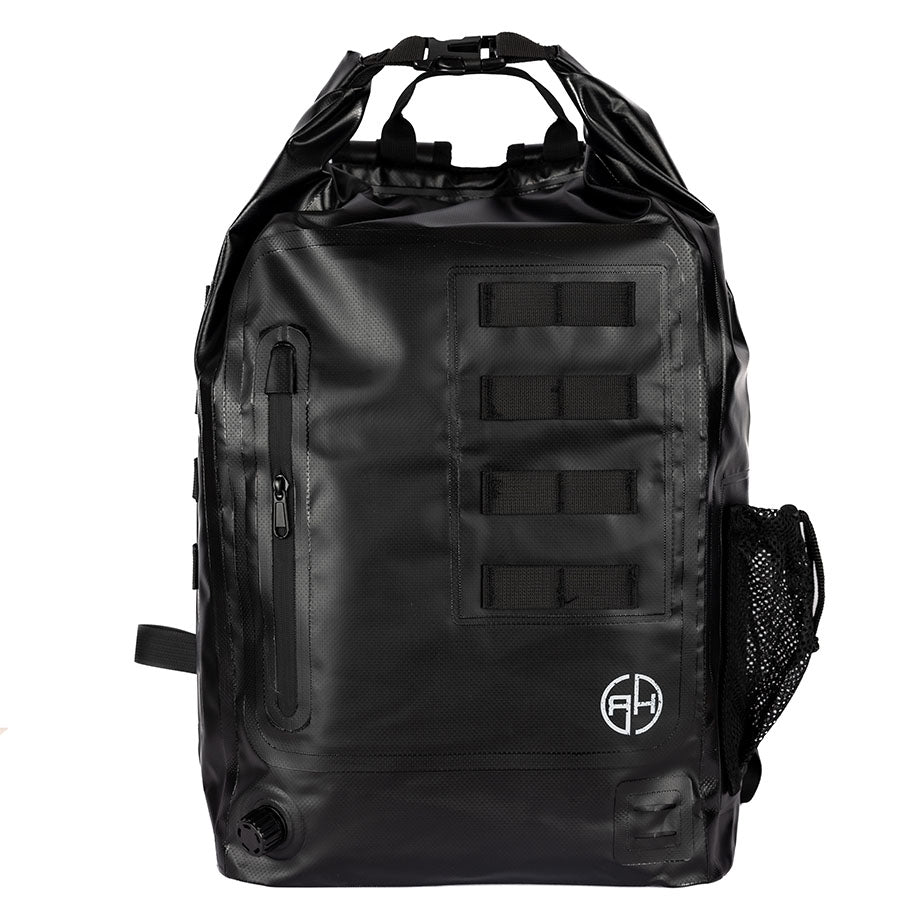
A backpack built as a faraday bag to shield phones, laptops and radios from EMP and signals, for preppers protecting electronics; check the current spec sheet.
Why it's here: Listed for the narrow case it actually addresses. Any faraday claim is worth testing yourself before you rely on it.
A waterproof backpack built as a faraday bag to shield phones, laptops and radios from EMP and signals, for preppers protecting electronics; check the current spec sheet.
“Normalcy bias, the tendency to discount a threat that hasn't fully arrived, is a commonly described obstacle in evacuation planning, and it is not a character flaw.” (rewritten to what the article can stand behind)
“The National Interagency Fire Center and most state forestry agencies publish real time fire perimeter maps worth bookmarking before you need them, not during.” (cited → nifc.gov)
“A specific creek or river gauge level, pulled from NOAA or USGS stream gauge data for your watershed, that you know corresponds to your low-water crossing going under.” (cited → waterwatch.usgs.gov)
“Treat defensible space work as something that may help the structure, and assume it does not make staying to defend the property safe.” (rewritten to what the article can stand behind)
“If your parcel has poor cell coverage or no registered address in the county alert system, you may not receive an evacuation notice at all, so check how your county notifies reside…” (rewritten to what the article can stand behind)
“Cell service can fail or overload during a regional emergency, so plan a backup channel such as NOAA weather radio.” (rewritten to what the article can stand behind)
“Livestock and pets are a common reason off-grid evacuations take longer than planned, since loading them is slow under time pressure.” (rewritten to what the article can stand behind)
“Gas stations near you may be closed, out of power, or mobbed during a regional event.” (reasoning shown in the article)
Before you go
One useful off-grid email a week.
Practical gear rundowns, honest how-tos, and plain-English guides from someone doing the homework in the open.
I am building a place for off-grid people to swap real answers: a forum by topic, classifieds for gear and services, and real estate for off-grid land and homes. It is new, so the early members shape what it becomes. A free account lets you post in all three.
No ER ten minutes away means you have to be your own triage nurse. Here's how to tell a bad bee sting from the real emergency, and what to actually stock.
Tax sale and sheriff's auction land looks like a bargain, but redemption periods, hidden liens, and unseen parcels turn a lot of cheap acreage into an expensive lesson. Here's how to vet a listing before you bid.