The first winter is when new homesteaders often discover that a garden is not a food plan. You can grow forty pounds of zucchini in July and still be eating instant rice out of a bag in January, because growing food and having food are two different problems with two different solutions.
A real year-round food plan for off-grid living has four overlapping parts: what you grow, what you preserve, what you store long-term, and what you keep as backup. None of these work alone. A root cellar full of potatoes doesn't help if you never planted enough. A pantry stacked with canned goods doesn't help if it floods or freezes. This guide walks through how to build all four pieces so they cover for each other's weaknesses.
Start with a calendar, not a seed catalog
A mistake that comes up again and again in homesteading forums is buying seeds based on what looks good in a catalog in February, then planting all of it at once in May. That gives you one enormous harvest window and eleven months of nothing.
Instead, work backward from your last frost date and build three planting waves:
Spring wave: cold-hardy crops (spinach, peas, radishes, brassicas) that go in as soon as soil is workable
Summer wave: your main calorie and preservation crops (tomatoes, beans, squash, corn, potatoes)
Fall wave: a second planting of quick crops (carrots, beets, kale, turnips) timed to mature right before hard frost, plus anything you'll overwinter in the ground
This staggered approach also spreads out your preservation workload, which matters more than most first-timers expect. Canning forty quarts of tomato sauce in one August weekend, on top of a wood cookstove or a propane range with no shore power backing it up, is genuinely brutal. If you haven't yet settled on your off-grid cooking setup, it's worth reading through a realistic kitchen setup for cooking without shore power before harvest season hits, because your stove capacity and fuel supply directly limit how much you can process in a given week.
Calorie crops matter more than variety
New gardeners tend to plant what's exciting: heirloom tomatoes, six kinds of peppers, specialty greens. All good, but none of it keeps you fed through winter. The crops that actually carry a household through the cold months are boring and dense:
Potatoes: high yield per square foot, store for months in the right conditions, forgiving of poor soil
Winter squash (butternut, hubbard, delicata): cure in the field, store at room temperature for months without any processing
Dry beans: shell out, dry on the vine or on screens, then store for a long time in sealed jars or buckets kept cool and dark
Corn (dent or flint varieties for grinding, not sweet corn): dries on the stalk, grinds into meal
Cabbage and root vegetables (carrots, beets, turnips): store for months in a cold, humid root cellar
Potatoes, squash, and dry beans are the usual backbone of a storage garden because they are dense in carbohydrates and protein, but how much ground you need depends entirely on soil, climate, and labor, so treat any published figure as a starting guess. Don't take any online calculator's exact projection as gospel. Track your own harvest weights year over year and adjust.
Preserving: match the method to the crop, not the trend
Fermenting and dehydrating get a lot of attention because they're low-energy and photogenic, but a real preservation plan uses several methods because different crops behave differently.
Canning works well for tomatoes, sauces, fruit, and pressure-canned meats and low-acid vegetables. It requires the most fuel and time, and pressure canning specifically requires sustained, controllable heat, which is another reason your stove choice matters. Wood cookstoves can pressure can, but holding a steady simmer for 60-90 minutes takes practice and attention.
Dehydrating is efficient for herbs, fruit leather, jerky, and vegetables you'll rehydrate into soups later. A solar dehydrator or a small electric one run off panels during peak sun hours can process a lot of food without touching your battery bank hard, but plan drying days around weather, since humidity slows everything down.
Fermenting (sauerkraut, kimchi, pickles) needs almost no energy input at all, just salt, time, and a cool spot to store the finished jars. It's one of the best preservation methods for an off-grid household precisely because it doesn't compete with your cooking fuel or power budget.
Root cellaring is preservation by doing almost nothing: you just keep certain crops cold, dark, and humid, and they last on their own. This is the most energy-efficient method there is, and it deserves more attention than it usually gets.
Building (or faking) a root cellar
You don't need a stone-walled cellar dug into a hillside, though that's the classic version and works beautifully if your site allows it. A functional root cellar just needs to hold roughly 32-40°F with high humidity and darkness. Options that work depending on your climate and build:
A buried or partially buried storage room on the north side of a structure
A repurposed chest freezer (unplugged, used purely as an insulated box) buried or placed in an unheated space
A trench or clamp: a pit lined with straw, filled with root vegetables, covered with more straw and soil, an old-school method that still works fine for potatoes, carrots, and beets in the right climate
A cool corner of an insulated but unheated outbuilding, with crops packed in damp sand inside bins
Whatever version you use, the crops need to go in cured properly first. Potatoes need a week or two in a dark, moderately warm spot to toughen their skins before cold storage. Squash needs 10-14 days of curing in warm, dry conditions before it goes anywhere cool. Curing is what toughens skins and heals surface wounds, so uncured crops are far more likely to rot in storage and spread that rot to their neighbors.
Humidity control is the detail people miss. Too dry and root vegetables shrivel; too wet and they rot. Damp sand, an open bucket of water in the room, or just packing crops in slightly moist material like sawdust or peat all help hold humidity where it needs to be.
The pantry: your buffer, not your foundation
Store-bought staples (rice, dried pasta, oats, flour, cooking oil, salt, sugar) round out what your garden and root cellar can't provide, especially calories that are hard to grow in small spaces, like grains and oils. Buying these in bulk when you have the storage space and the cash flow to do it is usually worthwhile, since larger packages tend to cost less per pound and it means fewer town trips during bad weather or a rough stretch.
Store dry goods in food-grade buckets with gasketed lids, ideally with oxygen absorbers for anything you're storing more than a year. Keep them up off concrete floors on pallets or boards, since concrete can stay damp and hold moisture against the buckets, and keep them out of direct sun. Rotate stock: oldest in front, newest in back, and actually eat through it rather than let it sit for a decade.
Water and food are the same conversation
It's easy to treat food storage and water storage as separate projects, but they're deeply connected. Canning, dehydrating fruit, rehydrating dried beans, and even basic cooking all need clean water in real quantity, and a garden needs a lot more. If your water plan depends on a single source, a dry summer can quietly wreck both your kitchen and your garden at once.
If you haven't worked out how you'll filter what you collect, it's worth comparing gravity filters against pump filters to understand which setup actually fits your household's volume needs, since a garden-heavy summer schedule pulls water demand in a very different direction than a quiet winter does.
Don't forget the freezer question
A chest freezer is one of the more contested pieces of off-grid food planning. It's a genuinely efficient appliance, chest freezers use less power than upright models because cold air doesn't spill out when you open the lid, and a well-insulated one can coast for many hours on stored cold if the power drops. But it's also a single point of failure: lose power for an extended stretch during a heat wave and you can lose a freezer's worth of meat and garden produce in a day.
A freezer is best treated as a convenience layer rather than a core storage strategy, because it depends entirely on continuous power. If you're running one, pair it with methods that don't fail when the sun doesn't shine for a week, canning, root cellaring, dehydrating, so a freezer outage is an inconvenience rather than a disaster.
Planning the actual calendar
A rough month-by-month rhythm, adjusted for your zone:
Late winter: start seeds indoors, plan garden layout, inventory pantry and see what actually got eaten versus what sat untouched
Spring: direct sow cold crops, transplant starts after last frost, begin fermenting early greens
Early summer: succession plant, start canning early fruit, monitor water use closely
Late summer: the big preservation push, tomatoes, beans, the bulk of canning and dehydrating
Fall: harvest and cure winter squash and potatoes, pull root vegetables before hard freeze, stock the root cellar
Winter: live off stores, evaluate what worked, order seeds for next year based on actual gaps
Common mistakes worth naming
Growing what you like instead of what stores. A garden full of lettuce and cucumbers is pleasant in July and useless in December.
Underestimating labor at harvest. Preserving a big harvest takes real hours, often more than growing it did. Build that time into your season, not just your planting weekends.
No backup for a bad year. Weather, pests, and equipment failures happen. A single crop failure shouldn't mean an empty winter, which is exactly why the pantry and bulk staples layer exists alongside the garden.
Treating heating and cooking as separate from food planning. How you heat your space in winter affects what you can cook and how much fuel you have left for canning. If you're still deciding between wood, rocket stove, and propane heat, it's worth reading through how those options compare before you lock in a kitchen and preservation plan around one of them.
Ignoring greywater and garden water connections. A lot of off-grid households route kitchen and wash water back into garden irrigation, which is worth understanding early since it changes both your plumbing layout and your planting decisions.
Putting it together
None of these four systems, growing, preserving, root cellaring, and pantry stocking, is optional if the goal is actually eating well through a full year off-grid. They're not redundant with each other so much as they cover different failure modes: garden failure is covered by pantry stock, power outages are covered by root cellaring and canning, and a bad preservation season is covered by whatever you grew and cured well enough to store.
Building this out takes a few seasons to get right. Track what you grow, what you actually eat, and what rotted or went stale untouched, then adjust the next year's plan around real data instead of guesses. For more on the gear and systems that support this kind of planning, from dehydrators to storage containers to kitchen setups, the guides collected at my start-here gear page are a good next stop, and the full archive at the blog has deeper dives into most of the individual pieces mentioned here. If you've got a specific climate or setup question that isn't covered anywhere on the site, reach out through the contact page, questions from actual readers shape a lot of what gets covered next.
Building the plan around your own season
A year-round food plan is arithmetic before it is technique, and the number it starts from is the length of your frost-free window. Average last and first frost dates decide what can be grown outdoors without protection and how much of the year storage has to carry, and they shift meaningfully with elevation over short distances. The site report gives frost dates and precipitation for any address.
From there, the garden calculator sizes beds against household size and season, and the food storage calculator turns a year of eating into the volume that actually has to be preserved and kept. Doing both before planting is what prevents the common first-year outcome of a glut that rots while the household is busy building something else.
Water is the constraint people forget: a garden that depends on a pump competes with the household in a dry August. The water usage calculator accounts for irrigation alongside domestic use, and lesson three of the free course covers why water gets designed before almost anything else.
The rest of the shortlist
Recommended off-grid gear
Affiliate disclosure: Some links on this site are affiliate links, including Amazon links: as an Amazon Associate I earn from qualifying purchases. Buying through one costs you nothing extra, and it never changes what I recommend.
Products appear here only when they match this article's subject. Selection is based on documented specs and owner reports, never on compensation; pages with no relevant gear carry none.
The Emergency Essentials one-year emergency food kit, a large long-term food supply for households planning a full year of reserve; check the current spec sheet.
Why it's here: Listed so the one-year tier is not one vendor's decision. Compare servings and calories per day, not headline duration.
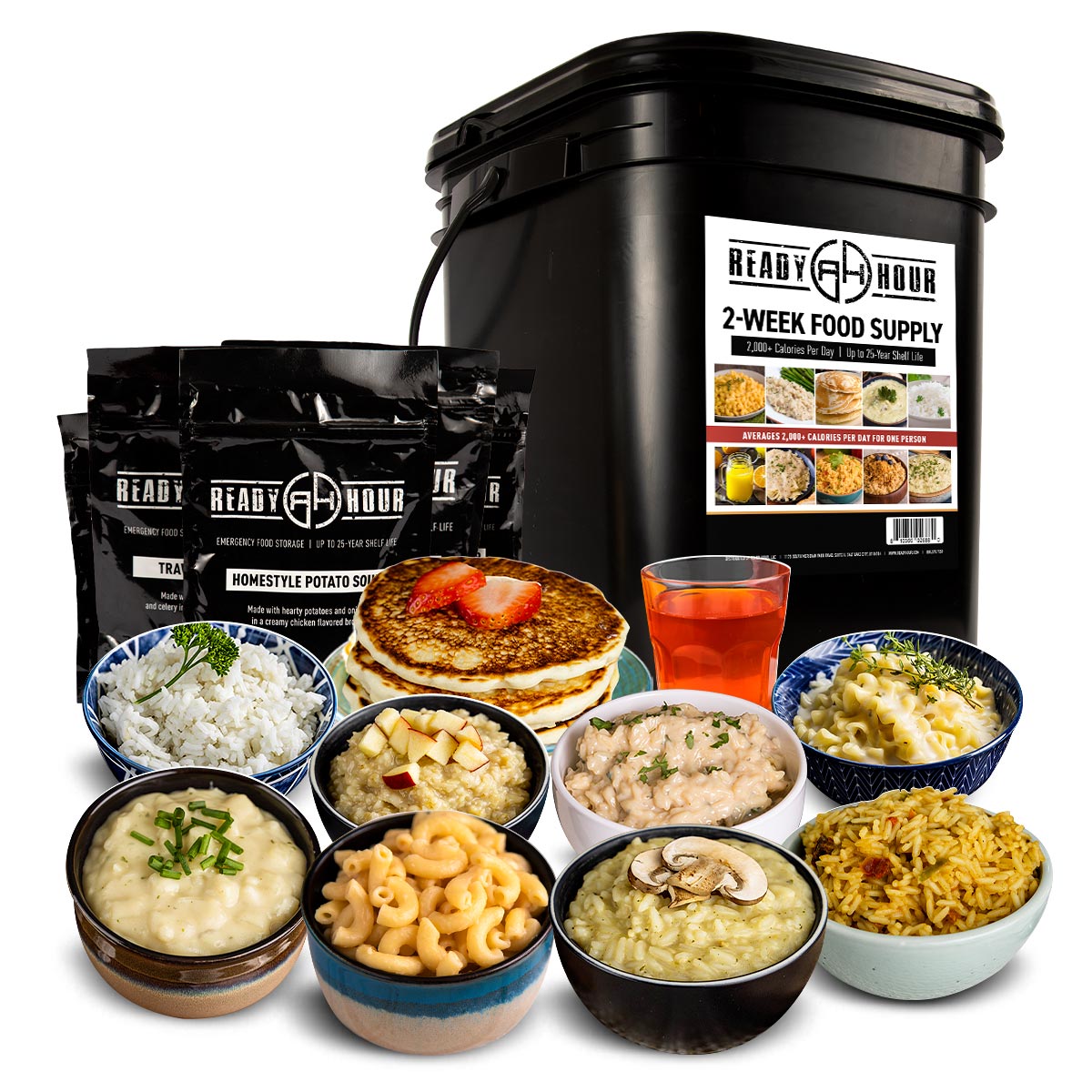
A two-week emergency food kit from Emergency Essentials, a mid-size reserve for households starting food storage; check the current spec sheet for servings and calories.
Claim audit: 11 consequential claims checked against the article's sources; unsupported wording revised where it could not be substantiated.
Claim-by-claim audit (11 checked)
“Potatoes, squash, and dry beans are the usual backbone of a storage garden because they are dense in carbohydrates and protein, but how much ground you need depends entirely on soi…” (rewritten to what the article can stand behind)
“**Dry beans**: shell out, dry on the vine or on screens, then store for a long time in sealed jars or buckets kept cool and dark” (rewritten to what the article can stand behind)
“It requires the most fuel and time, and pressure canning specifically requires sustained, controllable heat, which is another reason your stove choice matters.” (cited → nchfp.uga.edu)
“A functional root cellar just needs to hold roughly 32-40°F with high humidity and darkness.” (cited → extension.umn.edu)
“Potatoes need a week or two in a dark, moderately warm spot to toughen their skins before cold storage.” (cited → extension.umn.edu)
“Squash needs 10-14 days of curing in warm, dry conditions before it goes anywhere cool.” (cited → extension.umn.edu)
“Curing is what toughens skins and heals surface wounds, so uncured crops are far more likely to rot in storage and spread that rot to their neighbors.” (rewritten to what the article can stand behind)
“Buying these in bulk when you have the storage space and the cash flow to do it is usually worthwhile, since larger packages tend to cost less per pound and it means fewer town tri…” (rewritten to what the article can stand behind)
“Keep them up off concrete floors on pallets or boards, since concrete can stay damp and hold moisture against the buckets, and keep them out of direct sun.” (rewritten to what the article can stand behind)
“It's a genuinely efficient appliance, chest freezers use less power than upright models because cold air doesn't spill out when you open the lid, and a well-insulated one can coast…” (reasoning shown in the article)
“A freezer is best treated as a convenience layer rather than a core storage strategy, because it depends entirely on continuous power.” (rewritten to what the article can stand behind)
Before you go
One useful off-grid email a week.
Practical gear rundowns, honest how-tos, and plain-English guides from someone doing the homework in the open.
I am building a place for off-grid people to swap real answers: a forum by topic, classifieds for gear and services, and real estate for off-grid land and homes. It is new, so the early members shape what it becomes. A free account lets you post in all three.
No ER ten minutes away means you have to be your own triage nurse. Here's how to tell a bad bee sting from the real emergency, and what to actually stock.
In many off-grid disasters, the fire or flood itself isn't the decisive factor, it's the hour you waited too long to leave. Here's how to set real, numeric triggers before you need them.
Tax sale and sheriff's auction land looks like a bargain, but redemption periods, hidden liens, and unseen parcels turn a lot of cheap acreage into an expensive lesson. Here's how to vet a listing before you bid.