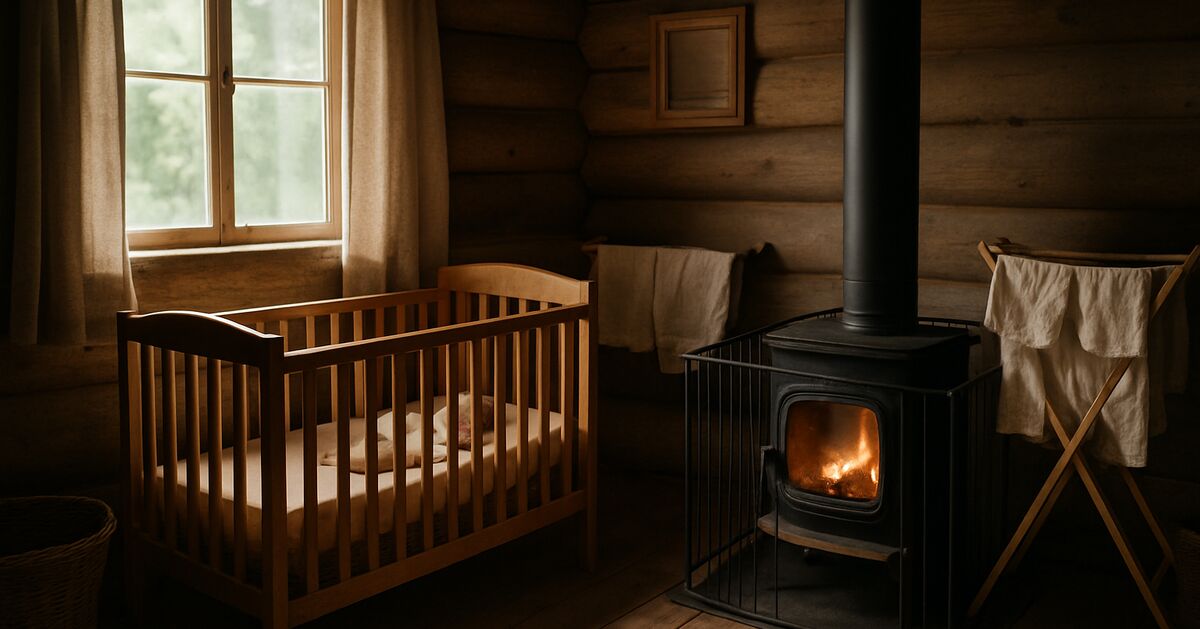
A newborn doesn't care that your well pump runs on a timer or that your propane fridge only holds so much formula. Babies and toddlers have their own schedule, and off-grid life has to bend around it, not the other way around. If you're planning a move with a little one already here, or one on the way, the logistics are different from anything else you'll deal with on the property. This isn't about whether off-grid life is "good for kids" in some abstract sense. It's about the concrete, unglamorous stuff: what you wipe them with, where they sleep, how you keep them from touching the wood stove, and what happens at 2 a.m. when something's wrong and the clinic is 45 minutes away.
I've spent a lot of time researching this because it comes up often from readers who are planning a move with young children, and the honest answer is that standard baby advice tends to assume municipal water, grid power, and a pharmacy fifteen minutes away. None of that applies off-grid, so you have to rebuild the basics from scratch.
Diapering without a diaper genie or a washing machine
Disposable diapers are the easy answer and plenty of off-grid families use them without guilt. The problem isn't morality, it's logistics: newborns go through a lot of diapers a day and toddlers somewhat fewer, and that adds up to a serious supply chain problem if your nearest store run is a once-a-month event. Stockpiling a few months' worth in a rodent-proof bin is smart, but you'll still want a backup plan for when you run short or run out.
Cloth diapering solves the supply problem but creates a water and power problem. Washing cloth diapers by hand is doable but grim, especially in cold weather when hanging them to dry outside means frozen boards instead of dry fabric. If you're running a washing machine off solar, check your numbers against what's covered in how much solar you actually need to live off-grid, because heating water draws far more power than the motor does, so a heated wash cycle can strain a small system. A cold-wash cycle with a wringer, followed by indoor drying racks near the wood stove, is the more realistic setup for most families.
A lot of off-grid parents land on a hybrid: cloth at home when water and power allow, disposables for travel days, illness, or the depths of winter when hanging wet cloth isn't practical. Whatever you choose, budget more water than you think you need. Diaper laundry can add a meaningful amount of daily water use for a family with one child in diapers, which matters a great deal if you're hauling water or your well output is marginal. If you haven't sized your well yet, the real numbers on cost and output are covered in drilling or driving a well off-grid, and it's worth running the math with your specific household in mind before you commit to a design.
Formula, breastfeeding, and food logistics
Breastfeeding solves a lot of off-grid problems by default. No mixing, no sterilizing, no refrigeration, no supply chain. It's not always possible, though, and there's no reason to feel guilty if formula is what works for your family.
If you're formula feeding, the two things that matter most are water safety and refrigeration. Powdered formula needs water that's been properly treated, and "properly treated" off-grid means more than just running it through a basic filter. Pathogens that a healthy adult shrugs off can seriously harm an infant, so if you haven't already sorted out your household water treatment, read through gravity filters vs pump filters and don't cut corners here. For infant formula specifically, ask your pediatrician whether to boil water first even after filtering, and if so, factor the fuel and time cost of boiling into your daily routine.
Refrigeration for opened formula, breast milk, or baby food is another one of those things that grid living hides from you and off-grid living forces you to confront directly. A propane fridge or a well-sized 12V compressor fridge both work, but they need to run reliably around the clock, which means your battery bank and solar array need to be sized with zero tolerance for the fridge going down. This is exactly the kind of load that trips people up when they undersize a system, so if you're still in the planning phase, it's worth reading about system voltage choices in 12V vs 24V vs 48V battery banks before you buy anything, since retrofitting a fridge circuit later is a bigger job than doing it right the first time.
Sleep, warmth, and the realities of a one-room (or two-room) cabin
Small cabins and infants are a tricky combination. On one hand, close quarters make nighttime feeding and checking on a baby easier. On the other hand, wood stoves, propane heaters, and small floor plans create real risks that don't exist in a larger house with central heat.
A few things matter more than people expect:
Crib or bassinet placement away from the wood stove's radiant heat zone, not just away from direct contact. Radiant heat from a hot stove can overheat a sleeping infant from several feet away, and infants can't regulate their body temperature or move away from heat the way toddlers and adults can.
Carbon monoxide and smoke detectors that run on battery, not just grid power, positioned near sleeping areas. A poorly maintained flue is a real risk in a small cabin, and it's worth reading chimney and flue safety for wood stoves if you haven't already, since creosote buildup and improper clearances cause both house fires and CO poisoning, and a baby's room is often the closest room to the stove in a small floor plan.
Humidity control. Heating with wood tends to dry the indoor air, which many parents find irritates infant sinuses and skin. A simple pot of water on the stove or a battery-free humidifier helps more than people expect.
Layering over heating. Off-grid nights get cold fast if a stove burns down overnight, so sleep sacks and layered bedding matter more than cranking the heat, especially since an unattended stove running hot all night is its own hazard.
Temperature swings are a common sleep disruptor for off-grid families with infants. A cabin can drop many degrees overnight once the stove burns down, and small infants lose heat faster than adults do. Many off-grid parents keep a battery-powered room thermometer by the crib just to catch this before it becomes a problem, and it's a cheap habit that pays off during the first winter especially.
Babyproofing a homestead that wasn't built with babies in mind
Standard babyproofing advice (outlet covers, cabinet locks, corner guards) still applies, but off-grid properties have hazards that a suburban childproofing checklist doesn't cover:
Open flames and hot surfaces are everywhere: wood stoves, propane burners, oil lamps, fire pits. A stove gate or physical barrier around the wood stove is close to mandatory once a baby starts crawling, not optional.
Water hazards multiply. Rain barrels, stock tanks, ponds, and even five-gallon buckets used for hauling water are drowning risks for toddlers, and toddlers drown silently and fast, without splashing or calling out. Lids, fencing, or simply never leaving a bucket with more than an inch of standing water are non-negotiable habits once a child is mobile.
Tools, batteries, and chemicals that would be in a locked garage in town are often just in a shed or under a porch off-grid. Battery banks in particular contain acid or corrosive electrolyte depending on chemistry, and they need to be in a space a toddler simply cannot reach, not just a space they're told not to go.
Livestock and predators are a different category of risk that deserves its own planning; if you're raising animals near young kids, it's worth reading protecting livestock and pets from predators alongside basic barn safety rules for toddlers, since predator deterrents like electric fencing also need to be kept away from small hands.
Outhouses and composting toilets present fall and entrapment risks that standard bathroom childproofing doesn't address. If your setup includes a pit-style outhouse, the design and siting details in building a proper off-grid outhouse are worth reviewing specifically with toddler safety in mind, since seat size and door latches matter more once a child starts using it independently.
Medical basics and knowing your limits
The plain truth is that off-grid life means accepting a different relationship with medical risk. A fever that would mean a same-day pediatrician visit in town might mean a 45-minute drive, a phone call to a nurse line, or a wait-and-watch decision based on your own judgment. That's a real tradeoff, and it deserves honest thought before you move, not after.
A well-stocked first-aid kit built specifically for infants and toddlers, not just adults, is worth assembling before you move, and building an off-grid first-aid kit covers the broader framework, but infant-specific additions matter: infant acetaminophen dosed correctly for weight, a rectal thermometer, saline drops and a bulb syringe, and a card with emergency contact numbers and the nearest pediatric-capable hospital, laminated and posted somewhere visible.
It's also worth having a real conversation with a pediatrician before the move about what symptoms warrant an immediate drive to town versus what can be monitored at home. A pediatrician who knows your situation can give specific guidance on fever thresholds, dehydration signs, and breathing concerns that's more useful than generic internet advice.
The parts nobody warns you about
A few things surprise most families the first year:
Isolation hits differently with a baby. Postpartum support, whether that's a lactation consultant, a mothers' group, or just another adult who can hold the baby for twenty minutes, is harder to access off-grid, and it's worth building a plan for this before you're in the thick of it, not after. This connects to broader isolation planning too; if winter weather can cut off your road entirely, the concerns in winter isolation planning apply just as much to a family with a newborn as to anyone else, arguably more, since a snowed-in road during a medical scare is a genuinely frightening scenario worth planning around in advance.
Laundry and water use go up more than people expect once a baby arrives, cutting into margins that seemed fine before. It's worth revisiting your whole household budget with a baby added to the math, and budgeting for off-grid life is a good place to start that recalculation, since diapers, formula, and extra propane or wood for a warmer nursery all add real annual cost that a childless budget doesn't include.
None of this means off-grid life is a bad fit for young families. Plenty of people raise happy, healthy babies and toddlers this way. It just means the planning has to be more deliberate, the margins have to be wider, and the assumptions that work for grid-connected suburban parenting need to be thrown out and rebuilt from the ground up. If you're still in the early planning stages, my start here guide has the gear breakdowns that pair well with this kind of family-specific planning, and if you've got a specific situation you're trying to work through, I'm always glad to hear from readers through the contact page.
The rest of the shortlist
Recommended off-grid gear
Affiliate disclosure: Some links on this site are affiliate links, including Amazon links: as an Amazon Associate I earn from qualifying purchases. Buying through one costs you nothing extra, and it never changes what I recommend.
Products appear here only when they match this article's subject. Selection is based on documented specs and owner reports, never on compensation; pages with no relevant gear carry none.
The InstaFire Vesta self-powered indoor heater and stove bundled with 24 cans of canned heat fuel, for power-outage heating and cooking; check the current spec sheet.
The InstaFire Vesta self-powered indoor heater and stove bundled with canned heat cooking fuel, for power-outage heating and cooking; check the current spec sheet.
Claim audit: 12 consequential claims checked against the article's sources; unsupported wording revised where it could not be substantiated.
Claim-by-claim audit (12 checked)
“The problem isn't morality, it's logistics: newborns go through a lot of diapers a day and toddlers somewhat fewer, and that adds up to a serious supply chain problem if your neare…” (rewritten to what the article can stand behind)
“If you're running a washing machine off solar, check your numbers against what's covered in [how much solar you actually need to live off-grid](/blog/how-much-solar-do-you-actually…” (rewritten to what the article can stand behind)
“Diaper laundry can add a meaningful amount of daily water use for a family with one child in diapers, which matters a great deal if you're hauling water or your well output is marg…” (rewritten to what the article can stand behind)
“Pathogens that a healthy adult shrugs off can seriously harm an infant, so if you haven't already sorted out your household water treatment, read through [gravity filters vs pump f…” (cited → medlineplus.gov)
“For infant formula specifically, ask your pediatrician whether to boil water first even after filtering, and if so, factor the fuel and time cost of boiling into your daily routine…” (rewritten to what the article can stand behind)
“Radiant heat from a hot stove can overheat a sleeping infant from several feet away, and infants can't regulate their body temperature or move away from heat the way toddlers and a…” (cited → safetosleep.nichd.nih.gov)
“A poorly maintained flue is a real risk in a small cabin, and it's worth reading [chimney and flue safety for wood stoves](/blog/chimney-and-flue-safety-for-wood-stoves-creosote-cl…” (reasoning shown in the article)
“Heating with wood tends to dry the indoor air, which many parents find irritates infant sinuses and skin.” (rewritten to what the article can stand behind)
“Temperature swings are a common sleep disruptor for off-grid families with infants.” (rewritten to what the article can stand behind)
“A cabin can drop many degrees overnight once the stove burns down, and small infants lose heat faster than adults do.” (rewritten to what the article can stand behind)
“Rain barrels, stock tanks, ponds, and even five-gallon buckets used for hauling water are drowning risks for toddlers, and toddlers drown silently and fast, without splashing or ca…” (cited → medlineplus.gov)
“A pediatrician who knows your situation can give specific guidance on fever thresholds, dehydration signs, and breathing concerns that's more useful than generic internet advice.” (rewritten to what the article can stand behind)
Before you go
One useful off-grid email a week.
Practical gear rundowns, honest how-tos, and plain-English guides from someone doing the homework in the open.
I am building a place for off-grid people to swap real answers: a forum by topic, classifieds for gear and services, and real estate for off-grid land and homes. It is new, so the early members shape what it becomes. A free account lets you post in all three.
No ER ten minutes away means you have to be your own triage nurse. Here's how to tell a bad bee sting from the real emergency, and what to actually stock.
In many off-grid disasters, the fire or flood itself isn't the decisive factor, it's the hour you waited too long to leave. Here's how to set real, numeric triggers before you need them.
Tax sale and sheriff's auction land looks like a bargain, but redemption periods, hidden liens, and unseen parcels turn a lot of cheap acreage into an expensive lesson. Here's how to vet a listing before you bid.