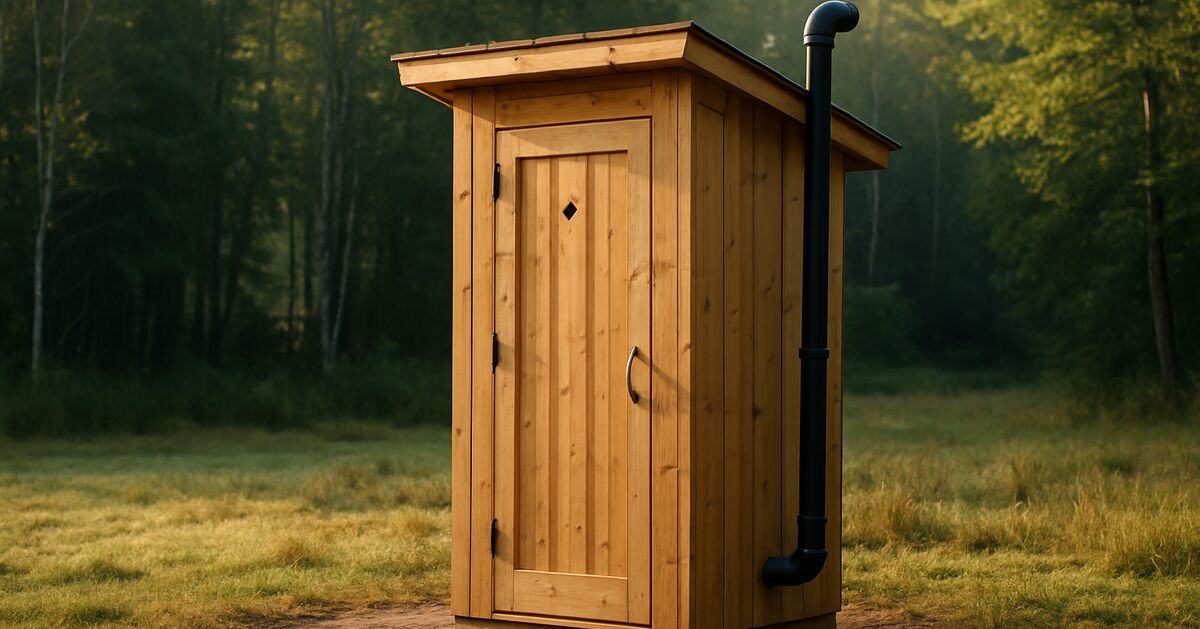
Every off-grid property eventually needs an answer to the question nobody wants to talk about at the dinner table: where does the waste go when there's no septic truck coming out to your road. A composting toilet is one answer, and I've covered that ground in composting toilets explained. But a properly built pit outhouse is still the oldest, cheapest, and in many cases the most durable answer there is, and it gets almost no serious coverage anywhere. Most of what's online is either a joke about outhouse humor or a vague sketch with no real numbers. This is the version with numbers.
Why a pit outhouse still makes sense
A composting toilet needs carbon material, regular attention, and somewhere to finish the compost. A pit outhouse needs a hole, a structure, and time. For a seasonal cabin, a hunting camp, a bug-out property you visit twice a month, or a first-year homestead before you've got the budget for anything fancier, a pit privy is often the more honest choice. It has no moving parts, nothing to freeze and crack, and nothing that needs emptying every few weeks.
The tradeoff is that it's a fixed, in-ground structure. Once it's built and used, that spot is committed for years. Get the siting wrong and you've created a real health hazard, not just an inconvenience. So the siting rules matter more here than almost anywhere else in off-grid sanitation.
Setback distances that actually protect your water
This is the part people skip, and it's the part that actually matters. A pit outhouse is essentially a slow-release source of pathogens and nitrates into the soil. Groundwater and surface water are how those pathogens get to you, your neighbors, or your livestock.
The commonly used minimums, drawn from state health department guidance across the US (these vary a bit by state and soil type, so check with your local health department before you dig):
At least 50 feet from any well, spring, or water source used for drinking
Some guidance calls for a larger separation, often around 100 feet, in sandy, fast-draining soil or near a shallow water table, so confirm the figure your county uses.
A property line setback, often in the range of 25 feet, is common, but the exact number is set locally.
A setback from buildings, often around 10 feet, is typical, but check the figure your county uses.
Well uphill and upslope-adjacent, never directly upslope of a well if you can help it, and never in a location where runoff drains toward your water source
If you already have a well and you're researching what it actually costs to drill or drive one, site your outhouse before you finalize a well location, not after. Fixing the relationship between the two after both are built is far more expensive than planning it on paper first.
Soil type changes everything here. Pure sand drains fast and lets contamination travel farther before it's filtered out. Clay drains slow, which sounds safer but can mean the pit fills with water and stops functioning entirely, especially in wet climates. Loam is the sweet spot: enough drainage to break down waste, enough structure to filter it. If you're not sure what you've got, dig a test hole two feet down and look at it, or ask a neighbor who's farmed the same ground for a real answer.
Sizing and digging the pit
A single-family pit for a cabin used regularly by two to four people should be roughly 3.5 to 4 feet in diameter and 8 to 12 feet deep, though depth depends heavily on how deep you can safely dig before hitting bedrock or the water table. Never dig into or near the water table. If you hit water before you hit a workable depth, stop and go wider instead of deeper, or move the site entirely.
One planning approach is to estimate a few cubic feet of pit volume per person per year of expected use, adjusted down for seasonal use, but treat any number you find as a rough starting point. A family of four using a cabin only on weekends will fill a pit far more slowly than full-time users, so expect many years of service, with the actual span depending on pit volume and soil drainage. The same pit used by a full-time household of four will fill several times faster, so plan on retiring it much sooner.
Line the top few feet of the pit walls with something rigid, old concrete blocks, a wooden crib, or a section of large-diameter culvert pipe, to prevent collapse near the surface where the structure's weight sits and where people are actually standing. The deeper sections in stable soil often don't need lining, but check as you dig. If soil starts sloughing off the walls, that's your sign to line it or stop.
Never pour concrete straight into the pit bottom or add any kind of sealant down there. The whole system depends on the pit bottom and lower walls staying permeable so liquid can drain into the surrounding soil while solids break down. A sealed pit just becomes a holding tank with no outlet, and it will back up and smell terribly.
The slab, the seat, and the vent stack
The structure on top does three jobs: keeps people from falling in, keeps rain out of the pit, and keeps flies and odor under control.
A concrete slab (poured on site or precast and hauled in) is the standard because wood rots quickly right at ground level where it stays damp. The slab needs a hole sized for the seat riser, and ideally a raised lip around the edge so surface runoff can't sheet directly into the pit during heavy rain. Surface runoff entering the pit adds water the soil has to absorb, which is one way an otherwise well-built outhouse floods during wet seasons.
The single biggest upgrade over the classic movie-prop outhouse is a proper vent stack: a 4-inch PVC pipe running from inside the pit, through the structure, and above the roofline, capped with a screen to keep insects out. This does two things. It lets pit gases escape upward and away from the seat instead of lingering inside the structure, and it creates a slight airflow that actually pulls odor out of the building rather than letting it sit. A pit outhouse without a vent stack generally smells worse, since gases have no path out except through the seat opening. This one detail is the difference between "rustic but tolerable" and "avoid at all costs."
Paint the vent pipe or the roof cap a dark color if you're in a sunny climate. The sun heating the pipe helps drive the convective draft that pulls air upward, which is a small but real improvement in ventilation.
Fly and odor control day to day
Lime (agricultural lime, not the citrus) or wood ash sprinkled down the hole after each use cuts odor and discourages flies significantly, and it's cheap. Keep a scoop and a small bucket of it right in the structure so it's actually used. A tight-fitting seat lid that's kept closed between uses also matters more than people expect, since an open pit is what lets odor and flies escape into the structure in the first place.
Do not add chemicals, bleach, or anything marketed as a septic treatment down a pit toilet. Those products are formulated for enclosed tanks and can disrupt the natural decomposition happening in an open pit, sometimes making odor worse, not better.
When a pit outhouse is the wrong choice
Bedrock close to the surface, a high water table, very small lots where you simply can't hit the setback distances, or a location in a floodplain all rule out a traditional pit design. In any of those situations, a composting toilet or a vault toilet (sealed tank that's pumped out periodically, more like a holding tank than a pit) is the better answer, even though it costs more upfront and requires more ongoing management. Some counties and states also restrict or ban pit privies outright in certain zones, particularly near shared water sources or in denser rural subdivisions, so a call to your local health department before you dig isn't optional, it's the difference between a legal structure and a violation you'll have to tear out later.
Permits and code realities
Rules vary enormously by state and county. Permitting requirements differ widely, and some rural counties regulate a single outhouse much more lightly than others. Others require a percolation test, a site plan, and a permit before any digging starts, especially if the property will ever have a residence built on it or if it's near any shared water source. Given how much the answer varies, the only honest advice is to call your county health department or environmental services office and ask directly. It's usually a five-minute phone call, and it's far cheaper than digging something you'll be forced to fill in and relocate.
Capping and retiring a pit
When a pit fills to within about two feet of the surface, it's time to retire it. Backfill the remaining space with soil, mound it slightly above grade since it will settle over time, and mark the spot clearly so nobody digs a well or a garden bed there for at least a year while decomposition finishes. Wait before planting food crops directly on a capped pit site, since pathogens can persist in the soil while decomposition finishes, and check local health guidance for a recommended interval.
Move the structure itself, or build a new one, at least 10 to 15 feet away in a fresh, well-sited spot, and repeat the process. A well-run property often rotates through two or three pit locations over a couple of decades, which is a perfectly normal part of long-term rural land use.
How this fits into a bigger sanitation plan
An outhouse rarely stands alone on a real homestead. Most setups also handle laundry and dish water separately through a greywater system, collect and store water carefully as described in the guide to rainwater collection, and keep the outhouse itself well clear of any well recommendations covered in the well drilling cost guide. Sanitation off-grid isn't one decision, it's a small system of decisions that all need to respect each other's setback distances and drainage paths.
If you're just starting to plan a property and haven't settled on any of this yet, it's worth reading through the broader gear and systems guides over on my start-here page before you dig anything permanent, since siting a well, a garden, and an outhouse all at once, on paper, before any digging happens, saves an enormous amount of regret later. And if a question comes up that's specific to your soil, slope, or county rules, I'm always happy to hear from readers through the contact page, even though the honest answer for anything code-related will usually point you back to your local health department.
A pit outhouse isn't glamorous, and it will never show up in a homesteading magazine spread. But built with the right setbacks, the right depth, and a real vent stack, it's one of the most reliable, lowest-maintenance sanitation systems available to anyone living off-grid, and it's been working for exactly that reason for a very long time.
Claim audit: 20 consequential claims checked against the article's sources; unsupported wording revised where it could not be substantiated.
Claim-by-claim audit (20 checked)
“At least 50 feet from any well, spring, or water source used for drinking” (cited → doh.wa.gov)
“Some guidance calls for a larger separation, often around 100 feet, in sandy, fast-draining soil or near a shallow water table, so confirm the figure your county uses.” (rewritten to what the article can stand behind)
“A property line setback, often in the range of 25 feet, is common, but the exact number is set locally.” (rewritten to what the article can stand behind)
“A setback from buildings, often around 10 feet, is typical, but check the figure your county uses.” (rewritten to what the article can stand behind)
“A single-family pit for a cabin used regularly by two to four people should be roughly 3.5 to 4 feet in diameter and 8 to 12 feet deep, though depth depends heavily on how deep you…” (cited → uaf.edu)
“Never dig into or near the water table.” (reasoning shown in the article)
“One planning approach is to estimate a few cubic feet of pit volume per person per year of expected use, adjusted down for seasonal use, but treat any number you find as a rough st…” (rewritten to what the article can stand behind)
“A family of four using a cabin only on weekends will fill a pit far more slowly than full-time users, so expect many years of service, with the actual span depending on pit volume …” (rewritten to what the article can stand behind)
“The same pit used by a full-time household of four will fill several times faster, so plan on retiring it much sooner.” (rewritten to what the article can stand behind)
“A sealed pit just becomes a holding tank with no outlet, and it will back up and smell terribly.” (reasoning shown in the article)
“A concrete slab (poured on site or precast and hauled in) is the standard because wood rots quickly right at ground level where it stays damp.” (cited → uaf.edu)
“Surface runoff entering the pit adds water the soil has to absorb, which is one way an otherwise well-built outhouse floods during wet seasons.” (rewritten to what the article can stand behind)
“A pit outhouse without a vent stack generally smells worse, since gases have no path out except through the seat opening.” (rewritten to what the article can stand behind)
“The sun heating the pipe helps drive the convective draft that pulls air upward, which is a small but real improvement in ventilation.” (reasoning shown in the article)
“Lime (agricultural lime, not the citrus) or wood ash sprinkled down the hole after each use cuts odor and discourages flies significantly, and it's cheap.” (cited → uaf.edu)
“Those products are formulated for enclosed tanks and can disrupt the natural decomposition happening in an open pit, sometimes making odor worse, not better.” (cited → epa.gov)
“Some counties and states also restrict or ban pit privies outright in certain zones, particularly near shared water sources or in denser rural subdivisions, so a call to your local…” (cited → doh.wa.gov)
“Permitting requirements differ widely, and some rural counties regulate a single outhouse much more lightly than others.” (rewritten to what the article can stand behind)
“Others require a percolation test, a site plan, and a permit before any digging starts, especially if the property will ever have a residence built on it or if it's near any shared…” (cited → doh.wa.gov)
“Wait before planting food crops directly on a capped pit site, since pathogens can persist in the soil while decomposition finishes, and check local health guidance for a recommend…” (rewritten to what the article can stand behind)
Before you go
One useful off-grid email a week.
Practical gear rundowns, honest how-tos, and plain-English guides from someone doing the homework in the open.
I am building a place for off-grid people to swap real answers: a forum by topic, classifieds for gear and services, and real estate for off-grid land and homes. It is new, so the early members shape what it becomes. A free account lets you post in all three.
No ER ten minutes away means you have to be your own triage nurse. Here's how to tell a bad bee sting from the real emergency, and what to actually stock.
In many off-grid disasters, the fire or flood itself isn't the decisive factor, it's the hour you waited too long to leave. Here's how to set real, numeric triggers before you need them.
Tax sale and sheriff's auction land looks like a bargain, but redemption periods, hidden liens, and unseen parcels turn a lot of cheap acreage into an expensive lesson. Here's how to vet a listing before you bid.