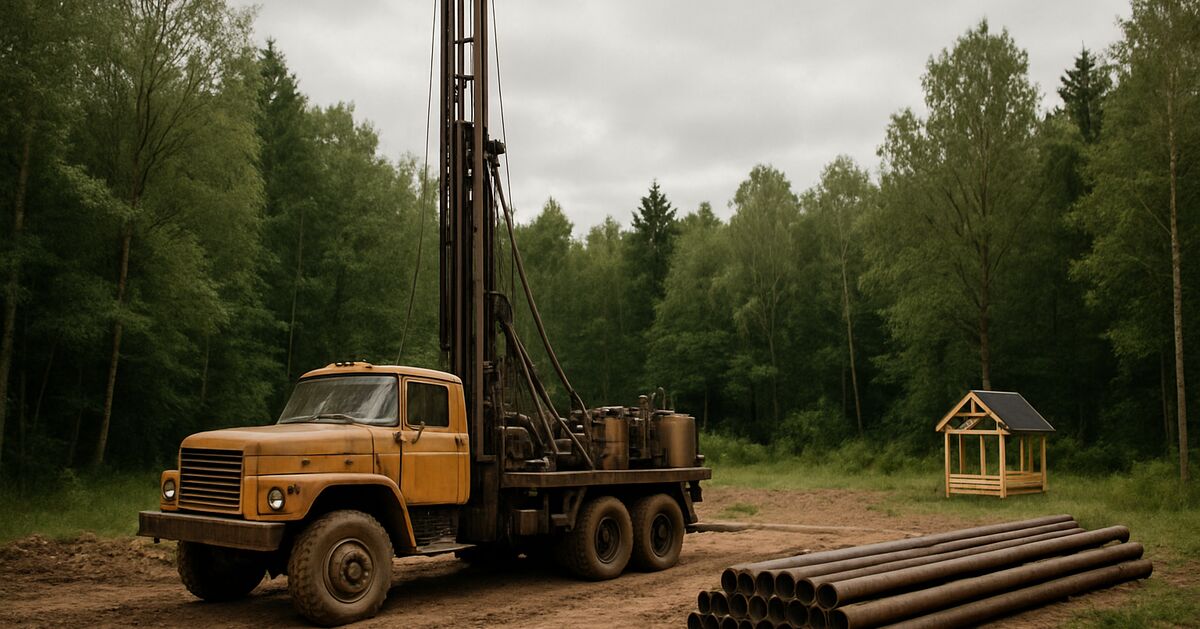
A well sounds like the clean, simple answer to off-grid water. No hauling, no rainwater math, no worrying about drought. Just a pipe in the ground and water forever.
The reality is more complicated, and more expensive, than it appears when you first start pricing this out. I've spent a lot of time digging through well driller quotes, state well records, and pump specs while researching this for my own future property, and the honest answer is: it depends enormously on where you're buying land, and you need to know that before you close on it, not after.
This isn't a rainwater article (I've already covered how to collect and store rainwater safely for that side of things). This is about putting a well in, what it takes, what can go wrong, and what it really costs from the ground up.
The first question: drilled, driven, or dug?
Not all wells are the same, and the type you need is dictated almost entirely by your local geology, not your preference.
Drilled wells are the standard option for off-grid properties. A drilling rig bores down, often 100 to 400 feet or more, through rock and soil, and a steel or PVC casing lines the hole to keep it from collapsing. Drilled wells can reach deep, reliable aquifers and are the most common choice where bedrock is close to the surface or the water table is deep.
Driven wells work in areas with soft ground and a shallow water table, usually under 25 feet. A small-diameter pipe with a well point on the end gets literally driven or hammered into the ground. These are cheaper and faster, but only work where the ground allows it, and they're more vulnerable to contamination since they draw from shallow groundwater that's closer to surface runoff, septic fields, and agricultural chemicals.
Dug wells are the old-fashioned wide-diameter type, hand dug or excavated with equipment, lined with stone or tile. They're mostly historical at this point, rarely recommended for new construction because they're shallow, exposed, and easily contaminated.
For buyers of raw off-grid land today, it's usually going to be a drilled well, and that's what most of this article focuses on. But it's worth asking a local driller early what's typical in your area, because the answer changes your budget dramatically.
What actually drives the cost
This is the question everyone wants a straight number for, and the honest answer is that a real range exists but it's wide, because the variables are wide.
Per-foot drilling prices vary widely by region and rock type, so ask two or three local drillers for their current per-foot rate rather than relying on a national figure. Whatever per-foot rate you're quoted, multiply it by expected depth to get the drilling-only figure, before casing, pump, and wiring. A deep well in hard rock with difficult site access will cost substantially more, since depth, rock hardness, and access all add to the bill separately.
Here's what actually moves that number:
Depth to water. This is the big one, and it's the one you can't fully know until you drill, though a driller who's worked your area can usually give you a solid estimate from nearby well logs. Some states keep public well completion records searchable by county, so check whether your state does and pull a few from your target area before you buy land.
Ground conditions. Soft soil drills fast and cheap. Granite, basalt, and other hard rock slow the bit down and wear out equipment, and drillers price that in. Some geology also requires more casing to keep the hole stable, which adds material and labor cost.
Access. If a drilling rig, which is a large truck, can't get to your well site on existing roads, you're paying for road work, a smaller rig, or in some cases equipment that has to be brought in piece by piece. Remote, off-grid parcels chosen specifically for privacy and distance from neighbors are often exactly the parcels where access is hardest.
Casing and grouting requirements. Casing length and grout seal requirements are set by state or county rules, so check yours, since the seal is what keeps surface contamination out of the well. Some geology needs more casing than the legal minimum to stay stable, and that's added footage you pay for.
Pump and equipment. The drilling is only part of the bill. You still need a submersible pump, priced by depth and flow requirements, plus a pressure tank, wiring, pitless adapter, and often a well house or insulated cover in cold climates. Altogether, pump and equipment add a significant amount on top of the drilling cost, so price those items separately before you budget.
Permits and testing. Many jurisdictions require a permit before drilling and a water quality test, and sometimes a flow test, after, so confirm the rules where you're buying. Budget a few hundred dollars for this, more if your state requires extensive testing for arsenic, nitrates, or other regional concerns.
Put together, an all-in drilled well with pump and basic setup is often a five-figure line item, and the range is wide depending on the factors above. Anyone quoting you a firm number before they've drilled anywhere near your land, or without pulling nearby well logs, is guessing.
Powering the pump without shore power
This is where a well and off-grid living intersect in a way a lot of people don't think through before they've already got a hole in the ground. A standard submersible well pump draws a meaningful surge of power on startup, often several times its running wattage, and running one off-grid means your solar and battery system has to be sized to handle that surge, not just the average draw.
There are two broad approaches. Standard AC submersible pumps run off an inverter, and this works fine for a lot of off-grid systems, but the pump's startup surge needs to be checked against your inverter's surge rating specifically, not just its continuous rating. This is exactly the kind of load calculation that belongs in the same conversation as wiring your solar system safely with the right fuses, breakers, and wire gauge, because an undersized breaker or wire run on a well pump circuit is a real fire risk, not a theoretical one.
The other option is a DC solar well pump, purpose built to run directly off panels or a DC battery bank without an inverter in between. These are often used for stock watering and remote wells and can be simpler without an inverter, but check the rated flow, since many are lower flow than standard AC pumps and may not meet whole-house pressure needs.
Either way, a well means an additional, fairly demanding electrical load that needs to be part of your system sizing from the start, not bolted on afterward. If you're still deciding between a modest power setup and a full system, that tradeoff is worth reading through in my comparison of portable power stations versus a full solar system, because a well pump is one of the loads that tends to push people toward a full system rather than a portable one.
Water quality: don't assume "well water" means "clean water"
A lot of people move off-grid assuming a well is automatically safe, clean water. It isn't automatic, it's a starting point that needs verification and often ongoing management.
Get the water tested before you rely on it, and then periodically after. Standard tests look at coliform bacteria, nitrates, and often arsenic, and in some regions you'll want tests specific to local concerns like radon, uranium, or agricultural runoff. A test costs far less than dealing with a health problem or a well that turns out to be unusable.
Even a clean bacterial test doesn't mean the water is pleasant or appliance-friendly. Hard water, meaning high mineral content, shows up in a lot of well water and mineral scale can build up in pipes, water heaters, and fixtures over years. Iron and sulfur (that rotten egg smell) are common nuisances that don't necessarily make water unsafe but make it unpleasant, and treating for them is a separate project and cost from the well itself.
This is also where the debate between gravity filters and pump filters becomes relevant again, because even good well water often benefits from an additional point-of-use filter for taste, sediment, or specific contaminants the well test flagged.
Mistakes that cost people real money
Drilling before checking neighboring well logs. Public well completion records exist in many states precisely so you're not flying blind. A quick records search or a call to the state's water resources office can tell you what depth and yield to expect in your area before you commit to a driller.
Choosing the cheapest driller without checking their casing and grouting practices. A cheap well that isn't properly sealed against surface contamination is a health risk and often an expensive fix later. Licensed drillers should be able to explain exactly what casing depth and grout they're using and why, and a driller who brushes off that question is a red flag.
Underestimating the pump's electrical demand. As above, the pump surge often gets discovered the hard way, when an inverter trips or a breaker fails, rather than planned for in advance.
Assuming a low-yield well will improve. Some wells simply don't produce much water, often measured in gallons per minute, and that number matters enormously for daily use, especially if you're also running irrigation or livestock watering. A storage tank (often called a cistern or pressure tank system) can buffer a low-yield well by filling slowly and storing enough for peak use, and this is a legitimate and common solution, but it needs to be planned, not discovered after the well is already producing less than expected.
Not budgeting for freeze protection. In cold climates, well houses, pitless adapters, and buried water lines need frost-depth burial or insulation, since any water left above frost depth can freeze and split the line.
Is a well always the right answer?
Not necessarily, and it's worth saying plainly. For some off-grid properties, particularly smaller cabins or seasonal setups, a well is a large upfront cost that a well-designed rainwater catchment and storage system can substitute for at a fraction of the price, especially in regions with decent annual rainfall. For year-round homesteads with livestock, gardens, or multiple people, a well's reliability and volume are hard to match with catchment alone.
The honest answer for anyone planning a serious, permanent off-grid homestead is that a well, where geology allows it at a reasonable depth, is worth the investment for the reliability it buys. But it's a five-figure decision in a lot of cases, and it deserves the same due diligence you'd put into any other major infrastructure choice on the property, not an assumption that water will just be there because you dug down far enough.
If you're still in the planning stages and haven't settled land yet, this is exactly the kind of research worth doing before you buy, not after. I've got more on the practical realities of the early stages of a homestead in what actually happens in the first six months, and a broader rundown of gear and systems worth understanding early in my start here guide. If you've got a specific situation, land already in hand, a strange well log, an odd quote, feel free to get in touch and I'll try to help you think it through.
Water is the one system on an off-grid property you genuinely cannot improvise your way around for long. Get the well question right at the start, and a lot of the rest of the homestead gets easier to plan around it.
The rest of the shortlist
Recommended off-grid gear
Affiliate disclosure: Some links on this site are affiliate links, including Amazon links: as an Amazon Associate I earn from qualifying purchases. Buying through one costs you nothing extra, and it never changes what I recommend.
Products appear here only when they match this article's subject. Selection is based on documented specs and owner reports, never on compensation; pages with no relevant gear carry none.
The Alexapure emergency water bank sold through Emergency Essentials, for storing a large volume of water before a storm or outage; check the current spec sheet.
Claim audit: 22 consequential claims checked against the article's sources; unsupported wording revised where it could not be substantiated.
Claim-by-claim audit (22 checked)
“Drilled wells can reach deep, reliable aquifers and are the most common choice where bedrock is close to the surface or the water table is deep.” (cited → usgs.gov)
“Driven wells work in areas with soft ground and a shallow water table, usually under 25 feet.” (cited → usgs.gov)
“These are cheaper and faster, but only work where the ground allows it, and they're more vulnerable to contamination since they draw from shallow groundwater that's closer to surfa…” (cited → usgs.gov)
“They're mostly historical at this point, rarely recommended for new construction because they're shallow, exposed, and easily contaminated.” (cited → usgs.gov)
“Per-foot drilling prices vary widely by region and rock type, so ask two or three local drillers for their current per-foot rate rather than relying on a national figure.” (rewritten to what the article can stand behind)
“Whatever per-foot rate you're quoted, multiply it by expected depth to get the drilling-only figure, before casing, pump, and wiring.” (rewritten to what the article can stand behind)
“A deep well in hard rock with difficult site access will cost substantially more, since depth, rock hardness, and access all add to the bill separately.” (rewritten to what the article can stand behind)
“Some states keep public well completion records searchable by county, so check whether your state does and pull a few from your target area before you buy land.” (rewritten to what the article can stand behind)
“Casing length and grout seal requirements are set by state or county rules, so check yours, since the seal is what keeps surface contamination out of the well.” (rewritten to what the article can stand behind)
“You still need a submersible pump, priced by depth and flow requirements, plus a pressure tank, wiring, pitless adapter, and often a well house or insulated cover in cold climates.” (rewritten to what the article can stand behind)
“Altogether, pump and equipment add a significant amount on top of the drilling cost, so price those items separately before you budget.” (rewritten to what the article can stand behind)
“Many jurisdictions require a permit before drilling and a water quality test, and sometimes a flow test, after, so confirm the rules where you're buying.” (rewritten to what the article can stand behind)
“Put together, an all-in drilled well with pump and basic setup is often a five-figure line item, and the range is wide depending on the factors above.” (rewritten to what the article can stand behind)
“A standard submersible well pump draws a meaningful surge of power on startup, often several times its running wattage, and running one off-grid means your solar and battery system…” (reasoning shown in the article)
“This is exactly the kind of load calculation that belongs in the same conversation as [wiring your solar system safely with the right fuses, breakers, and wire gauge](/blog/wiring-…” (reasoning shown in the article)
“These are often used for stock watering and remote wells and can be simpler without an inverter, but check the rated flow, since many are lower flow than standard AC pumps and may …” (rewritten to what the article can stand behind)
“Get the water tested before you rely on it, and then periodically after.” (cited → epa.gov)
“Standard tests look at coliform bacteria, nitrates, and often arsenic, and in some regions you'll want tests specific to local concerns like radon, uranium, or agricultural runoff.” (cited → epa.gov)
“Hard water, meaning high mineral content, shows up in a lot of well water and mineral scale can build up in pipes, water heaters, and fixtures over years.” (rewritten to what the article can stand behind)
“Public well completion records exist in many states precisely so you're not flying blind.” (rewritten to what the article can stand behind)
“A cheap well that isn't properly sealed against surface contamination is a health risk and often an expensive fix later.” (cited → epa.gov)
“In cold climates, well houses, pitless adapters, and buried water lines need frost-depth burial or insulation, since any water left above frost depth can freeze and split the line.” (rewritten to what the article can stand behind)
Before you go
One useful off-grid email a week.
Practical gear rundowns, honest how-tos, and plain-English guides from someone doing the homework in the open.
I am building a place for off-grid people to swap real answers: a forum by topic, classifieds for gear and services, and real estate for off-grid land and homes. It is new, so the early members shape what it becomes. A free account lets you post in all three.
No ER ten minutes away means you have to be your own triage nurse. Here's how to tell a bad bee sting from the real emergency, and what to actually stock.
In many off-grid disasters, the fire or flood itself isn't the decisive factor, it's the hour you waited too long to leave. Here's how to set real, numeric triggers before you need them.
Tax sale and sheriff's auction land looks like a bargain, but redemption periods, hidden liens, and unseen parcels turn a lot of cheap acreage into an expensive lesson. Here's how to vet a listing before you bid.