Plenty of people obsess over panel wattage and battery capacity, then bolt the array on at whatever angle the roof happens to be, or worse, dead flat because it seemed easier. That single decision can cost you more usable winter energy than any battery upgrade you could buy. Angle and orientation are free. You already own the panels. Getting the geometry right is just paying attention to something the sun has been telling you the whole time.
Why angle matters more than most people think
A solar panel makes the most power when sunlight hits it straight on, perpendicular to the glass. Hit it at an angle and the same amount of light gets spread over a wider effective area, so less energy actually gets absorbed per square inch of cell. This isn't a minor rounding error. A large mismatch between the sun's position and the panel's face spreads the same light over more area, so output drops noticeably, and in winter, when the sun sits low and daylight is short, that mismatch is often at its worst right when you need every watt.
This matters more off-grid than it does for a grid-tied roof system, because a grid-tied home doesn't care if December is lean. It just pulls extra from the utility. You don't have that luxury. Your battery bank has to survive on whatever the array delivers, and if you've read how much solar you actually need to live off-grid, you already know winter is the design constraint, not summer. Tilt is one of the cheapest levers you have to fix a winter shortfall.
The basic rule of thumb, and why it's only a starting point
The old rule of thumb is to set your tilt angle equal to your latitude for a year-round average, steeper than latitude (add about 15 degrees) to favor winter production, and flatter than latitude (subtract about 15 degrees) to favor summer. So if you're at 40 degrees north latitude, a winter-optimized tilt lands around 55 degrees, a summer-optimized tilt around 25 degrees, and a flat year-round compromise sits near 40 degrees.
That's a fine starting point, but it's a simplification. The sun's actual path changes with the seasons far more than a single number captures, and local weather patterns (persistent winter cloud, morning fog, monsoon season) can matter more than the geometry. NREL's solar radiation data and PVWatts calculator, built and maintained by the U.S. Department of Energy, let you plug in your exact coordinates and see modeled output at different tilt and azimuth combinations for every month of the year. It's free, it's public, and it will tell you far more about your specific hillside than any rule of thumb. If you haven't run your coordinates through it, that's worth doing before you weld a fixed rack in place.
Azimuth: the other half of the equation
Tilt gets the attention, but which direction the panel faces (its azimuth) matters just as much. In the Northern Hemisphere, true south is generally the best fixed orientation for maximizing total annual output. Magnetic south, what your compass shows you, is not the same thing, and depending on where you are, the difference (called magnetic declination) can be significant enough to matter. NOAA publishes declination data for any location, and it's worth checking before you set panel orientation by compass alone.
That said, true south isn't always the right answer for your situation. If your energy use is heaviest in late afternoon, a slight west-of-south orientation captures more of that afternoon sun. If trees or a ridge block the eastern sky until midmorning, biasing west can recover hours you'd otherwise lose. This is the kind of site-specific tradeoff that matters more than chasing a theoretically perfect number. If you're dealing with real obstructions, it's worth reading through the workarounds for sun blocked by trees, hills, or clouds alongside this, because azimuth and shading decisions are tangled together on most real parcels.
Fixed racks vs seasonal adjustment vs trackers
There are three basic approaches, and each one is a different trade of labor against output.
Fixed rack, one angle, set it and forget it. This is a common setup on off-grid cabins, and for good reason. It's the cheapest to build, has no moving parts to fail, and once it's dialed in it just works. The cost is that you're accepting a compromise angle that isn't optimal for either summer or winter. If your usage is fairly steady, this may be the right call, especially paired with a system sized with enough margin that the seasonal swing doesn't leave you short. Wiring the array correctly on a fixed rack still matters just as much as the angle. If you haven't gone through it, our piece on wiring an off-grid solar system safely covers the fuse, breaker, and wire gauge choices that keep a fixed array both efficient and safe.
Seasonal adjustment, two or three angles a year. This is the sweet spot for a lot of off-grid setups. Twice a year, usually around the equinoxes, you loosen a few bolts and swing the rack to a steeper winter angle or a flatter summer angle. It takes twenty minutes and no special tools if the rack is designed for it. The gain over a single fixed angle can be meaningful, though the real number depends heavily on your latitude, your specific site, and how aggressive your seasonal swing is, so model it in PVWatts before committing. The catch is you have to actually remember to do it, and on a steep roof or a tall ground rack, it isn't always a casual job. Build the adjustment mechanism into the rack design from day one rather than trying to retrofit it later.
Trackers, panels that follow the sun through the day. Single-axis and dual-axis trackers can meaningfully boost output, particularly in high-sun climates, but they introduce a motor, a controller, and moving parts exposed to weather, dust, and ice, all of which are exactly the kind of thing that breaks at the worst time in a remote setting. For many off-grid homes the added complexity and maintenance burden can outweigh the gain, especially when a simpler fix, like adding another panel or two to a fixed array, gets you the same watts without anything that can seize up. Trackers make more sense for larger installations where the labor of manual adjustment doesn't scale, and where someone is on-site regularly enough to catch a problem before it becomes a dark battery bank.
Ground mount vs roof mount changes your options
A roof-mounted array is stuck with the roof's pitch unless you build a tilted rack on top of it, which adds wind load and complexity. A ground mount gives you full control over angle and orientation and makes seasonal adjustment far easier, since you're not on a ladder to do it. If you're still in the planning stages of a build and haven't settled on your cabin's roof design yet, it's worth thinking about whether the roof pitch you're choosing for shedding snow also happens to be a reasonable angle for panels, because getting both right in one structure can save you a separate rack entirely.
Ground mounts have their own trade-offs. They're closer to ground-level shading from brush and snow drift, they need their own footings or ballast, and in snow country a steep winter angle actually helps here too, since a steep panel sheds snow far more readily than a shallow one. A snow-covered panel produces close to nothing regardless of how well you angled it, so in heavy snow climates, tilt isn't just about sun geometry, it's about keeping the glass clear without having to go out and brush it off after every storm.
Common mistakes worth avoiding
A mistake that comes up again and again in off-grid forums is copying a neighbor's or a YouTube video's angle without checking it against actual local latitude and shading. Someone three states away at a different latitude with a different tree line is not a reliable template for your roof.
Another common one is setting the array for summer performance because that's when the installer happened to be on-site, then getting caught short every December. If your system has to run entirely on its own, winter is the season that decides whether you have enough. Design and angle for the low point, not the easy point.
A third mistake is ignoring inter-row shading in larger ground-mounted arrays. When you tilt panels steeply for winter, each row casts a longer shadow behind it. If your rows are spaced for a flatter summer angle, a winter tilt can shade the row behind it for part of the day, which quietly erases some of the gain you were trying to capture. Spacing rows for your steepest planned angle avoids this.
Measuring whether it's actually working
Don't just trust the geometry, check it. Most charge controllers, especially MPPT units (and if you're not clear on the difference, our piece on charge controllers demystified is a good primer) log daily production, and comparing actual output against what PVWatts modeled for your location and angle tells you quickly whether something's off. A gap that's larger than expected usually means shading, a wiring loss, or a panel angle that got knocked out of alignment, not a mysterious drop in sun.
If you're weighing a bigger investment against a simple angle fix, it's also worth running the numbers the way we laid out in the true payback math on solar, because a well-placed rack redesign sometimes pays for itself faster than adding another panel ever will. Getting the angle right is one of the few upgrades in an off-grid power system that costs almost nothing and pays back in the exact season you need it most.
Angle and orientation won't fix an undersized system, and they won't replace good battery management through winter the way we cover in keeping a solar battery bank alive through a real off-grid winter. But they're the free lever, the one you can adjust with a tape measure, a compass, and twenty minutes on a ladder. If you haven't checked your rack's angle against your actual latitude and season, it's worth doing before you spend money solving a problem geometry could have handled for you.
The rest of the shortlist
Recommended off-grid gear
Affiliate disclosure: Some links on this site are affiliate links, including Amazon links: as an Amazon Associate I earn from qualifying purchases. Buying through one costs you nothing extra, and it never changes what I recommend.
Products appear here only when they match this article's subject. Selection is based on documented specs and owner reports, never on compensation; pages with no relevant gear carry none.
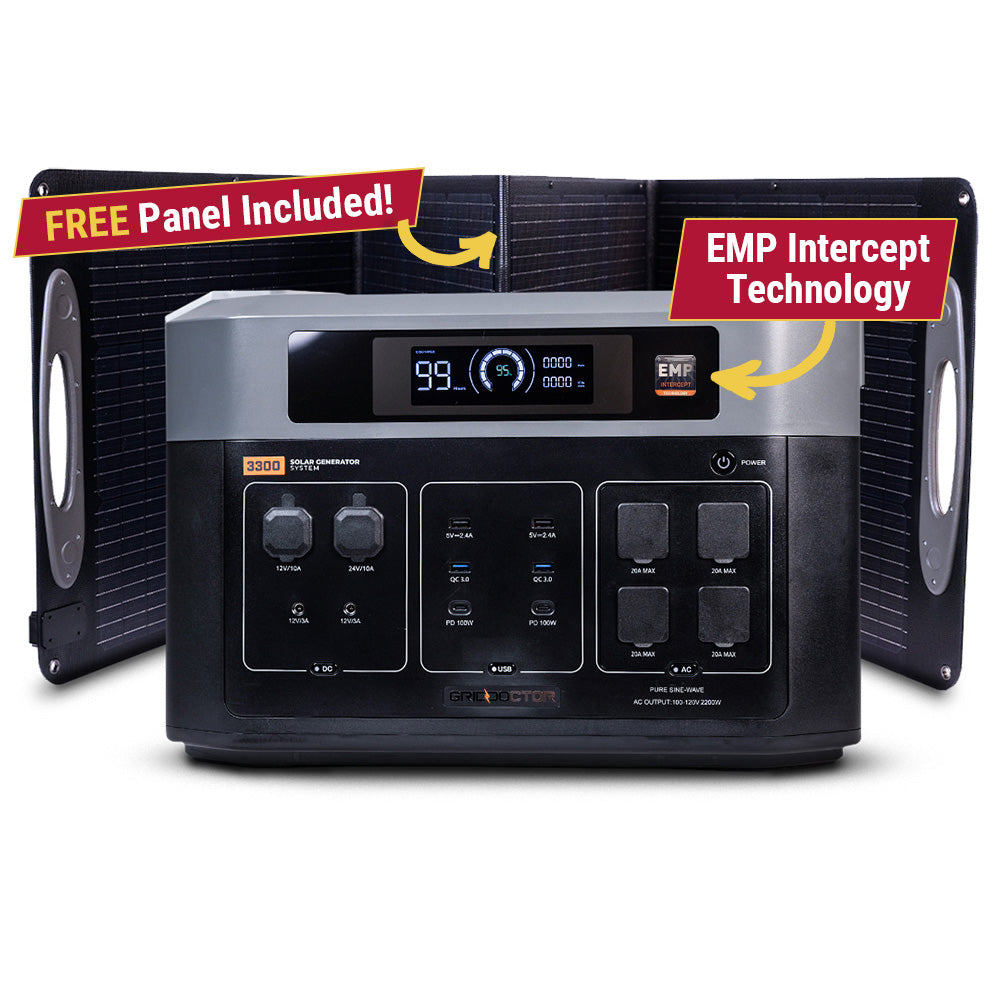
The Grid Doctor 3300 solar generator system sold with EMP shielding, a large portable power station for home backup and off-grid use; check the current spec sheet for details.
Why it's here: Listed with its EMP shielding as a stated feature, not a verified one. Judge it on the power specs first.
The Grid Doctor 3300-watt EMP-shielded solar generator sold through Emergency Essentials, a large power station for home backup and off-grid use; check the current spec sheet.
Why it's here: Listed through a second retailer so availability and pricing on this unit are not down to one storefront.
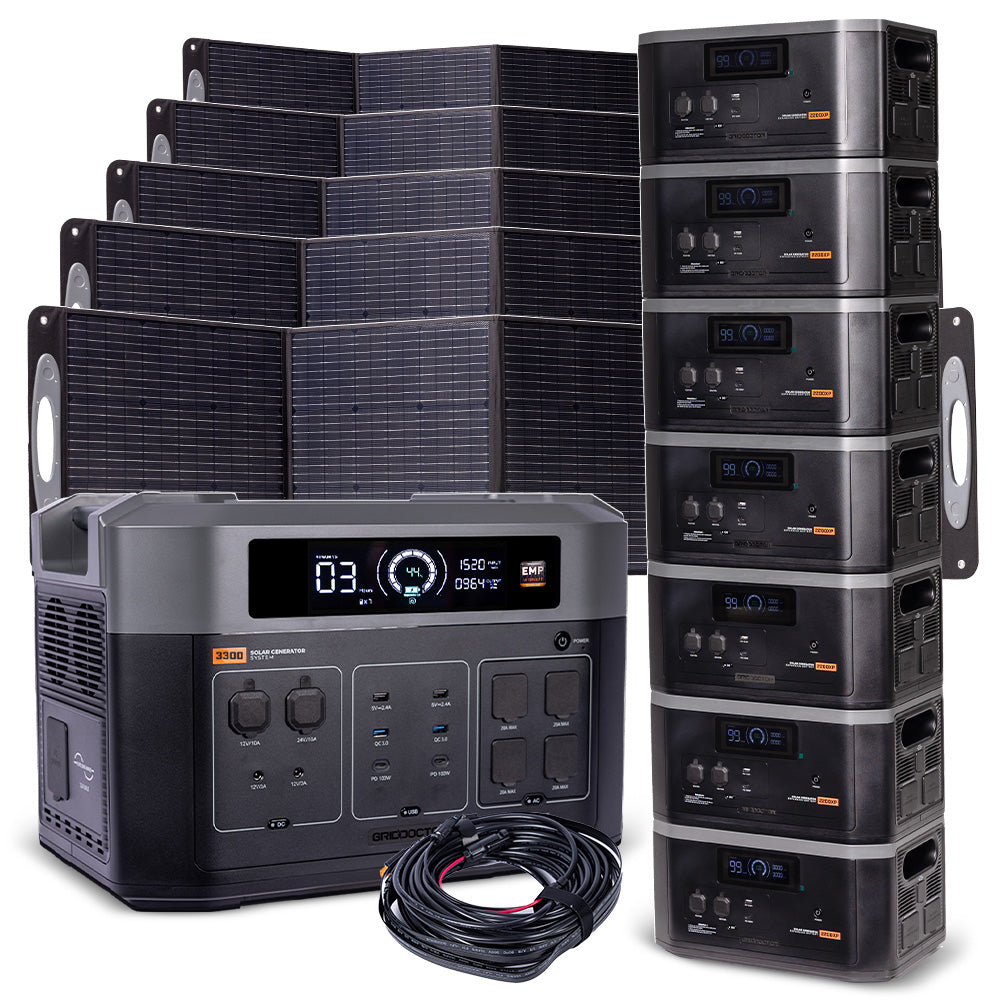
The Grid Doctor 3300 Power Tower, a large portable power station for home backup and off-grid systems; check the current spec sheet for capacity and output details.
Why it's here: Listed so form factor is part of the decision: this capacity class in a shape that stands rather than sits.
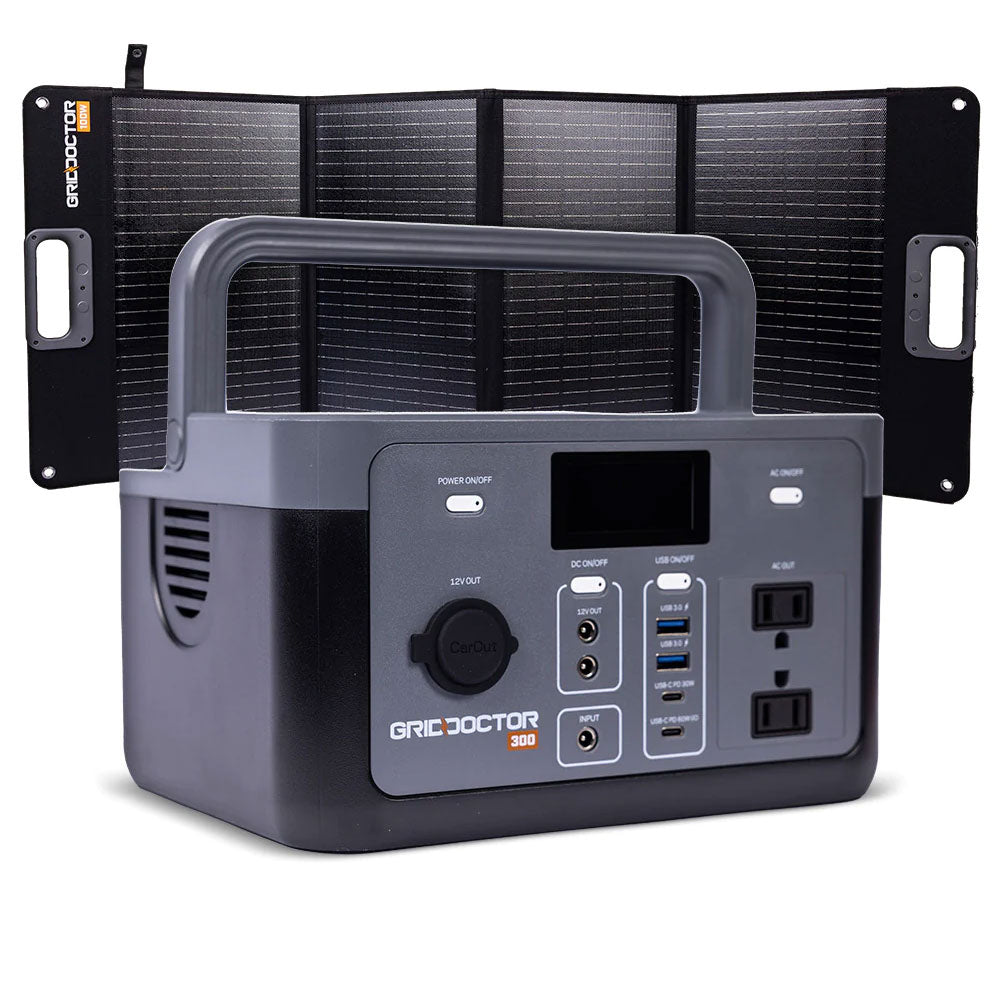
The Grid Doctor 300 solar generator bundled with a 100-watt solar panel, a compact power station for charging small devices; check the current spec sheet for details.
Why it's here: Listed as the small end: phones, lights and a radio, not a fridge. Sizing disappointment usually starts here.
“A large mismatch between the sun's position and the panel's face spreads the same light over more area, so output drops noticeably, and in winter, when the sun sits low and dayligh…” (rewritten to what the article can stand behind)
“The old rule of thumb is to set your tilt angle equal to your latitude for a year-round average, steeper than latitude (add about 15 degrees) to favor winter production, and flatte…” (reasoning shown in the article)
“NREL's solar radiation data and PVWatts calculator, built and maintained by the U.S. Department of Energy, let you plug in your exact coordinates and see modeled output at differen…” (cited → nrel.gov)
“NOAA publishes declination data for any location, and it's worth checking before you set panel orientation by compass alone.” (cited → ngdc.noaa.gov)
“The gain over a single fixed angle can be meaningful, though the real number depends heavily on your latitude, your specific site, and how aggressive your seasonal swing is, so mod…” (rewritten to what the article can stand behind)
“Single-axis and dual-axis trackers can meaningfully boost output, particularly in high-sun climates, but they introduce a motor, a controller, and moving parts exposed to weather, …” (reasoning shown in the article)
“A snow-covered panel produces close to nothing regardless of how well you angled it, so in heavy snow climates, tilt isn't just about sun geometry, it's about keeping the glass cle…” (reasoning shown in the article)
Before you go
One useful off-grid email a week.
Practical gear rundowns, honest how-tos, and plain-English guides from someone doing the homework in the open.
I am building a place for off-grid people to swap real answers: a forum by topic, classifieds for gear and services, and real estate for off-grid land and homes. It is new, so the early members shape what it becomes. A free account lets you post in all three.
Grounding gets skipped on more DIY solar builds than anyone admits. Here's what actually needs a ground rod, why, and how to tell if your system is wired safely.
Signing up with the local volunteer fire department is one of the fastest, most honest ways to become a real neighbor in a rural area. Here's what it actually involves.
A practical, no-nonsense look at what it actually takes to live off the grid, from power and water to food storage, mistakes to avoid, and honest trade-offs.