Plenty of off-grid solar builds start with weeks of agonizing over panel wattage and battery chemistry, and then the charge controller becomes an afterthought, a box you grab off the shelf because it fits the budget. That's backwards. The charge controller is the traffic cop between your panels and your batteries, and picking the wrong one, or wiring the right one incorrectly, can quietly cost you a meaningful share of the power you paid for.
If you've already worked out how much solar you actually need, the charge controller is the next decision that determines whether you actually get that capacity out of your array. Let's get into it.
What a charge controller actually does
Solar panels don't just hand batteries a nice, safe trickle of power. Left alone, a panel's raw voltage would overcharge and cook a battery bank in short order, especially on a bright cold day when panel voltage climbs. The charge controller's job is to take the panel's variable output and turn it into a properly regulated charge, at the right voltage and current, that a battery can actually absorb safely through each stage of charging (bulk, absorption, float).
Get this wrong and you get two failure modes: undercharged batteries that never quite reach full capacity, shortening their working life, or overcharged batteries that boil off electrolyte, warp plates, or in worse cases, vent gas somewhere you don't want it. Neither failure shows up immediately. It shows up eighteen months later when your bank that should be at 80 percent of original capacity is at 50, and you're trying to figure out why.
PWM: simple, cheap, and limited
Pulse Width Modulation controllers are the older, simpler technology. They work by essentially switching the connection between panel and battery on and off rapidly, which pulls the panel's voltage down to match whatever the battery needs at that moment.
The catch is that this only works efficiently when your panel's voltage is already close to your battery bank's voltage. A PWM controller doesn't convert excess voltage into usable current, it just throws it away as waste. If you've got a 12 volt battery bank and a panel rated for around 18 volts open circuit (a typical "12 volt" panel), a PWM controller works reasonably well. But if your panel voltage is much higher than your battery voltage, you lose a real chunk of your potential harvest.
PWM controllers are cheap, rugged, and simple to troubleshoot, which matters when the nearest replacement part is an hour's drive away. For a small cabin, a single fixed array matched carefully to battery voltage, or a bargain-basement backup system, PWM can be the right call. It's also a reasonable choice if you're piecing together a system from used solar gear and want something forgiving of mismatched or older panels.
MPPT: more expensive, more efficient, more flexible
Maximum Power Point Tracking controllers are smarter. They hunt for the voltage and current combination where the panel is producing the most actual watts, then convert that down to whatever your battery bank needs, sacrificing very little in the process. This means you can run panels wired in series at much higher voltage than your battery bank, and the MPPT controller will step that down efficiently rather than wasting it.
This matters more than it sounds like on paper. Higher voltage on the panel side means thinner wire runs from your array to your controller, less voltage drop over distance, and the ability to add panels without hitting current limits on your wiring. If your array sits any real distance from your battery shed, which is common on off-grid parcels where the best sun exposure isn't right next to the cabin, MPPT often pays for itself in copper savings alone.
MPPT controllers also perform meaningfully better in cold weather, when panel voltage rises, and in partial shade or hazy conditions, when they squeeze more usable power out of a weaker signal. If you're dealing with a site where trees, hills, or terrain block direct sun for part of the day, an MPPT controller is doing real work to make the most of the light you do get.
The real-world cost difference
A basic PWM controller for a small system is usually the cheapest item on the list, so check current retail listings before budgeting. A quality MPPT controller sized for a real off-grid cabin costs considerably more, with price rising alongside capacity and brand, so price a few units at your array size. That's a real gap, and for a tight first-year budget it can feel hard to justify.
But run the math over a full system life. If MPPT recovers even 15 to 20 percent more usable power from the same panels, on a 2,000 watt array that's the equivalent of adding 300 to 400 watts of panels for free, every single day the sun shines. Panels themselves aren't cheap either, so in many cases you come out ahead buying fewer panels and a better controller than more panels and a bargain controller. This is exactly the kind of decision worth running through the true payback math on solar before you commit to a shopping list.
When PWM still makes sense
There are legitimate cases for sticking with PWM. A small backup system for a shed, a well pump, or a single-purpose load doesn't need the added complexity. If your panel and battery voltages are already closely matched, and your wire runs are short, the efficiency gap shrinks to the point where it may not be worth the extra cost. And if you're the kind of off-grid household that values field-repairable simplicity over maximum efficiency, particularly somewhere remote where a failed MPPT controller means weeks without full charging until a replacement arrives, a PWM setup with a spare controller on the shelf might genuinely serve you better than a single sophisticated unit with no backup.
Sizing a controller correctly
Whichever type you choose, undersizing the controller is an easy mistake to make when expanding a system. Controllers are rated by maximum current (amps) they can handle, and by maximum input voltage. If you add panels later without checking these numbers, you can push a controller past its rated limits, which either trips a protective shutdown or, in a poorly made unit, causes real damage.
As a practical habit, size your controller with headroom above your current array so you can add panels later without buying a whole new controller. This is especially worth planning for if you expect your power needs to grow, whether that's a well pump, a workshop, or simply because your first estimate of usage turns out to be too conservative.
Wiring considerations that matter
The charge controller doesn't operate in isolation. Fuses or breakers between the panel array and the controller, and between the controller and the battery bank, are not optional extras, they're what keeps a short circuit or a controller failure from becoming a fire. Wire gauge has to be matched to the actual current the array can produce under full sun, not just your average expected output. If you haven't already gone through the specifics of fusing and wire gauge for a solar system, do that alongside your controller selection, not after.
Grounding also matters more than first-time installers may expect. Grounding is there to give fault current and lightning-induced surges a path away from your equipment and you, which is why codes and installers treat it as required rather than optional.
Reading the display and catching problems early
Many modern MPPT controllers, and some PWM units, include a small display or a Bluetooth app showing real-time voltage, current, and daily harvest totals. Get in the habit of checking this regularly, not just when something seems wrong. A sudden drop in daily harvest on a clear day is often the first sign of a failing panel, a loose connection, or a controller starting to lose efficiency, and catching it early is far cheaper than diagnosing a dead battery bank in January.
This kind of routine system-checking fits naturally into the broader habit of walking your property and gear on a regular schedule, the same instinct that serves you well during the first 30 days settling raw land and every season after.
Temperature compensation and battery chemistry
One feature worth checking for, regardless of controller type, is temperature compensation, either built into the controller or through an external sensor placed at the battery bank. Battery charging voltage targets shift with temperature, which is why manufacturers publish temperature compensation figures and why a controller that ignores them can charge too high in heat or too low in cold. This becomes especially important if you're trying to keep a bank alive through a real off-grid winter, where getting the charge profile right through the coldest months makes the difference between a bank that lasts years and one that needs early replacement.
Also confirm your controller supports the specific charge profile for your battery chemistry, whether that's lead-acid, AGM, or lithium (LiFePO4). These chemistries call for different absorption voltages and float behavior, so a controller set to the wrong profile will not charge the bank the way its manufacturer specifies.
The bottom line
There's no universal right answer between PWM and MPPT, but there is a right answer for your specific setup, based on your array size, wire run distance, budget, and how much you value simplicity versus efficiency. Don't let a charge controller be the part of your system you buy last and think about least. It's the piece quietly deciding, every single day, how much of the sun you're paying to capture actually makes it into your batteries.
If you're still working through the broader planning process, our FAQ page covers common questions people ask before committing to a full system, and the blog index has deeper dives on batteries, wiring, and sizing that pair well with this decision. And if something here doesn't match what you're seeing on your own property, our contact page is always open for a real conversation, not a sales pitch.
The rest of the shortlist
Recommended off-grid gear
Affiliate disclosure: Some links on this site are affiliate links, including Amazon links: as an Amazon Associate I earn from qualifying purchases. Buying through one costs you nothing extra, and it never changes what I recommend.
Products appear here only when they match this article's subject. Selection is based on documented specs and owner reports, never on compensation; pages with no relevant gear carry none.
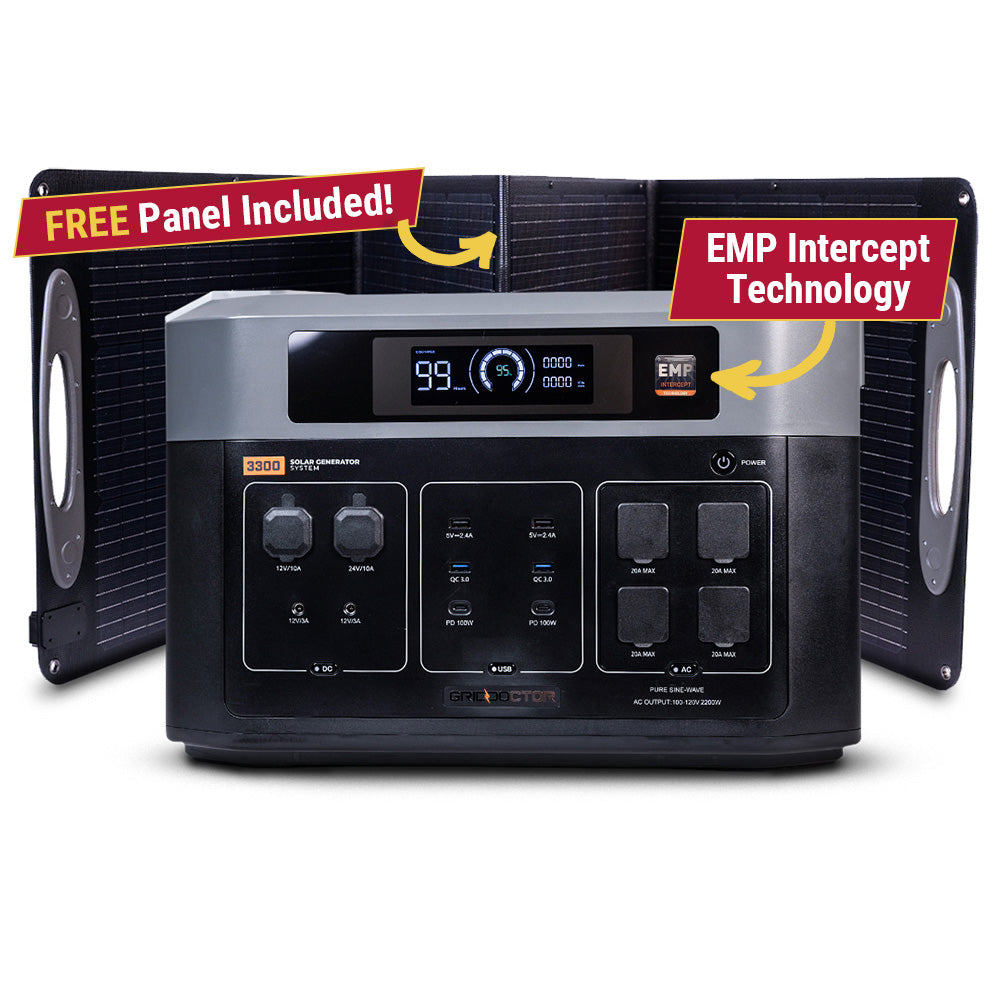
The Grid Doctor 3300 solar generator system sold with EMP shielding, a large portable power station for home backup and off-grid use; check the current spec sheet for details.
Why it's here: Listed with its EMP shielding as a stated feature, not a verified one. Judge it on the power specs first.
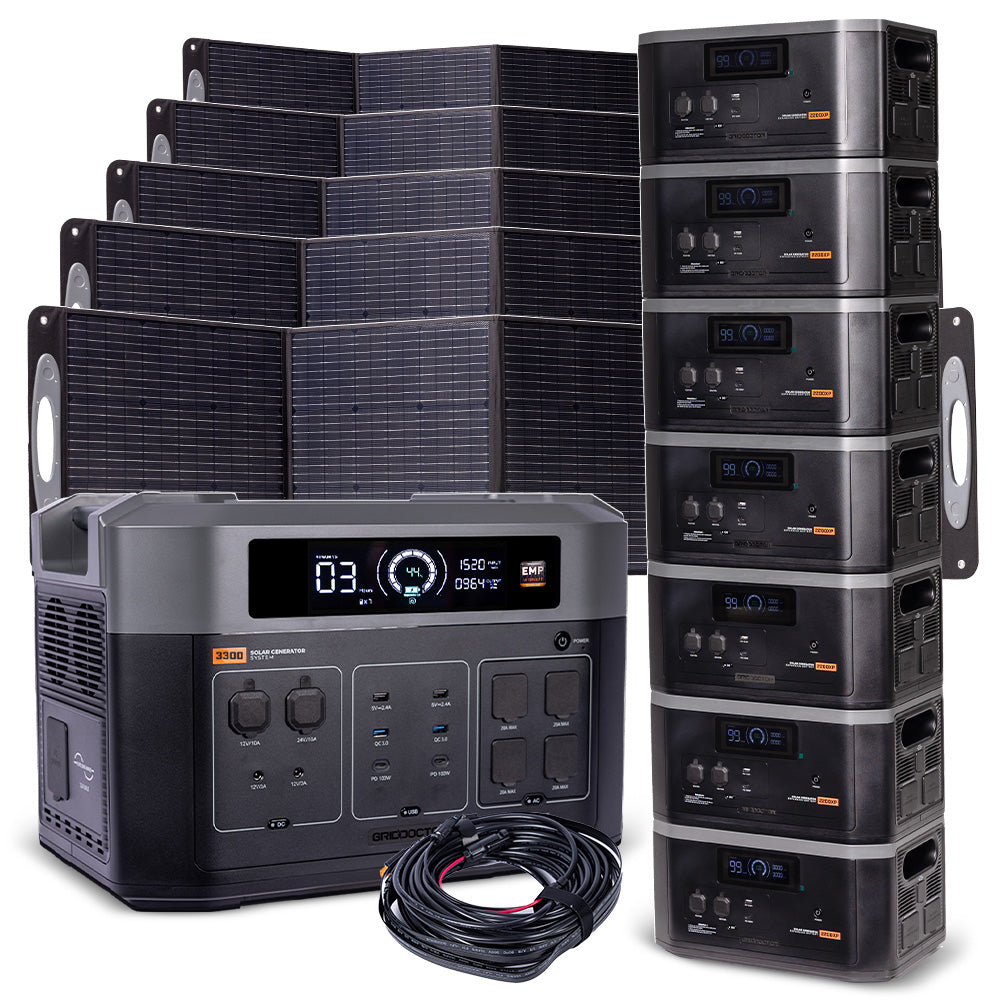
The Grid Doctor 3300 Power Tower, a large portable power station for home backup and off-grid systems; check the current spec sheet for capacity and output details.
Why it's here: Listed so form factor is part of the decision: this capacity class in a shape that stands rather than sits.
Assertion lint: 1 prevalence/consensus statement(s) softened to attributed or mechanism-based wording.
Claim audit: 20 consequential claims checked against the article's sources; unsupported wording revised where it could not be substantiated.
Claim-by-claim audit (20 checked)
“The charge controller is the traffic cop between your panels and your batteries, and picking the wrong one, or wiring the right one incorrectly, can quietly cost you a meaningful s…” (rewritten to what the article can stand behind)
“Left alone, a panel's raw voltage would overcharge and cook a battery bank in short order, especially on a bright cold day when panel voltage climbs.” (cited → victronenergy.com)
“Get this wrong and you get two failure modes: undercharged batteries that never quite reach full capacity, shortening their working life, or overcharged batteries that boil off ele…” (reasoning shown in the article)
“A PWM controller doesn't convert excess voltage into usable current, it just throws it away as waste.” (cited → victronenergy.com)
“They hunt for the voltage and current combination where the panel is producing the most actual watts, then convert that down to whatever your battery bank needs, sacrificing very l…” (cited → victronenergy.com)
“Higher voltage on the panel side means thinner wire runs from your array to your controller, less voltage drop over distance, and the ability to add panels without hitting current …” (reasoning shown in the article)
“MPPT controllers also perform meaningfully better in cold weather, when panel voltage rises, and in partial shade or hazy conditions, when they squeeze more usable power out of a w…” (cited → victronenergy.com)
“A basic PWM controller for a small system is usually the cheapest item on the list, so check current retail listings before budgeting.” (rewritten to what the article can stand behind)
“A quality MPPT controller sized for a real off-grid cabin costs considerably more, with price rising alongside capacity and brand, so price a few units at your array size.” (rewritten to what the article can stand behind)
“If MPPT recovers even 15 to 20 percent more usable power from the same panels, on a 2,000 watt array that's the equivalent of adding 300 to 400 watts of panels for free, every sing…” (reasoning shown in the article)
“Whichever type you choose, undersizing the controller is an easy mistake to make when expanding a system.” (rewritten to what the article can stand behind)
“If you add panels later without checking these numbers, you can push a controller past its rated limits, which either trips a protective shutdown or, in a poorly made unit, causes …” (reasoning shown in the article)
“As a practical habit, size your controller with headroom above your current array so you can add panels later without buying a whole new controller.” (rewritten to what the article can stand behind)
“This is especially worth planning for if you expect your power needs to grow, whether that's a well pump, a workshop, or simply because your first estimate of usage turns out to be…” (rewritten to what the article can stand behind)
“Fuses or breakers between the panel array and the controller, and between the controller and the battery bank, are not optional extras, they're what keeps a short circuit or a cont…” (reasoning shown in the article)
“Grounding is there to give fault current and lightning-induced surges a path away from your equipment and you, which is why codes and installers treat it as required rather than op…” (rewritten to what the article can stand behind)
“Many modern MPPT controllers, and some PWM units, include a small display or a Bluetooth app showing real-time voltage, current, and daily harvest totals.” (rewritten to what the article can stand behind)
“A sudden drop in daily harvest on a clear day is often the first sign of a failing panel, a loose connection, or a controller starting to lose efficiency, and catching it early is …” (reasoning shown in the article)
“Battery charging voltage targets shift with temperature, which is why manufacturers publish temperature compensation figures and why a controller that ignores them can charge too h…” (rewritten to what the article can stand behind)
“These chemistries call for different absorption voltages and float behavior, so a controller set to the wrong profile will not charge the bank the way its manufacturer specifies.” (rewritten to what the article can stand behind)
Before you go
One useful off-grid email a week.
Practical gear rundowns, honest how-tos, and plain-English guides from someone doing the homework in the open.
I am building a place for off-grid people to swap real answers: a forum by topic, classifieds for gear and services, and real estate for off-grid land and homes. It is new, so the early members shape what it becomes. A free account lets you post in all three.
No ER ten minutes away means you have to be your own triage nurse. Here's how to tell a bad bee sting from the real emergency, and what to actually stock.
In many off-grid disasters, the fire or flood itself isn't the decisive factor, it's the hour you waited too long to leave. Here's how to set real, numeric triggers before you need them.
Tax sale and sheriff's auction land looks like a bargain, but redemption periods, hidden liens, and unseen parcels turn a lot of cheap acreage into an expensive lesson. Here's how to vet a listing before you bid.