Somebody at a solar expo or on a forum thread has told you your system will "pay for itself in seven years." Maybe it was a salesman. Maybe it was a neighbor who did the math on a napkin. Either way, the number is almost certainly wrong, not because anyone's lying, but because payback period is one of the most misunderstood numbers in off-grid finance. It hides more than it reveals.
If you're planning an off-grid system, or you already have one and you're wondering whether that next battery bank upgrade is worth the money, you need a better way to think about this than a single magic number. Let's build one.
Why the simple payback formula lies to you
The formula everyone uses looks like this: total system cost divided by annual savings equals years to payback. Spend $18,000 on solar, save $2,500 a year on fuel and utility bills, and you get a 7.2 year payback. Clean, tidy, wrong.
Here's what that formula quietly ignores:
It assumes your savings are the same every year. They're not. Generator fuel prices swing. Propane costs more some winters than others. If you were on a grid-tied plan before going off, utility rates may rise over time, so your "savings" can grow rather than stay flat.
It ignores the cost of money. Eighteen thousand dollars spent today is not the same as eighteen thousand dollars spent over five years. If you financed any part of the system, or if you pulled that cash out of an investment account, the real cost includes what that money could have earned or what interest you're paying on it.
It assumes zero maintenance and zero replacement. Batteries wear out. Inverters die. Panels lose some output as they age, and manufacturer warranties usually spell out how much. A payback number that pretends the system runs forever with no further spending isn't measuring payback, it's measuring fantasy.
It ignores what you were comparing against. Payback against what, exactly? Against staying on grid power (if that was ever an option)? Against running a generator full time? Against doing nothing and hauling water and burning candles? The baseline changes the whole answer.
None of this means solar is a bad investment for off-grid life. It often isn't, because for an off-grid household there may be no cheaper way to make electricity at all, so the comparison isn't solar versus grid power, it's solar versus generator fuel and darkness. But if you want a number you can actually trust, you have to build it yourself, with your own numbers, not a salesman's.
Step one: get honest about what you're actually replacing
Before you can calculate payback, you need to know what you'd be spending if you didn't have solar. For an off-grid household this breaks into two buckets.
Generator fuel and runtime. If you're currently running a generator for several hours a day to cover lights, a fridge, a well pump, and charging, add up your fuel costs across a full year, not just the sunny months. Include oil changes and the wear that eventually means an engine rebuild or replacement. If you haven't kept records, start now, even a rough logbook for two months will get you close enough. This is also a good moment to think about the small engine repair kit that keeps a generator running years longer instead of needing early replacement, because that maintenance cost is part of the real "generator only" baseline you're comparing against.
What you're not doing because you don't have power. This one's sneaky. Maybe you're currently hand washing dishes because you don't want to run a pump and heater off the generator. Maybe you're skipping power tools, running a smaller fridge than you'd like, or timing showers around generator hours. Solar's value isn't just fuel saved, it's quality of life gained, and while you can't put a clean dollar figure on comfort, you can at least be honest that a "payback" calculation based purely on fuel dollars undersells what a bigger, more reliable system is actually worth to you.
Step two: build a realistic annual savings number, not a flat one
Instead of one flat savings figure, sketch out savings for at least five years, adjusting for the things that actually change:
Fuel and propane prices move around and can rise as well as fall, so don't assume today's price holds. Assume some modest annual increase rather than flat pricing.
Generator maintenance and eventual replacement costs are lumpy, not smooth. Budget a large one-time cost every several years rather than pretending it's spread evenly.
If you added solar specifically to reduce generator hours, your fuel savings will be biggest in the first year and may shrink slightly if you also expand your loads (more panels tempts owners to run more things, which is fine, but it eats into the savings side of the ledger).
This is the same discipline that matters when you're working out the real annual cost of self-reliance in general. Off-grid budgets that only track big purchases and ignore the slow bleed of small recurring costs are the ones that blow up in year two or three.
Step three: count the real cost side, including what breaks
The other half of an honest payback calculation is the true cost of the system, not just the sticker price.
Battery banks are a cost that comes up again and again in owner forums as underestimated. Lead-acid batteries are generally sold with much shorter expected service lives than panels, so check the manufacturer's cycle rating. Lithium banks are usually rated for more cycles but are priced higher up front, so compare the spec sheets and quotes you have. Either way, if your payback math doesn't include a battery replacement fund, you're going to hit year eight or nine with a system that "paid for itself" on paper but now needs another five figures to keep running. If you haven't already, it's worth reading through how to keep a solar battery bank alive through a real winter, because the maintenance habits described there directly extend the life of your most expensive component, which directly improves your real payback number.
Inverters and charge controllers carry their own warranty periods, often shorter than panel warranties, and being electronics they are vulnerable to surges and wiring mistakes. This is one more reason that wiring the system safely in the first place isn't just a safety issue, it's a financial one. A fried inverter from an undersized fuse is an unplanned cost that wrecks your payback math just as surely as a bad year of diesel prices.
Panels lose output as they age, so a system sized to exactly meet your needs on day one will fall short years later; check the degradation figure in your panel warranty. That's not a flaw, it's just physics, but it means "payback" should really be measured against a system that's already accounting for its own slow decline.
Step four: pick the comparison that actually applies to you
Your real payback number depends entirely on what you were doing before. Three common scenarios, three very different answers:
You were paying a utility to run a line to remote land. In this case, compare the full cost of a grid extension (poles, trenching, transformer, monthly bills forever) against the full cost of solar plus battery. Grid extension is quoted by the foot, so the further you are from a line the more likely solar comes out cheaper; get an actual utility quote and compare.
You were running a generator as your main power source. This is the most common comparison, and it's the one where fuel costs, maintenance, and noise all matter. Payback here depends heavily on how many hours a day you were actually running that generator before, so run the numbers with your own fuel logs.
You're expanding an existing solar system. This is the trickiest case, because you're not replacing an alternative power source, you're buying comfort and headroom. Adding panels so you can finally run power tools, a chest freezer, or a second fridge doesn't "pay back" in the traditional sense unless you can quantify what you're avoiding (a second generator, spoiled food, trips to town). Be honest with yourself that some solar spending is a lifestyle upgrade, not an investment, and that's a perfectly fine reason to spend money, it just shouldn't be dressed up as a payback calculation.
The sizing question changes the math more than the panels do
One of the biggest levers on your real payback number isn't the price of panels at all, it's whether the system is sized correctly in the first place. A system that's undersized means you're still running a generator as backup, which means you're paying for both fuel and solar and getting the savings of neither fully. A system that's oversized means you spent money on capacity you don't use.
Getting this right starts before you even buy panels, with an honest look at your site. Two nearly identical cabins can have wildly different solar economics depending on tree cover, orientation, and slope, which is exactly why reading a parcel's sun exposure before you buy or build matters so much. A partially shaded site can add years to a payback calculation no spreadsheet will save you from, because no amount of financial modeling fixes a system that isn't producing what it was designed to produce.
Once you know your site's real solar potential, working out how much capacity you actually need, rather than what a salesperson wants to sell you, is the next lever. That's covered in more depth elsewhere on the site if you're still in the sizing phase, but the short version for payback purposes is this: right sized systems have the best economics, because every panel and every battery cell is actually being used rather than sitting as unused headroom you paid for and never needed.
What a healthy payback number actually looks like
For an off-grid household replacing a generator-heavy setup, the realistic payback window varies widely once you account for maintenance, battery replacement, and actual fuel savings, so build the estimate from your own numbers. That's a wide range on purpose, because the honest answer depends on your specific fuel costs, your climate, your load, and how well you take care of the equipment afterward.
What matters more than hitting a specific number is understanding the shape of the calculation: real savings that change over time, real costs that include replacement parts, and a comparison against what you were actually doing before, not an idealized alternative. A system that "pays back" in six years on a salesman's napkin math might actually take ten once you account for a battery bank replacement, and that's fine, as long as you went in with your eyes open rather than being surprised in year seven.
If you're still deciding whether solar makes sense for your situation at all, or you're trying to figure out where your specific numbers might land, the FAQ page covers some of the common sizing and cost questions people ask before committing, and it's worth a read before you sign for a system based on someone else's payback promise.
Money questions like this one are exactly what this site exists to work through in plain language, without the sales pitch. If you've got a specific setup you're trying to evaluate, or a comparison you can't quite make sense of, the contact page is open, and there's a growing archive on the blog covering the financial side of off-grid life alongside the technical side, because the two are never really separate questions.
The rest of the shortlist
Recommended off-grid gear
Affiliate disclosure: Some links on this site are affiliate links, including Amazon links: as an Amazon Associate I earn from qualifying purchases. Buying through one costs you nothing extra, and it never changes what I recommend.
Products appear here only when they match this article's subject. Selection is based on documented specs and owner reports, never on compensation; pages with no relevant gear carry none.
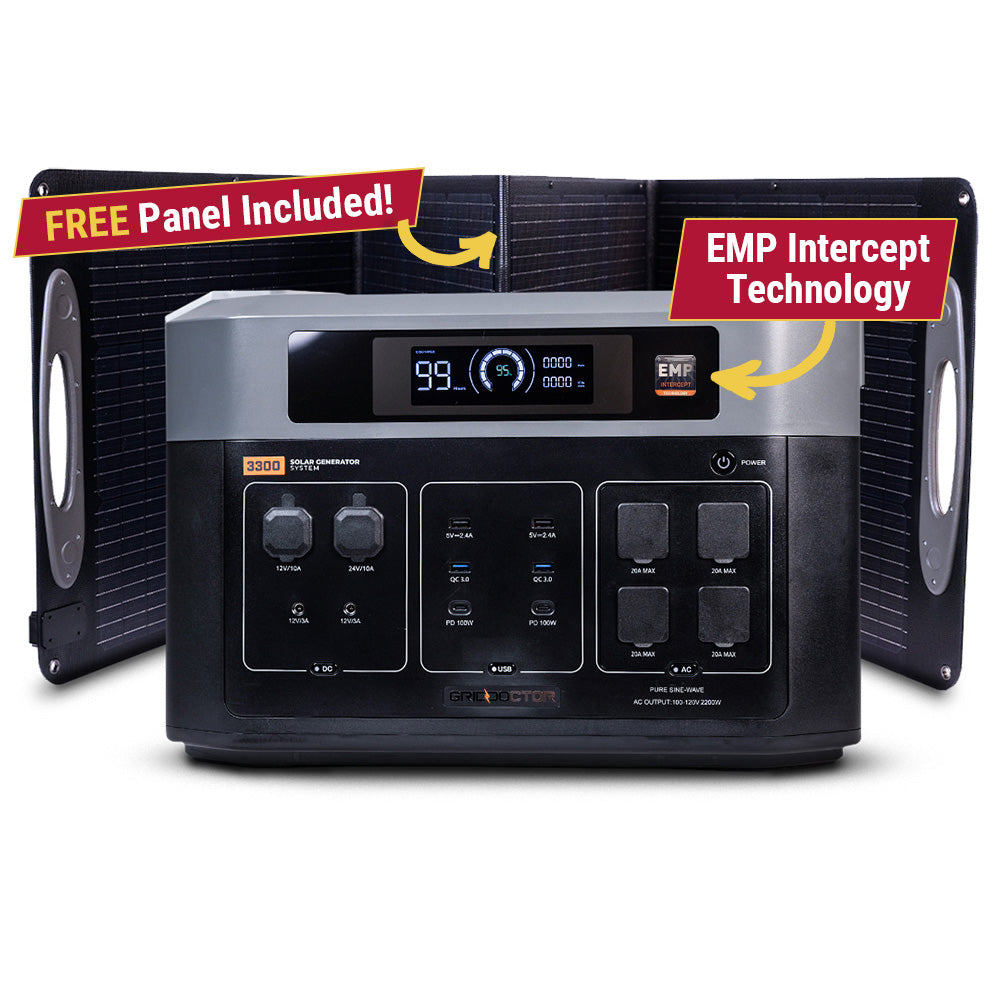
The Grid Doctor 3300 solar generator system sold with EMP shielding, a large portable power station for home backup and off-grid use; check the current spec sheet for details.
Why it's here: Listed with its EMP shielding as a stated feature, not a verified one. Judge it on the power specs first.
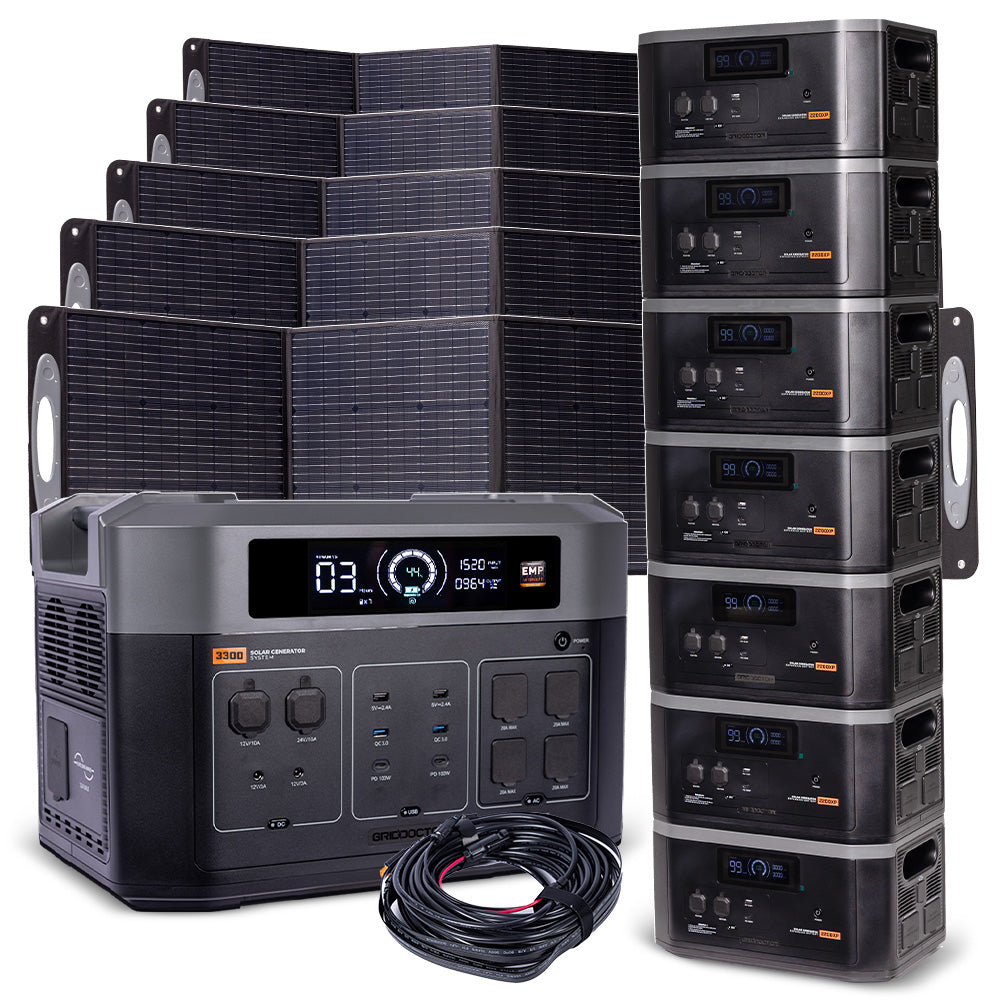
The Grid Doctor 3300 Power Tower, a large portable power station for home backup and off-grid systems; check the current spec sheet for capacity and output details.
Why it's here: Listed so form factor is part of the decision: this capacity class in a shape that stands rather than sits.
The Grid Doctor 3300-watt EMP-shielded solar generator sold through Emergency Essentials, a large power station for home backup and off-grid use; check the current spec sheet.
Why it's here: Listed through a second retailer so availability and pricing on this unit are not down to one storefront.
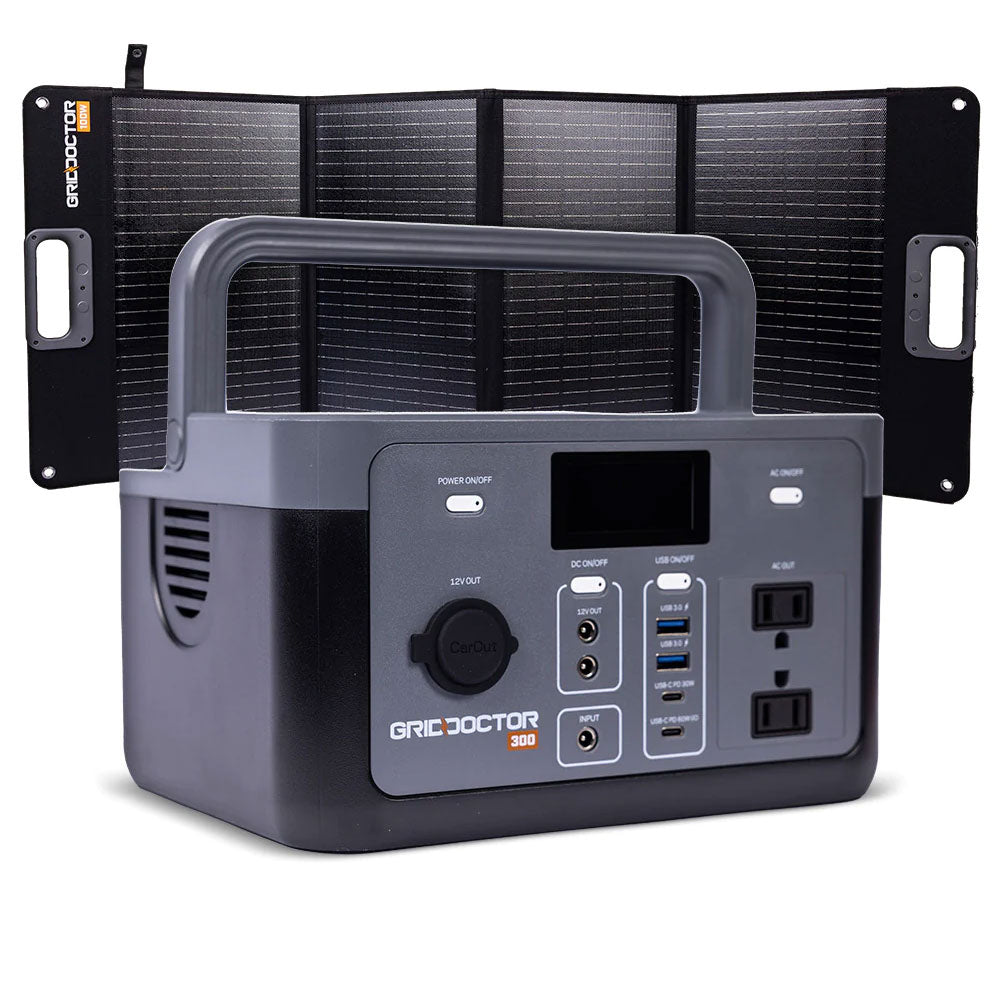
The Grid Doctor 300 solar generator bundled with a 100-watt solar panel, a compact power station for charging small devices; check the current spec sheet for details.
Why it's here: Listed as the small end: phones, lights and a radio, not a fridge. Sizing disappointment usually starts here.
Claim audit: 11 consequential claims checked against the article's sources; unsupported wording revised where it could not be substantiated.
Claim-by-claim audit (11 checked)
“If you were on a grid-tied plan before going off, utility rates may rise over time, so your "savings" can grow rather than stay flat.” (rewritten to what the article can stand behind)
“Panels lose some output as they age, and manufacturer warranties usually spell out how much.” (rewritten to what the article can stand behind)
“Fuel and propane prices move around and can rise as well as fall, so don't assume today's price holds.” (rewritten to what the article can stand behind)
“Lead-acid batteries are generally sold with much shorter expected service lives than panels, so check the manufacturer's cycle rating.” (rewritten to what the article can stand behind)
“Lithium banks are usually rated for more cycles but are priced higher up front, so compare the spec sheets and quotes you have.” (rewritten to what the article can stand behind)
“Inverters and charge controllers carry their own warranty periods, often shorter than panel warranties, and being electronics they are vulnerable to surges and wiring mistakes.” (rewritten to what the article can stand behind)
“Panels lose output as they age, so a system sized to exactly meet your needs on day one will fall short years later; check the degradation figure in your panel warranty.” (rewritten to what the article can stand behind)
“Grid extension is quoted by the foot, so the further you are from a line the more likely solar comes out cheaper; get an actual utility quote and compare.” (rewritten to what the article can stand behind)
“Payback here depends heavily on how many hours a day you were actually running that generator before, so run the numbers with your own fuel logs.” (rewritten to what the article can stand behind)
“For an off-grid household replacing a generator-heavy setup, the realistic payback window varies widely once you account for maintenance, battery replacement, and actual fuel savin…” (rewritten to what the article can stand behind)
“right sized systems have the best economics, because every panel and every battery cell is actually being used rather than sitting as unused headroom you paid for and never needed.” (reasoning shown in the article)
Before you go
One useful off-grid email a week.
Practical gear rundowns, honest how-tos, and plain-English guides from someone doing the homework in the open.
I am building a place for off-grid people to swap real answers: a forum by topic, classifieds for gear and services, and real estate for off-grid land and homes. It is new, so the early members shape what it becomes. A free account lets you post in all three.
No ER ten minutes away means you have to be your own triage nurse. Here's how to tell a bad bee sting from the real emergency, and what to actually stock.
In many off-grid disasters, the fire or flood itself isn't the decisive factor, it's the hour you waited too long to leave. Here's how to set real, numeric triggers before you need them.
Tax sale and sheriff's auction land looks like a bargain, but redemption periods, hidden liens, and unseen parcels turn a lot of cheap acreage into an expensive lesson. Here's how to vet a listing before you bid.