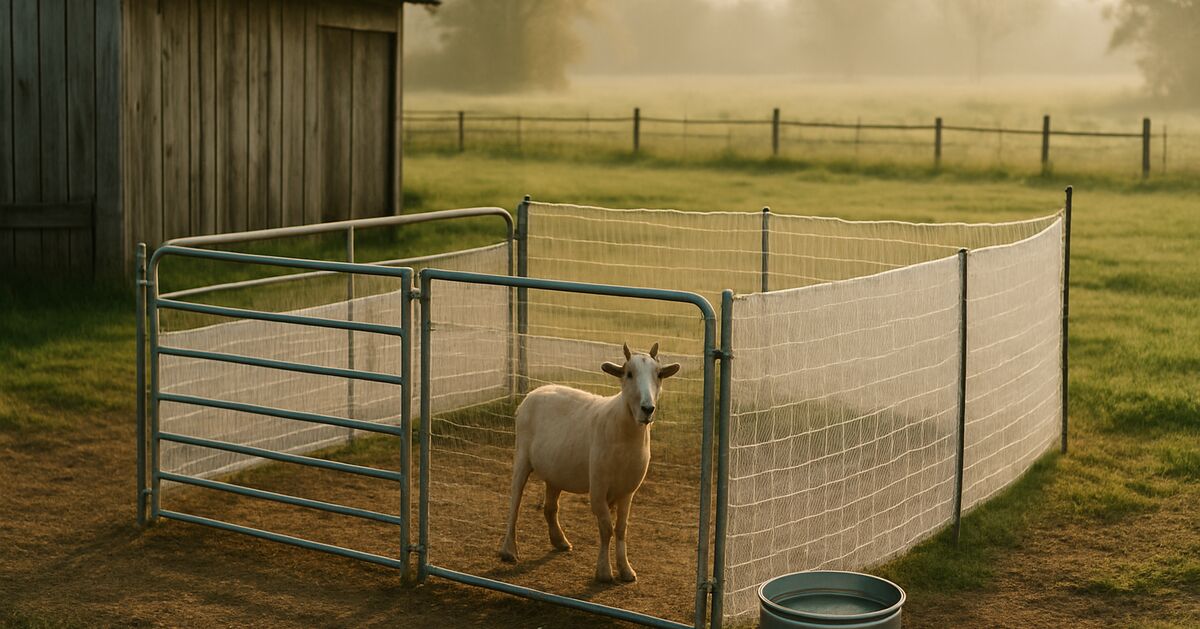
You bring home the animal you have been wanting for months. It looks fine. It walks off the trailer, eats, drinks, seems normal. Three weeks later half your flock is coughing, or your existing goats are scouring, or you find lice on the new arrival and now everyone has them. This is not bad luck. This is what happens when a new animal goes straight into the general population with no quarantine period, and extension guidance treats it as a largely preventable problem.
Quarantine gets skipped, not because people do not know it exists, but because building a second pen feels like a luxury when you already have a fence, a coop, or a barn stall you are itching to use. It is not a luxury. It is cheap insurance against the kind of loss that can wipe out a season of breeding work or a flock you have spent two years building up.
Why "it looked healthy" is not good enough
A lot of serious livestock diseases have an incubation period, meaning the animal can be infected and shedding pathogens before it shows any visible sign of illness. Coccidiosis, internal parasites, respiratory viruses, external parasites like lice and mites, and bacterial infections such as caseous lymphadenitis in goats and sheep can all be present in an animal that looks completely normal at the point of sale.
Sellers are not usually lying to you. Many genuinely believe their stock is healthy because nothing looks wrong. But subclinical infection is common enough in livestock populations that responsible extension programs (Cornell, Purdue, and other land-grant ag schools all publish guidance on this) recommend isolating every new animal regardless of its apparent condition or the seller's reputation. This applies to animals from a livestock auction, a private seller down the road, a 4-H project animal, and arguably even a hatchery order of chicks, since transport stress and a new environment can bring problems along with them.
The other risk people underestimate is the reverse direction: your existing animals can also carry something the newcomer has never been exposed to. Quarantine protects both directions.
What quarantine actually needs to look like
A quarantine pen does not need to be fancy. It needs to be separate enough that pathogens cannot travel between it and your main stock through air, water, shared equipment, or your own boots.
Distance and airflow. For poultry, some respiratory diseases can spread through the air, so airflow between pens is worth thinking about. A separate building, or as much distance as you can manage with no shared airflow, is a sensible target for birds. For goats, sheep, and cattle, a stall or paddock with no nose-to-nose contact through a fence line is the baseline, since many pathogens spread through direct contact and shared feed or water.
Separate equipment. This is an easy part to cut corners on.** The quarantine pen needs its own feed bucket, its own water container, its own shovel or muck fork, and ideally its own boots or boot covers you swap at the gate. If you use the same wheelbarrow for both areas without cleaning it, you have effectively connected the two pens.
A workable water setup. If you are quarantining poultry, something like a Little Giant Galvanized Poultry Waterer dedicated only to that pen is a small purchase that keeps you from grabbing "just this once" from the main coop's supply. Whatever waterer you use, pick one you can scrub out and disinfect easily, which matters when you are cycling new arrivals through regularly.
Timing. For poultry, a few weeks of isolation is a commonly cited window, on the logic that many incubating conditions will show themselves in that time. For goats and sheep, a similar 3 to 4 week period is typical guidance from extension sources, sometimes longer if you are specifically screening for something like CL or Johne's disease, which can take much longer to manifest. Cattle quarantine periods run similarly, though a producer bringing in breeding stock often extends this if bloodwork or testing is part of the plan.
Order of operations for daily chores. Feed, water, and handle your main stock first, then do quarantine animals last, every single day, without exception. This is the single easiest habit to build and the easiest one to let slide once you're busy. If you tend quarantine first and then walk into the main pen with the same boots, you have just carried whatever is on that animal straight to your established stock.
What to actually watch for during the quarantine window
Quarantine is not just about physical separation, it is also your best window to actually observe an animal closely before it is mixed in and harder to monitor individually.
Manure consistency and frequency, since scours or unusually hard stool are often the first visible sign of a parasite load or dietary stress
Appetite and water intake, tracked daily rather than just glanced at
Coughing, nasal or eye discharge, or labored breathing, especially in poultry and small ruminants
Skin and coat condition, checking for lice, mites, or bald patches
Lameness or unusual gait, which can indicate joint infection, hoof rot, or injury from transport
Body condition relative to what the seller told you, since a thin animal on a "great diet" is a red flag worth asking about
If you have the means, a fecal egg count done by a vet or ag extension office during the quarantine window is one of the more useful diagnostic steps for ruminants, since it tells you the parasite load without guessing. It is a small cost relative to the cost of treating an outbreak across your whole herd later.
Fencing the quarantine area without overbuilding
You do not need permanent fencing to run a proper quarantine setup, and in fact a temporary, movable option is often better because it lets you position the pen wherever airflow and distance work best that season. A solar electric fence charger paired with portable netting or a couple of strands of polywire can hold many goats, sheep, and cattle in a temporary spot without trenching wire or setting posts in concrete. It also means the quarantine area is not a permanent fixture eating up ground you would rather use for pasture once you are confident the setup works.
If you are still in the early stages of laying out your property and have not built permanent structures yet, this is worth factoring into how you think about fencing a homestead in stages. A quarantine paddock is one of those "build it before you need it" items, not something to figure out mid-emergency with a sick animal already on the property.
The mistakes that undo a good quarantine plan
Skipping it for "just one" animal. A single new hen, a single new goat, feels low-risk. Disease does not care how many animals came with it.
Quarantining together. If you buy three goats from three different sources, they do not automatically get to share a quarantine pen just because they arrived on the same day. Each source is a separate risk until proven otherwise.
Cutting the window short because the animal seems fine at day 10. Seeming fine is exactly the problem quarantine exists to catch before it is too late.
Forgetting your own hands and clothes. Wash up or change clothes after handling quarantine animals before touching your main stock, the same way you would with sick livestock. This matters even more if you also keep dogs or cats that move between areas, since pathogens do not respect species lines cleanly. It is worth reading up on the crossover risks in our piece on zoonotic and animal-borne illness off-grid if you are new to how these risks travel between species and to people.
No plan for what happens if something does show up. Decide before you bring an animal home what your threshold is for calling a vet, treating on your own, or in the worst case not integrating the animal at all. Waiting to figure this out after symptoms appear costs you time you do not have.
Building this into how you think about the whole homestead
Quarantine discipline is really a subset of a bigger habit: treating your homestead's biosecurity as seriously as you treat its physical security. The same instinct that makes you protect livestock and pets from predators should apply to protecting them from what rides in on four legs looking perfectly healthy. It costs you a little land, a little extra fencing, a little extra chore time each day. It is nothing compared to what a coccidiosis outbreak in a young flock or a CL abscess working through a goat herd will cost you in time, money, and animals you cannot replace.
If you are still deciding what animals to bring onto the property at all, our post on choosing the right first livestock for an off-grid homestead is a good place to start before you get to this stage. And if you are new to the site generally and want a sense of how we approach these tradeoffs, our about page lays out where we are coming from. Questions on quarantine setups or anything else homestead-related are always welcome through our contact page, and our FAQ covers a few of the recurring questions we get on livestock basics.
A quarantine pen will not be the most exciting thing you build this year. It also will not be the thing anyone notices when it works, because nothing goes wrong. That is exactly the point.
Claim audit: 16 consequential claims checked against the article's sources; unsupported wording revised where it could not be substantiated.
Claim-by-claim audit (16 checked)
“This is what happens when a new animal goes straight into the general population with no quarantine period, and extension guidance treats it as a largely preventable problem.” (rewritten to what the article can stand behind)
“A lot of serious livestock diseases have an incubation period, meaning the animal can be infected and shedding pathogens before it shows any visible sign of illness.” (cited → extension.psu.edu)
“Coccidiosis, internal parasites, respiratory viruses, external parasites like lice and mites, and bacterial infections such as caseous lymphadenitis in goats and sheep can all be p…” (cited → extension.psu.edu)
“But subclinical infection is common enough in livestock populations that responsible extension programs (Cornell, Purdue, and other land-grant ag schools all publish guidance on th…” (cited → cals.cornell.edu)
“This applies to animals from a livestock auction, a private seller down the road, a 4-H project animal, and arguably even a hatchery order of chicks, since transport stress and a n…” (rewritten to what the article can stand behind)
“For poultry, some respiratory diseases can spread through the air, so airflow between pens is worth thinking about.” (rewritten to what the article can stand behind)
“A separate building, or as much distance as you can manage with no shared airflow, is a sensible target for birds.” (rewritten to what the article can stand behind)
“For goats, sheep, and cattle, a stall or paddock with no nose-to-nose contact through a fence line is the baseline, since many pathogens spread through direct contact and shared fe…” (reasoning shown in the article)
“This is an easy part to cut corners on.” (rewritten to what the article can stand behind)
“Whatever waterer you use, pick one you can scrub out and disinfect easily, which matters when you are cycling new arrivals through regularly.” (rewritten to what the article can stand behind)
“For poultry, a few weeks of isolation is a commonly cited window, on the logic that many incubating conditions will show themselves in that time.” (rewritten to what the article can stand behind)
“For goats and sheep, a similar 3 to 4 week period is typical guidance from extension sources, sometimes longer if you are specifically screening for something like CL or Johne's di…” (cited → extension.psu.edu)
“If you tend quarantine first and then walk into the main pen with the same boots, you have just carried whatever is on that animal straight to your established stock.” (reasoning shown in the article)
“If you have the means, a fecal egg count done by a vet or ag extension office during the quarantine window is one of the more useful diagnostic steps for ruminants, since it tells …” (cited → aces.edu)
“A solar electric fence charger paired with portable netting or a couple of strands of polywire can hold many goats, sheep, and cattle in a temporary spot without trenching wire or …” (rewritten to what the article can stand behind)
“It is a small cost relative to the cost of treating an outbreak across your whole herd later.” (reasoning shown in the article)
Before you go
One useful off-grid email a week.
Practical gear rundowns, honest how-tos, and plain-English guides from someone doing the homework in the open.
I am building a place for off-grid people to swap real answers: a forum by topic, classifieds for gear and services, and real estate for off-grid land and homes. It is new, so the early members shape what it becomes. A free account lets you post in all three.
No ER ten minutes away means you have to be your own triage nurse. Here's how to tell a bad bee sting from the real emergency, and what to actually stock.
In many off-grid disasters, the fire or flood itself isn't the decisive factor, it's the hour you waited too long to leave. Here's how to set real, numeric triggers before you need them.
Tax sale and sheriff's auction land looks like a bargain, but redemption periods, hidden liens, and unseen parcels turn a lot of cheap acreage into an expensive lesson. Here's how to vet a listing before you bid.