The first winter is usually when an off-grid battery bank gets tested, and it's usually when people discover the gap between "rated capacity" and what a battery actually gives them when the temperature drops and the sun barely clears the tree line for six hours a day. This isn't a problem you solve by buying more panels. It's a problem you solve by understanding what cold does to a battery, what short days do to your charging window, and how to change your habits and your system so you're not chipping away at the bank's lifespan every winter you live out there.
I've spent a lot of time going through manufacturer data sheets, forum threads from people who've actually lived through multiple off-grid winters, and the fine print in battery management system (BMS) manuals, because this is one of those topics where the marketing glosses over real limitations. Here's what actually matters.
Why winter is harder on batteries than summer, even with the same system
Two things stack against you in winter: temperature and daylight. Both hit your battery bank from different angles, and together they can cut your usable power by half or more compared to a summer day, even if your panels are angled perfectly.
Temperature affects both how much energy a battery can accept while charging and how much it can safely deliver. Lead-acid batteries lose a meaningful chunk of their rated capacity as the mercury drops. A flooded or AGM battery rated at a given amp-hour figure at 77°F will deliver noticeably less at freezing, so check your manufacturer's temperature-capacity table for the actual numbers. Lithium (LiFePO4) batteries are worse in one specific way: manufacturer data sheets commonly set a charging floor near freezing (32°F/0°C), citing the risk of permanent internal damage from charging cold cells, so check the spec sheet for your own battery. A lot of newer LiFePO4 batteries have built-in low-temperature charge cutoffs in the BMS for exactly this reason, which is good for safety but means your panels can be producing power your battery simply refuses to accept.
Daylight is the other half of the squeeze. Depending on your latitude, a December day might give you five or six usable sun-hours compared to ten or more in June. Combine a shorter charging window with reduced panel output (snow, low sun angle, more atmosphere for light to pass through) and a system that comfortably covers your loads in July can fall well short in January; a tool like PVWatts will show the month-by-month gap for your site.
If you're still working out your basic sizing, it's worth reviewing how much solar you actually need to live off-grid before layering winter-specific adjustments on top, since your winter demand is really the number that should drive your system size, not your summer average.
What actually happens to lead-acid batteries in the cold
Flooded and AGM lead-acid batteries are more cold-tolerant than lithium in one sense: their data sheets generally allow charging below freezing rather than blocking it outright, though at reduced acceptance. But there are real tradeoffs.
Capacity drops with temperature. As a rough rule, expect noticeably reduced capacity for every significant drop below the battery's rated temperature (usually 77°F/25°C). The exact curve varies by manufacturer, but treat any lead-acid capacity claim as a summer number.
Charging voltage needs to be temperature-compensated. Many good charge controllers and inverter-chargers have a temperature sensor you can attach directly to the battery bank, which raises the charge voltage in cold weather and lowers it in warm weather. Without this, you risk undercharging in winter (voltage set too low for cold conditions) or overcharging in summer.
Cold electrolyte in flooded batteries can freeze if the battery is left in a deep discharge state, because a fully charged flooded battery has electrolyte with a much lower freezing point than a discharged one. A battery sitting at 50 percent state of charge in an unheated shed during a hard freeze is genuinely at risk of physical damage from frozen electrolyte cracking the case.
The practical takeaway is that lead-acid batteries want to stay as close to fully charged as possible through winter, both for performance and for physical survival, and they benefit enormously from being kept somewhere insulated rather than in an open shed or an uninsulated battery box outdoors.
What actually happens to lithium (LiFePO4) batteries in the cold
Lithium iron phosphate is the more forgiving chemistry in most ways: better cycle life, flatter discharge curve, less capacity loss with age. But the cold-charging restriction is a real limitation that a lot of first-time buyers don't fully grasp until they hit their first freeze.
LiFePO4 batteries marketed for off-grid use commonly list a charging temperature floor around 32°F (0°C) on their spec sheets, and some cheaper cells set it higher. Below that, the BMS should stop charging automatically. Discharge temperature limits on these batteries are usually far lower than the charge limit, so you can often still run lights and a pump off a cold lithium bank while being unable to refill it until it warms up; confirm the rated range for your model.
This creates a scenario worth planning for: a string of cold, sunny days where your panels are producing plenty of power, but your batteries won't accept a charge because they're too cold, so all that potential energy is wasted while you slowly drain what's left in the bank running the cold. Some options people use to manage this:
Battery heating pads or heated battery boxes. Several lithium battery manufacturers sell or recommend self-regulating heating pads that draw a small amount of power to keep the battery above the charge threshold. This is the cleanest fix but adds a parasitic load and complexity.
Insulated, semi-conditioned battery enclosures. Keeping the battery bank inside the living space, or in an insulated closet that gets some residual heat, avoids the problem entirely for many small cabins. This is often simpler than it sounds if you're already thinking about how you're insulating an off-grid cabin so it holds heat, since the same principles apply to a small battery closet.
Oversizing the bank so a few unproductive days don't matter. If your battery bank has enough reserve capacity to coast through several cold, low-charge days without dropping to a critically low state, occasional charge interruptions are a lot less stressful.
Whatever you choose, do not assume a lithium battery will "figure it out." A BMS that refuses to charge below its temperature floor is doing its job correctly. The fix has to happen on your end, either by warming the battery or by physically locating it somewhere that doesn't get that cold in the first place.
Sizing your winter reserve, not your summer average
A common and costly mistake in off-grid solar planning is sizing the system around an annual average instead of the worst realistic stretch. A week of overcast, short winter days with a lithium bank that won't charge below freezing is a completely different scenario than a sunny July afternoon, and your system needs to survive both.
A few practical steps:
Calculate your daily load in watt-hours for winter specifically, not annually. Space heating aside (that's usually wood or propane, covered elsewhere), think about lighting (more hours of darkness), any pump or well equipment, communications gear, and anything else running daily.
Build in several days of "autonomy," meaning battery capacity that can cover your loads with zero solar input, because multi-day snow or fog events happen. Pick an autonomy target you can defend for your own site and load, and size the bank so a multi-day no-sun stretch does not push it to a critically low state.
Oversize your panel array beyond what a simple summer calculation suggests, since winter sun-hours and panel efficiency losses from cold, snow cover, and low angle can cut effective production dramatically. Many off-grid planners aim for panel capacity that would look like overkill in summer, specifically because winter performance is so much lower per panel.
Consider a generator or other backup charging source as a genuine part of the system, not just an emergency backup. Plan on running a small generator during low-sun stretches to keep the bank topped up, and build that fuel into your budget from the start rather than assuming solar alone will carry you.
If you're still assembling the physical system, pairing this planning with a careful look at wiring an off-grid solar system safely will help make sure your fusing and wire gauge choices hold up under the higher charge currents a cold-compensated system can call for.
Snow, panel angle, and the problem nobody plans for
Snow-covered panels produce essentially nothing, and in a heavy snow year that can mean multiple consecutive days of near-zero solar input even when the underlying weather clears up, because the panels are simply buried. A steep panel mounting angle, closer to vertical than a summer setup would use, helps snow slide off on its own, and this is one of the few places where a "wrong for summer" angle is actually right for winter performance. Some off-grid setups use an adjustable rack specifically so the angle can be steepened for the winter months.
Physically clearing snow off panels with a soft roof rake or broom is common practice, but it needs to be done carefully. Panel glass and cells can be damaged by a metal-edged tool or hard scraping, and any crack or scratch that blocks light will cut output, so clear snow gently. A soft-bristle brush or a squeegee-style tool made for the job is worth the small cost.
Monitoring matters more in winter than any other season
A battery monitor that tracks actual state of charge (not just voltage, which is a poor proxy under load) becomes essential in winter, because the margin for error shrinks. Voltage alone can be misleading, especially under load or right after charging, so a shunt-based monitor that tracks amp-hours in and out gives a far more honest picture of where the bank actually stands. Watching that number daily through winter lets you catch a slow decline before it becomes a crisis, and it's the kind of habit that separates people who sail through their first winter from people who end up with a dead bank in February wondering what happened.
When to just add a generator or accept propane backup
There's no shame in running a generator through the darkest stretch of winter. A lot of experienced off-grid households treat solar as the primary summer and shoulder-season power source, and treat a generator (or in some cases a small wind turbine, where the site suits it) as a legitimate winter supplement rather than a failure of the solar design. Trying to size a pure solar system to cover the worst week of the darkest month of the year, with zero other backup, usually means paying for a wildly oversized array that sits underused for eight months of the year. A modest generator, a few jerry cans of stabilized fuel, and a clear plan for when to run it is often the more honest and more affordable answer.
If any of this is still new territory, it's worth spending time in my broader start-here gear guides before buying equipment, since battery chemistry, charge controller features, and temperature sensors all need to work together rather than being picked separately. And if you want to think through this alongside your specific site, latitude, and climate, reach out through the contact page; winter power planning is genuinely one of the most site-specific parts of going off-grid, and generic advice only gets you so far.
Whatever chemistry and system size you land on, plan for winter as its own season with its own rules, not a smaller version of summer. The batteries, the daylight, and your own habits all behave differently once the temperature drops, and respecting that difference is what keeps the lights on through February instead of just through October.
The rest of the shortlist
Recommended off-grid gear
Affiliate disclosure: Some links on this site are affiliate links, including Amazon links: as an Amazon Associate I earn from qualifying purchases. Buying through one costs you nothing extra, and it never changes what I recommend.
Products appear here only when they match this article's subject. Selection is based on documented specs and owner reports, never on compensation; pages with no relevant gear carry none.
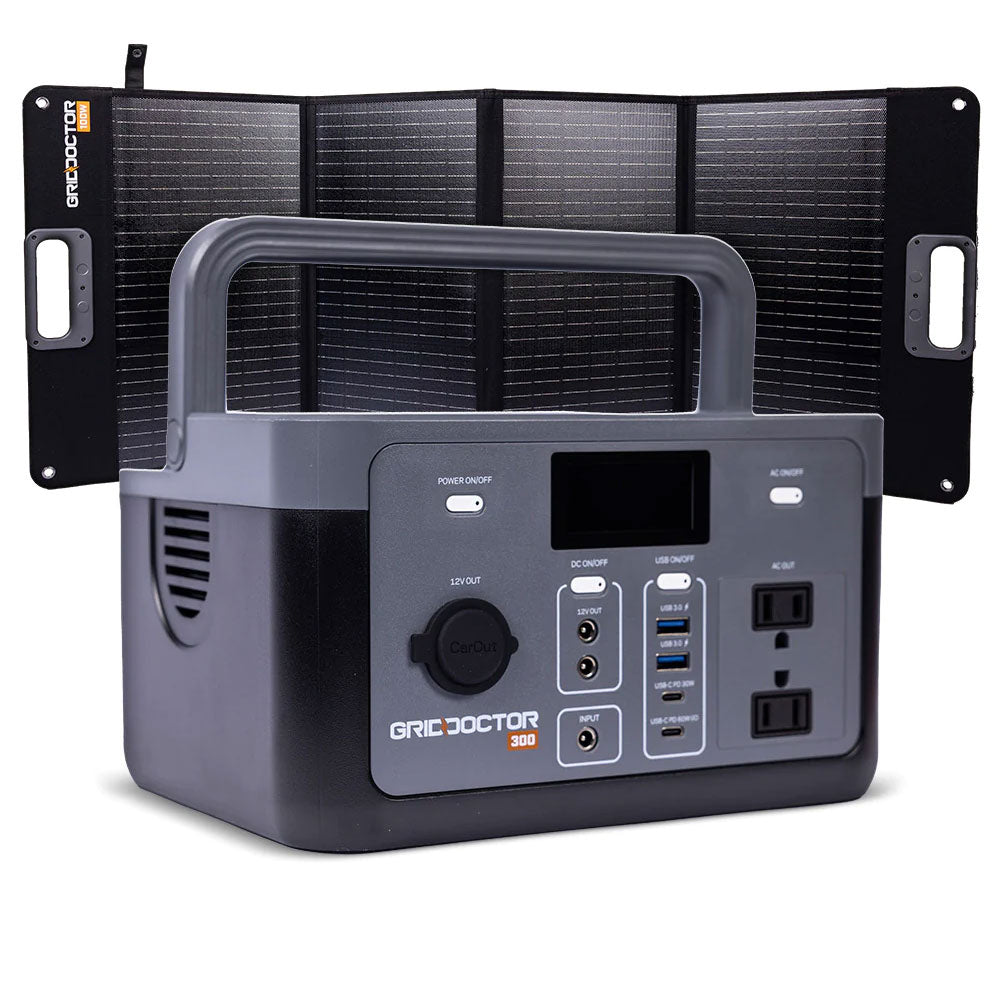
The Grid Doctor 300 solar generator bundled with a 100-watt solar panel, a compact power station for charging small devices; check the current spec sheet for details.
Why it's here: Listed as the small end: phones, lights and a radio, not a fridge. Sizing disappointment usually starts here.
The Grid Doctor 300 solar generator sold through Emergency Essentials, a compact power station for charging phones, lights and small devices; check the current spec sheet.
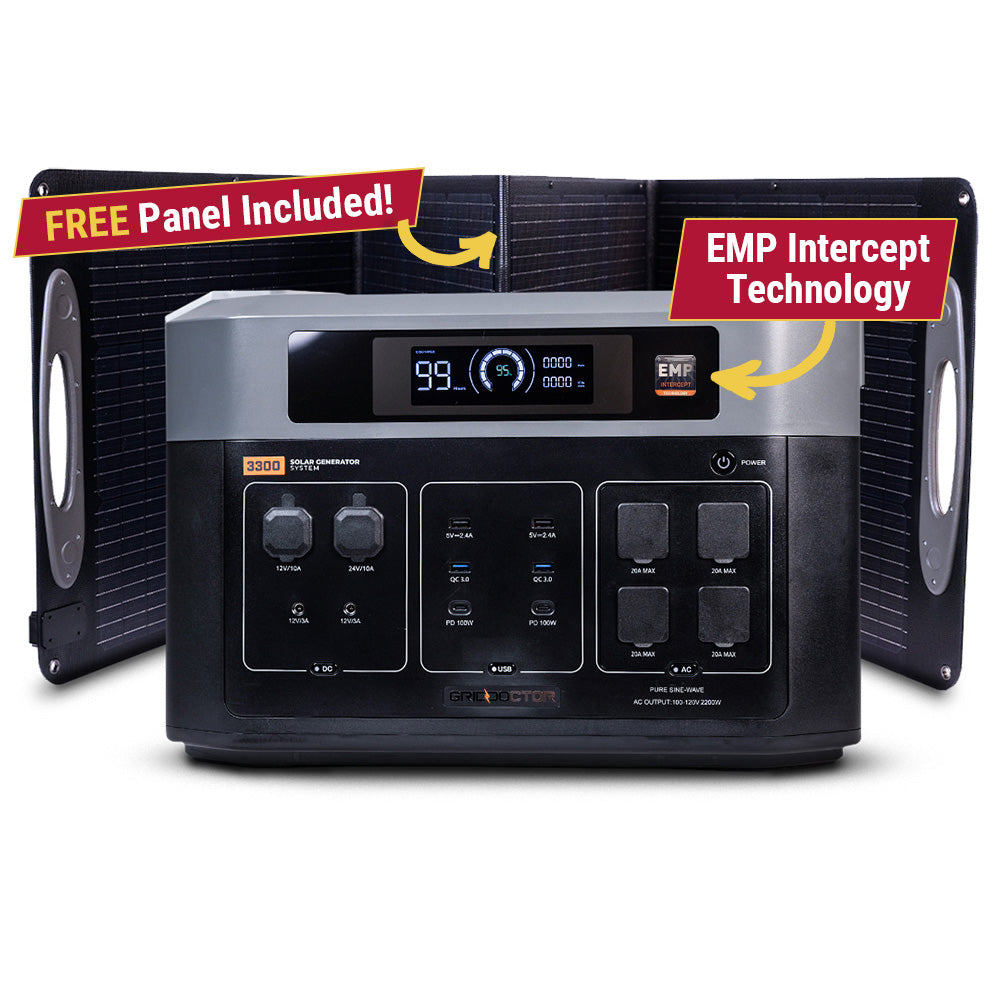
The Grid Doctor 3300 solar generator system sold with EMP shielding, a large portable power station for home backup and off-grid use; check the current spec sheet for details.
Why it's here: Listed with its EMP shielding as a stated feature, not a verified one. Judge it on the power specs first.
Claim audit: 17 consequential claims checked against the article's sources; unsupported wording revised where it could not be substantiated.
Claim-by-claim audit (17 checked)
“A flooded or AGM battery rated at a given amp-hour figure at 77°F will deliver noticeably less at freezing, so check your manufacturer's temperature-capacity table for the actual n…” (rewritten to what the article can stand behind)
“Lithium (LiFePO4) batteries are worse in one specific way: manufacturer data sheets commonly set a charging floor near freezing (32°F/0°C), citing the risk of permanent internal da…” (rewritten to what the article can stand behind)
“Depending on your latitude, a December day might give you five or six usable sun-hours compared to ten or more in June.” (cited → pvwatts.nlr.gov)
“Combine a shorter charging window with reduced panel output (snow, low sun angle, more atmosphere for light to pass through) and a system that comfortably covers your loads in July…” (rewritten to what the article can stand behind)
“Flooded and AGM lead-acid batteries are more cold-tolerant than lithium in one sense: their data sheets generally allow charging below freezing rather than blocking it outright, th…” (rewritten to what the article can stand behind)
“Cold electrolyte in flooded batteries can freeze if the battery is left in a deep discharge state, because a fully charged flooded battery has electrolyte with a much lower freezin…” (reasoning shown in the article)
“A battery sitting at 50 percent state of charge in an unheated shed during a hard freeze is genuinely at risk of physical damage from frozen electrolyte cracking the case.” (reasoning shown in the article)
“Lithium iron phosphate is the more forgiving chemistry in most ways: better cycle life, flatter discharge curve, less capacity loss with age.” (cited → nlr.gov)
“LiFePO4 batteries marketed for off-grid use commonly list a charging temperature floor around 32°F (0°C) on their spec sheets, and some cheaper cells set it higher.” (rewritten to what the article can stand behind)
“Discharge temperature limits on these batteries are usually far lower than the charge limit, so you can often still run lights and a pump off a cold lithium bank while being unable…” (rewritten to what the article can stand behind)
“A common and costly mistake in off-grid solar planning is sizing the system around an annual average instead of the worst realistic stretch.” (rewritten to what the article can stand behind)
“Pick an autonomy target you can defend for your own site and load, and size the bank so a multi-day no-sun stretch does not push it to a critically low state.” (rewritten to what the article can stand behind)
“Plan on running a small generator during low-sun stretches to keep the bank topped up, and build that fuel into your budget from the start rather than assuming solar alone will car…” (rewritten to what the article can stand behind)
“Snow-covered panels produce essentially nothing, and in a heavy snow year that can mean multiple consecutive days of near-zero solar input even when the underlying weather clears u…” (reasoning shown in the article)
“Panel glass and cells can be damaged by a metal-edged tool or hard scraping, and any crack or scratch that blocks light will cut output, so clear snow gently.” (rewritten to what the article can stand behind)
“A battery monitor that tracks actual state of charge (not just voltage, which is a poor proxy under load) becomes essential in winter, because the margin for error shrinks.” (reasoning shown in the article)
“Trying to size a pure solar system to cover the worst week of the darkest month of the year, with zero other backup, usually means paying for a wildly oversized array that sits und…” (reasoning shown in the article)
Before you go
One useful off-grid email a week.
Practical gear rundowns, honest how-tos, and plain-English guides from someone doing the homework in the open.
I am building a place for off-grid people to swap real answers: a forum by topic, classifieds for gear and services, and real estate for off-grid land and homes. It is new, so the early members shape what it becomes. A free account lets you post in all three.
No ER ten minutes away means you have to be your own triage nurse. Here's how to tell a bad bee sting from the real emergency, and what to actually stock.
In many off-grid disasters, the fire or flood itself isn't the decisive factor, it's the hour you waited too long to leave. Here's how to set real, numeric triggers before you need them.
Tax sale and sheriff's auction land looks like a bargain, but redemption periods, hidden liens, and unseen parcels turn a lot of cheap acreage into an expensive lesson. Here's how to vet a listing before you bid.