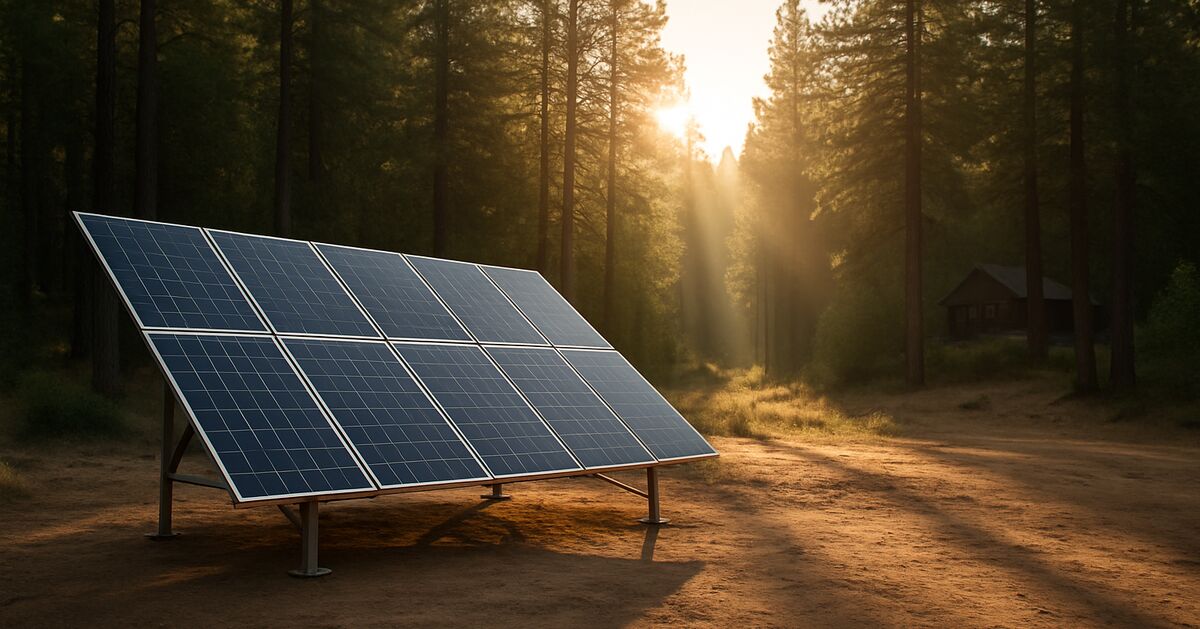
Most solar advice assumes you've got a wide open south-facing slope with nothing between your panels and the sky. Real parcels are rarely that generous. You've got a ridge blocking the morning sun, a stand of oaks you don't want to cut, a valley that fogs in until ten a.m., or a roof pitch that faces the wrong direction because that's just how the cabin got built. If that's your situation, you're not doing solar wrong. You're doing solar on a harder site, and there's a real difference between the two.
This isn't about pretending shade doesn't matter. It does, and no amount of clever wiring turns a shaded panel into a full-output one. But there are honest workarounds that can take a mediocre site from "barely limping through winter" to "actually reliable," and knowing which ones apply to your land will save you money and disappointment.
Why shade hurts more than people expect
A single panel that's 30 percent shaded doesn't just lose 30 percent of its output. Depending on how your array is wired, one shaded panel can drag down the output of an entire string, because in a traditional series string the current is limited by the weakest link. In our experience this is one of the most commonly misunderstood points in backyard solar. People see a small shadow from a chimney or a branch and assume it's a minor loss. In a series-wired string it can gut half your array's production for the hours that shadow sits there.
This matters most in the shoulder seasons and winter, when the sun sits low in the sky and shadows stretch long even from objects that don't bother you in July. A tree that clears your panels easily at the summer solstice can shade them for hours in December, right when you need every watt.
Start with an honest site read
Before you buy a single panel, walk your site with a sun path idea in your head, not just a guess. A basic tool like a solar pathfinder app on your phone, or even a cheap physical sun path chart held up at panel height, will show you exactly when and how much shade hits your proposed array location across the whole year, not just today. Do this in more than one season if you can, because a site that looks clear in August can be a shadowbox in January.
If you're still shopping for land, this is worth doing before you commit. It ties directly into reading a parcel's sun and slope, which is exactly the kind of homework that prevents a bad purchase. If you already own the land and the shade is what it is, the rest of this article is for you.
Option one: split your array instead of one big string
If part of your roof or clearing gets full sun and another part gets partial shade at different times of day, don't wire them as one series string. Split the array into separate strings or even separate charge controllers, one for the clear zone and one for the compromised zone. This way a shaded section drags down only itself, not your whole system.
This is a case where spending a bit more on a second charge controller, or a controller that supports multiple independent inputs, actually pays for itself. It's also a good moment to revisit how your wiring is actually protected, because splitting strings means more junctions, more fuses, and more chances to get gauge or breaker sizing wrong. If you haven't already, read through the basics of fusing and wire gauge before you start adding branches to your array.
Option two: microinverters or power optimizers, if you're running AC-coupled
For grid-tied and some hybrid off-grid setups, microinverters or DC power optimizers attached to each individual panel let every panel produce independently of its neighbors. A shaded panel loses its own output but doesn't touch the others. Per-panel electronics generally add cost and more parts that can fail, so they are not automatically the right call for a simple 12 or 24 volt cabin system. But if your site has patchy, moving shade throughout the day rather than one predictable dead zone, per-panel optimization can be the difference between a system that works and one that never quite gets there.
Option three: go vertical or use pole mounts to chase gaps in the canopy
Panels don't have to lie flat on a roof. A pole mount or ground rack lets you place panels in the one genuine gap in your tree line, even if that gap isn't anywhere near the cabin. An extra 50 or 100 feet of properly sized wire is often cheaper than living with a permanently shaded roof array, though you should price the wire and check voltage drop first. Vertical or steeply tilted mounts also shed snow better in winter, which matters if you're in a climate where a flat roof array gets buried for days at a time.
This is also where a two-axis or even simple seasonal tilt adjustment earns its keep on a shaded site. Because you're already fighting for every hour of clear sun, squeezing more out of the hours you do get by tilting toward the winter sun angle is worth the twice-a-year effort of loosening a few bolts.
Option four: oversize the array rather than fight the shade
Sometimes the honest answer is that you can't engineer your way out of shade, you just have to buy more panel to compensate. If your realistic clear-sun window is four hours instead of six, you may simply need 50 percent more rated wattage to hit the same daily production. This isn't glamorous advice, but with panel prices where they are it can be worth pricing against more complex wiring schemes before you commit. Before you do this, though, make sure you actually understand your daily watt-hour needs. Oversizing blindly is how people end up with panels they didn't need, which is its own kind of waste. If you haven't run those numbers yet, it's worth reading through how much solar you actually need to live off-grid before you start throwing extra panels at a shade problem.
Option five: accept a hybrid system and lean on a generator for the worst stretches
Not every shaded or fog-prone site can be fully solved by solar alone, and that's fine. A realistic plan for a genuinely hard site includes a backup generator sized for your worst week, not your average week. This is especially true if you're in a valley that fogs in for days at a time or get long stretches of overcast winter weather on top of the shade problem. Treat the generator as insurance for a small share of your yearly power needs rather than as your daily driver, since running it only in the weak season burns less fuel than leaning on it year round.
The trade-offs nobody likes to say out loud
Every one of these fixes costs something, either money, complexity, or maintenance. Split strings and multiple controllers mean more wiring to inspect and more failure points. Microinverters mean electronics living outside in the weather. Pole mounts mean trenching wire runs and dealing with voltage drop over distance. Oversizing means a bigger upfront cost and more roof or ground space. None of these are free lunches, and anyone who tells you otherwise is selling you something.
The real skill in a shaded or low-sun-window property isn't finding a magic fix. It's being honest about which trade-off you can live with, and building in enough margin that a string of foggy days doesn't turn into a genuine emergency. This is the same mindset behind a proper shakedown period before you fully commit to a system, since a shaded site is exactly the kind of thing that only reveals its full personality after a few real seasons.
Don't skip the boring maintenance side
Shaded and marginal sites punish sloppy maintenance harder than wide-open ones, because you have less margin to begin with. A layer of dust, pollen, or a light dusting of snow that a well-sited array shrugs off can be the deciding factor between "enough power" and "brownout" on a site that's already fighting for every watt. Get in the habit of a quick visual check on your panels every week or two during the shoulder seasons, and keep your battery bank happy through the low-production months, because a marginal solar input makes battery health even more important than usual, not less.
When it's time to bring in real engineering help
If you've read this far and you're still not sure whether your site can be made to work with solar at all, that's a legitimate question, and it's worth getting a second opinion from someone who actually understands shade analysis and array design, not just someone who sells panels. Some installers will run a real shade study for a property before you buy equipment, and it is worth asking what that costs compared to guessing. It's also worth browsing more of the practical system-design writing on this site's blog, since sizing, voltage choice, and wiring safety all interact with how you handle a shade problem, and getting one piece wrong tends to expose weaknesses in the others.
Shade doesn't mean solar is off the table. It means you need to design around reality instead of around a brochure photo of a sunny rooftop. Do the honest site read, pick the workaround that matches your actual shade pattern, size your backup for your worst week, and you can still build a system that gets you through the year without surprises.
Working out what your site can actually deliver
Before spending anything on a workaround, get the number your site starts from. The worst-month peak sun hours for your location, rather than the annual average, is what decides whether an array meets a load list in the season that matters, and the two figures can differ by roughly half in much of the country. The site report gives both for any address, alongside the heating degree days and design low that shape the rest of the design.
Then work the array from a real load list rather than from a guess, because reducing a load is always cheaper than generating and storing the energy to serve it. Lesson four of the free course covers building that list properly, and the solar calculator runs the arithmetic with your own numbers and shows its working.
If shading is severe enough that a workaround will not close the gap, the honest answer is usually a generator with its fuel budget stated, or a smaller load list. The generator calculator matches a machine to the bank it would be charging, and the system planner sizes the whole design at once so the components are chosen against each other rather than one at a time.
The rest of the shortlist
Recommended off-grid gear
Affiliate disclosure: Some links on this site are affiliate links, including Amazon links: as an Amazon Associate I earn from qualifying purchases. Buying through one costs you nothing extra, and it never changes what I recommend.
Products appear here only when they match this article's subject. Selection is based on documented specs and owner reports, never on compensation; pages with no relevant gear carry none.
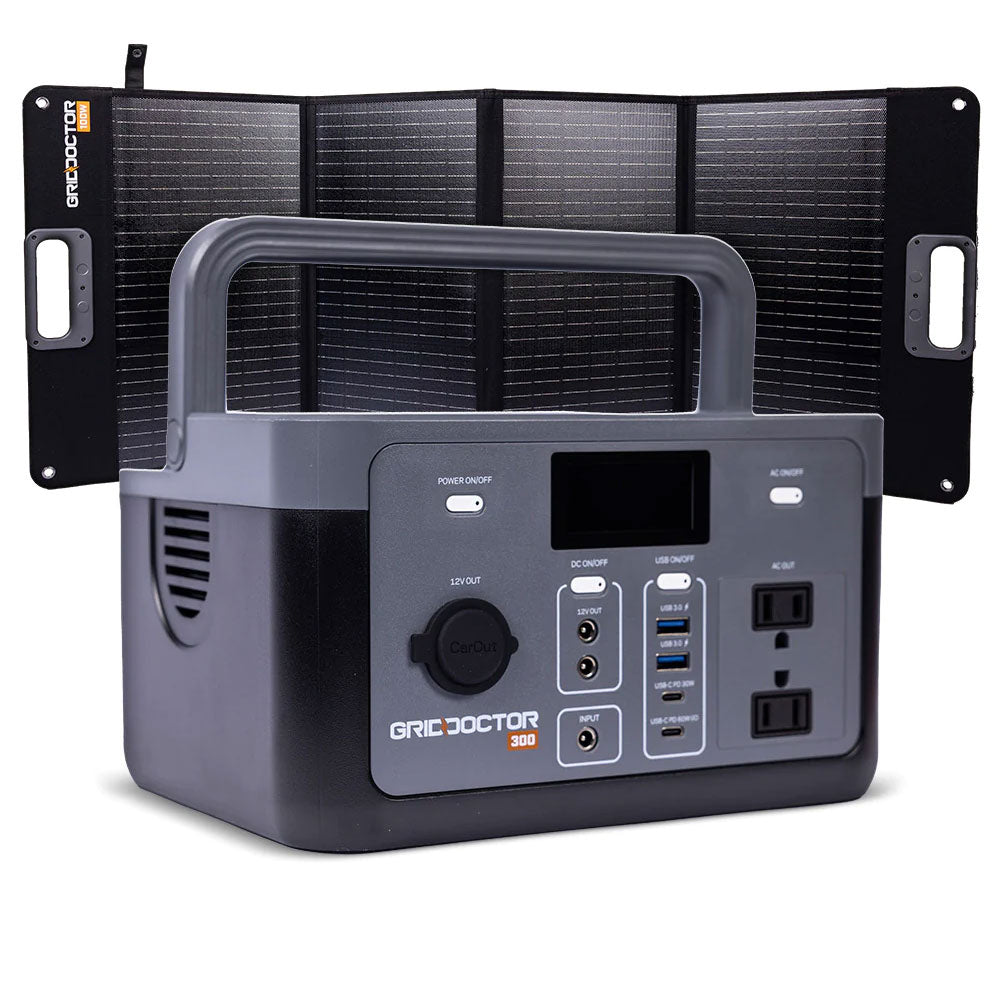
The Grid Doctor 300 solar generator bundled with a 100-watt solar panel, a compact power station for charging small devices; check the current spec sheet for details.
Why it's here: Listed as the small end: phones, lights and a radio, not a fridge. Sizing disappointment usually starts here.
The Grid Doctor 300 solar generator sold through Emergency Essentials, a compact power station for charging phones, lights and small devices; check the current spec sheet.
The small inverter generator with the longest track record in owner reports. Quiet, sips fuel, and exactly right for topping up a battery bank on a cloudy week; see the spares page for the plug, carb, and oil to keep on the shelf.
Why it's here: Listed on its owner-report record rather than its spec sheet, which is the only long-run evidence any of us have.
Claim audit: 13 consequential claims checked against the article's sources; unsupported wording revised where it could not be substantiated.
Claim-by-claim audit (13 checked)
“Depending on how your array is wired, one shaded panel can drag down the output of an entire string, because in a traditional series string the current is limited by the weakest li…” (reasoning shown in the article)
“In our experience this is one of the most commonly misunderstood points in backyard solar.” (rewritten to what the article can stand behind)
“In a series-wired string it can gut half your array's production for the hours that shadow sits there.” (reasoning shown in the article)
“A tree that clears your panels easily at the summer solstice can shade them for hours in December, right when you need every watt.” (cited → energy.gov)
“For grid-tied and some hybrid off-grid setups, microinverters or DC power optimizers attached to each individual panel let every panel produce independently of its neighbors.” (cited → energy.gov)
“Per-panel electronics generally add cost and more parts that can fail, so they are not automatically the right call for a simple 12 or 24 volt cabin system.” (rewritten to what the article can stand behind)
“An extra 50 or 100 feet of properly sized wire is often cheaper than living with a permanently shaded roof array, though you should price the wire and check voltage drop first.” (rewritten to what the article can stand behind)
“Vertical or steeply tilted mounts also shed snow better in winter, which matters if you're in a climate where a flat roof array gets buried for days at a time.” (reasoning shown in the article)
“If your realistic clear-sun window is four hours instead of six, you may simply need 50 percent more rated wattage to hit the same daily production.” (reasoning shown in the article)
“This isn't glamorous advice, but with panel prices where they are it can be worth pricing against more complex wiring schemes before you commit.” (rewritten to what the article can stand behind)
“Treat the generator as insurance for a small share of your yearly power needs rather than as your daily driver, since running it only in the weak season burns less fuel than leanin…” (rewritten to what the article can stand behind)
“Some installers will run a real shade study for a property before you buy equipment, and it is worth asking what that costs compared to guessing.” (rewritten to what the article can stand behind)
“Shaded and marginal sites punish sloppy maintenance harder than wide-open ones, because you have less margin to begin with.” (reasoning shown in the article)
Before you go
One useful off-grid email a week.
Practical gear rundowns, honest how-tos, and plain-English guides from someone doing the homework in the open.
I am building a place for off-grid people to swap real answers: a forum by topic, classifieds for gear and services, and real estate for off-grid land and homes. It is new, so the early members shape what it becomes. A free account lets you post in all three.
No ER ten minutes away means you have to be your own triage nurse. Here's how to tell a bad bee sting from the real emergency, and what to actually stock.
In many off-grid disasters, the fire or flood itself isn't the decisive factor, it's the hour you waited too long to leave. Here's how to set real, numeric triggers before you need them.
Tax sale and sheriff's auction land looks like a bargain, but redemption periods, hidden liens, and unseen parcels turn a lot of cheap acreage into an expensive lesson. Here's how to vet a listing before you bid.