The first time a lot of people step into an off-grid shower, they get a sad little dribble that can't rinse shampoo out of their own hair, and they assume that's just what off-grid life costs you. It isn't. Water pressure off-grid is a solvable engineering problem, not a sacrifice you have to accept for choosing this life.
Most of the frustration comes from people who understood water storage and filtration before they moved, but never thought hard about pressure until they were standing under a weak spray wondering what went wrong. Storage and quality get all the attention because they show up in the "how much water do I need" and "is this water safe" questions. Pressure only becomes real once you turn the tap on, and by then you've already bought the tank, run the lines, and maybe even closed up the walls.
Why grid houses have great pressure and yours might not
A municipal water system pushes water to your house at somewhere between 40 and 80 psi, all day, every day, without you thinking about it once. That pressure comes from massive water towers and treatment plant pumps serving thousands of homes at once, spreading the energy cost across a whole community.
Off-grid, you're building that entire system yourself, at the scale of one house, and every psi of pressure has to come from somewhere you control: elevation, a pump, or both. There's no shared infrastructure quietly doing the work in the background. This is one of those gaps that people don't fully appreciate until land forces them to learn it, similar to the broader pattern covered in the first-year skills gap, where the things that seem simple in a normal house turn out to have quiet infrastructure behind them.
Two basic sources of pressure exist, and off-grid systems use one or a combination of both.
Gravity. Water stored higher than your fixtures wants to fall, and falling water creates pressure. Roughly speaking, you get about 0.43 psi for every foot of elevation between your tank and your tap. That means a tank sitting 10 feet above your shower head gives you around 4.3 psi, which is barely a trickle. A tank on a stand 30 feet up gives you about 13 psi, which is usable but still soft. To get a genuinely satisfying shower in the 40 to 50 psi range from gravity alone, you'd need a tank perched 90 to 115 feet above your fixtures, which is not realistic for almost anyone outside of a hillside with a very specific slope.
Pumped pressure. A pressure pump takes water from a tank or well at whatever height it happens to sit and pushes it through your lines at a pressure you set, typically in that same 40 to 60 psi range city water uses. Pumped pressure is the practical option for most sites, since the elevation needed for gravity alone is rarely available, which is why pump selection usually matters more than elevation.
The pump is the real answer, so get the right one
A demand pump (sometimes called an on-demand or pressure pump) sits inline between your storage tank and your plumbing. It has a pressure switch that senses when you open a tap, kicks on, builds pressure, and shuts off again when you close the tap or when a small pressure tank downstream fills up. This is functionally the same thing your municipal system does, just shrunk down to fit under a sink or in a pump closet.
A few things matter more than most people expect when picking one:
Flow rate matters as much as pressure. A pump rated for 45 psi but only 1 gallon per minute will feel weak the moment you run two fixtures at once, like a shower and a kitchen tap. Pick a flow rating that covers the fixtures you expect to run at once, which for a full-time home usually means several gallons per minute rather than one.
A pressure tank smooths everything out. Without one, your pump cycles on and off with every small draw, which is loud, wears the pump out faster, and causes annoying pressure surges. A small diaphragm pressure tank (even 2 to 4 gallons) lets the pump fill it once, then coast for a while before firing again.
Amp draw is the hidden cost. A demand pump strong enough for a real shower draws meaningful current every time someone turns on a tap, so check the amp draw on the pump's own spec sheet. Multiply that by a family's actual daily water use and it adds up to a real line item on your power budget, not a footnote. If you're still working out your overall system size, this is worth factoring in before you commit to how much solar you actually need to live off-grid, because a strong-pressure pump used generously can be a bigger load than people expect from something so ordinary.
Matching the pump to your voltage and your wiring
Many off-grid water pumps are sold in 12 volt or 24 volt DC versions, which can be run straight off the battery bank instead of through an inverter. If your system runs at 12V, 24V, or 48V, make sure the pump you buy matches, since a pump built for 12V run on 24V (or the reverse, through the wrong adapter) can burn out fast or just never build the pressure it's rated for.
Wire gauge matters here too. A pump drawing 6 to 8 amps over a long run of undersized wire will lose enough voltage that it underperforms no matter how good the pump itself is. This is the same principle covered in wiring an off-grid solar system safely: the wire has to be sized for the actual amperage and the actual distance, not just "whatever was in the bin." A pump installed 40 feet from the battery bank on wire meant for a 15 foot run is a common, quiet cause of weak pressure that has nothing to do with the pump itself.
Common mistakes that quietly kill your pressure
Undersized tubing or old fittings. Half-inch poly line feels fine for filling a tank slowly, but it chokes flow when you're trying to run a shower and a sink at once. Three-quarter inch supply lines from the tank to the pump, and half-inch from the pump to fixtures, is a reasonable rule of thumb for most small to medium homes.
Too much elevation change working against the pump. If your tank sits below your fixtures, the pump has to fight gravity on top of building pressure. That's not a dealbreaker, pumps are built to do exactly this, but it does mean sizing up a bit versus a flat or gravity-assisted layout.
Filters in the wrong place choking flow. A fine sediment or carbon filter installed before the pump can restrict flow enough to make the pump work harder and deliver less. If you're running a gravity filter versus a pump filter setup, make sure your inline filtration is rated for the flow rate you actually need, not just the flow rate it happened to come with.
Air in the lines. After any work on the system, air trapped in the pipe can cause sputtering, pressure drops, and a pump that short-cycles annoyingly. Bleeding the lines by running every fixture for a minute after any plumbing work solves this more often than people expect, and it's worth doing as routine maintenance rather than only troubleshooting.
Freezing damage nobody caught yet. A cracked fitting or a slow leak inside a wall from a partial winter freeze can bleed off pressure invisibly for weeks before it shows up as a puddle. If your pressure has dropped gradually rather than suddenly, it's worth checking the advice in keeping off-grid water safe through a hard freeze even outside of winter, since damage from a cold snap months ago can still be the quiet cause.
What a good system actually feels like
A well-sized off-grid pressure system, gravity-assisted where the land allows it and pump-driven the rest of the way, should feel close to a normal house. You should be able to run a shower and a sink at the same time without either one dropping to a dribble. The pump should cycle on, build pressure quickly, and go quiet, not chug away between draws. If you're regularly frustrated by pressure, it usually isn't "just how off-grid is," it tends to be one specific fixable thing: undersized pump, undersized wire, undersized tubing, a choked filter, or trapped air.
Sizing for real household use, not just one shower
Think through your actual daily pattern rather than testing the system with one tap running. A morning where someone showers while someone else runs the kitchen tap and the washing machine fills is a realistic peak demand, and it's worth testing your setup under that kind of load rather than assuming a single-fixture test tells you the whole story. If you're still in the planning stage and haven't finalized your storage size yet, cross-reference against sizing your off-grid water storage so the tank, the pump, and your daily habits are all designed around the same numbers instead of three separate guesses.
It's also worth building some slack into your power budget for pump use during a stretch of low sun, the same way you'd plan a generator backup for solar: water pressure is one of those systems that people notice immediately when it's rationed, so it's not a place you want to be cutting corners first during a cloudy week.
If you're still early in planning your whole setup and want a broader sense of what else tends to surprise new off-grid households, our FAQ covers a lot of the recurring questions we hear, and the blog index has deeper dives into related systems like filtration, storage, and freeze protection that all connect back to the same water system you're building around this pump. You can also read more about how this site approaches these topics on our about page, or send a question through the contact page if you want to talk through your specific situation.
Getting real pressure off-grid isn't about luxury, it's about not treating your household water like an inconvenience you have to tolerate. A correctly sized pump, decent tubing, a pressure tank, and wiring sized for the load will get you a shower that feels like a shower, not a reminder that you left the grid behind.
The rest of the shortlist
Recommended off-grid gear
Affiliate disclosure: Some links on this site are affiliate links, including Amazon links: as an Amazon Associate I earn from qualifying purchases. Buying through one costs you nothing extra, and it never changes what I recommend.
Products appear here only when they match this article's subject. Selection is based on documented specs and owner reports, never on compensation; pages with no relevant gear carry none.
The My Patriot Supply water filtration collection, including gravity filters, pitchers, treatment tablets and storage, for households planning emergency drinking water.
Why it's here: Here as a category rather than a pick, because water is the system where a second, independent method earns its cost.
An emergency water bank with hand pump for storing a large volume of water before an outage or storm; check the current spec sheet for capacity details.
Why it's here: Listed because storage is the half of the water problem that filtration does not solve.
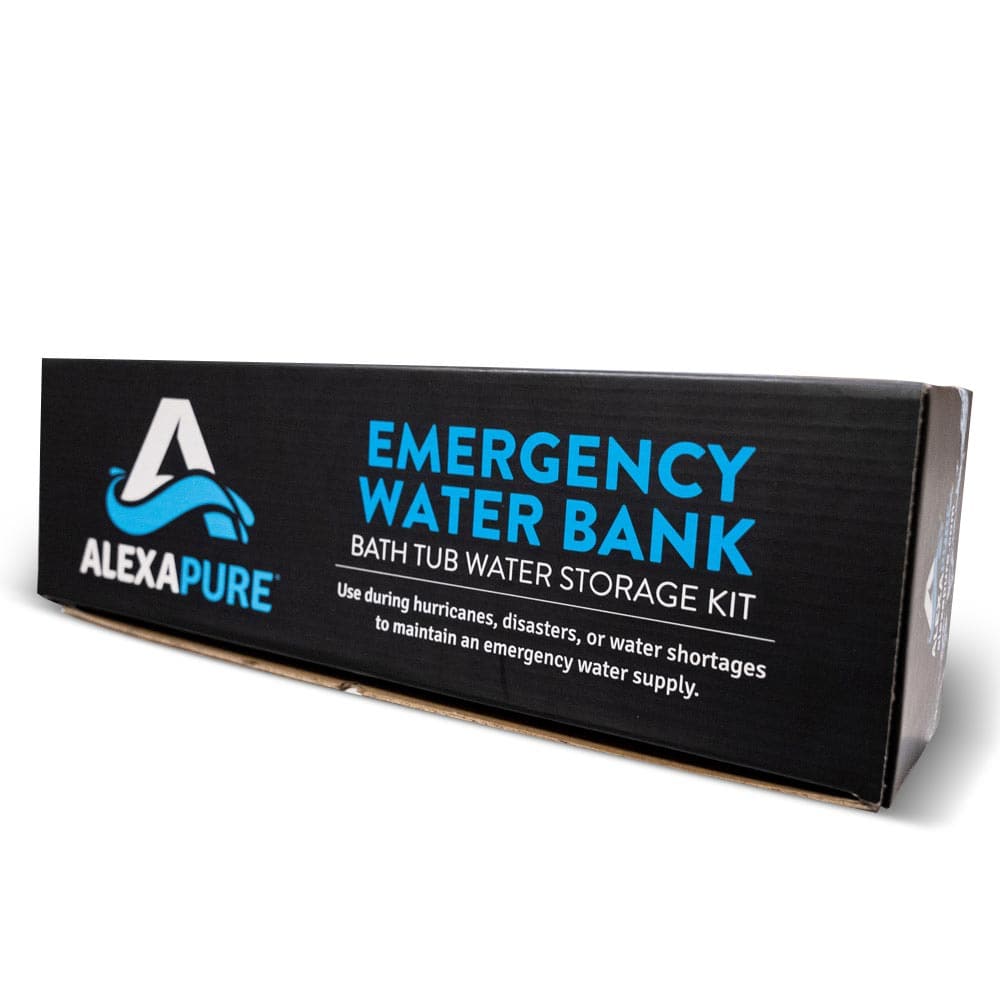
The Alexapure emergency water bank sold through Emergency Essentials, for storing a large volume of water before a storm or outage; check the current spec sheet.
Claim audit: 11 consequential claims checked against the article's sources; unsupported wording revised where it could not be substantiated.
Claim-by-claim audit (11 checked)
“A municipal water system pushes water to your house at somewhere between 40 and 80 psi, all day, every day, without you thinking about it once.” (cited → extensionpubs.unl.edu)
“Roughly speaking, you get about 0.43 psi for every foot of elevation between your tank and your tap.” (reasoning shown in the article)
“Pumped pressure is the practical option for most sites, since the elevation needed for gravity alone is rarely available, which is why pump selection usually matters more than elev…” (rewritten to what the article can stand behind)
“Pick a flow rating that covers the fixtures you expect to run at once, which for a full-time home usually means several gallons per minute rather than one.” (rewritten to what the article can stand behind)
“Without one, your pump cycles on and off with every small draw, which is loud, wears the pump out faster, and causes annoying pressure surges.” (cited → extensionpubs.unl.edu)
“A demand pump strong enough for a real shower draws meaningful current every time someone turns on a tap, so check the amp draw on the pump's own spec sheet.” (rewritten to what the article can stand behind)
“Many off-grid water pumps are sold in 12 volt or 24 volt DC versions, which can be run straight off the battery bank instead of through an inverter.” (rewritten to what the article can stand behind)
“If your system runs at [12V, 24V, or 48V](/blog/12v-vs-24v-vs-48v-battery-banks-choosing-the-right-system-voltage), make sure the pump you buy matches, since a pump built for 12V r…” (reasoning shown in the article)
“A pump drawing 6 to 8 amps over a long run of undersized wire will lose enough voltage that it underperforms no matter how good the pump itself is.” (reasoning shown in the article)
“A fine sediment or carbon filter installed before the pump can restrict flow enough to make the pump work harder and deliver less.” (reasoning shown in the article)
“A cracked fitting or a slow leak inside a wall from a partial winter freeze can bleed off pressure invisibly for weeks before it shows up as a puddle.” (reasoning shown in the article)
Before you go
One useful off-grid email a week.
Practical gear rundowns, honest how-tos, and plain-English guides from someone doing the homework in the open.
I am building a place for off-grid people to swap real answers: a forum by topic, classifieds for gear and services, and real estate for off-grid land and homes. It is new, so the early members shape what it becomes. A free account lets you post in all three.
No ER ten minutes away means you have to be your own triage nurse. Here's how to tell a bad bee sting from the real emergency, and what to actually stock.
In many off-grid disasters, the fire or flood itself isn't the decisive factor, it's the hour you waited too long to leave. Here's how to set real, numeric triggers before you need them.
Tax sale and sheriff's auction land looks like a bargain, but redemption periods, hidden liens, and unseen parcels turn a lot of cheap acreage into an expensive lesson. Here's how to vet a listing before you bid.