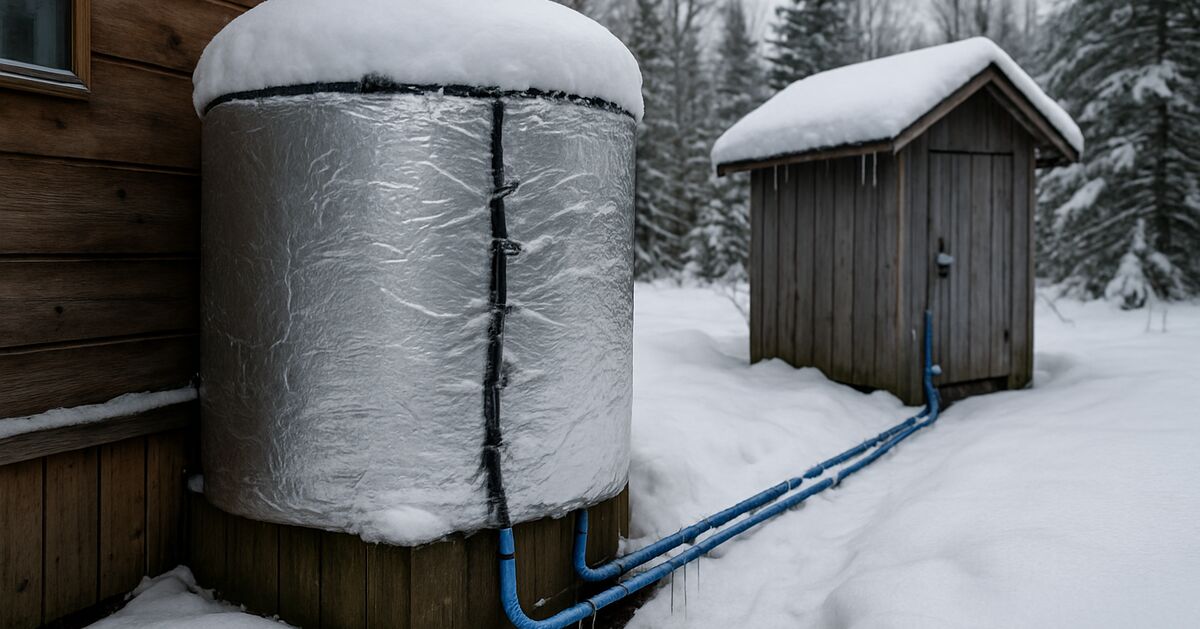
The first time an off-grid water line freezes solid, the lesson that comes up again and again is the same: it's never just one thing. A frozen pipe usually means a frozen pump, a cracked fitting, and a tank you can't get into until it thaws. By the time you notice, you're not dealing with an inconvenience, you're dealing with days of hauling water in five gallon buckets while you figure out what broke and why.
Winterizing an off-grid water system is different from winterizing a house on municipal water. You don't have a heated basement, a buried main six feet down, or a utility crew to call. Everything above ground, and a lot of what's below it, is exposed to whatever the winter actually does. This piece is about the specific, practical work of keeping water usable through a real freeze, not the general seasonal checklist you've probably already seen.
Why off-grid systems freeze differently
A municipal water line sits deep enough that ground temperature protects it. Off-grid setups often don't have that luxury. You've likely got some combination of:
A shallow well or a spring line running above the frost line for at least part of its run
Above-ground or shallow-buried tanks
Exposed pump housings, especially on solar-powered DC pumps
PEX or poly lines running through unheated crawl spaces, cabin skirting, or straight through open air to a garden or barn
Every one of those is a weak point. And because you're not drawing water on the same schedule a household on a pressure tank system does, water can sit still in a line for hours, which is exactly the condition that lets it freeze. Moving water resists freezing far better than static water. That single fact drives most of the practical advice below.
The real cost of getting this wrong
Before the how-to, it's worth being blunt about what a freeze actually costs you. A cracked PEX fitting is a cheap fix if you catch it in November. The same crack, undiscovered until a February thaw floods your crawl space or drains your storage tank overnight, can mean days without water, a soaked subfloor, and a repair you're making in subzero weather instead of a warm afternoon. If you're relying on sized storage to get you through outages, a freeze-cracked tank fitting can undo weeks of careful reserve planning in a single night.
This is also a good moment to be honest about your own limits. If you're aging in place, or dealing with mobility issues, hauling emergency water in freezing conditions is genuinely dangerous, not just annoying. That's part of why it's worth reading through when it's time to bring in outside help even if you're not there yet. Winter water failures can be the point where people decide they need more support than they planned for.
Burying and insulating what you can
If you're still in the planning or building phase, this is the cheapest window you'll ever have to fix freeze risk. Once ground is frozen, trenching is miserable or impossible.
Depth matters more than insulation. Local frost depth varies enormously by climate, from very shallow in mild regions to several feet in cold northern areas. Check your county extension office or a local well driller for the actual frost line in your area, not a national chart. Lines buried below that depth generally don't need much else.
Where you can't bury deep enough, insulate and add heat. Pipe insulation sleeves help modestly, but they only slow heat loss, they don't add heat. For lines that have to run shallow or above ground, self-regulating heat tape is the standard answer. It draws real but manageable power, and the manufacturer's watts per foot rating is what matters if you're running it off a solar battery bank. Before you commit to heat tape running all winter, run the math on what that adds to your winter load, especially if you're already watching a bank through short winter days.
Insulate tanks, not just pipes. Above-ground storage tanks lose heat fast, especially in wind. A simple insulated enclosure, even rigid foam board screwed into a plywood box around the tank, makes a real difference. Some people bury smaller tanks partially, leaving just the access lid exposed, which uses the ground's own stored heat.
Keeping water moving instead of fighting to warm it
Static water freezes. Moving water mostly doesn't, at least not quickly. If your system allows it, a slow, continuous trickle through vulnerable sections during the coldest stretches (well below 20F, or whatever threshold your specific setup struggles at) can be the cheapest insurance you have. This isn't practical for every system, and it does waste some water, but for a short cold snap it beats a cracked fitting every time.
If continuous flow isn't an option, think about your daily draw pattern. A system that gets used morning and evening, then sits idle for eight or ten hours in between, is more freeze-prone than one with smaller draws spread through the day. If you're home and paying attention, running a tap for two or three minutes every few hours during a hard freeze is a low-effort habit that prevents a lot of damage.
The pump is usually the first casualty
In many setups the pump and its above-ground parts are more exposed than the buried pipe, so check them first. A submersible well pump sitting below the frost line is usually fine. It's the above-ground components, pressure switches, check valves, and especially DC solar-fed pumps sitting in an unheated pump house, that take the hit first.
A few specific habits help:
Keep pump housings enclosed, even a simple insulated box with a low-wattage heat source (a thermostatically controlled heat cable or even a incandescent bulb on a thermostat plug) can be enough in moderate climates.
Know where your shutoff valves are and label them before winter, not during an emergency in the dark with cold hands.
Keep a spare pressure switch and a couple of common fittings on hand. This is the same logic behind keeping a small engine repair kit, you're not trying to stock everything, just the parts that are cheap now and brutal to source in a February blizzard.
Knowing when to shut it down instead of fighting it
Sometimes the right move isn't heat tape or trickle flow, it's a clean, deliberate shutdown. If you're heading into an extended cold snap and won't be drawing water anyway (a hunting trip, a stretch away from the cabin, a stretch of weather you know will beat your system), draining lines completely and shutting off supply is often safer than trying to keep everything running.
A proper drain-down means:
Shutting off the source (well pump breaker, spring valve, whatever feeds the system)
Opening low points and drain valves to let gravity pull water out of exposed runs
Blowing out remaining water with a shop vac or small air compressor if your system has dead legs that won't drain by gravity alone
Adding non-toxic RV antifreeze to traps and low spots that can't fully drain, the same way you'd winterize an RV
This is worth practicing once when it's not an emergency. If you moved in within the last year, this is exactly the kind of thing a 90 day shakedown should have surfaced. If it didn't, do a deliberate cold-weather dry run before the first real freeze hits, not during it.
What to keep on hand regardless
Even a well-protected system can fail in an unusually hard freeze, an unexpected power gap, or a part you didn't know was worn. A basic winter water emergency kit is worth keeping year round once the weather turns:
Several days of stored drinking water separate from your main tank, so a system failure isn't also a drinking water crisis
A backup way to melt snow or ice safely if it comes to that (a large pot and a heat source you already have, like a wood stove)
Spare fittings sized to your actual pipe (PEX, poly, or copper, whatever you're running)
A basic pipe repair kit: shark bite style fittings are genuinely useful here because they don't require soldering or crimping tools in a cold, awkward space
A flashlight or headlamp stored specifically near your shutoff valves, so a nighttime failure doesn't turn into a search for a working light
None of this needs to be elaborate. It needs to be specific to your actual system, which means walking your own lines, tanks, and pump housing at least once before winter and asking honestly where the weak points are.
The bigger picture
Freeze protection is really just an extension of the same planning that goes into every other part of off-grid water: knowing your real usage, understanding your storage margins, and being honest about what fails first under stress. If you haven't already thought through your baseline reserve, it's worth reading how much storage you actually need before winter forces the question on you.
Water problems off-grid rarely stay contained to water. A frozen system means hauling buckets, which means more physical strain, more time, and less margin for everything else in your day. Treat freeze protection as core infrastructure, not a side chore, and you'll spend your winter dealing with weather instead of plumbing emergencies.
If you're still working through the broader planning that goes into a first off-grid winter, our blog index has a growing set of posts on exactly that, and if you're weighing whether your current setup can actually handle a hard freeze, the FAQ and about pages are a good place to see how we think about this kind of practical, no-hype planning before you commit to a season you can't easily undo.
The rest of the shortlist
Recommended off-grid gear
Affiliate disclosure: Some links on this site are affiliate links, including Amazon links: as an Amazon Associate I earn from qualifying purchases. Buying through one costs you nothing extra, and it never changes what I recommend.
Products appear here only when they match this article's subject. Selection is based on documented specs and owner reports, never on compensation; pages with no relevant gear carry none.
The Alexapure emergency water bank sold through Emergency Essentials, for storing a large volume of water before a storm or outage; check the current spec sheet.
The My Patriot Supply water filtration collection, including gravity filters, pitchers, treatment tablets and storage, for households planning emergency drinking water.
Why it's here: Here as a category rather than a pick, because water is the system where a second, independent method earns its cost.
The Alexapure Pro gravity-fed countertop water filtration system, for households that want a non-electric filter for daily or emergency drinking water; check the current spec sheet.
Why it's here: Listed so gravity filtration is not a single brand's decision. Compare element life and replacement cost before choosing.
The Alexapure Pro gravity-fed countertop water filter sold through Emergency Essentials, for households that want a non-electric drinking water filter; check the current spec sheet.
Why it's here: Listed through a second retailer so element availability on this system is not down to one storefront.
Claim audit: 8 consequential claims checked against the article's sources; unsupported wording revised where it could not be substantiated.
Claim-by-claim audit (8 checked)
“Moving water resists freezing far better than static water.” (cited → extension.usu.edu)
“Winter water failures can be the point where people decide they need more support than they planned for.” (rewritten to what the article can stand behind)
“Local frost depth varies enormously by climate, from very shallow in mild regions to several feet in cold northern areas.” (rewritten to what the article can stand behind)
“Lines buried below that depth generally don't need much else.” (reasoning shown in the article)
“Pipe insulation sleeves help modestly, but they only slow heat loss, they don't add heat.” (cited → extension.usu.edu)
“It draws real but manageable power, and the manufacturer's watts per foot rating is what matters if you're running it off a solar battery bank.” (rewritten to what the article can stand behind)
“In many setups the pump and its above-ground parts are more exposed than the buried pipe, so check them first.” (rewritten to what the article can stand behind)
“A submersible well pump sitting below the frost line is usually fine.” (reasoning shown in the article)
Before you go
One useful off-grid email a week.
Practical gear rundowns, honest how-tos, and plain-English guides from someone doing the homework in the open.
I am building a place for off-grid people to swap real answers: a forum by topic, classifieds for gear and services, and real estate for off-grid land and homes. It is new, so the early members shape what it becomes. A free account lets you post in all three.
No ER ten minutes away means you have to be your own triage nurse. Here's how to tell a bad bee sting from the real emergency, and what to actually stock.
In many off-grid disasters, the fire or flood itself isn't the decisive factor, it's the hour you waited too long to leave. Here's how to set real, numeric triggers before you need them.
Tax sale and sheriff's auction land looks like a bargain, but redemption periods, hidden liens, and unseen parcels turn a lot of cheap acreage into an expensive lesson. Here's how to vet a listing before you bid.