A solar array that covers 95 percent of your needs will still fail you on the exact week you need it most. That's not a flaw in your design. It's just weather. Every off-grid solar system, no matter how well planned, eventually meets a stretch of clouds, short days, or a battery bank that got pushed too hard for too long. A generator is how you get through that stretch without rationing power like it's wartime or draining your batteries into the ground.
This isn't the post about whether solar can carry your whole life. It's the one about the machine that quietly saves your batteries, your food, and your patience when solar can't. Pairing a generator with a solar system well is its own skill, separate from sizing panels or picking a charge controller, and the sizing mistake tends to run in one of two directions: buying way more generator than needed, or buying a little box that can't actually push the batteries back up in a reasonable time.
Why solar alone isn't a complete system
Solar sizing math is built on averages. You look at your location's sun-hours, your daily load, and you size an array and battery bank to cover a "typical" bad stretch, usually somewhere between two and five days of low production depending on how conservative you want to be. But averages hide the tail end of the distribution. Some winters bring a week of solid overcast. Some summers bring smoke from a wildfire three states away that cuts your production in half for ten days straight. If you sized your battery bank to survive the average bad stretch, the below average stretch will eat you alive.
You can respond to that risk two ways. You can way oversize your solar and battery bank so almost nothing gets through, which costs a fortune and still isn't bulletproof. Or you can size solar and batteries for the common case and keep a generator on hand for the uncommon one. The second approach is usually the cheaper one, and it's honest about what solar actually is: a weather-dependent system that needs a non-weather-dependent backup.
If you haven't worked out your baseline loads and array size yet, that math is covered in how much solar do you actually need to live off-grid. This post assumes you've done that work and starts from the question of what happens when the math runs out.
What a generator is actually for in a solar system
A generator paired with solar has one job most of the time: recharge the battery bank fast when solar can't keep up, then shut off. It is not there to run your whole cabin around the clock. If you find yourself running the generator for six or eight hours a day, every day, something upstream is undersized, either your array, your battery bank, or both.
The right way to think about it is a bridge, not a crutch. You lean on it during a bad stretch, and once the sun comes back, it goes quiet again for weeks or months. Fuel is expensive and finite, engines wear out, and the noise gets old fast when you're used to quiet. A generator that runs for long stretches every day is a sign your solar system needs a redesign, not a sign your generator is doing its job well.
Sizing the generator: bigger isn't automatically better
The instinct is to buy the biggest generator you can afford, on the logic that more power is always safer. But oversizing a generator paired with battery charging has real downsides.
Battery chargers, and most inverter-chargers used in off-grid setups, can only accept so many amps of charging current before they hit their limit, often set conservatively to protect battery health. A 30 amp charger doesn't care if you feed it from a 3,500 watt generator or a 12,000 watt one, it will only pull what it's rated to pull. Beyond a certain point, a bigger generator just means the engine runs at a lower percentage of its rated load, which is bad for small engines. Many manufacturers list a preferred load band for small gas and propane generators, so check your manual rather than assuming any load is fine. Running one at very light load for hours at a time is commonly blamed for wet-stacking, where unburned fuel and carbon foul the engine, along with rough running and extra wear.
The better approach is to size the generator to your charger's real draw, plus whatever loads you plan to run at the same time (well pump, power tools, a load of laundry), with a bit of headroom, not a huge cushion. For a small cabin with a single inverter-charger, add the charger's rated AC draw to your simultaneous loads and add modest headroom, which often points to a mid-size portable unit. Bigger homes with 48 volt systems and higher-capacity chargers will land higher, especially if you also want to run a well pump or shop tools off the same unit. If you're not sure what your inverter-charger can actually accept, that number is in its spec sheet, and it matters more than anything on the generator's own label.
Fuel choice changes more than you'd think
Gasoline generators are cheap to buy and easy to find parts for, but stored gasoline degrades over time and is widely reported to gum up carburetors when a generator sits unused for a season, which is exactly how backup generators tend to be used. If you go gas, plan on fuel stabilizer and a rotation schedule, or plan on carb cleaning as a regular chore.
Propane and dual-fuel generators sidestep the stale fuel problem because propane does not degrade in storage the way gasoline does, and if you already have a propane tank on site you can often tie into the same supply. Manufacturers typically rate propane output slightly lower than gasoline on the same engine, and a quality dual-fuel unit usually costs more upfront, so check the spec sheet. Given that backup generators can sit idle for months, propane's shelf stability alone is worth the tradeoff for many off-grid setups. If you're weighing propane logistics for the whole property, it's worth reading up on tank sizing and refill scheduling so your generator fuel and your kitchen fuel aren't competing for the same delivery truck.
Diesel is the choice for people running larger generators for longer stretches, common on bigger homesteads or anywhere with heavier loads. Diesel sets are generally built for sustained load and diesel is often stored with additives, but the generators themselves cost more and the smaller end of the diesel market is thin. Unless you're already committed to diesel for a tractor or truck, it's usually more machine than a small cabin setup needs.
Wiring it in: don't just run an extension cord
One of the most dangerous shortcuts is backfeeding a generator into a household outlet with a makeshift cord. It can energize wiring you think is dead, it can damage your inverter-charger, and if your system ever reconnects to a grid line (even a shared line with a neighbor or a utility crew working nearby), it can kill someone. Off-grid or not, this is not a place to improvise.
The right setup runs the generator into a transfer switch or directly into your inverter-charger's dedicated generator input, which most quality off-grid inverter-chargers have built in. That input is designed to sync the incoming AC, charge the batteries at a controlled rate, and isolate the generator from your solar charge controller so the two don't fight each other. If your inverter-charger doesn't have a generator input, a manual transfer switch installed by someone who understands your system is the next best thing. Whatever you choose, it needs breakers sized correctly and wire gauge that matches the load, the same rules that apply anywhere else in your system. If you haven't already, it's worth reading through the fundamentals on wiring an off-grid solar system safely before you add a generator input, since a badly wired generator connection can undo a well wired solar setup fast.
Running it well: habits that make the pairing work
A few habits separate people who get years of reliable use out of a backup generator from people who keep troubleshooting it.
Exercise it monthly, even when you don't need it. A generator that sits untouched all year is far more likely to give you starting trouble in an emergency, which is the point of a monthly test run.
Let it run under real load, not idling. Idling for ten minutes to "keep it charged" does little useful work and leaves the engine running cold and lightly loaded. Run it long enough to actually push power into the batteries.
Change the oil on hours, not on a calendar. Small engines under load rack up wear faster than people expect. Keep a log.
Store fuel appropriately for the type you chose, and never let a gas generator sit for a season without stabilizer or a full drain.
Keep the generator dry and ventilated, but not so far from the cabin that starting it in a January storm becomes its own ordeal.
What this means for your winter planning
Generators earn their keep most in winter, when short days and heavy cloud cover stack up and battery banks take the hardest hit of the year. If you haven't already worked through how your battery bank behaves in cold weather and low production, that's covered in keeping a solar battery bank alive through a real off-grid winter, and it pairs directly with this decision. A generator that's sized right and wired in correctly is what lets you follow good battery habits (not draining below a safe depth of discharge, not leaving batteries at low charge for days) instead of quietly breaking your own rules because there's no other way to keep the lights on.
It's also worth thinking about what happens if the generator itself fails mid-storm, which is its own kind of emergency. Knowing what to shut down first and in what order, so a struggling system doesn't take your electronics or your batteries down with it, is covered in power outage triage: what to shut off first when your system is failing. A generator is your backup for solar. It's smart to also know your backup for the backup.
The honest tradeoffs
A generator is noise, fuel, maintenance, and upfront cost, on top of everything you've already spent on solar. For some people living somewhere with strong, consistent sun and a genuinely light load, a generator sits unused for most of the year and can feel like money that didn't need spending. But for an off-grid setup, especially anywhere with real winters, wildfire smoke seasons, or a lot of tree cover, it's the piece that turns a good solar system into a system you can actually trust. The cost of not having one isn't zero. It's a dead battery bank in the exact week you can least afford it, and a very long, very quiet cabin until the sun comes back.
If you're still deciding how the pieces of your power system fit together, from array size to battery voltage to backup, the rest of the Solar & Power archive walks through those decisions one at a time, and the FAQ covers a lot of the questions people ask before they commit to a full build. There's no substitute for running your own numbers, but knowing where a generator fits in that math, and where it doesn't, will save you from buying either too little backup or too much machine.
The rest of the shortlist
Recommended off-grid gear
Affiliate disclosure: Some links on this site are affiliate links, including Amazon links: as an Amazon Associate I earn from qualifying purchases. Buying through one costs you nothing extra, and it never changes what I recommend.
Products appear here only when they match this article's subject. Selection is based on documented specs and owner reports, never on compensation; pages with no relevant gear carry none.
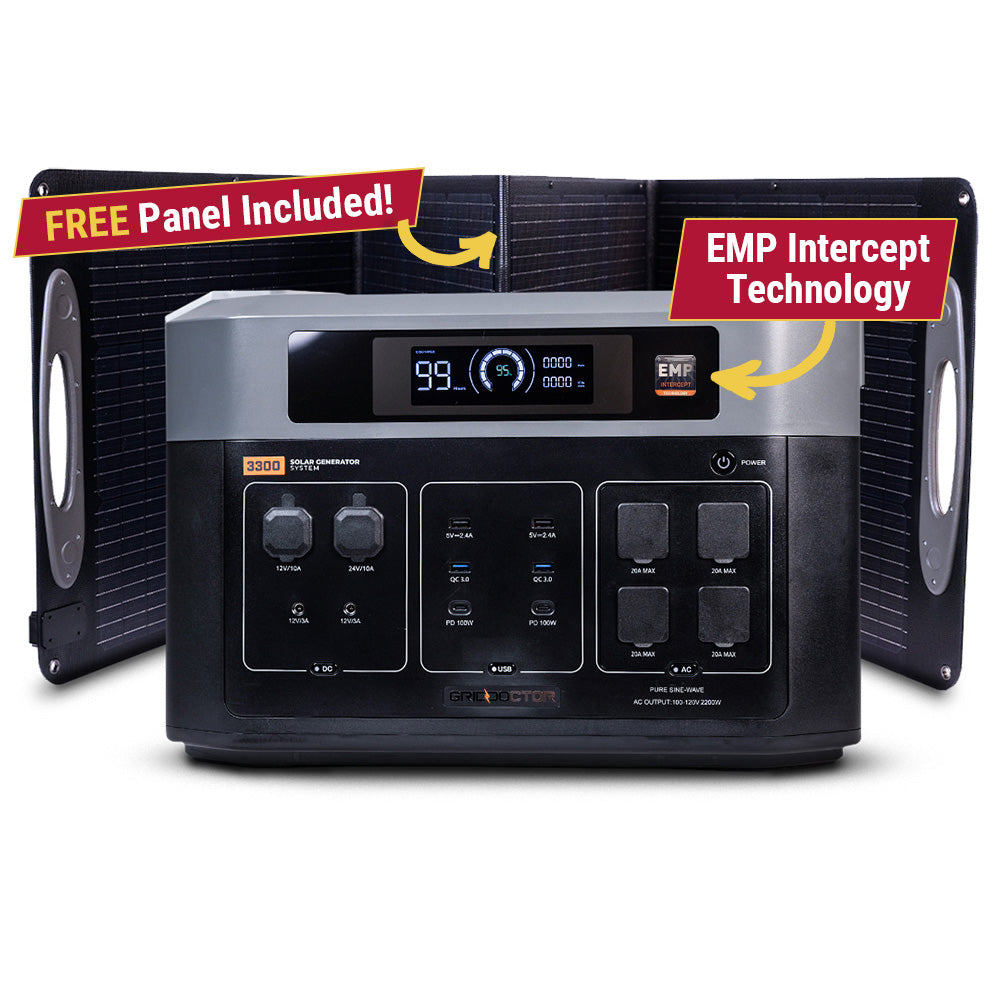
The Grid Doctor 3300 solar generator system sold with EMP shielding, a large portable power station for home backup and off-grid use; check the current spec sheet for details.
Why it's here: Listed with its EMP shielding as a stated feature, not a verified one. Judge it on the power specs first.
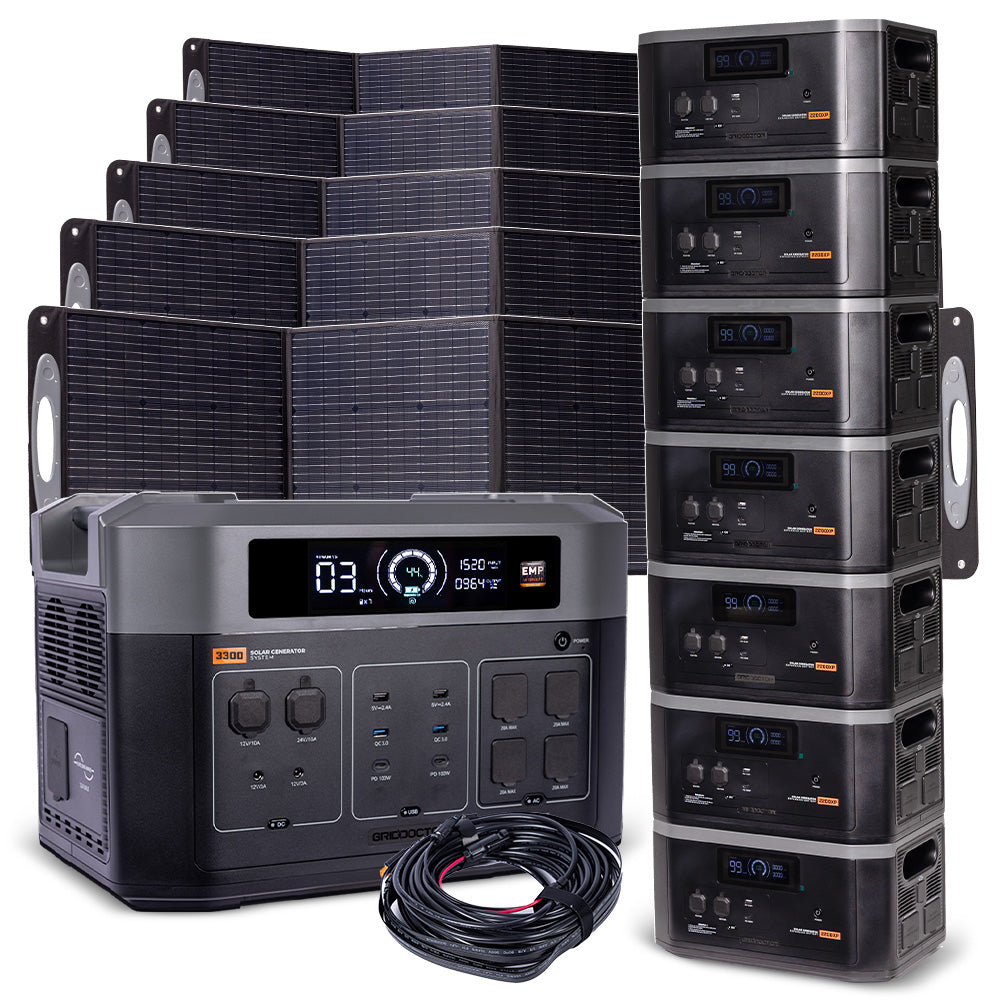
The Grid Doctor 3300 Power Tower, a large portable power station for home backup and off-grid systems; check the current spec sheet for capacity and output details.
Why it's here: Listed so form factor is part of the decision: this capacity class in a shape that stands rather than sits.
The Grid Doctor 3300-watt EMP-shielded solar generator sold through Emergency Essentials, a large power station for home backup and off-grid use; check the current spec sheet.
Why it's here: Listed through a second retailer so availability and pricing on this unit are not down to one storefront.
Claim audit: 17 consequential claims checked against the article's sources; unsupported wording revised where it could not be substantiated.
Claim-by-claim audit (17 checked)
“Pairing a generator with a solar system well is its own skill, separate from sizing panels or picking a charge controller, and the sizing mistake tends to run in one of two directi…” (rewritten to what the article can stand behind)
“The second approach is usually the cheaper one, and it's honest about what solar actually is: a weather-dependent system that needs a non-weather-dependent backup.” (rewritten to what the article can stand behind)
“A 30 amp charger doesn't care if you feed it from a 3,500 watt generator or a 12,000 watt one, it will only pull what it's rated to pull.” (reasoning shown in the article)
“Many manufacturers list a preferred load band for small gas and propane generators, so check your manual rather than assuming any load is fine.” (rewritten to what the article can stand behind)
“Running one at very light load for hours at a time is commonly blamed for wet-stacking, where unburned fuel and carbon foul the engine, along with rough running and extra wear.” (rewritten to what the article can stand behind)
“For a small cabin with a single inverter-charger, add the charger's rated AC draw to your simultaneous loads and add modest headroom, which often points to a mid-size portable unit…” (rewritten to what the article can stand behind)
“Bigger homes with 48 volt systems and higher-capacity chargers will land higher, especially if you also want to run a well pump or shop tools off the same unit.” (rewritten to what the article can stand behind)
“Gasoline generators are cheap to buy and easy to find parts for, but stored gasoline degrades over time and is widely reported to gum up carburetors when a generator sits unused fo…” (rewritten to what the article can stand behind)
“Propane and dual-fuel generators sidestep the stale fuel problem because propane does not degrade in storage the way gasoline does, and if you already have a propane tank on site y…” (rewritten to what the article can stand behind)
“Manufacturers typically rate propane output slightly lower than gasoline on the same engine, and a quality dual-fuel unit usually costs more upfront, so check the spec sheet.” (rewritten to what the article can stand behind)
“Diesel sets are generally built for sustained load and diesel is often stored with additives, but the generators themselves cost more and the smaller end of the diesel market is th…” (rewritten to what the article can stand behind)
“One of the most dangerous shortcuts is backfeeding a generator into a household outlet with a makeshift cord.” (rewritten to what the article can stand behind)
“It can energize wiring you think is dead, it can damage your inverter-charger, and if your system ever reconnects to a grid line (even a shared line with a neighbor or a utility cr…” (cited → esfi.org)
“The right setup runs the generator into a transfer switch or directly into your inverter-charger's dedicated generator input, which most quality off-grid inverter-chargers have bui…” (cited → esfi.org)
“A generator that sits untouched all year is far more likely to give you starting trouble in an emergency, which is the point of a monthly test run.” (rewritten to what the article can stand behind)
“Idling for ten minutes to "keep it charged" does little useful work and leaves the engine running cold and lightly loaded.” (rewritten to what the article can stand behind)
“Keep the generator dry and ventilated, but not so far from the cabin that starting it in a January storm becomes its own ordeal.” (cited → epa.gov)
Before you go
One useful off-grid email a week.
Practical gear rundowns, honest how-tos, and plain-English guides from someone doing the homework in the open.
I am building a place for off-grid people to swap real answers: a forum by topic, classifieds for gear and services, and real estate for off-grid land and homes. It is new, so the early members shape what it becomes. A free account lets you post in all three.
No ER ten minutes away means you have to be your own triage nurse. Here's how to tell a bad bee sting from the real emergency, and what to actually stock.
In many off-grid disasters, the fire or flood itself isn't the decisive factor, it's the hour you waited too long to leave. Here's how to set real, numeric triggers before you need them.
Tax sale and sheriff's auction land looks like a bargain, but redemption periods, hidden liens, and unseen parcels turn a lot of cheap acreage into an expensive lesson. Here's how to vet a listing before you bid.