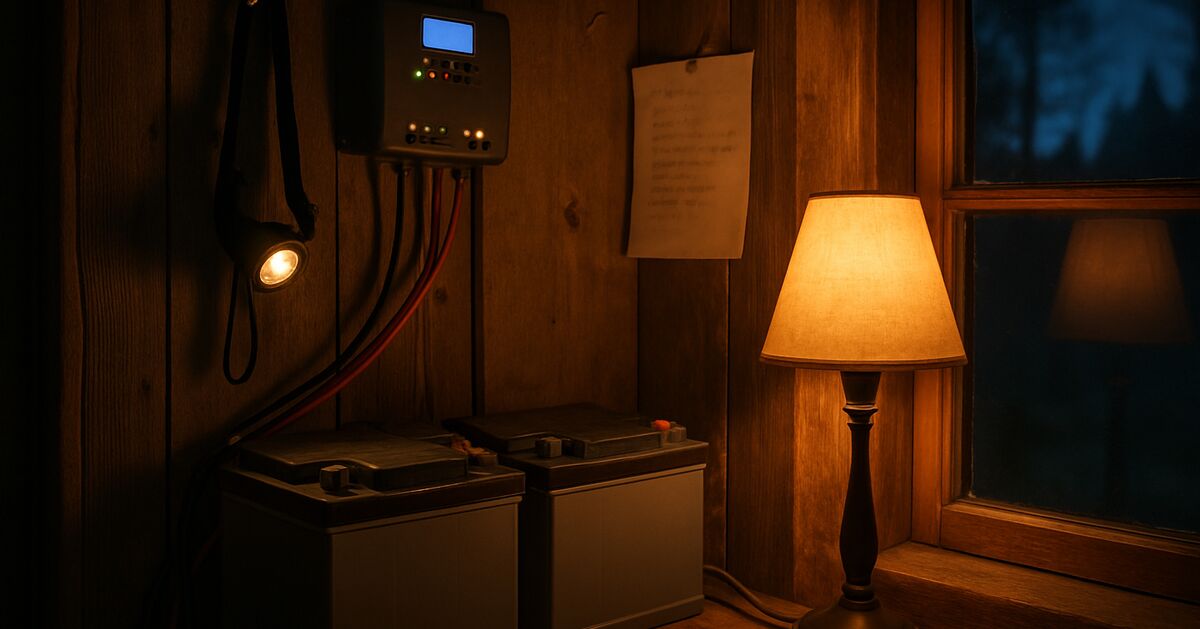
Your battery voltage is dropping faster than the math says it should, the inverter just threw a fault light, and it's getting dark. This is the moment that separates people who lose an evening of comfort from people who lose a battery bank, a freezer full of meat, or a well pump that won't restart until a part ships in from three states away.
Off-grid articles often focus on sizing your system, and that is the framing I see in the ones I read. Almost nobody talks about what to do in the twenty minutes after something goes wrong. That gap matters, because a system that's degrading (a bad charge controller, a cloudy week stacked on a cloudy week, a generator that won't start, a dead cell in the bank) doesn't fail all at once. It fails in stages, and every stage gives you a choice about what to save and what to let go dark. This is a post about making that choice fast, calmly, and in the right order, before the choice gets made for you.
Why triage order matters more than total capacity
If you've read anything about how much solar you actually need to live off-grid, you already know that off-grid systems are built around averages and margins, not guarantees. A well designed system has enough slack to cover a run of bad weather or a skipped generator day. But slack runs out, and when it does, the damage isn't distributed evenly across your loads. It's concentrated in whatever keeps drawing power after the bank is already too low.
Battery manufacturers generally warn that pulling a bank below its rated minimum state of charge repeatedly shortens its usable life, so check your own bank's spec sheet for the limit. A well pump that starts and stalls repeatedly on low voltage draws high current without spinning up, which is the condition pump makers warn against in their manuals. A refrigerator compressor that browns out and restarts in a loop is under similar strain, which is why appliance manuals advise disconnecting during unstable power. The failure you're managing in the moment (low battery voltage, a tripped breaker, an inverter fault) is rarely the expensive failure. The expensive failure is the one you cause by letting things keep drawing power in the wrong order while you're troubleshooting.
Triage means having a pre-decided sequence so you're not making load-shedding decisions from scratch while stressed, in the dark, with a flashlight in your teeth.
The four tiers, decided before you need them
Walk through your own loads right now, not during an emergency, and sort them into four tiers. Write the list down and tape it inside a cabinet door or your electrical panel. You will not remember this cleanly at 9pm with a beeping inverter.
Tier 1, cut first, no debate. Anything that's a convenience, not a need, and draws meaningful power: space heaters, entertainment electronics, power tools charging, hot water heating elements if you have an on-demand electric unit, extra lighting beyond what you need to move safely. These come off the instant you see a voltage sag or a fault code. No exceptions, no "just for another hour."
Tier 2, cut soon if the trend doesn't reverse. Things that matter for comfort but won't spoil or break if they're off for a night: a chest freezer that's well insulated and mostly full (full freezers hold cold far longer than empty ones), non-essential Wi-Fi and networking gear covered in our piece on off-grid Wi-Fi that reaches the barn, shop, and garden, washing machines, and any battery charging that isn't for a critical tool.
Tier 3, protect as long as possible. Your well pump (losing water pressure cascades into losing your ability to flush, cook, or fight a small fire), a refrigerator with medication or an actively cooking dinner inside, and any life-support-adjacent medical equipment. If you or someone in your household depends on refrigerated insulin or powered oxygen, that load isn't really tier 3, it's tier zero, and it needs its own dedicated small backup (a separate battery, a DC-only setup, or a generator-fed circuit) so it never competes with the rest of the tiers at all. If that's your situation, it's worth reading alongside dedicated posts on managing chronic conditions off-grid.
Tier 4, the bank itself. Above everything else you're trying to save, the battery bank needs to survive the night. Repeatedly pushing a bank below its rated minimum tends to bring replacement forward, and batteries are typically among the costlier parts of a system to replace. Protecting the bank sometimes means accepting that the freezer thaws a little, or the pump doesn't run until morning. That's the trade you make, on purpose, ahead of time, so you're not negotiating with yourself in the moment.
Reading the warning signs before full failure
Triage works best when you catch the slide early, not at the cliff edge. A few signs to watch for that mean "start cutting tier 1 now" rather than "wait and see":
Battery voltage dropping faster in the evening than it has on comparable cloudy days recently. This usually means either the bank has lost capacity (aging cells, one bad battery dragging the group down) or something is drawing more than usual.
Your charge controller showing lower peak input than the weather should explain. Dirty panels, a loose connector, or a failing controller can all look like "just a cloudy day" until you check the numbers against a clear-sky baseline.
An inverter that's cycling on and off, or throwing an overload fault on loads it normally handles fine. That's often a sign the battery voltage has sagged enough that the inverter's low-voltage cutoff is close, even if the displayed percentage still looks okay.
A generator that starts but won't hold a load, or won't start at all. This is the moment triage matters most, because you've just lost your backup-to-the-backup, and everything downstream needs to stretch further than planned.
None of these mean panic. They mean start executing the list you already wrote.
The generator question
A lot of off-grid households treat the generator as the answer to every version of this problem, and it usually is, right up until it isn't. Generators can fail to start in cold weather, run out of fuel if the gauge goes unchecked, or suffer a gummed carburetor after sitting unused. If your triage plan assumes the generator will bail you out, you need a second plan for when it doesn't.
That means keeping basic starting fluid, a spare pull cord, and fresh fuel on hand, and it means treating generator maintenance as a monthly task, not an as-needed one. If you haven't already, our post on building a small engine repair kit for keeping generators and pumps alive is worth pairing with this one, because half of "what to shut off" is really "what to fix so you don't have to shut anything off."
Don't forget the manual overrides
Every automated system should have a manual fallback, and triage is the moment you find out whether yours actually works. Can you hand-pump water if the well pump is offline? Do you have a way to cook dinner that doesn't touch the battery bank at all, the way a propane or wood setup does? This is where a layered kitchen matters. If your only cooking method is an electric induction plate wired into the same bank as everything else, you've got no fallback, and that's worth fixing before winter, not during it. It ties directly into the tradeoffs covered in posts about cooking heat versus space heat and about sizing propane for off-grid cooking, because redundancy in your energy sources is what makes triage survivable instead of miserable.
The same logic applies to lighting. Headlamps, oil lamps, or a couple of dedicated solar garden lights charged separately from the main bank mean you're never choosing between "see in the dark" and "protect the battery bank." That choice should never exist in the first place.
Building the habit, not just the list
A written tier list is only half the job. The other half is a habit of checking your system's vital signs often enough that you catch the slide in tier 1 territory, not tier 4. That means glancing at battery voltage and charge controller input at the same time each day, roughly, so you build a feel for what normal looks like in your specific setup during each season. A number that's fine in July might be a warning sign in December.
It also means testing your own triage plan once, on purpose, on a low-stakes day. Kill tier 1 loads manually and see how the system responds. Practice finding the breaker panel by feel or by headlamp. Walk through who in the household needs to know the plan, because if you're the only one who understands the tier list, it doesn't help anyone when you're not home. This overlaps with the kind of household-wide planning covered in posts about emergency phone trees and backup contact webs, where the real lesson is the same: a plan that lives only in one person's head is not a plan, it's a liability.
When it's more than a bad week
Sometimes what looks like triage-worthy weather is actually a sign of a deeper problem: a battery bank that's simply worn out, a charge controller nearing end of life, or panels that have degraded more than expected. If you find yourself running the tier list more than once or twice a season, that's not bad luck, that's data. It's worth a hard look at your actual system health rather than just getting better at rationing power around a failing setup. Our FAQ page covers some of the common diagnostic questions people run into here, and if you want a second set of eyes on what you're seeing, our contact page is there for exactly that kind of question.
Living off-grid means you are your own utility company, and utility companies plan for outages instead of hoping they don't happen. A tier list won't stop a bad week of weather or a failed part. What it does is make sure that when something does fail, you lose the least valuable thing first and the most valuable thing last, on purpose, instead of by accident. That's the whole job of triage, and it's a much better feeling to have decided it in daylight than to be deciding it by headlamp.
The rest of the shortlist
Recommended off-grid gear
Affiliate disclosure: Some links on this site are affiliate links, including Amazon links: as an Amazon Associate I earn from qualifying purchases. Buying through one costs you nothing extra, and it never changes what I recommend.
Products appear here only when they match this article's subject. Selection is based on documented specs and owner reports, never on compensation; pages with no relevant gear carry none.
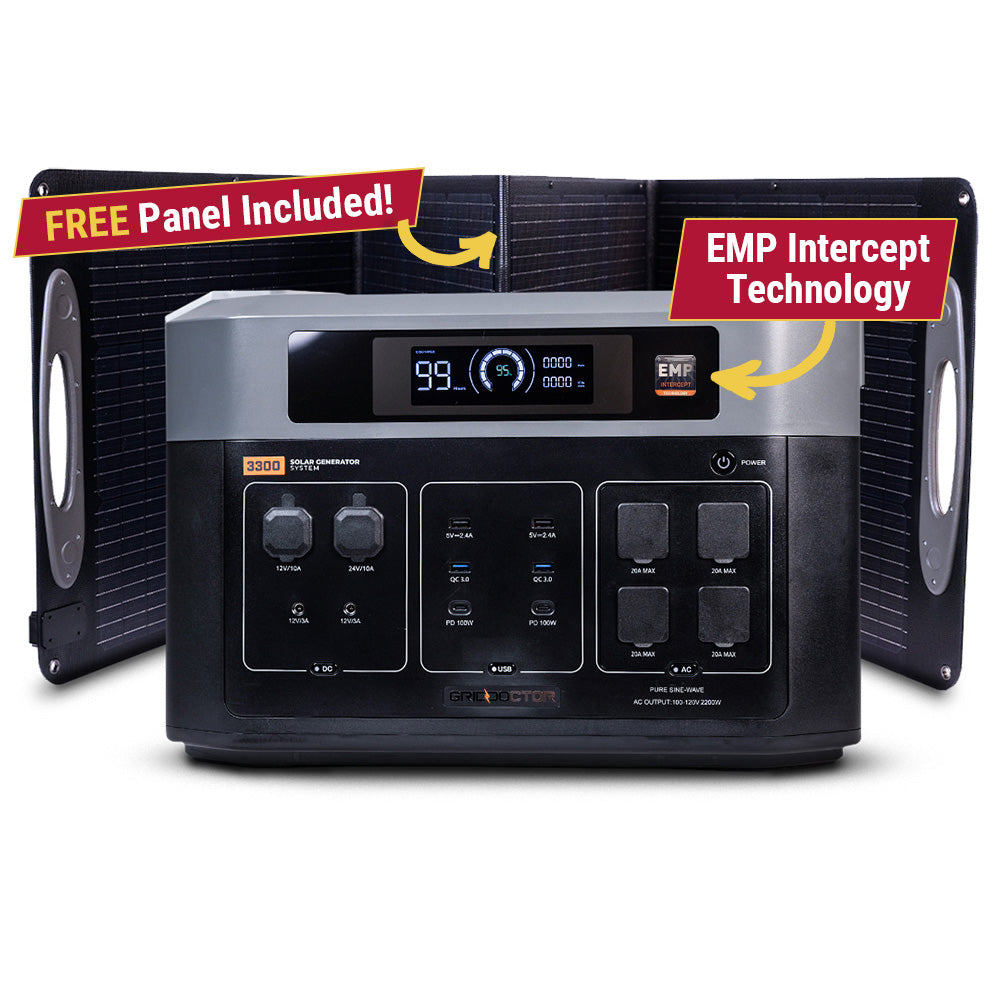
The Grid Doctor 3300 solar generator system sold with EMP shielding, a large portable power station for home backup and off-grid use; check the current spec sheet for details.
Why it's here: Listed with its EMP shielding as a stated feature, not a verified one. Judge it on the power specs first.
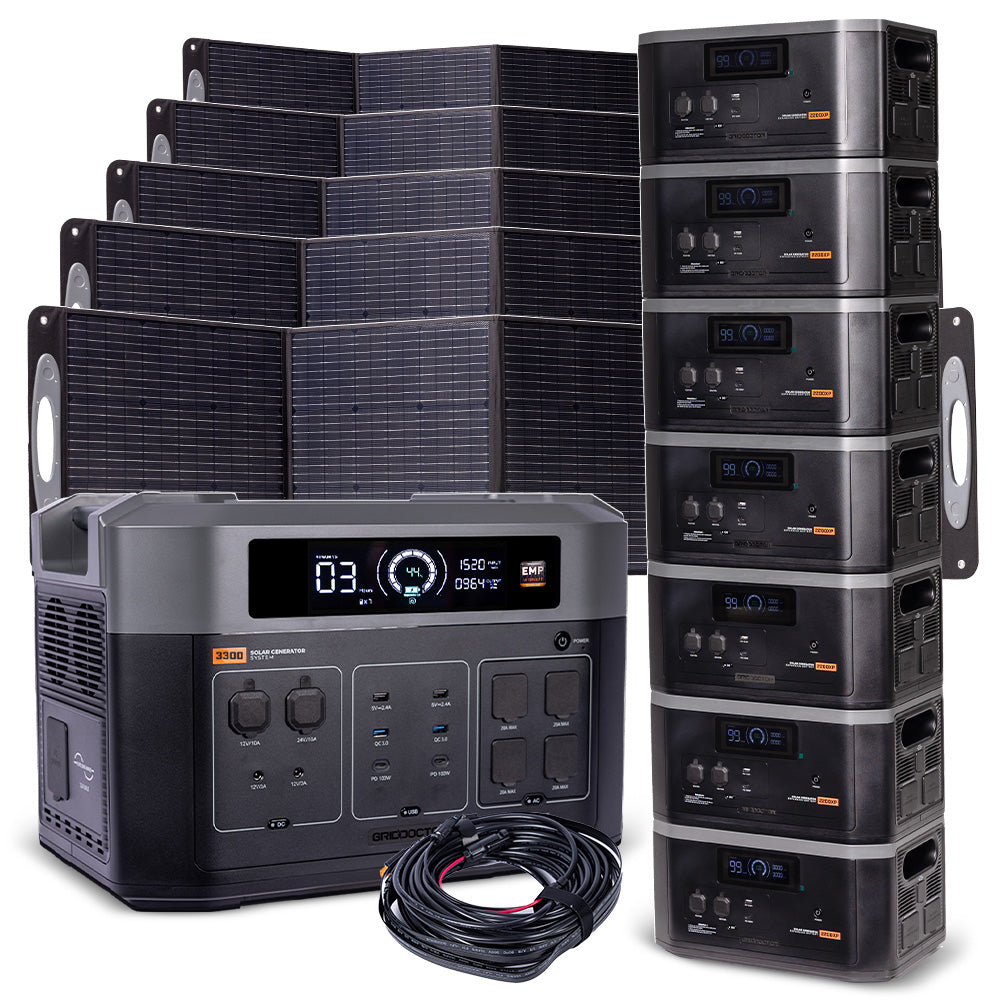
The Grid Doctor 3300 Power Tower, a large portable power station for home backup and off-grid systems; check the current spec sheet for capacity and output details.
Why it's here: Listed so form factor is part of the decision: this capacity class in a shape that stands rather than sits.
The Grid Doctor 3300-watt EMP-shielded solar generator sold through Emergency Essentials, a large power station for home backup and off-grid use; check the current spec sheet.
Why it's here: Listed through a second retailer so availability and pricing on this unit are not down to one storefront.
Claim audit: 7 consequential claims checked against the article's sources; unsupported wording revised where it could not be substantiated.
Claim-by-claim audit (7 checked)
“Battery manufacturers generally warn that pulling a bank below its rated minimum state of charge repeatedly shortens its usable life, so check your own bank's spec sheet for the li…” (rewritten to what the article can stand behind)
“A well pump that starts and stalls repeatedly on low voltage draws high current without spinning up, which is the condition pump makers warn against in their manuals.” (rewritten to what the article can stand behind)
“A refrigerator compressor that browns out and restarts in a loop is under similar strain, which is why appliance manuals advise disconnecting during unstable power.” (rewritten to what the article can stand behind)
“full freezers hold cold far longer than empty ones” (cited → extension.umn.edu)
“Repeatedly pushing a bank below its rated minimum tends to bring replacement forward, and batteries are typically among the costlier parts of a system to replace.” (rewritten to what the article can stand behind)
“Generators can fail to start in cold weather, run out of fuel if the gauge goes unchecked, or suffer a gummed carburetor after sitting unused.” (rewritten to what the article can stand behind)
“That's often a sign the battery voltage has sagged enough that the inverter's low-voltage cutoff is close, even if the displayed percentage still looks okay.” (reasoning shown in the article)
Before you go
One useful off-grid email a week.
Practical gear rundowns, honest how-tos, and plain-English guides from someone doing the homework in the open.
I am building a place for off-grid people to swap real answers: a forum by topic, classifieds for gear and services, and real estate for off-grid land and homes. It is new, so the early members shape what it becomes. A free account lets you post in all three.
No ER ten minutes away means you have to be your own triage nurse. Here's how to tell a bad bee sting from the real emergency, and what to actually stock.
In many off-grid disasters, the fire or flood itself isn't the decisive factor, it's the hour you waited too long to leave. Here's how to set real, numeric triggers before you need them.
Tax sale and sheriff's auction land looks like a bargain, but redemption periods, hidden liens, and unseen parcels turn a lot of cheap acreage into an expensive lesson. Here's how to vet a listing before you bid.