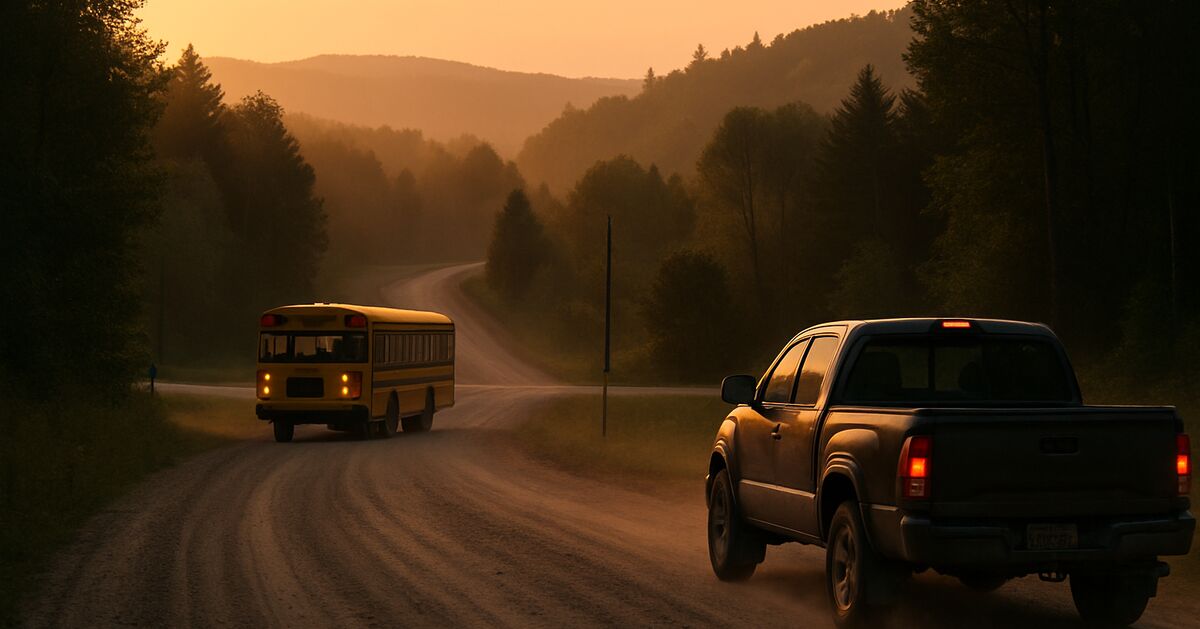
The question nobody warns you about before you move off-grid isn't diapers or homeschooling curricula. It's the school bus. Or rather, the fact that there often isn't one, or there is one but it won't come down your road, or it comes but only to a pickup point that's forty minutes from your actual door.
Transportation is the quiet logistics problem that off-grid families with school-age kids run into within the first month, and it doesn't get talked about much because it sounds mundane compared to solar arrays and water systems. But ask any parent who's actually doing this and they'll tell you: figuring out how your kids move between home, school, sports, friends, and everything else is one of the most disruptive parts of the whole transition. Here's how families actually solve it.
Why this catches people off guard
Planning an off-grid move tends to focus mental energy on power, water, and heat. Those are the systems that fail dramatically if you get them wrong, so they get the attention. Kid transportation fails quietly instead. It shows up as a kid who stops getting invited to birthday parties because nobody wants to drive forty-five minutes each way, or a teenager who can't do a sport because practice ends at 6pm and it's dark and icy by the time you'd get home, or a family that burns two extra hours a day just on driving that never existed when you lived in town.
It's not a dealbreaker. But it is a real cost, and it deserves the same clear-eyed planning you'd give to sizing your water storage or figuring out your actual annual budget. If you map it out before you move instead of discovering it after, you'll make better decisions about where on the land to build, what vehicle to buy, and how to structure your family's schedule.
Start with the bus question, specifically
Before you buy land, or at least before you finalize where the driveway and house pad go, call the school district's transportation office and ask two very specific things:
What's the farthest point on our road that the bus will service, and what turnaround radius they require (districts often set a minimum turning radius for buses, so ask for their exact figure if your road narrows or has switchbacks)
What's the actual scheduled pickup time at the nearest stop to our parcel, not the average for the route
Ask whether your district has written policies on road grade, maintained all-weather surfaces, or guardrails on drop-offs, since these conditions can rule a road out for buses. If your access road is steep, seasonal, or unmaintained by the county, district policy may prevent the bus from coming near you regardless of how badly they want to serve your family, so ask them directly. This is worth knowing before you're the parent driving a kindergartner two miles down a mud track every morning at 6:40am because that's the earliest the bus stop can be reached safely.
Some families discover their only real option is a bus stop at the paved road junction, which means someone drives the kids there and back twice a day no matter what. That's a fixed daily commitment worth factoring into your morning and evening routine the same way you'd factor in feeding livestock or checking the water pump.
The vehicle question is a family-planning question
Off-grid families end up needing a rig that can handle mud, snow, washboard gravel, and steep grades reliably, in all seasons, with kids and their gear in it. This changes what "family car" means.
A few things that consistently matter more than people expect:
Ground clearance and a locking differential or good all-wheel drive matter more than seating capacity in the shopping decision, because a stuck vehicle on pickup day is a missed day of school
Two working vehicles, not one, becomes close to mandatory once you have a spouse working and kids needing rides, because a single vehicle down for repair strands everyone
A second, older, cheaper 4x4 as a dedicated "kid hauler" that you don't mind getting scratched and muddy is often smarter than one nice truck everyone shares
Winter tires (actual winter-rated, not all-season) on the vehicle that does school runs are worth prioritizing in snow country, since traction on the school run is what keeps the day from being canceled
If your access road becomes impassable for stretches of the year (mud season is the classic offender, worse in many ways than snow), you need a real answer for those weeks, not a hope that it'll be fine. Some families park a vehicle at the top of the driveway during mud season and walk or ATV down to it. Others simply accept that certain weeks mean homeschooling by necessity even for kids normally in a brick-and-mortar school. Know which kind of family you're going to be before the first bad thaw catches you flat-footed.
Sports, activities, and the friendship tax
This is the part that surprises parents most. It's not the twice-daily school run that grinds people down, it's the unpredictable stuff: practice that runs late, a friend's sleepover invite, a school play rehearsal added at the last minute, a doctor's appointment in town that overlaps with pickup time.
Every one of these now costs real windshield time, often 30 to 90 minutes each way depending on how remote you are. A few patterns that actually help:
Carpool with the one or two other rural families on your route, even if it means your kid's practice schedule has to bend a little to match theirs. This is worth more than almost any other single fix.
Pick one or two activities per kid rather than four, and be honest with your kids about why. Off-grid distance is a real constraint, not a punishment, and explaining it plainly gives kids something concrete to work with rather than a vague no.
Build slack into evening plans. If practice ends at 6, plan to leave home by 5:15 even for a 20 minute drive, because gravel roads and wildlife and weather all eat time unpredictably.
Consider a "town day" model where you batch errands, practices, and social visits into one or two set days a week rather than driving in on demand. This is the same logic homesteaders use for batching town trips for fuel and supply runs, just applied to kid logistics.
Friendships take a hit too, especially for younger kids who can't drive themselves anywhere yet. Teenagers eventually get a license and some independence, but a seven-year-old who wants to play with a school friend is entirely dependent on a parent willing to make a long round trip. Some families solve this by hosting more than they visit (it's easier to have friends come stay for a weekend once than to make four separate day trips) and by leaning on video calls between visits, part of a broader layered communications setup that keeps kids connected between in-person visits.
Teen drivers change the math, for better and worse
Once a kid is old enough to drive, off-grid life actually gets easier in one sense: they can start doing their own school runs, sports pickups, and social visits. But it introduces a genuinely serious safety question, because rural roads are statistically more dangerous for new drivers than town streets. Gravel, wildlife crossings, no shoulder, no cell coverage if something goes wrong, and long stretches with no other traffic to help if a car goes off the road all add real risk.
Practical steps that matter:
Put in serious supervised hours on your specific road and route before handing over solo driving privileges, not just generic driving lessons in a parking lot
Make sure the teen's vehicle has a way to call for help if it breaks down or goes off the road out of cell range. This ties directly into your family's emergency phone tree and whatever you've set up for staying reachable with no cell signal
Set a firm rule about driving in bad weather versus waiting it out, since ice and mud are hard to judge from inside a warm vehicle at any age
Keep a basic winter kit (blanket, water, flashlight, traction aid) in any vehicle a teen drives solo, the same way you would for any adult driving your remote roads
Homeschool families aren't off the hook either
If you've gone the homeschool route (and there's a lot of practical guidance on building a real school day without wifi if that's new territory for you), you might assume transportation stops being an issue. It doesn't disappear, it just shifts shape. Homeschool co-ops, group classes, 4-H, community sports leagues, and library programs all still require getting kids somewhere, often on a fixed weekly schedule that doesn't bend for weather or road conditions the way a flexible homeschool day can.
Many off-grid homeschool families end up structuring their whole week around one or two "in-town days" that cover co-op, sports, grocery runs, and social time in a single trip, with the rest of the week fully at home. This isn't a compromise, it's usually the smarter design from the start, and it plays nicely with a homeschool schedule's natural flexibility in a way a rigid public school calendar can't.
What to actually decide before you buy land
If you're still in the land-shopping phase, a few kid-transportation questions deserve a spot on your checklist right alongside sun exposure and water rights:
How far is the nearest bus stop the district will actually service, in minutes, not miles
What does the access road do in the worst month of the year (mud season, deep snow, monsoon washouts)
How far is the nearest cluster of other kids your children's ages, realistically, given the roads
Is there a second household on or near your route you could realistically carpool with
None of this should override a parcel with great water, good solar exposure, and solid soil. But it's a real factor, and weighing it honestly now saves you from a rough surprise in September when the bus route map finally gets published and your address isn't on it.
The bigger picture
Off-grid living asks a lot of trade-offs from every member of the family, and kids feel the transportation piece more than most other adjustments because it touches their friendships, their activities, and their sense of independence. The families who do this well don't eliminate the driving, they just plan around it deliberately: right vehicles, real slack in the schedule, honest conversations with kids about what's possible, and a community of other rural families to share the load with.
If you want more on building that kind of local support network, the piece on finding your people before you move off-grid covers a lot of the groundwork that makes carpooling and shared rides possible in the first place. And if you're still working through the broader planning process, our FAQ and home page have more starting points, or you can always get in touch with specific questions about your situation.
Getting your kids where they need to go off-grid isn't glamorous prep work, but it's some of the most immediately practical planning you can do, and it pays off every single week once you're living it.
Claim audit: 8 consequential claims checked against the article's sources; unsupported wording revised where it could not be substantiated.
Claim-by-claim audit (8 checked)
“What's the farthest point on our road that the bus will service, and what turnaround radius they require (districts often set a minimum turning radius for buses, so ask for their e…” (rewritten to what the article can stand behind)
“Ask whether your district has written policies on road grade, maintained all-weather surfaces, or guardrails on drop-offs, since these conditions can rule a road out for buses.” (rewritten to what the article can stand behind)
“If your access road is steep, seasonal, or unmaintained by the county, district policy may prevent the bus from coming near you regardless of how badly they want to serve your fami…” (rewritten to what the article can stand behind)
“Winter tires (actual winter-rated, not all-season) on the vehicle that does school runs are worth prioritizing in snow country, since traction on the school run is what keeps the d…” (rewritten to what the article can stand behind)
“Two working vehicles, not one, becomes close to mandatory once you have a spouse working and kids needing rides, because a single vehicle down for repair strands everyone” (reasoning shown in the article)
“Off-grid distance is a real constraint, not a punishment, and explaining it plainly gives kids something concrete to work with rather than a vague no.” (rewritten to what the article can stand behind)
“But it introduces a genuinely serious safety question, because rural roads are statistically more dangerous for new drivers than town streets.” (cited → ruralsafetycenter.org)
“Set a firm rule about driving in bad weather versus waiting it out, since ice and mud are hard to judge from inside a warm vehicle at any age” (rewritten to what the article can stand behind)
Before you go
One useful off-grid email a week.
Practical gear rundowns, honest how-tos, and plain-English guides from someone doing the homework in the open.
I am building a place for off-grid people to swap real answers: a forum by topic, classifieds for gear and services, and real estate for off-grid land and homes. It is new, so the early members shape what it becomes. A free account lets you post in all three.
No ER ten minutes away means you have to be your own triage nurse. Here's how to tell a bad bee sting from the real emergency, and what to actually stock.
In many off-grid disasters, the fire or flood itself isn't the decisive factor, it's the hour you waited too long to leave. Here's how to set real, numeric triggers before you need them.
Tax sale and sheriff's auction land looks like a bargain, but redemption periods, hidden liens, and unseen parcels turn a lot of cheap acreage into an expensive lesson. Here's how to vet a listing before you bid.