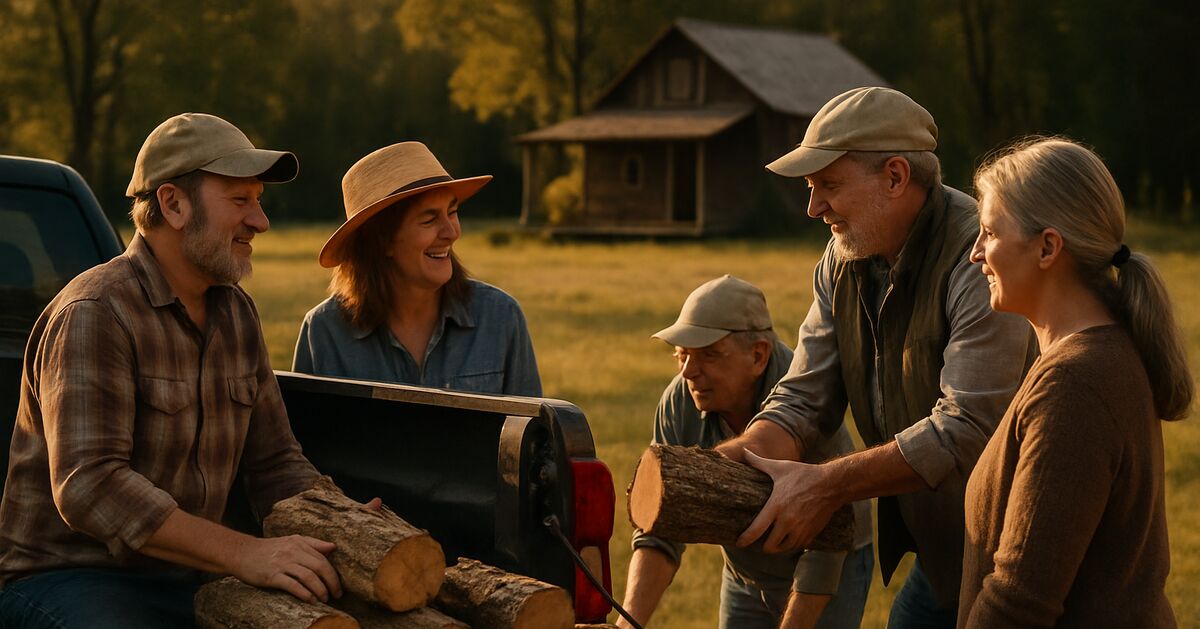
One reason people give up on off-grid living has nothing to do with a dead battery bank or a frozen pipe. It's loneliness. I've read enough forum threads and talked to enough people who sold their off-grid places within two years to notice a pattern among the folks who stick it out: they built a real human network before the isolation set in, not after.
This gets skipped because it's less concrete than sizing a solar array or figuring out how much solar you actually need to live off-grid. Community doesn't show up on a spec sheet. But if you're planning a move, treating it as seriously as your water system or your power system can spare you a kind of burnout that gear won't fix.
Why community matters more than most people admit
Off-grid living is sold as an individualist dream, and there's truth in that. You're not waiting on a utility company, you're not beholden to a landlord, and you're solving your own problems. But "self-reliant" doesn't mean "alone." Every long-term off-gridder I've read about or corresponded with relies on other people for things that are genuinely hard to do solo:
A second set of hands when a tree falls across the driveway or a roof needs re-shingling before the snow flies
Someone who knows the local well drillers, the honest mechanic, the guy who actually answers his phone
A person to call when you're snowed in and the propane truck can't get up the road
Basic mental health maintenance, because long stretches of near-total isolation can wear on people in ways they didn't plan for
There's also a practical safety dimension. If you're hurt and alone on a remote property, "hours away from help" (the phrase you'll see in guides about building an off-grid first-aid kit) becomes a lot less frightening if a neighbor checks in on you regularly. Community isn't a soft add-on to off-grid life. It's part of the infrastructure, right alongside your water and power.
Start looking before you buy land
A mistake I see repeatedly is getting this backwards. They buy land first, then wonder who's out there. Flip the order if you can.
Drive the area at different times of year. A road that looks charming in July can be an impassable ice sheet in January, and the neighbors you meet in summer are a different crowd than the ones who actually live there year-round. If you're serious about a parcel, visit in the worst season before you commit, and while you're there, knock on doors. In my experience, a genuine, respectful introduction tends to land better in rural areas than newcomers expect.
Check for existing informal networks. Volunteer fire departments, feed stores, church groups (even if you're not religious, these are often the actual hub of rural mutual aid), 4-H chapters, and grange halls are where rural community actually happens. Ask the feed store clerk who does hay, who does fencing, who plows driveways in winter. That conversation will teach you more about the real social fabric of an area than any real estate listing.
Look at land access carefully, because it affects your neighbors too. A shared easement or a right-of-way dispute can sour a relationship with the one neighbor you'll depend on most before you've even moved in. This is worth reading up on separately if you haven't already looked into land access and easements, because a legal fight with your closest neighbor is one of the worst possible ways to start off-grid life.
Where to find off-grid-minded people before you move
You don't need to already own land to start building your network. In fact, doing this early can change which piece of land you end up buying.
Regional homesteading and off-grid Facebook groups and forums. Every state and most rural counties have at least one active group. Search "[county name] homesteading" or "[state] off-grid" and you'll usually find something. These groups are where people post about land for sale before it hits the MLS, ask for recommendations on well drillers, and organize skill-shares.
Extension office events. Land-grant universities run county extension offices that host workshops on canning, livestock, forestry management, and soil testing, often free or nearly free. These aren't just educational, they're a built-in room full of people doing exactly what you want to do, in your target region.
Homesteading and prepper expos and swap meets. These vary a lot in quality, but the good ones are full of people who've been doing this for a decade and are happy to talk your ear off about what they wish they'd known. Bring questions, not just business cards.
Online forums with a regional focus, as opposed to generic national ones. A national off-grid forum is good for gear reviews and general knowledge, but a regional one is more likely to cover local building inspectors, power co-op net metering terms, and which counties are friendlier to off-grid builds, since zoning is set locally and you'll need to check your own county's rules.
Amateur radio clubs. This sounds like a tangent, but ham radio is one of the best on-ramps into rural community there is. Local clubs skew toward exactly the kind of self-reliant, technically-minded people who thrive off-grid, and getting licensed gives you a communication backup that doesn't depend on cell towers, which matters a great deal if you're also researching how to fix a weak cell signal off-grid.
Building relationships once you're there
Moving in is where a lot of well-intentioned people fumble. Rural communities, especially ones with a lot of longtime multi-generation families, can be slow to warm up to newcomers, particularly ones who show up with money and opinions about how things should be done.
Show up before you need anything. Introduce yourself at the mailbox, at the feed store, at the volunteer fire department pancake breakfast, before you need to ask anyone for help. Asking a stranger for a favor on day one lands very differently than asking a familiar face for a favor on day sixty.
Contribute labor before you contribute opinions. If there's a community work day, a fence-building project, or a barn raising, show up and work. In small communities, showing up and doing the work tends to build trust faster than friendliness alone.
Learn the local etiquette around land, gates, and dogs. Leaving a gate open that should be closed, or letting a dog roam onto someone's grazing land, will cost you goodwill fast in a way that's hard to rebuild. Ask before you assume.
Don't lead with why you left the city. Plenty of newcomers over-explain their politics or their reasons for "escaping," and it can come across as judgmental of the people who've lived there their whole lives. Lead with curiosity about how things work locally instead.
Be the neighbor you'd want. Offer to check on a place while someone's away, share extra produce, plow a shared stretch of driveway without being asked. Reciprocity is the actual currency of rural life.
Building a mutual aid network intentionally
Beyond casual friendliness, it's worth deliberately mapping out who covers which gaps in your self-reliance plan, because no homestead is actually self-sufficient in isolation. Think through:
Who can help you if a tree comes down across your access road
Who has equipment you don't (a tractor, a stock trailer, a chainsaw mill) that you might trade labor or goods for
Who you'd call first in a medical emergency, and whether they know your property's address and access route
Who checks on you if you go quiet for a few days, and vice versa
This kind of planning pairs naturally with winter isolation planning, because a lot of these arrangements matter most exactly when weather cuts you off. Write these names and numbers down somewhere physical, not just in a phone, because phones die and towers go down.
What to do if you're truly remote
Some off-grid land is genuinely isolated, hours from the nearest town and with only a handful of year-round neighbors. If that's your situation, community looks different but it's still buildable:
Scheduled radio check-ins with other remote households, even just once a week
Online communities that become a real support network even without in-person contact, particularly useful for troubleshooting technical problems like solar wiring or well pumps
Planned town trips that double as social time, not just supply runs
A realistic conversation with yourself and any family about how much isolation you can actually tolerate long-term, since it's hard to judge before you've lived through a full winter of it
If you're homeschooling, isolation affects your kids too, and it's worth reading through practical approaches to homeschooling off-grid with an eye toward the social side, not just the academic one. Co-ops with other homeschooling families, even ones an hour away, can matter as much as the curriculum itself.
The honest tradeoffs
Building community takes time you might rather spend on your homestead, and it can feel inefficient compared to just solving problems yourself. Rural communities can also be insular, political in ways that don't match your own views, or simply slow to trust outsiders no matter what you do. Not every area will be a good social fit, and that's worth weighing as heavily as soil quality or well depth when you're choosing land.
But the alternative, moving to remote land with zero local ties and figuring it out entirely alone, is a much harder version of off-grid living than it needs to be. From what I've seen, the people who make this life work long-term aren't necessarily the most self-sufficient people you'll ever meet. They're the ones who figured out, early, who to call.
If you want more on the practical side of getting a homestead running once you've got your people in place, my start-here page collects my best gear guides by category, and the full blog has deeper dives on everything from water to power to food storage. And if you've got a specific situation you're weighing, whether it's a particular region or a particular kind of isolation, feel free to get in touch. I read everything that comes through, and I'm always looking for real questions to answer in future posts. You can also learn more about why I write this site on the about page.
Claim audit: 12 consequential claims checked against the article's sources; unsupported wording revised where it could not be substantiated.
Claim-by-claim audit (12 checked)
“One reason people give up on off-grid living has nothing to do with a dead battery bank or a frozen pipe. It's loneliness.” (rewritten to what the article can stand behind)
“But if you're planning a move, treating it as seriously as your water system or your power system can spare you a kind of burnout that gear won't fix.” (rewritten to what the article can stand behind)
“Basic mental health maintenance, because long stretches of near-total isolation can wear on people in ways they didn't plan for” (rewritten to what the article can stand behind)
“If you're hurt and alone on a remote property, "hours away from help" (the phrase you'll see in guides about [building an off-grid first-aid kit](/blog/building-an-off-grid-first-a…” (cited → michigan.gov)
“In my experience, a genuine, respectful introduction tends to land better in rural areas than newcomers expect.” (rewritten to what the article can stand behind)
“A shared easement or a right-of-way dispute can sour a relationship with the one neighbor you'll depend on most before you've even moved in.” (reasoning shown in the article)
“A national off-grid forum is good for gear reviews and general knowledge, but a regional one is more likely to cover local building inspectors, power co-op net metering terms, and …” (rewritten to what the article can stand behind)
“In small communities, showing up and doing the work tends to build trust faster than friendliness alone.” (rewritten to what the article can stand behind)
“Beyond casual friendliness, it's worth deliberately mapping out who covers which gaps in your self-reliance plan, because no homestead is actually self-sufficient in isolation.” (cited → extension.missouri.edu)
“Write these names and numbers down somewhere physical, not just in a phone, because phones die and towers go down.” (reasoning shown in the article)
“A realistic conversation with yourself and any family about how much isolation you can actually tolerate long-term, since it's hard to judge before you've lived through a full wint…” (rewritten to what the article can stand behind)
“From what I've seen, the people who make this life work long-term aren't necessarily the most self-sufficient people you'll ever meet.” (rewritten to what the article can stand behind)
Before you go
One useful off-grid email a week.
Practical gear rundowns, honest how-tos, and plain-English guides from someone doing the homework in the open.
I am building a place for off-grid people to swap real answers: a forum by topic, classifieds for gear and services, and real estate for off-grid land and homes. It is new, so the early members shape what it becomes. A free account lets you post in all three.
No ER ten minutes away means you have to be your own triage nurse. Here's how to tell a bad bee sting from the real emergency, and what to actually stock.
In many off-grid disasters, the fire or flood itself isn't the decisive factor, it's the hour you waited too long to leave. Here's how to set real, numeric triggers before you need them.
Tax sale and sheriff's auction land looks like a bargain, but redemption periods, hidden liens, and unseen parcels turn a lot of cheap acreage into an expensive lesson. Here's how to vet a listing before you bid.