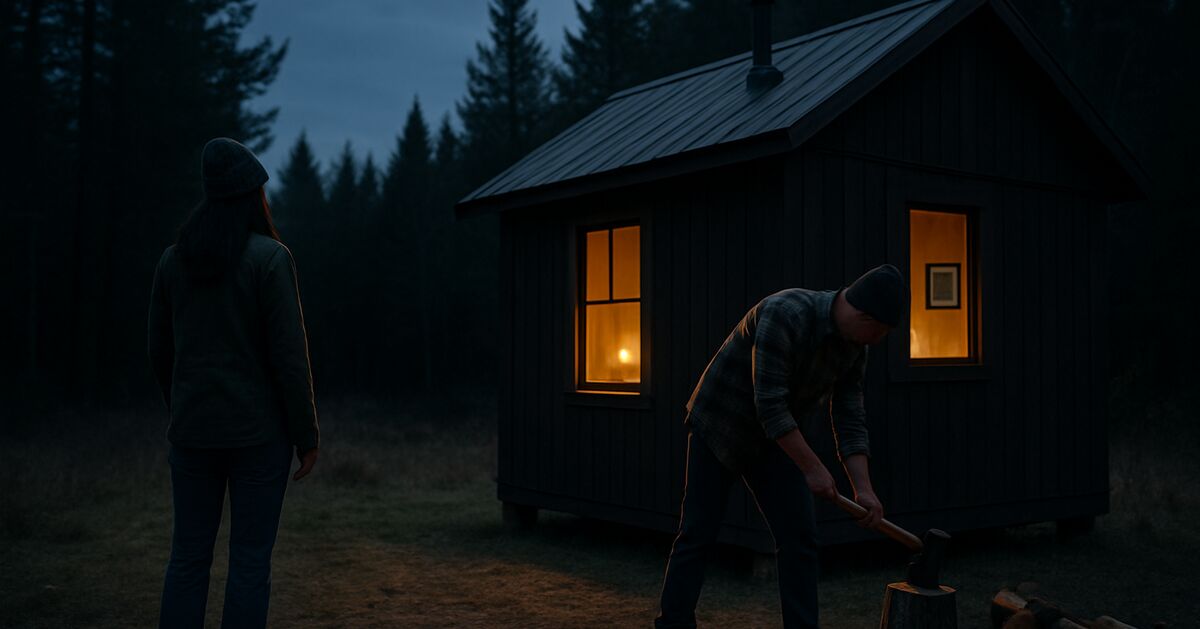
The gear list for going off-grid gets all the attention: solar arrays, wood stoves, water systems. Nobody puts "learn to fight fair with your spouse in a 400 square foot cabin" on a checklist, but it probably belongs closer to the top than a lot of the hardware does.
I've spent a lot of time reading forums, talking to people further down this road than me, and researching what actually breaks off-grid moves before the well runs dry or the batteries die. In those conversations, the answer that came up most often for me was relationships. Not soil pH. Not solar math. People.
This piece is about that specific, under-discussed angle: what off-grid living does to marriages, partnerships, friendships, and family ties, and what you can actually do about it before it becomes a crisis.
Why off-grid life is a pressure cooker for relationships
Living off-grid strips away a lot of the buffers that modern life gives relationships without anyone noticing they're there. In town, if you and your partner are getting on each other's nerves, you can go to work, meet a friend for coffee, take a long drive, or just have separate rooms with a door that closes and a television in each one. Off-grid, especially in the first year, a lot of that space disappears.
You're often in a smaller structure than you're used to. You're doing physical work together, all day, that has real consequences if it goes wrong (a botched fence job, a frozen pipe, a missed harvest window). Money is tighter and more visible, since off-grid infrastructure costs real cash up front, the kind of numbers I go into in detail in my honest breakdown of the real annual cost of self-reliance. And you're likely more isolated from outside friendships that used to absorb some of the emotional load you're now putting entirely on each other.
None of that means off-grid life is bad for relationships. Some couples and families describe coming through it closer than they went in. But it is a different kind of pressure than a normal move, and pretending it isn't is how good partnerships get quietly worn down.
The specific stress patterns that show up
A few patterns come up again and again in accounts from people who've actually done this, and they're worth naming so you can recognize them early rather than after they've calcified into resentment.
Skill imbalance turning into a power imbalance. Often one partner has done more of the research, has more of the mechanical or building skill, or simply has more confidence about the move. That person can slide into being the default decision maker on everything, which starts to feel less like partnership and more like being managed. This shows up especially around big systems, like when one person understands the solar setup and wiring and the other doesn't, similar to the kind of gap I try to close in my guide to wiring an off-grid solar system safely. If only one person in the household understands how the power works, that person becomes the only one who can fix it, which is exhausting for them and disempowering for everyone else.
Different tolerances for discomfort and risk. One partner might be genuinely fine with an outhouse, a slow internet connection, and a woodstove that needs tending at 3am. The other might be gritting their teeth through all of it, unwilling to say so because they don't want to be the one who "ruins" the dream. If it isn't talked about, that gap can widen rather than close over the first year.
Loss of individual identity. In town, people often have jobs, friend groups, and hobbies that are entirely their own. Off-grid, especially in a two-person household on a shared property, a huge amount of daily life becomes joint. That can be lovely, but it can also mean each person loses the separate identity that gave them somewhere to retreat to when the relationship itself was stressed.
Family and friends who don't get it. Parents, siblings, and old friends may react to an off-grid move with a mix of worry, judgment, and distance. Some relationships that used to be close start to feel strained because the two of you no longer share a frame of reference for daily life. That loss is real and worth grieving rather than dismissing.
What actually helps before you move
The good news is that almost everything above is predictable, which means it's plannable. A few things genuinely help, based on what people who've navigated this well tend to describe doing.
Talk about the discomfort tolerance gap honestly, before the move, not during it. Sit down and go through specifics: how do you each feel about an outhouse in January, about no hot shower some mornings, about spotty internet, about neighbors being 20 minutes away. Don't let one person's enthusiasm steamroll the other's honest hesitation. If there's a real gap, address it directly, maybe by phasing the move, keeping a town apartment for the first year, or agreeing on non-negotiables (a real toilet indoors, reliable hot water) that make the discomfort tolerable for the less-enthusiastic partner. If a composting toilet is on the table, it's worth both partners actually understanding how the options work and what daily life with one is really like, which I lay out plainly in composting toilets explained, rather than one person assuming and the other discovering.
Split the skills, on purpose. Don't let the wiring, the well, the wood stove, and the food storage all become one person's exclusive domain. Even if one partner naturally takes the lead on something, make sure the other one learns enough to do it solo if needed. This isn't just practical for emergencies, it's protective for the relationship, because nobody wants to feel like a permanent apprentice in their own home.
Build in individual space and individual identity, deliberately. This might mean a small building or even just a room that's genuinely one person's own, a regular solo trip into town, a hobby that has nothing to do with the homestead, or a standing video call with an old friend using whatever connectivity you've set up (my Starlink setup guide and related connectivity pieces are worth reading before you assume you'll be totally cut off). The goal isn't to recreate town life, it's to make sure the relationship isn't the only source of stimulation and identity for either person.
Get ahead of the money conversations. Before the move, agree on a realistic budget and a plan for what happens when something costs more than expected, because something usually will. In my experience money fights are often less about the amount and more about surprise and blame. A shared, honest number going in defuses a lot of that.
Keep outside relationships alive on purpose. Off-grid life naturally narrows your social circle, and family or old friends may drift if you let the distance be passive. Schedule visits. Use whatever internet or cell setup you have, including boosting a weak signal if you need to (see boosting a weak cell signal off-grid for the practical side), to keep real conversations going rather than just texts. If you're planning to homeschool, that adds another layer of togetherness worth planning for deliberately, something I go into in my guide to homeschooling off-grid.
When to actually worry
Some tension is normal and even healthy, it means people are being honest instead of just going along. But there are signs worth taking seriously rather than writing off as "just an adjustment period."
Watch for a partner going quiet and disengaged rather than arguing, ongoing resentment that isn't being talked about, one person making all the real decisions while the other just complies, or either partner using isolation itself as a kind of leverage ("where else would you even go"). Isolation can make controlling dynamics harder to spot, since there are fewer outside friends and family around to notice and challenge them. If you notice any of that, in yourself or your partner, it's worth addressing directly and, if needed, getting outside perspective from a counselor before the move, even if that means a few sessions over video call while you're still near town.
It's also worth having a real conversation, before you move, about what the exit plan looks like if it truly isn't working, for either of you. That's not planning to fail. It's the same kind of honest risk planning you'd do for land access and easements before an off-grid buy or securing a remote property, just applied to the relationship instead of the land.
Before the move, it's worth actively researching what community exists near the land you're considering: a local grange, a church, a homesteading meetup, even a regular farmers market. These don't replace a solid partnership, but they take pressure off it by giving both of you outside outlets, which is easy to overlook when you're busy pricing out solar panels and well depth.
The bottom line
Off-grid life can be genuinely good for relationships. Shared physical work, shared purpose, and fewer distractions can bring couples and families closer than town life did. But that outcome isn't automatic, and it isn't guaranteed by good gear or a solid cabin. It comes from the same things that make any relationship work: honest conversation, fair distribution of power and skill, protected individual space, and a willingness to name problems before they calcify.
If you're planning a move, I'd put "have the hard conversations" on the checklist right next to "size the solar array." It's less fun to research, but it might matter more. If you want to dig into the practical systems side of the move while you're working through the relational side, my start-here page collects the gear and systems guides by category, and I'm always glad to hear from readers working through their own version of this at my contact page. You can also read more about why I write about this side of off-grid life, not just the hardware, on my about page.
Claim audit: 9 consequential claims checked against the article's sources; unsupported wording revised where it could not be substantiated.
Claim-by-claim audit (9 checked)
“In those conversations, the answer that came up most often for me was relationships.” (rewritten to what the article can stand behind)
“Some couples and families describe coming through it closer than they went in.” (rewritten to what the article can stand behind)
“If it isn't talked about, that gap can widen rather than close over the first year.” (rewritten to what the article can stand behind)
“Parents, siblings, and old friends may react to an off-grid move with a mix of worry, judgment, and distance.” (rewritten to what the article can stand behind)
“In my experience money fights are often less about the amount and more about surprise and blame.” (rewritten to what the article can stand behind)
“Off-grid life naturally narrows your social circle, and family or old friends may drift if you let the distance be passive.” (reasoning shown in the article)
“Isolation can make controlling dynamics harder to spot, since there are fewer outside friends and family around to notice and challenge them.” (rewritten to what the article can stand behind)
“Isolation from a broad community, not just a spouse, is its own risk factor for mental strain, something worth reading alongside [the winter dip and managing seasonal depression be…” (cited → nimh.nih.gov)
“Shared physical work, shared purpose, and fewer distractions can bring couples and families closer than town life did.” (rewritten to what the article can stand behind)
Before you go
One useful off-grid email a week.
Practical gear rundowns, honest how-tos, and plain-English guides from someone doing the homework in the open.
I am building a place for off-grid people to swap real answers: a forum by topic, classifieds for gear and services, and real estate for off-grid land and homes. It is new, so the early members shape what it becomes. A free account lets you post in all three.
No ER ten minutes away means you have to be your own triage nurse. Here's how to tell a bad bee sting from the real emergency, and what to actually stock.
In many off-grid disasters, the fire or flood itself isn't the decisive factor, it's the hour you waited too long to leave. Here's how to set real, numeric triggers before you need them.
Tax sale and sheriff's auction land looks like a bargain, but redemption periods, hidden liens, and unseen parcels turn a lot of cheap acreage into an expensive lesson. Here's how to vet a listing before you bid.