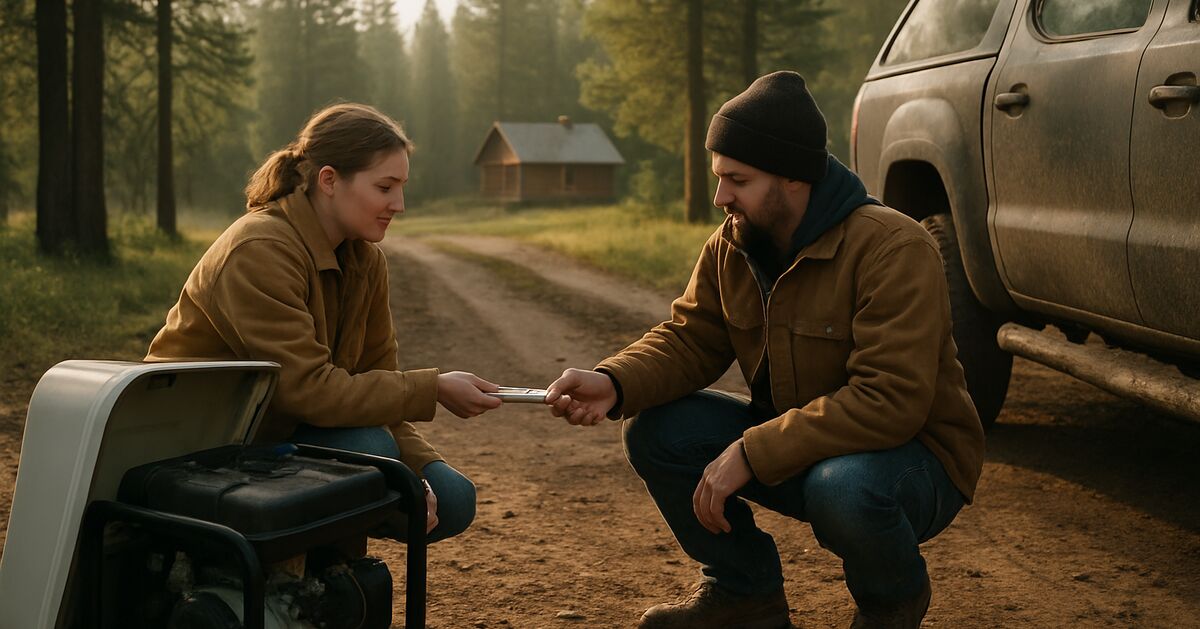
The first time your truck is stuck in mud a quarter mile from your own driveway, you find out fast what your standing in the neighborhood actually is. Not what you think it is. What it actually is, measured in how many trucks show up, how fast, and whether anyone seems glad to be there.
That standing isn't built with a bottle of whiskey at Christmas or a friendly wave at the mailbox. It's built with skills. Specifically, with skills your neighbors can name when someone asks "who do you call for that." Off-grid communities run on a quiet ledger of who is useful for what, and getting yourself onto that ledger, in a good column, is one of the most practical things you can do in your first year on the land.
This is different from the general advice about "getting to know your neighbors" or setting up a barter and trade circle. Those are about relationships and systems. This is about something narrower and more concrete: what specific, nameable skill are you bringing to the table, how do you make it known without bragging, and how do you keep that reputation once you have it. It's the difference between being liked and being needed. Both matter. Only one of them gets your driveway plowed at 6 a.m. in a whiteout.
Why skill reputation matters more off-grid
In a subdivision, nobody needs to know you can weld. There's a shop twenty minutes away and a guy on an app who'll show up same day. Off-grid, the nearest welder might be an hour off pavement, booked out two weeks, and not answering his phone because he's out checking cattle. The gap between "there's a service for that" and "there's nobody for that" is where rural and off-grid neighbors become each other's infrastructure.
This isn't romantic. It's economic. A community where five households each have a genuinely useful, specific skill, and know that about each other, effectively has access to a small business's worth of capability without anyone paying retail or driving two hours. A chainsaw-competent neighbor who can also fell a leaning tree safely is worth more to you in a windstorm than a chainsaw you don't know how to use correctly. A neighbor who can diagnose why your well pump tripped the breaker for the third time this month, over the phone, in five minutes, has just saved you a service call and half a day.
The people who get folded into this web early are the ones whose skills got known early, and known accurately. Not "handy" (too vague to act on) but "can rebuild a carburetor," "used to do EMT work," "grew up on a dairy," "does bookkeeping and knows how to read a lease." Specific enough that when a real need shows up, your name is the first one that comes to mind.
The mistake most newcomers make
Some people moving off-grid try to build community the polite way: potlucks, waving, dropping by with baked goods, joining the volunteer fire department's fundraiser. All fine. None of it tells anyone what you're actually good for.
The bigger mistake is the opposite one: showing up and immediately trying to prove competence you don't fully have. Rural communities have long memories for the guy who confidently offered to help with a controlled burn and nearly took out a fence line, or the woman who "used to do wiring" and left a junction box that made the next electrician swear under his breath for twenty minutes. In our experience, overclaiming a skill tends to cost more reputation than quietly having no skill at all, because the failure gets remembered and retold. It's better to say "I don't know that one yet, but I'm handy and I learn fast" than to fake competence you'll get exposed on the first real test.
The fix is to be honest about your current skill level, then deliberately close the gap on one or two things that are both genuinely useful in your area and things you can practice safely before you're tested for real. That's the 90-day shakedown mindset applied to yourself, not just your systems: test your skills before the emergency does.
Figuring out what's actually in demand
Every rural pocket has its own shortage list. Before you decide what skill to build or advertise, spend a few months just listening. Ask around, casually, what people wish they had more of. Common shortages in off-grid and rural communities:
Small engine repair (generators, pumps, chainsaws, ATVs)
Basic electrical and solar troubleshooting
Livestock handling, especially birthing assistance and basic vet-adjacent skills
Welding and metal fabrication
Chainsaw work and safe tree felling
Basic plumbing, especially well and septic systems
Medical or EMT-level first response
Bookkeeping, tax prep, or navigating county paperwork
Internet and radio troubleshooting
Canning, food preservation, and butchering
Notice how narrow and physical most of these are. That's the point. "I'm good with computers" is not rural currency unless it means "I can get your radio or weak cell signal working." Translate your existing skills into the specific problems your neighbors actually have.
If you already have a trade, a lot of this work is done for you. If you don't, pick one thing from the shortage list that overlaps with something you're already halfway competent at, and go deep on it over a winter. Small engine repair is a particularly good choice for newcomers: the barrier to entry is low, the parts are cheap to practice on (buy a dead generator off a local listing for parts money), and rural households tend to own something with a small engine that eventually breaks.
Building the skill without faking it
Books and videos get you started, but the skill that actually earns trust is the one that's been tested on real, ugly, non-textbook problems. A few ways to get there honestly:
Apprentice yourself, informally. Find the person in your area who already does the thing well and ask if you can help on their next job for free, just to learn. Plenty of rural tradespeople and old-timers are glad to be asked and happy to have an extra pair of hands, though some will say no. This is also how you get folded into the local network in the first place, since it comes with an implicit vouch: "he worked with me on the Hendersons' well, he's alright."
Practice on your own gear first. Your own generator, your own truck, your own fence line. Make your mistakes where the only cost is your own time and money.
Take the actual class where one exists. Wilderness first responder courses, extension office livestock clinics, welding classes at a community college, ham radio licensing sessions. These aren't just skill-building, they're also where you meet other serious people, which is its own form of community building.
Keep a repair log. Write down what broke, what you tried, what worked. Six months in, you'll be shocked how much you've actually learned, and you'll have real answers ready when someone asks "have you ever dealt with X."
Letting people know without bragging
The delivery matters as much as the skill. Nobody trusts the guy who announces his own competence. What works instead:
Mention it in context, not as a pitch. "Oh, that sounds like your alternator, not your battery, I had the same thing happen last winter" tells people what you know without a sales pitch attached.
Offer small, low-stakes help first. Look at a neighbor's ailing chainsaw for ten minutes at a gathering. Small favors that go well are the fastest way onto the mental ledger.
Let other people vouch for you. If you helped the Hendersons with their well, let that story travel on its own. It will, in a small community, faster than you'd think.
Show up reliably to shared work, like helping stack someone's firewood or getting a stuck vehicle out. Physical presence at unglamorous group tasks builds trust as much as any specific skill does.
This is the same slow-build logic behind finding your people before you move off-grid, just aimed at a sharper target: not just being known, but being known for something specific and useful.
The reciprocity trap, and how to avoid it
Once you're known for a skill, you will get asked for it, sometimes a lot, sometimes at inconvenient times. This is where a lot of newcomers either burn out or overcorrect into resentment. A few things that keep this sustainable:
Set an honest personal policy early, before you need one. Maybe that's "free for genuine emergencies, barter or cash for planned jobs." Maybe it's "I'll teach you to do it yourself rather than doing it for you every time," which is often the more generous long-term move anyway, since it grows the whole community's capability instead of making everyone dependent on you specifically.
Don't keep a strict mental scoreboard, but don't be a doormat either. Rural mutual aid often works on rough, long-run reciprocity rather than tit-for-tat, so tracking every favor too tightly can read as distrust. If you give freely and never ask for anything back, requests can pile up without anyone meaning to overload you. Somewhere in the middle is sustainable.
Be honest about your limits, especially medical ones. If your skill overlaps with health or safety, like basic first response or something adjacent to the deeper medical self-reliance skills worth building off-grid, be very clear about where your competence ends and a real clinic or hospital trip begins. Reputation built on genuine limits held honestly lasts. Reputation built on overreach collapses fast, usually at the worst possible moment.
This compounds faster than you'd expect
The quiet secret is that this kind of standing compounds. The neighbor who fixed your pump last spring is more likely to mention your name when someone three properties over needs the same thing. Being useful once tends to generate more chances to be useful, and each one adds to a reputation that eventually does a lot of your community-building for you, without a single potluck.
It also changes how isolated off-grid life actually feels day to day. A lot of the social drift that off-grid living can quietly cause comes from having no functional reason to interact with neighbors beyond pleasantries. Being genuinely useful to each other gives you a reason to be in contact that isn't performative, and that kind of contact tends to hold up better over years than friendliness alone.
None of this needs to be fast. A reputation like this can take a year or two to solidify, and that's fine. Start with one skill, get honestly good at it over a season, let it be known through small acts rather than announcements, and keep your limits clear. That's the whole method. It's slower than joining a barter circle or building a phone tree, but it's also the thing that makes both of those work better once they exist, because they're built on people who've already proven, in small ways, that they're worth counting on.
If you're still early in planning your move and want more on how these pieces fit together, our blog has deeper dives on the systems side, and the FAQ covers a lot of the "is this actually realistic" questions people ask before they commit. And if you've got a specific angle you think we're missing, the contact page reaches us directly, we read everything.
Claim audit: 7 consequential claims checked against the article's sources; unsupported wording revised where it could not be substantiated.
Claim-by-claim audit (7 checked)
“A neighbor who can diagnose why your well pump tripped the breaker for the third time this month, over the phone, in five minutes, has just saved you a service call and half a day.” (rewritten to what the article can stand behind)
“In our experience, overclaiming a skill tends to cost more reputation than quietly having no skill at all, because the failure gets remembered and retold.” (rewritten to what the article can stand behind)
“Plenty of rural tradespeople and old-timers are glad to be asked and happy to have an extra pair of hands, though some will say no.” (rewritten to what the article can stand behind)
“Rural mutual aid often works on rough, long-run reciprocity rather than tit-for-tat, so tracking every favor too tightly can read as distrust.” (rewritten to what the article can stand behind)
“If you give freely and never ask for anything back, requests can pile up without anyone meaning to overload you.” (rewritten to what the article can stand behind)
“A reputation like this can take a year or two to solidify, and that's fine.” (rewritten to what the article can stand behind)
“Being useful once tends to generate more chances to be useful, and each one adds to a reputation that eventually does a lot of your community-building for you, without a single pot…” (reasoning shown in the article)
Before you go
One useful off-grid email a week.
Practical gear rundowns, honest how-tos, and plain-English guides from someone doing the homework in the open.
I am building a place for off-grid people to swap real answers: a forum by topic, classifieds for gear and services, and real estate for off-grid land and homes. It is new, so the early members shape what it becomes. A free account lets you post in all three.
No ER ten minutes away means you have to be your own triage nurse. Here's how to tell a bad bee sting from the real emergency, and what to actually stock.
In many off-grid disasters, the fire or flood itself isn't the decisive factor, it's the hour you waited too long to leave. Here's how to set real, numeric triggers before you need them.
Tax sale and sheriff's auction land looks like a bargain, but redemption periods, hidden liens, and unseen parcels turn a lot of cheap acreage into an expensive lesson. Here's how to vet a listing before you bid.