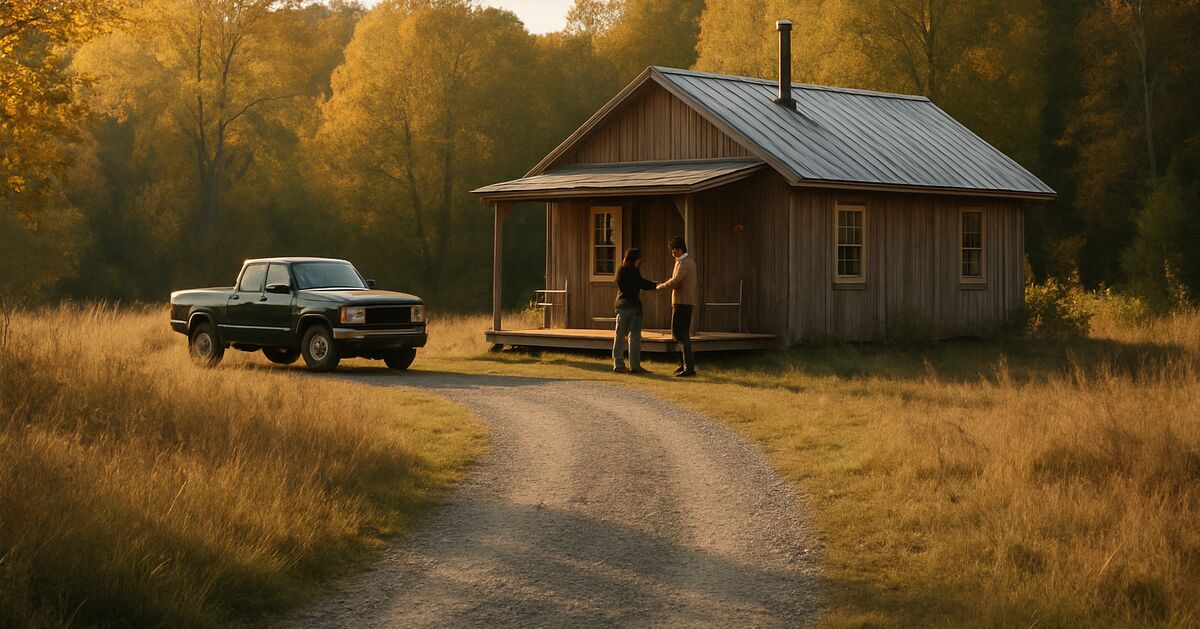
The first year off-grid, people are curious. Friends drive out to see the cabin. Family visits over holidays because it's a novelty. You still make an effort to get to town for errands, and you run into people. Then year two arrives, and the calendar goes quiet. The novelty has worn off for everyone else, and you've settled into a rhythm that doesn't require leaving the property much at all. That's the moment social drift starts, and it can be harder to catch than a single hard week of loneliness, because it doesn't feel like a crisis. It feels like peace and quiet. Until it doesn't.
This is a different problem than the isolation of living alone day to day, which we've covered in keeping your mind steady when you live and work alone. Social drift can happen even to couples, even to families with kids underfoot all day. It's not about the absence of people in your house. It's about the slow erosion of your connection to people outside your house, and how easy it is to not notice until you're genuinely cut off.
Why the drift happens and why it's sneaky
Off-grid life rewards self-sufficiency. You solve your own problems: the pump, the stove, the fence, the garden. Over time this builds a kind of psychological momentum where asking for help, or even just showing up somewhere without a task attached, starts to feel unnecessary or even a little foreign. You stop going to the feed store because you learned to order in bulk. You stop going to church or the community hall because the drive is long and you're tired. You stop calling old friends because the conversation always turns into explaining your life choices, and that gets old.
None of these are bad decisions individually. Each one, on its own, is efficient and reasonable. The problem is they compound. A parcel of small, sensible withdrawals adds up to a life where you might go three or four weeks without a real face to face conversation that isn't with your spouse or your kids. That's not resilience. That's isolation wearing the costume of self-reliance.
The tricky part is that this drift rarely feels bad while it's happening. It often feels like relief. Fewer obligations, fewer people needing things from you, fewer awkward small talk sessions at the co-op. The cost shows up later, usually as a flatness you can't quite name, or an irritability that seems disproportionate to whatever triggered it, or a sense that problems feel heavier than they used to. By the time you notice, the muscle for reaching out has already gone soft.
The specific markers to watch for
Generic advice to "stay connected" isn't useful because it doesn't tell you what to actually track. Here are concrete markers that indicate drift is happening, not just a normal quiet stretch:
You can't remember the last time you had a conversation with someone that wasn't about logistics, weather, or a task.
Invitations you used to say yes to, you now find reasons to decline, and the reasons feel completely legitimate every time.
You've stopped initiating contact with anyone. All your remaining social contact is other people reaching out to you.
A friend or family member has mentioned, even jokingly, that they "never hear from you anymore."
Your trips to town have shrunk to the minimum necessary errands, done as fast as possible, with no lingering.
You feel a flash of dread, not relief, at the thought of a visitor showing up unannounced.
That last one matters most. Genuine peace with solitude doesn't come with dread of interruption. Dread at the idea of another human being in your space may be a sign your tolerance for social contact has shrunk, and in my experience that is worth checking on early.
Building structural reasons to leave the property
The fix isn't willpower, it's structure. Waiting until you "feel like" reconnecting is risky, since the longer you go without contact the less likely you are to want to start. You need standing appointments that exist independent of your mood on any given week.
A few structures that actually hold up over time:
A recurring town day. Not "go to town when we need something," but a fixed day, say every other Thursday, where you go regardless of whether you strictly need anything. Attach it to something social if you can: a diner counter where you know the regulars, a farmers market, a library. The errand is the excuse. The contact is the point.
A standing commitment with a consequence. A volunteer shift, a class, a shared project with someone outside your household. The key is that it's something other people are counting on you for, because that kind of obligation survives low motivation in a way that purely optional social plans don't.
Trading favors on purpose. If you're part of a barter and trade circle with neighbors, lean on it not just for the practical value but for the built in reason to interact. Swapping eggs for firewood, or trading a hand with a fence for help with a tractor, keeps you in regular contact with people who aren't your spouse, and it does it under a low pressure, task oriented banner that's easy to say yes to even when you're feeling withdrawn.
Deliberately kept phone habits. A short weekly call to a parent, sibling, or old friend, scheduled like an appointment rather than left to chance. If your connectivity is spotty, this might mean planning around your cell signal boosting setup or your Starlink window, but the scheduling matters more than the technology.
When kids or a partner mask the problem
Families sometimes assume that having people in the house solves the isolation problem entirely. It doesn't. Many parents want their kids to have peer contact and adult role models beyond their parents, something covered in more depth in the context of homeschooling without wifi, and a marriage under the strain that off-grid life can bring, discussed in the relationship strain nobody warns you about, is unlikely to get easier when both people are isolated. A couple that only ever talks to each other, day after day, month after month, can end up routing all their stress through one relationship instead of a wider network. That's a lot of weight for two people to carry alone.
If you have kids, treat their social contact with other kids and other adults as non negotiable, not a nice extra. If you have a partner, make sure each of you has at least one outside relationship that doesn't run through the other person. It sounds small. It matters enormously when things get hard.
Reading your own resistance honestly
Here's the uncomfortable part. When drift sets in, your own judgment about whether you need people is worth double checking, since the habit of being alone can make being alone feel like the obvious preference. This is worth taking seriously rather than dismissing as overthinking.
A useful gut check: imagine a friend described your exact social pattern to you, second hand, about their own life. Would you think it sounded healthy, or would you quietly worry about them? I find it easy to judge my own withdrawal more generously than I would judge a friend's identical withdrawal. Use that gap. If you'd worry about a friend living this way, take your own worry seriously too.
It's also worth being honest that some withdrawal is legitimate. Not everyone needs constant socializing, and plenty of people move off-grid specifically because they're drained by crowds and small talk. The goal here isn't to force extroversion onto someone who's genuinely content with quiet. The goal is to catch the difference between chosen solitude, which feels calm and full, and drifted isolation, which feels flat, defensive, and a little afraid of interruption.
What to do if you're already there
If you read this and recognized your own life in it, the fix doesn't need to be dramatic. Don't try to reverse months of drift with one big trip to town or a flurry of phone calls, since a sudden burst can leave you drained and convinced that socializing is exhausting.
Start smaller. Pick one standing commitment and put it on the calendar for the next four weeks straight, no exceptions, no "we'll see how we feel." Tell one person in your life, honestly, that you've noticed you've gone quiet and you're working on it. Naming it out loud to someone else can help break the pattern, because it puts a witness on your recovery.
If the flatness has gone past ordinary drift into something that feels like real depression, low energy that doesn't lift, loss of interest in things you used to enjoy, sleep or appetite changes, treat that as its own problem worth real attention, similar in seriousness to the seasonal dip covered in our winter depression piece, and don't assume more socializing alone will fix a clinical level problem. Off-grid living doesn't mean giving up access to a doctor or counselor when you need one, even if that access requires more planning than a quick appointment in town.
The long view
The people I know who do off-grid life well for decades, not just survive a first winter but actually thrive for twenty or thirty years, have this figured out. They've built a life that's self-reliant on the practical side, water, power, food, shelter, while staying deliberately porous on the social side. They let people in. They go out. They keep the door, literally and figuratively, from rusting shut.
Self-reliance was never supposed to mean solitary. It means not depending on anyone for your survival needs, which frees you up to depend on people for the things that actually make a life worth living: conversation, shared meals, someone who notices if you've gone quiet. If you want a deeper look at how to build that web of connection before you even move out, our piece on finding your people before you move off-grid is a good companion to this one. And if you're still working out the basics of your setup and want more grounded, no hype guidance on the things that actually matter, our blog index and FAQ cover the practical side while this piece covers the part that's just as real but harder to measure.
Guard the visits. Keep the calendar. The land will always be there when you get back.
Claim audit: 10 consequential claims checked against the article's sources; unsupported wording revised where it could not be substantiated.
Claim-by-claim audit (10 checked)
“That's the moment social drift starts, and it can be harder to catch than a single hard week of loneliness, because it doesn't feel like a crisis.” (rewritten to what the article can stand behind)
“Dread at the idea of another human being in your space may be a sign your tolerance for social contact has shrunk, and in my experience that is worth checking on early.” (rewritten to what the article can stand behind)
“Waiting until you "feel like" reconnecting is risky, since the longer you go without contact the less likely you are to want to start.” (rewritten to what the article can stand behind)
“The key is that it's something other people are counting on you for, because that kind of obligation survives low motivation in a way that purely optional social plans don't.” (reasoning shown in the article)
“Many parents want their kids to have peer contact and adult role models beyond their parents, something covered in more depth in the context of [homeschooling without wifi](/blog/h…” (rewritten to what the article can stand behind)
“A couple that only ever talks to each other, day after day, month after month, can end up routing all their stress through one relationship instead of a wider network.” (rewritten to what the article can stand behind)
“When drift sets in, your own judgment about whether you need people is worth double checking, since the habit of being alone can make being alone feel like the obvious preference.” (rewritten to what the article can stand behind)
“Don't try to reverse months of drift with one big trip to town or a flurry of phone calls, since a sudden burst can leave you drained and convinced that socializing is exhausting.” (rewritten to what the article can stand behind)
“Naming it out loud to someone else can help break the pattern, because it puts a witness on your recovery.” (rewritten to what the article can stand behind)
“If the flatness has gone past ordinary drift into something that feels like real depression, low energy that doesn't lift, loss of interest in things you used to enjoy, sleep or ap…” (cited → nimh.nih.gov)
Before you go
One useful off-grid email a week.
Practical gear rundowns, honest how-tos, and plain-English guides from someone doing the homework in the open.
I am building a place for off-grid people to swap real answers: a forum by topic, classifieds for gear and services, and real estate for off-grid land and homes. It is new, so the early members shape what it becomes. A free account lets you post in all three.
No ER ten minutes away means you have to be your own triage nurse. Here's how to tell a bad bee sting from the real emergency, and what to actually stock.
In many off-grid disasters, the fire or flood itself isn't the decisive factor, it's the hour you waited too long to leave. Here's how to set real, numeric triggers before you need them.
Tax sale and sheriff's auction land looks like a bargain, but redemption periods, hidden liens, and unseen parcels turn a lot of cheap acreage into an expensive lesson. Here's how to vet a listing before you bid.