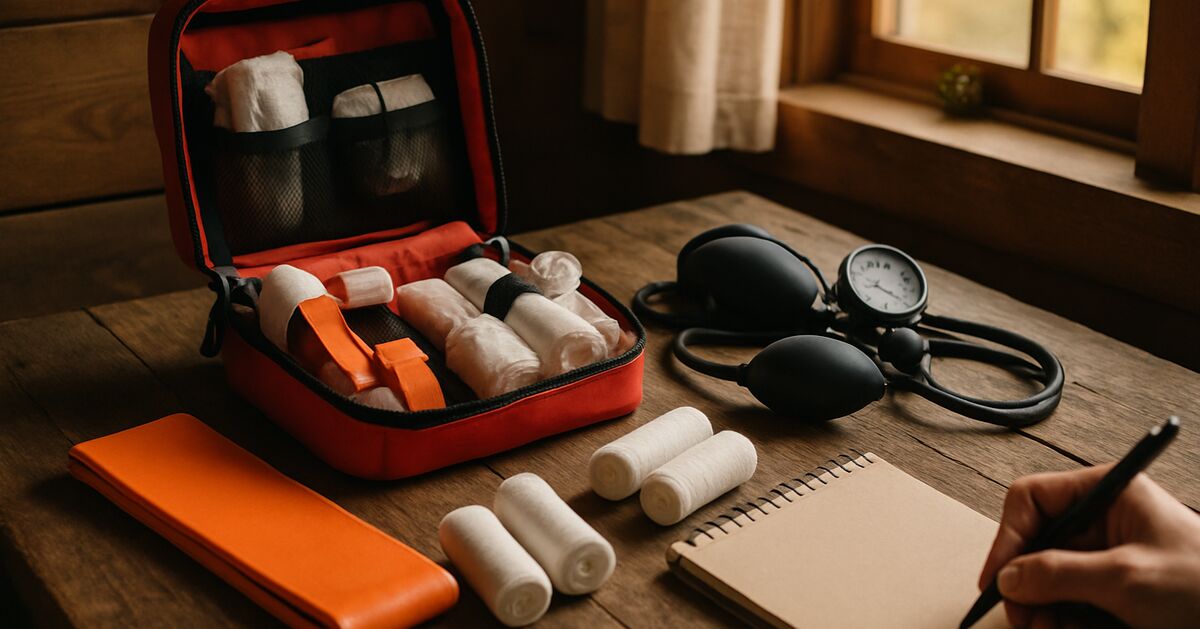
A well-stocked first-aid kit will not set a broken arm, and it will not tell you whether that fever in your kid is a virus or something that needs a two-hour drive to the ER right now. If you've spent any time researching off-grid life, you've probably already built or bought a first-aid kit for when help is hours away. That's the easy part. The harder, more important work is everything that kit assumes you already know how to do.
Medical self-reliance off-grid isn't about becoming a paramedic in your spare time. It's about closing the gap between "something happened" and "help arrives," which off-grid can be minutes, hours, or in bad weather, days. That gap is where people either handle a problem calmly and competently, or watch it get worse because nobody in the house knew what to do next.
This is the piece I didn't want to think about before I moved, and a regret I hear again and again from people already living somewhere remote.
Why this is different off-grid
In town, "call 911" is a real plan. Off-grid, it's a starting point that comes with caveats. Emergency response can take far longer in rural areas than in town, and that's if your address is easy to find, your road is passable, and you have a way to actually call. If you're relying on a boosted cell signal or a satellite messenger, add the time it takes to get a signal out and get a clear answer back.
Weather makes it worse. The same storm that snows in your road for weeks is the storm most likely to also keep an ambulance from reaching you, or a medevac helicopter from flying. Anyone who has read through winter isolation planning already understands that isolation cuts both ways: it keeps you in, and it keeps help out.
The honest takeaway is that off-grid living shifts real medical risk and real medical responsibility onto you and whoever you live with. That's not meant to scare you off the lifestyle. It's meant to get you to prepare for it deliberately, instead of hoping it never comes up.
Start with training, not gear
Gear is satisfying to buy. Training is the part people skip, and it's the part that actually matters. A first-aid kit in the hands of someone with no training is mostly just clean bandages and a false sense of security.
At minimum, plan on:
Wilderness First Aid (WFA): a short course, often taught over a weekend, that covers injuries and illnesses common in a remote setting: sprains, fractures, wounds, allergic reactions, hypothermia, heat illness, and how to make decisions when evacuation isn't quick. Check course length with the provider.
Wilderness First Responder (WFR): a much longer course aimed at people who may be the only medical response for an extended period. If you're the primary adult on a remote property, this is worth the time investment.
CPR and AED certification: cheap, widely available, and directly useful. Cardiac events don't wait for convenient timing.
Stop the Bleed: a short course focused specifically on severe bleeding, tourniquet use, and wound packing; check local pricing and availability. Chainsaws, axes, livestock, and machinery all carry a risk of serious bleeding, which is why knowing how to apply pressure, pack a wound, and use a tourniquet is worth practicing.
None of these require a medical background. They're built for regular people, and most are taught by outdoor programs, community colleges, or volunteer fire departments, sometimes within a reasonable drive of rural areas. If you're still in the planning stages of your move, taking these courses before you relocate is far easier than trying to schedule them once you're an hour from the nearest town.
Building a kit that matches your real risks, not a generic list
Once you understand what you're actually treating, the kit stops being generic and starts being specific to your land, your household, and your work.
Think through your actual risk profile:
Do you run chainsaws, chippers, or other machinery that can cause serious lacerations or crush injuries?
Do you keep livestock that can kick, bite, or trample?
Are you heating with a wood stove, which brings burn risk and CO exposure?
Do you have young kids, elderly family members, or anyone with a chronic condition (diabetes, asthma, heart issues) that needs specific supplies or medication management?
What's your terrain like: falls on rocky ground, water hazards, extreme heat or cold exposure?
Your kit should reflect those answers. A homestead running a lot of power equipment needs serious trauma supplies (tourniquets, hemostatic gauze, pressure bandages) front and center, not buried under blister pads. A property with young kids needs a pediatric dosing reference and children's formulations of common medications, not just adult doses.
Beyond the trauma basics, build out:
A well-stocked medication supply: pain relievers, antihistamines, anti-diarrheal, antibiotic ointment, and a genuine understanding from your doctor about which prescription medications you should keep extra of, and how they should be stored.
Splinting material: SAM splints are compact and versatile for suspected fractures or serious sprains.
Irrigation supplies for wound cleaning: standard first aid guidance stresses cleaning wounds thoroughly, since dirt left in a wound raises infection risk.
A reliable way to monitor vitals: a manual blood pressure cuff, a decent thermometer, and a pulse oximeter are inexpensive and genuinely useful for deciding whether something is an "watch and wait" situation or a "we need to go now" situation.
Telemedicine: a real tool, with real limits
One underused resource for off-grid households is telemedicine. If you have any kind of internet connectivity, whether that's Starlink or a boosted cell connection, a video call with a nurse line or telehealth doctor can help you triage a situation without guessing. Check whether your insurance plan includes telehealth access, and look into subscription telehealth services if it doesn't.
Telemedicine is genuinely good for: medication questions, minor infections, rashes, ongoing condition management, and helping you decide whether something needs an in-person visit. It's not a substitute for emergency care, and a shaky satellite connection during a storm is not something you want to depend on for a true emergency. Think of it as a middle tier: better than guessing alone, not as good as an in-person provider.
Chronic conditions need a specific plan, not a general one
If anyone in your household manages a chronic condition, diabetes, heart disease, asthma, seizure disorders, that deserves its own written plan, not just "extra supplies in the cabinet." Work with your doctor on:
How much medication you can safely stockpile, and how it should be stored, since many medications list temperature ranges on the label and that matters if you're heating with wood or dealing with power gaps for a fridge.
A written plan for what to do if you run low and can't get to a pharmacy quickly, including whether a 90-day mail-order supply makes sense given your mail and privacy setup.
Warning signs that mean "call for help now" versus "manage at home."
This is boring paperwork compared to buying gear, but it's the difference between a manageable situation and a genuine emergency when you're 45 minutes from a pharmacy.
Know your evacuation triggers before you need them
The hardest part of remote medicine isn't usually the treatment, it's the decision. When do you stop trying to manage something at home and start driving, or start calling for a medevac? Deciding in the moment, under stress, is how people wait too long.
Before you need it, write down actual criteria for your household: specific symptoms, vital sign thresholds, or situations (like a suspected fracture, a wound that won't stop bleeding after direct pressure, or any loss of consciousness) that mean "we go now, no debate." Having this decided in advance, when everyone is calm, takes the guesswork out of the worst moments.
One resource a lot of new off-gridders overlook: the people nearest you. In a lot of rural areas, neighbors are quietly the actual emergency response system, whether or not that's official. Knowing who nearby has medical training, who has a truck that can get through when yours can't, and who would notice if your lights didn't come on for two days, is worth more than another item in the kit.
This is worth bringing up early, the same way you'd bring up securing your property or sharing information about your road. A quick conversation now, "here's my situation, here's what I'd appreciate a hand with," can make a real difference later.
The honest bottom line
Medical self-reliance off-grid isn't a single purchase or a weekend project. It's an ongoing combination of real training, a kit built around your actual risks, a realistic understanding of what telemedicine can and can't do, a specific plan for chronic conditions, and decisions made in advance about when to stop managing something yourself.
None of this replaces professional care, and none of it should talk you out of calling for help when you genuinely need it. What it does is shrink the dangerous gap between "something happened" and "someone competent is handling it," which off-grid, is often the only gap that matters.
If you're still in the planning stages, this is worth working through before the move, not after. Take a look at my broader gear guides for kit recommendations, browse the rest of the blog for related planning topics, or get in touch if you have specific questions about your situation. You can also read more about how I approach this site and its research on the about page.
Claim audit: 10 consequential claims checked against the article's sources; unsupported wording revised where it could not be substantiated.
Claim-by-claim audit (10 checked)
“Emergency response can take far longer in rural areas than in town, and that's *if* your address is easy to find, your road is passable, and you have a way to actually call.” (rewritten to what the article can stand behind)
“The same storm that snows in your road for weeks is the storm most likely to also keep an ambulance from reaching you, or a medevac helicopter from flying.” (reasoning shown in the article)
“**Wilderness First Aid (WFA)**: a short course, often taught over a weekend, that covers injuries and illnesses common in a remote setting: sprains, fractures, wounds, allergic rea…” (rewritten to what the article can stand behind)
“**Wilderness First Responder (WFR)**: a much longer course aimed at people who may be the *only* medical response for an extended period.” (rewritten to what the article can stand behind)
“**Stop the Bleed**: a short course focused specifically on severe bleeding, tourniquet use, and wound packing; check local pricing and availability.” (rewritten to what the article can stand behind)
“Chainsaws, axes, livestock, and machinery all carry a risk of serious bleeding, which is why knowing how to apply pressure, pack a wound, and use a tourniquet is worth practicing.” (rewritten to what the article can stand behind)
“Check whether your insurance plan includes telehealth access, and look into subscription telehealth services if it doesn't.” (rewritten to what the article can stand behind)
“Irrigation supplies for wound cleaning: standard first aid guidance stresses cleaning wounds thoroughly, since dirt left in a wound raises infection risk.” (rewritten to what the article can stand behind)
“How much medication you can safely stockpile, and how it should be stored, since many medications list temperature ranges on the label and that matters if you're heating with wood …” (rewritten to what the article can stand behind)
“This pairs directly with knowing [how to recognize and treat hypothermia and heat illness](/blog/recognizing-and-treating-hypothermia-and-heat-illness-off-grid), since exposure inj…” (rewritten to what the article can stand behind)
Before you go
One useful off-grid email a week.
Practical gear rundowns, honest how-tos, and plain-English guides from someone doing the homework in the open.
I am building a place for off-grid people to swap real answers: a forum by topic, classifieds for gear and services, and real estate for off-grid land and homes. It is new, so the early members shape what it becomes. A free account lets you post in all three.
No ER ten minutes away means you have to be your own triage nurse. Here's how to tell a bad bee sting from the real emergency, and what to actually stock.
In many off-grid disasters, the fire or flood itself isn't the decisive factor, it's the hour you waited too long to leave. Here's how to set real, numeric triggers before you need them.
Tax sale and sheriff's auction land looks like a bargain, but redemption periods, hidden liens, and unseen parcels turn a lot of cheap acreage into an expensive lesson. Here's how to vet a listing before you bid.