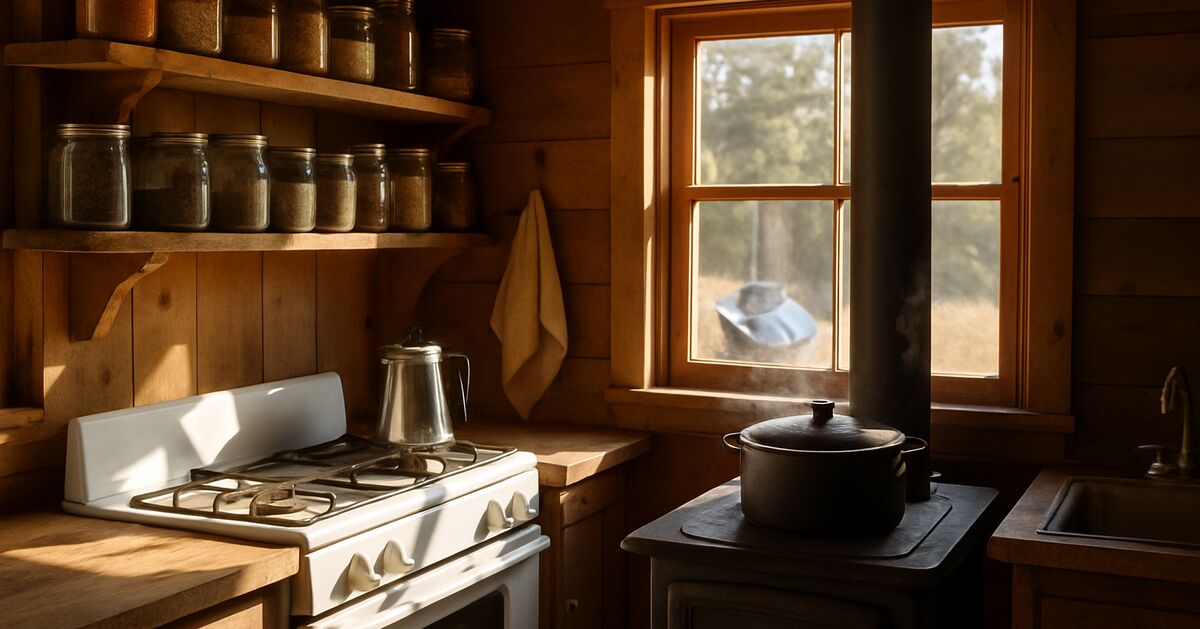
The first time you think seriously about off-grid cooking, you might be standing in a kitchen showroom staring at an induction range and wondering if it will even turn on without a wall outlet. The honest answer is: sometimes, but probably not the way you're picturing it. Cooking off-grid is less about finding one magic appliance and more about building a small system of fuels and tools that back each other up, because no single method covers every meal, every season, and every weather event.
This isn't a post about roughing it. People living off-grid full time still bake bread, simmer stews, can tomatoes, and make coffee every morning. The difference is that the energy for all of that has to come from somewhere you control: propane you hauled in, wood you cut, or electricity you generated yourself and are willing to spend on a burner. Once you understand the tradeoffs, building a kitchen that actually works becomes a lot less mysterious.
Start by asking what "off-grid" means for your kitchen
There's a big difference between a cabin with a modest solar array and battery bank, and a homestead running mostly on wood heat with occasional generator time. Your cooking setup should match your actual power budget, not an aspirational one.
If you're still sizing your electrical system, it helps to think about cooking loads separately from lighting, water pumping, and refrigeration, because cooking appliances are disproportionately power-hungry compared to almost everything else in the house. A single electric burner on high can pull more power in twenty minutes than your lights use all evening. That single fact drives most of the decisions below.
Propane: the realistic backbone for most off-grid kitchens
For many off-grid households, propane ends up doing most of the daily cooking, and for good reason. It's energy-dense, storable for years without degrading, and doesn't touch your battery bank at all. A standard 20 lb propane tank, the same size used for backyard grills, may last a two-burner cooktop a few weeks depending on how much you cook, with larger 100 lb or bulk tanks lasting proportionally longer.
The tradeoffs are real, though. Propane has to be trucked in or hauled out for refills, which means planning ahead in areas where roads become difficult in winter. Propane appliances also produce moisture and combustion byproducts, so kitchen ventilation matters more than people expect, especially in small, tightly built cabins. A cracked window isn't enough insurance if you're cooking three meals a day indoors; a proper vent hood or at minimum a carbon monoxide detector rated for propane is not optional.
Propane ranges and cooktops range widely in price depending on size and features, so check current listings before budgeting, and expect to pay more for an oven with a broiler and electronic ignition. Some off-grid oriented models use standing pilot or piezo spark instead of electronic ignition, which avoids an ignition board that can fail and can draw a small amount of power if wired in.
If your setup already leans on propane for heat, as covered in my comparison of wood, rocket, and propane heating options for small spaces, sharing a propane infrastructure between heating and cooking can simplify your fuel logistics considerably, since you're already managing tanks, refills, and ventilation for one purpose.
Wood cookstoves: slow, but they do more than cook
A wood cookstove is a serious commitment, not a weekend novelty. These cast iron stoves, often with a firebox, cooktop surface, and built-in oven, are a long-standing rural kitchen fixture, and they still make sense for people who are already burning wood for heat and have a reliable supply of dry, seasoned fuel.
The appeal is obvious: no fuel bill beyond what you cut or buy, no dependence on propane delivery, and the stove doubles as a heat source in cold months. The downside is just as real: wood cookstoves take real skill to regulate. Getting an oven to hold a steady 350°F requires understanding your particular stove's damper behavior, and by most accounts that skill takes considerable practice to develop. They also make the kitchen genuinely hot in summer, which is why many homesteads that use wood cookstoves also keep a propane burner or two for warm-weather cooking.
New wood cookstoves are a significant purchase, with price varying by size, oven capacity, and whether they include a water reservoir for domestic hot water, so compare current listings. Used stoves show up in classified listings for less, but budget for a chimney inspection and possible gasket replacement before you fire one up.
Electric cooking: possible, but budget the watts honestly
Electric induction burners and countertop appliances aren't off the table for off-grid living, they just require you to be honest about the math. Check the nameplate rating on any induction burner you consider, since these units commonly draw well over a thousand watts on high. Run that through an inverter for twenty minutes to boil pasta water and you've spent a meaningful chunk of a modest battery bank's daily capacity, especially on a 12V system where high current draws mean thicker wires and more line loss.
This is where system voltage really matters. Homes running 24V or 48V battery banks handle high-draw appliances like induction cooktops and electric pressure cookers more efficiently than 12V systems, because higher voltage means lower current for the same wattage, which means less wasted energy as heat in the wiring. If cooking with electricity is a priority for you, it's worth reading through the differences in my guide to choosing the right battery bank voltage before you finalize your solar and battery design, because retrofitting a system to a higher voltage after the fact is expensive and disruptive.
That said, electric cooking works well as a supplement rather than a primary method. A slow cooker or electric pressure cooker, run during peak sun hours when your panels are producing more than the house needs, uses far less energy per meal than an induction burner, though you should confirm the figures for your own appliance. Many off-grid households run their electric pressure cooker or rice cooker at midday specifically because that's when solar production is highest and the load doesn't touch stored battery capacity at all.
Solar ovens: free heat, real limitations
A solar oven, whether a simple reflective box design or a more elaborate parabolic cooker, uses no fuel and no electricity at all, just concentrated sunlight. On a clear day, manufacturers claim box-style solar ovens can reach baking temperatures, enough to cook rice, simmer beans, or slow-roast a chicken over several hours.
The catch is obvious: it only works when the sun is out and you're home to manage it, since most designs need to be repositioned every hour or two to track the sun. It's not a rainy-day or nighttime solution, and it's slower than any other method here. But for households that are already conservation-minded about propane and battery use, a solar oven handling even two or three meals a week directly displaces that fuel, and commercial box ovens are relatively inexpensive, or free if you build one from reflective panels and a repurposed window.
Building redundancy instead of picking a favorite
The realistic answer to "what should my off-grid kitchen run on" is usually more than one fuel, judging by what comes up again and again in owner forums. Propane handles daily cooking reliably in any weather. A wood cookstove, if you're already burning wood, adds a backup that costs nothing extra in fuel and helps in winter. A solar oven takes pressure off both during sunny stretches. And a modest electric appliance or two, run during peak solar production, rounds things out without taxing your battery bank.
This layered approach matters most when something breaks. Propane regulators fail. Wood cookstove gaskets wear out. Inverters trip. If your entire kitchen depends on one system, a single failure means no hot meals until it's fixed, which is a miserable position to be in during a cold snap or a stretch of bad weather. Households that have been off-grid for years tend to talk less about their favorite stove and more about how their fuels back each other up.
Water is part of the cooking system too
It's easy to plan a cooking setup around fuel and forget that every off-grid meal also needs clean water, for the food itself and for washing up afterward. If you're pulling water from a rain catchment system, understanding the safety basics covered in my guide to collecting and storing rainwater is worth doing before you start cooking with it regularly, particularly around first-flush diverters and tank maintenance.
For daily drinking and cooking water, the debate between gravity filters and pump filters is one I see raised often in off-grid forums, and the right answer depends more on your household size and water source than brand loyalty. My breakdown of gravity filters versus pump filters walks through which setups actually hold up under daily kitchen use versus which ones are better suited to backpacking.
And once the meal is cooked and the dishes are done, that greywater has to go somewhere sensible. A basic understanding of greywater basics for a cabin or homestead will save you from creating a soggy, smelly mess right outside your kitchen door, which is a more common rookie mistake than people expect.
Common mistakes worth avoiding
A few patterns show up again and again in off-grid kitchens that don't work well:
Under-ventilating a propane kitchen. Combustion appliances need real airflow, not just a cracked window, and a carbon monoxide detector is cheap insurance against a genuine hazard.
Sizing a battery bank around lighting and electronics, then discovering the induction burner they bought as an afterthought eats the whole daily budget in one meal.
Buying a wood cookstove without a season of wood already cut, split, and seasoned. Green wood holds moisture that must boil off before it burns hot, which tends to mean smoke, creosote buildup, and a stove that struggles to reach baking temperature.
Skipping a backup fuel entirely and assuming the primary system won't fail. It will, eventually, usually at an inconvenient time.
Forgetting that refrigeration and cooking often compete for the same power budget, especially in summer when a propane fridge or a 12V compressor fridge is already running long hours.
Putting together your own plan
There's no single "correct" off-grid kitchen, because the right combination depends on your climate, your budget, how often you're willing to haul propane or split wood, and how much solar capacity you've actually got. A cabin used mostly in summer might do fine with propane and a solar oven and skip the wood cookstove entirely. A year-round homestead in a cold climate almost certainly wants wood heat doing double duty in the kitchen, with propane as the reliable daily driver and electric appliances reserved for sunny afternoons.
The best next step is usually to look honestly at what you're already committed to for heating and power, since your cooking setup should fit into that system rather than fight it. My gear guides organized by category are a good place to compare specific propane cooktops, wood cookstoves, and solar ovens side by side before you buy. And if you're weighing a specific setup against your particular climate or cabin size, the full archive of articles covers a lot of adjacent ground, from water systems to heating choices, that all tie back into how a real off-grid kitchen functions day to day.
If you've got a specific setup in mind and aren't sure it pencils out, reaching out through my contact page is a reasonable way to get a second opinion before you spend money on equipment that might not fit your situation. And if you want to know more about how this publication approaches these topics, my about page explains the philosophy behind the advice here: practical, honest, and built from real tradeoffs rather than sales pitches.
Cooking off-grid takes more planning than turning a dial on a range, but it's not a hardship once the system is built correctly. Owners who make the switch often report that a well-thought-out kitchen, with two or three fuels backing each other up, cooks just as well as anything on the grid, just with a little more attention paid to where the energy actually comes from.
The rest of the shortlist
Recommended off-grid gear
Affiliate disclosure: Some links on this site are affiliate links, including Amazon links: as an Amazon Associate I earn from qualifying purchases. Buying through one costs you nothing extra, and it never changes what I recommend.
Products appear here only when they match this article's subject. Selection is based on documented specs and owner reports, never on compensation; pages with no relevant gear carry none.
The InstaFire Vesta self-powered indoor heater and stove bundled with canned heat cooking fuel, for power-outage heating and cooking; check the current spec sheet.
Claim audit: 15 consequential claims checked against the article's sources; unsupported wording revised where it could not be substantiated.
Claim-by-claim audit (15 checked)
“For many off-grid households, propane ends up doing most of the daily cooking, and for good reason.” (rewritten to what the article can stand behind)
“A standard 20 lb propane tank, the same size used for backyard grills, may last a two-burner cooktop a few weeks depending on how much you cook, with larger 100 lb or bulk tanks la…” (rewritten to what the article can stand behind)
“Propane appliances also produce moisture and combustion byproducts, so kitchen ventilation matters more than people expect, especially in small, tightly built cabins.” (reasoning shown in the article)
“A cracked window isn't enough insurance if you're cooking three meals a day indoors; a proper vent hood or at minimum a carbon monoxide detector rated for propane is not optional.” (reasoning shown in the article)
“Propane ranges and cooktops range widely in price depending on size and features, so check current listings before budgeting, and expect to pay more for an oven with a broiler and …” (rewritten to what the article can stand behind)
“Some off-grid oriented models use standing pilot or piezo spark instead of electronic ignition, which avoids an ignition board that can fail and can draw a small amount of power if…” (rewritten to what the article can stand behind)
“These cast iron stoves, often with a firebox, cooktop surface, and built-in oven, are a long-standing rural kitchen fixture, and they still make sense for people who are already bu…” (rewritten to what the article can stand behind)
“Getting an oven to hold a steady 350°F requires understanding your particular stove's damper behavior, and by most accounts that skill takes considerable practice to develop.” (rewritten to what the article can stand behind)
“New wood cookstoves are a significant purchase, with price varying by size, oven capacity, and whether they include a water reservoir for domestic hot water, so compare current lis…” (rewritten to what the article can stand behind)
“Check the nameplate rating on any induction burner you consider, since these units commonly draw well over a thousand watts on high.” (rewritten to what the article can stand behind)
“Homes running 24V or 48V battery banks handle high-draw appliances like induction cooktops and electric pressure cookers more efficiently than 12V systems, because higher voltage m…” (reasoning shown in the article)
“A slow cooker or electric pressure cooker, run during peak sun hours when your panels are producing more than the house needs, uses far less energy per meal than an induction burne…” (rewritten to what the article can stand behind)
“On a clear day, manufacturers claim box-style solar ovens can reach baking temperatures, enough to cook rice, simmer beans, or slow-roast a chicken over several hours.” (rewritten to what the article can stand behind)
“But for households that are already conservation-minded about propane and battery use, a solar oven handling even two or three meals a week directly displaces that fuel, and commer…” (rewritten to what the article can stand behind)
“Green wood holds moisture that must boil off before it burns hot, which tends to mean smoke, creosote buildup, and a stove that struggles to reach baking temperature.” (rewritten to what the article can stand behind)
Before you go
One useful off-grid email a week.
Practical gear rundowns, honest how-tos, and plain-English guides from someone doing the homework in the open.
I am building a place for off-grid people to swap real answers: a forum by topic, classifieds for gear and services, and real estate for off-grid land and homes. It is new, so the early members shape what it becomes. A free account lets you post in all three.
No ER ten minutes away means you have to be your own triage nurse. Here's how to tell a bad bee sting from the real emergency, and what to actually stock.
In many off-grid disasters, the fire or flood itself isn't the decisive factor, it's the hour you waited too long to leave. Here's how to set real, numeric triggers before you need them.
Tax sale and sheriff's auction land looks like a bargain, but redemption periods, hidden liens, and unseen parcels turn a lot of cheap acreage into an expensive lesson. Here's how to vet a listing before you bid.