The single most expensive trip you'll make off the grid is the one for a fifty cent washer.
You already know this if you've lived out past pavement for more than a season. Something fails on a Sunday afternoon, usually right when you need it most, and the part that would fix it is either not in the truck, not in the shop, or not anywhere on the property. So you lose the rest of the day, burn gas getting to town, and pay retail for a part that would have cost pennies if you'd bought it in bulk two years ago. Do that a dozen times a year and you've spent more time and money chasing hardware than you spent building whatever broke in the first place.
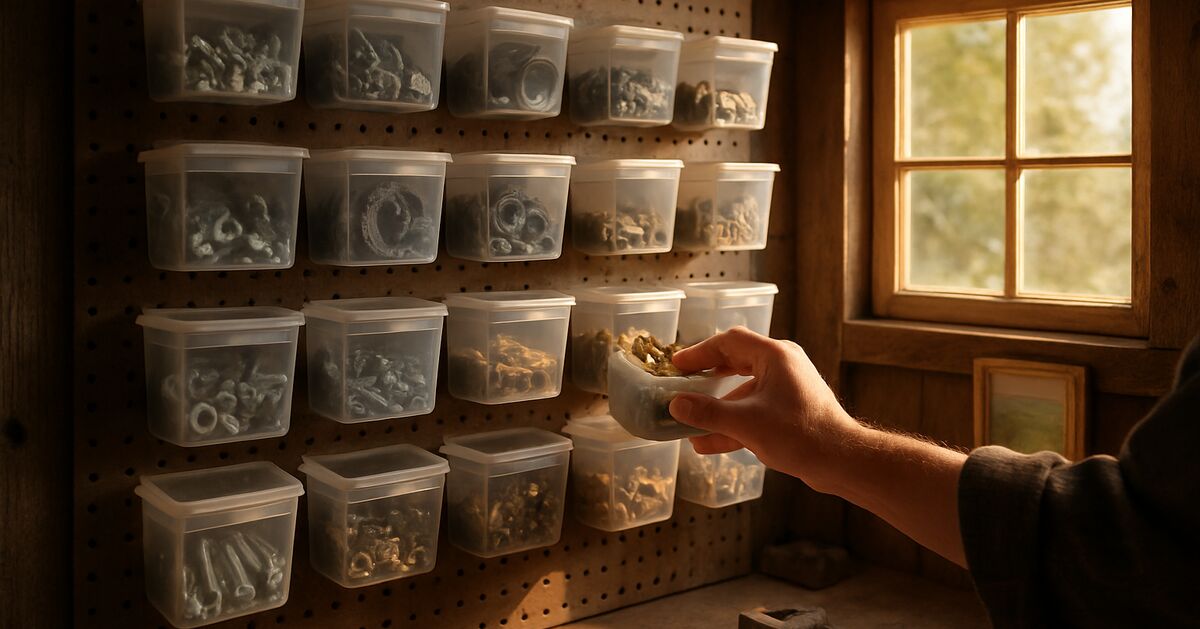
A spare parts wall fixes this. Not a junk drawer, not a five gallon bucket of mixed screws you dig through with a flashlight, but an actual organized wall of fasteners and fittings that you can walk up to, find what you need in under a minute, and get back to work. This post is about how to build one that you'll actually use, stocked with the specific things that fail or run out most often on off-grid properties.
Why a junk drawer doesn't cut it
Chances are you already have "spare parts." They're in a drawer, a tackle box, or a rusting coffee can on a shelf. The problem isn't that people don't save hardware, it's that saved hardware without organization is functionally the same as no hardware at all. You can't find the 3/8 inch stainless lag bolts when they're mixed in with drywall screws, wire nuts, and a single glove.
The wall solves this because it forces categorization. Every bin, every hook, every labeled jar has one job. When you build it right, muscle memory takes over. You don't think about where the hose clamps are, your hand just goes there.
There's also a psychological piece. A junk drawer feels like clutter, so you avoid dealing with it, which means it never gets restocked and slowly becomes useless. A clean wall with labeled sections feels like a tool, so you treat it like one. You notice when a bin is getting low. You restock it on your next town trip instead of after you've already run out and are standing there stuck.
Start with what actually breaks
Before you buy a single bin, spend a month paying attention to what you run out of or wish you had. Keep a running list on your phone or a scrap of paper taped inside a cabinet. Every time you improvise a fix, or drive to town for a part, write it down. After thirty days you'll have a very honest picture of your property's actual failure points, which is far more useful than any generic "off-grid hardware checklist" someone hands you.
That said, some categories are close to universal for anyone living off-grid with a cabin, a well or water system, solar power, and outbuildings. These are the ones worth stocking before you even start your own list.
The fastener backbone
Fasteners are the boring, unglamorous core of the wall, and they're also the thing you'll use most.
Deck screws and structural screws in a couple of common lengths (2 inch, 3 inch, and something long like 6 inch for framing repairs). Buy the exterior rated ones even for interior work, since their coatings resist corrosion better if they end up somewhere damp.
Lag bolts and washers in 3/8 and 1/2 inch, useful for anything load bearing: fence posts, deck ledgers, mounting brackets for solar racking.
Machine screws and nuts in a small assortment, mostly for equipment and electronics enclosures.
Stainless hose clamps in several sizes. These fail and get reused on water lines, propane connections (only where rated), and radiator hoses if you run any engine-driven equipment.
Cotter pins and clevis pins, cheap and easy to forget, but essential if you run any trailers, gates, or farm equipment with pinned connections.
Roofing screws with the rubber washer, because roofs on outbuildings, coops, and sheds always seem to develop one more leak a year, and matching an odd screw size at the hardware store an hour away is its own special misery.
Buy these in the mid-size multi-packs, not the giant contractor boxes (you'll go stale on quantity long before you use a 5 lb box of one specific screw) and not the tiny hardware-store-brand ten-packs (you'll run out again in a week). Aim for "enough to fix three or four things without reordering."
The fitting section: water, propane, and air
This is the section that saves the most dramatic trips, because water and propane failures tend to be the ones that actually stop your day cold.
For water systems, keep an assortment of PEX and/or poly fittings matching whatever your plumbing actually uses (don't stock a fitting standard you don't have pipe for), a few shutoff valves, extra clamps or crimp rings depending on your fitting style, and Teflon tape and thread sealant in more quantity than seems reasonable, because you will always need more than you think. If you haven't already, it's worth reading up on testing your off-grid water quality so you know what your system is actually doing before a fitting failure turns into a contamination problem.
For propane, this is one category where you should be conservative and buy only listed, rated fittings, and never improvise with plumbing parts that aren't propane rated. Keep a spare regulator, a couple of rated hose sections in common lengths, and extra POL fittings. If you're still working out how big a tank you need and how often you'll be hauling refills, our piece on propane tank sizing and refill logistics is a good companion to this section of the wall, since your fitting needs scale with your tank size and hose runs.
For anyone running air tools or a compressor for well work or tire repair, a small stock of quick-connect fittings and an extra length of air hose earns its shelf space fast.
Electrical and solar specific spares
Solar systems often fail in small, annoying ways, and many of those small failures are quick to fix if you have the right part on the wall.
MC4 connectors (male and female, plus a crimping tool if you don't already have one). Panel leads can be damaged by rodents, sun exposure, and age, and because panels in a string are wired in series, one failed connector can interrupt the whole string.
In-line fuses and fuse holders matched to your system's amperage.
Wire nuts, butt connectors, and a few feet of extra wire in the gauges you actually run.
Spare ring terminals for battery connections, since terminals exposed to battery gases and moisture can corrode and eventually need replacing.
Dielectric grease, small tube, helps seal moisture out of those connections and slow corrosion.
If your system still uses an older PWM controller, or you're deciding what to upgrade to, our explainer on PWM versus MPPT charge controllers is worth a read before you buy replacement parts, since the right spare depends heavily on which type of controller you're running.
Structural and outbuilding spares
Sheds, coops, fences, and the barn take a beating from weather and animals, and small structural fasteners are exactly the kind of thing you never have on hand when a hinge rips out or a panel comes loose in wind.
Keep an assortment of hinges, gate latches, and eye bolts, extra fence staples if you run any wire fencing, and a handful of general purpose brackets (L-brackets, T-brackets, corner braces) in a couple of sizes. If you keep chickens or a small flock, you already know how often a coop door or run panel needs an emergency fix at exactly the wrong time, and it pairs well with the strategies in our post on feeding a small flock without constant feed hauls, since a broken latch that lets predators in undoes a lot of that careful feed planning in one bad night.
Sanitation and tiny systems
If you're running a composting or off-grid toilet setup, or a small greywater system for a cabin or RV, keep spare gaskets, hose clamps sized to that specific unit, and any specialty fittings the manufacturer uses, since these can be hard to find locally and may need to be ordered. Our guide to sanitizing without a septic tank covers the systems where this matters most, and it's worth cross-referencing against your actual setup before you decide what to stock.
Building the physical wall
The parts themselves matter less than how you store them. A few principles that make the difference between a wall that gets used and one that becomes clutter:
Clear bins, labeled on the front, not the lid. You should be able to see contents and read the label without touching anything.
Group by system, not by fastener type. Put all your water fittings together, all your solar spares together, all your fence hardware together. You think in projects, not in "quarter inch bolts," so organize that way.
Mount it somewhere dry and accessible, not the far corner of an unheated barn. If getting to the wall is its own project, you'll stop using it within a month.
Leave room to grow. Build the wall for twice the bins you think you need right now. You will add categories.
Do a restock pass every time you're in town anyway. Keep the running list from the intro pinned near the wall itself, and add to it the moment you notice a bin getting low, not after it's empty.
What this actually saves you
It's worth being honest about the payoff instead of hand waving at "saves time." A single town trip for a fitting or fastener, once you count driving, browsing an aisle you don't know well, and driving back, is realistically an hour to half a day depending on how remote you are. Multiply that by even eight or ten trips a year that a stocked wall would have prevented, and you're looking at several full days of time back annually, plus the fuel. Stocking a reasonable wall is likely to cost a few hundred dollars depending on how much you already have on hand, so price it against the trips and fuel it would save you in a year.
There's a quieter benefit too. Knowing you have what you need on hand changes how you approach small problems. Instead of patching something badly because you don't have the right part and don't want to lose the day, you fix it properly the first time. That compounds. Buildings last longer, systems run better, and you spend less of your life doing the same repair twice.
If you're just getting your bearings on off-grid life more broadly, our about page covers what this site is built around, and the FAQ answers a lot of the "where do I even start" questions that come up around projects like this one. And if you've built your own version of a parts wall and found categories worth adding, we'd genuinely like to hear about it through the contact page, since the best additions to a list like this always come from people who've actually lived with the gaps. For more projects in this vein, our blog index has the rest of the series on building out a property system by system, including pieces on keeping Wi-Fi reaching the whole property and getting cabin windows sized correctly, both of which touch on their own categories of spare parts worth keeping on hand.
Build the wall once, stock it honestly based on what actually breaks on your place, and keep it fed. It's one of the cheapest, least glamorous projects you'll do out here, and it will save you more time than almost anything else on this list.
Claim audit: 10 consequential claims checked against the article's sources; unsupported wording revised where it could not be substantiated.
Claim-by-claim audit (10 checked)
“Buy the exterior rated ones even for interior work, since their coatings resist corrosion better if they end up somewhere damp.” (rewritten to what the article can stand behind)
“For propane, this is one category where you should be conservative and buy only listed, rated fittings, and never improvise with plumbing parts that aren't propane rated.” (reasoning shown in the article)
“Solar systems often fail in small, annoying ways, and many of those small failures are quick to fix if you have the right part on the wall.” (rewritten to what the article can stand behind)
“Panel leads can be damaged by rodents, sun exposure, and age, and because panels in a string are wired in series, one failed connector can interrupt the whole string.” (rewritten to what the article can stand behind)
“**Spare ring terminals** for battery connections, since terminals exposed to battery gases and moisture can corrode and eventually need replacing.” (rewritten to what the article can stand behind)
“**Dielectric grease**, small tube, helps seal moisture out of those connections and slow corrosion.” (rewritten to what the article can stand behind)
“If you're running a composting or off-grid toilet setup, or a small greywater system for a cabin or RV, keep spare gaskets, hose clamps sized to that specific unit, and any special…” (rewritten to what the article can stand behind)
“**Mount it somewhere dry and accessible, not the far corner of an unheated barn.** If getting to the wall is its own project, you'll stop using it within a month.” (reasoning shown in the article)
“A single town trip for a fitting or fastener, once you count driving, browsing an aisle you don't know well, and driving back, is realistically an hour to half a day depending on h…” (reasoning shown in the article)
“Stocking a reasonable wall is likely to cost a few hundred dollars depending on how much you already have on hand, so price it against the trips and fuel it would save you in a yea…” (rewritten to what the article can stand behind)
Before you go
One useful off-grid email a week.
Practical gear rundowns, honest how-tos, and plain-English guides from someone doing the homework in the open.
I am building a place for off-grid people to swap real answers: a forum by topic, classifieds for gear and services, and real estate for off-grid land and homes. It is new, so the early members shape what it becomes. A free account lets you post in all three.
No ER ten minutes away means you have to be your own triage nurse. Here's how to tell a bad bee sting from the real emergency, and what to actually stock.
In many off-grid disasters, the fire or flood itself isn't the decisive factor, it's the hour you waited too long to leave. Here's how to set real, numeric triggers before you need them.
Tax sale and sheriff's auction land looks like a bargain, but redemption periods, hidden liens, and unseen parcels turn a lot of cheap acreage into an expensive lesson. Here's how to vet a listing before you bid.