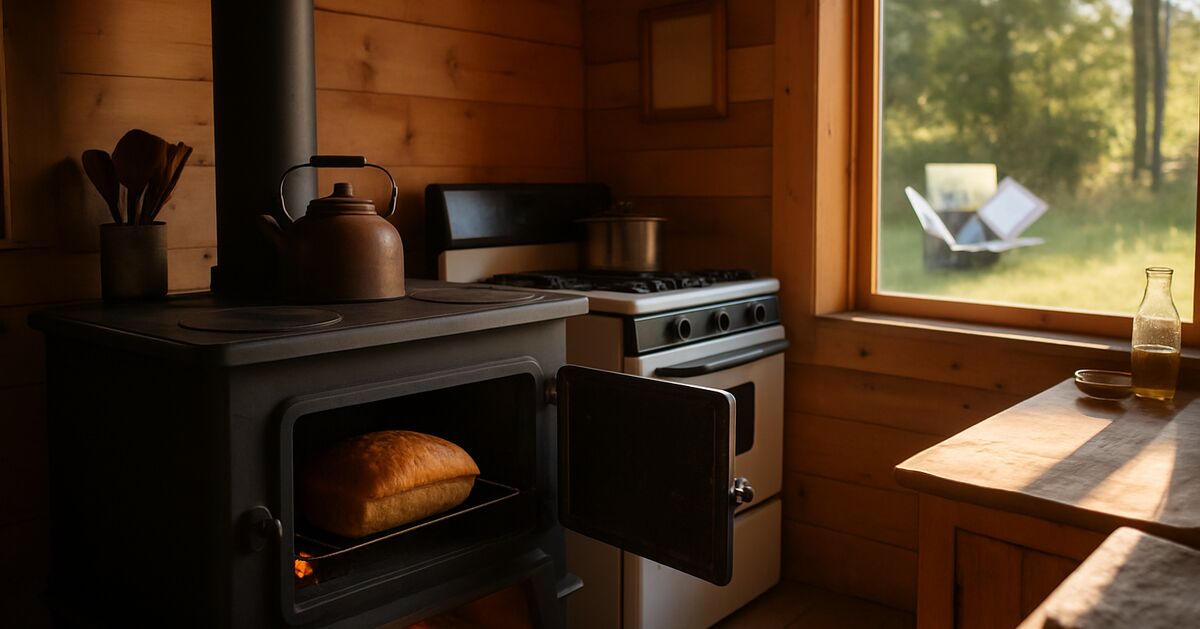
The first time you try to bake a loaf of bread in an off-grid kitchen, you find out fast that "oven" is doing a lot of heavy lifting as a word. A wood cookstove oven, a propane camp oven, and a solar oven all get called ovens, but they behave nothing alike, and if you pick the wrong one for how you actually cook, you'll end up with scorched bottoms, raw middles, or a pile of good ingredients you never got around to using because the fire wasn't hot enough, or the sun went behind a cloud at the wrong moment.
Baking is different from the stovetop cooking that many off-grid kitchens are built around. Frying eggs or boiling beans just needs heat under a pan. Baking needs even, enclosed, sustained heat, often in the range of a few hundred degrees F, held steady for anywhere from twenty minutes to a couple of hours. That's a much harder problem to solve without a utility hookup, and it's worth thinking through deliberately instead of assuming whatever cooktop you bought will "also" bake.
Why baking is the hard case
Off-grid cooking setups get planned around the everyday meals: coffee, eggs, stew, rice, tortillas. Those are stovetop jobs, and they're forgiving. You can nudge the flame, move the pan, adjust as you go.
Baking removes that feedback loop. Once the dough or batter is in a closed oven, you can't see it, adjust the flame under it directly, or fix an uneven heat source mid-bake without opening the door and losing all your heat. That means the oven itself has to do the evening-out work, and cheap or improvised ovens usually don't.
Wood cookstove ovens: the traditional answer, with real caveats
A dedicated wood cookstove, the kind with a firebox on one side and an oven box on the other, is the classic off-grid baking setup, and for good reason. It's been feeding families for well over a century, it needs no propane delivery or electricity, and once you learn its personality, it can turn out bread, biscuits, roasts, and pies all day long.
The catch is that "learn its personality" part is not a small ask. Wood cookstove ovens don't have a dial. Temperature comes from firebox management: how much wood, what kind, how packed the coal bed is, and how the damper is set. Most bakers use an oven thermometer (a mechanical one, since you have no power for a digital probe) and adjust by feel over weeks and months of use. Expect your first several loaves to come out uneven, too dark on one side, too pale on the other, because heat distribution in these ovens is rarely uniform. Rotating pans partway through is standard practice, not a sign you're doing something wrong.
A few practical notes if you're going this route:
Dry, seasoned hardwood burns more predictably than softwood or green wood, and predictability is what baking needs most.
A cookstove oven takes real time to come up to baking heat, often the better part of an hour of active firing, so it's not a spontaneous "let's bake" appliance.
These stoves put out serious ambient heat, which is wonderful in January and miserable in July. Some households with a wood cookstove shift most baking to the cold months and switch to propane or solar in summer, since the stove heats the room either way.
Chimney and flue upkeep matters even more with a cookstove that runs hot and long for baking sessions; if you haven't already, read through our guide on chimney and flue safety, creosote, and clearances before you commit to daily baking fires.
Propane ovens: the most predictable, if you can keep them fed
If you want an oven that behaves like the one you grew up with, dial in a temperature, preheat, set a timer, a propane oven is the closest you'll get off-grid. Standalone propane ovens and propane range/oven combos are widely available, many designed originally for RVs or cabins, and they hold temperature about as reliably as a home electric oven because they have a thermostat doing the regulating.
The trade-off is fuel logistics. A full-size propane oven used regularly for baking will go through more gas than you might expect, especially compared to a stovetop-only setup. Baking a couple loaves of bread and a casserole in one evening can use noticeably more propane than typical stovetop cooking, since the burner runs long to hold oven temperature. If you're already tracking consumption for your realistic off-grid kitchen setup, add a separate line for oven use and watch it for a month before you assume your tank size and delivery schedule will hold up.
A few things that trip people up with propane ovens specifically:
Many small propane ovens don't have a pilot light and instead need manual lighting each time, so keep a long lighter or match on hand and know the lighting sequence cold, since fumbling with it in a dark or smoky kitchen is a bad time.
Ventilation matters. Propane combustion uses oxygen and produces moisture and combustion byproducts; a tightly sealed cabin needs a cracked window or vent fan running during long bakes. This ties directly into the balance discussed in our post on air-sealing a cabin without suffocating it: a cabin sealed tight enough to hold heat also needs deliberate, planned ventilation for combustion appliances.
Altitude and cold both affect propane appliance performance somewhat, but the bigger real-world issue is simply running out mid-recipe because nobody was tracking tank level. Keep a spare bottle, always.
Solar ovens: free fuel, but only when the sky cooperates
A solar oven (a well-insulated box with reflective panels focusing sunlight through a glass or plastic window) is the only baking method here that costs nothing to run once you own it. On a clear day, a decent solar oven will comfortably hit 250 to 350 degrees F, enough to bake bread, roast vegetables, cook casseroles, and simmer beans for hours without touching your wood or propane supply at all.
The obvious limit is that it only works when there's strong, fairly direct sun, generally for several hours around midday, and performance drops fast with clouds, haze, wind, or a low winter sun angle. If your site has any of the shading issues covered in our piece on solar workarounds when the sun is blocked by trees, hills, or clouds, your solar oven will be far less reliable than the marketing photos suggest, and you should treat it as a bonus tool for good days rather than your primary baking method.
A few practical realities of solar baking:
Bake times run longer than a conventional oven, sometimes considerably, because temperatures are lower and less stable. Plan meals around that, don't try to solar-bake dinner at 5 pm in October.
You have to track and re-aim the oven periodically as the sun moves, which means it's not a walk-away appliance the way a thermostatted oven is.
Dark, thin metal pans work better than glass or light-colored pans, since they absorb heat instead of reflecting it.
Wind is a bigger enemy than people expect; a solar oven without wind protection can lose a shocking amount of heat on a breezy but sunny day.
Picking the right combination for your household
Almost nobody off-grid ends up relying on exactly one baking method year-round, and that's not a failure of planning, it's just matching the tool to the season and the day. A common and sensible pattern looks like this:
Wood cookstove for winter, when you're already running the firebox for heat anyway, so baking is nearly free heat you're using twice.
Propane oven for shoulder seasons, quick weeknight baking, and anytime you need a guaranteed result (company coming, a specific recipe that needs precision).
Solar oven for summer, when you don't want extra heat in the cabin and sunny days are abundant and long.
If you're still in the planning stage, before you buy any single oven, it's worth reading through the wider context on our home page and about page for how this site approaches off-grid systems generally: redundancy and matching tools to actual conditions beats betting everything on one "perfect" appliance.
Common mistakes worth avoiding
A few patterns show up again and again with people new to off-grid baking:
Buying an oven-equipped heating stove and expecting bakery results. Combination wood heat stoves with a small oven attached are convenient, but their ovens are usually an afterthought, uneven and hard to regulate, because the stove's real job is warming the room, not baking. If baking matters to you, budget for a dedicated cooking appliance rather than assuming a heating stove's bonus oven will do the job.
Underestimating preheat and fuel cost. Whether it's wood or propane, getting an oven to baking temperature takes real fuel and real time. Batch your baking (several loaves, a casserole, and a pie in one heating session) rather than firing up a full oven for a single item.
No backup plan for a bad-weather week. If your only oven is solar, a stretch of cloudy days means no baking at all. If your only oven is propane and your delivery is delayed, same problem. Having at least two of the three methods available, even if one is a backup you rarely use, is what actually lets you keep baking bread through an odd winter.
Skipping the thermometer. An off-grid oven, wood or propane, benefits from an independent oven thermometer rather than trusting a built-in gauge or the flame level by eye. That one cheap tool is an easy way to catch a badly calibrated oven before it ruins a bake.
Getting there gradually
You don't need to solve baking on day one of an off-grid move. A common path described by owners is to start with stovetop cooking (the approach covered in our realistic kitchen setup guide) and add oven capability once they know their fuel budget, their seasonal sun exposure, and their actual cooking habits. If you're still working through the early stretch of figuring out what your homestead actually needs day to day, our post on what really happens in the first six months of starting a small off-grid homestead covers how priorities like this tend to sort themselves out once you're living the reality instead of planning it on paper.
And if a question comes up that's specific to your site, your climate, or your setup that this post didn't answer, our FAQ page covers a lot of the recurring questions we hear, and you're always welcome to get in touch with what you're working through. Baking off-grid is absolutely doable, it just takes matching the oven to the conditions instead of assuming any single box will do it all.
The rest of the shortlist
Recommended off-grid gear
Affiliate disclosure: Some links on this site are affiliate links, including Amazon links: as an Amazon Associate I earn from qualifying purchases. Buying through one costs you nothing extra, and it never changes what I recommend.
Products appear here only when they match this article's subject. Selection is based on documented specs and owner reports, never on compensation; pages with no relevant gear carry none.
The InstaFire Vesta self-powered indoor heater and stove bundled with canned heat cooking fuel, for power-outage heating and cooking; check the current spec sheet.
The InstaFire Ember oven, a portable oven for baking and cooking without grid power at camp or during outages; check the current spec sheet for details.
Claim audit: 14 consequential claims checked against the article's sources; unsupported wording revised where it could not be substantiated.
Claim-by-claim audit (14 checked)
“Baking needs even, enclosed, sustained heat, often in the range of a few hundred degrees F, held steady for anywhere from twenty minutes to a couple of hours.” (rewritten to what the article can stand behind)
“Dry, seasoned hardwood burns more predictably than softwood or green wood, and predictability is what baking needs most.” (cited → epa.gov)
“A cookstove oven takes real time to come up to baking heat, often the better part of an hour of active firing, so it's not a spontaneous "let's bake" appliance.” (rewritten to what the article can stand behind)
“Some households with a wood cookstove shift most baking to the cold months and switch to propane or solar in summer, since the stove heats the room either way.” (rewritten to what the article can stand behind)
“Standalone propane ovens and propane range/oven combos are widely available, many designed originally for RVs or cabins, and they hold temperature about as reliably as a home elect…” (reasoning shown in the article)
“Baking a couple loaves of bread and a casserole in one evening can use noticeably more propane than typical stovetop cooking, since the burner runs long to hold oven temperature.” (rewritten to what the article can stand behind)
“Propane combustion uses oxygen and produces moisture and combustion byproducts; a tightly sealed cabin needs a cracked window or vent fan running during long bakes.” (cited → nfpa.org)
“On a clear day, a decent solar oven will comfortably hit 250 to 350 degrees F, enough to bake bread, roast vegetables, cook casseroles, and simmer beans for hours without touching …” (cited → energyresearch.ucf.edu)
“The obvious limit is that it only works when there's strong, fairly direct sun, generally for several hours around midday, and performance drops fast with clouds, haze, wind, or a …” (cited → energyresearch.ucf.edu)
“Bake times run longer than a conventional oven, sometimes considerably, because temperatures are lower and less stable.” (rewritten to what the article can stand behind)
“You have to track and re-aim the oven periodically as the sun moves, which means it's not a walk-away appliance the way a thermostatted oven is.” (rewritten to what the article can stand behind)
“Dark, thin metal pans work better than glass or light-colored pans, since they absorb heat instead of reflecting it.” (reasoning shown in the article)
“That one cheap tool is an easy way to catch a badly calibrated oven before it ruins a bake.” (rewritten to what the article can stand behind)
“Baking off-grid is absolutely doable, it just takes matching the oven to the conditions instead of assuming any single box will do it all.” (rewritten to what the article can stand behind)
Before you go
One useful off-grid email a week.
Practical gear rundowns, honest how-tos, and plain-English guides from someone doing the homework in the open.
I am building a place for off-grid people to swap real answers: a forum by topic, classifieds for gear and services, and real estate for off-grid land and homes. It is new, so the early members shape what it becomes. A free account lets you post in all three.
No ER ten minutes away means you have to be your own triage nurse. Here's how to tell a bad bee sting from the real emergency, and what to actually stock.
In many off-grid disasters, the fire or flood itself isn't the decisive factor, it's the hour you waited too long to leave. Here's how to set real, numeric triggers before you need them.
Tax sale and sheriff's auction land looks like a bargain, but redemption periods, hidden liens, and unseen parcels turn a lot of cheap acreage into an expensive lesson. Here's how to vet a listing before you bid.