The first winter is the one that teaches you what your off-grid setup is actually made of, not what the brochure said it was made of. Everything that was "probably fine" in October gets tested in January, usually all at once, usually at 2am, usually during the storm that also knocked out cell service. This isn't meant to scare you off. It's meant to help you find the weak points before winter finds them for you.
I've spent a lot of time reading accounts from people who moved off-grid, and a pattern shows up again and again. The failures aren't exotic. They're boring, predictable, and preventable with a few weeks of prep in the fall. Here's what actually tends to go wrong in the first year, roughly in the order it tends to bite.
Solar production drops harder than you expect
If you sized your system in summer, using summer sun as your baseline, you're in for a rough surprise. Short winter days, low sun angle, and weeks of overcast skies can cut solar production to a fraction of what you saw in June, so plan around your worst month rather than a summer figure. Snow sitting on panels makes it worse, and panels mounted flat instead of angled steeply will hold snow far longer than panels tilted closer to vertical for winter sun.
The fix isn't complicated, but it takes planning before the snow flies. Mount panels at a steeper winter angle if your rack allows it. Keep a soft roof rake or long-handled brush on hand to clear snow without scratching the glass. And be honest with yourself about backup power. If you haven't already read through how much solar you actually need for year-round living, do that math again specifically for your worst winter month, not your average month. A generator you rarely need in July may become your most-used appliance in December. Understanding how your wiring and overcurrent protection holds up under that extra generator-charging load matters too, since winter often means more charging cycles and more amperage running through the same wires.
Batteries lose capacity in the cold
Battery manufacturers generally derate usable capacity as temperatures drop, so check the cold weather specs for your bank. A battery bank that comfortably ran your cabin through a fall evening might come up noticeably short in a January cold snap, both because of reduced capacity and because you're likely running more load (lights earlier, maybe a heater blower, water pump fighting to keep lines from freezing).
If your battery bank lives in an unheated shed or an uninsulated corner, that's worth fixing before winter, not during it. A simple insulated battery box, or moving the bank to a semi-conditioned space, can preserve a meaningful chunk of capacity. This is also the season where undersized wire gauge shows its problems fastest, since voltage drop under heavier winter loads can leave you with less usable power at the far end of the line than your battery bank is actually producing.
Water lines freeze in places you didn't expect
Frozen water lines are one of the failures that comes up most often in first-winter accounts I've read. Not the well itself, usually, but the exposed run between the well or storage tank and the cabin. Any stretch of pipe that's above ground, under-insulated, or routed through an unheated crawlspace is a candidate for freezing solid, and worse, for splitting when it thaws.
If you're on a drilled or driven well, the well itself is usually buried below frost line and fine. The vulnerable point is the above-ground plumbing: hose bibs, exterior spigots, pump housings, and any line that runs along an exterior wall instead of through insulated interior space. Heat tape, pipe insulation, and simply routing lines through the warm part of the structure whenever possible will save you from the classic first-year disaster of a burst pipe you don't discover until the thaw, when water is running through your floor instead of your faucet.
If you're relying on stored rainwater instead of a well, the storage tank itself needs winter attention too. Even partially buried or insulated cisterns can freeze at the surface and crack fittings, so check that your setup accounts for expansion.
The wood stove gets used far more, and far harder, than you planned for
A stove that ran a few hours a night in October is suddenly running most of the day and night by January. That means more creosote buildup, more thermal cycling on the flue, and less margin for error on clearances that seemed fine when the stove barely got warm. A first winter is a likely time for chimney trouble, simply because nobody burns a stove that hard until the actual cold arrives.
This is worth taking seriously before the season starts. Go back through chimney and flue safety basics and actually schedule a mid-winter inspection, not just a fall one. A stovepipe that was clean in November can build a dangerous creosote layer by February if you're burning green or unseasoned wood, running the stove low and smoldering overnight, or just burning more hours total than you estimated.
The outhouse or composting system slows down or freezes
Biological breakdown depends on temperature, so composting toilets and pit systems tend to work more slowly in cold weather. A pit toilet that handled waste without much odor or trouble in summer may need different management in deep cold, and composting units often need supplemental heat or bulking material adjustments to keep working. If you built your outhouse with proper siting and drainage, winter shouldn't create new problems, but it's worth checking that snow load and ice buildup around the structure haven't created a safety hazard on the path out to it, especially for nighttime trips.
The road becomes the actual emergency
More than any single system failure, the thing that turns a manageable winter into a genuinely dangerous one is losing access to your own road. A property that's a pleasant fifteen minute drive to town in October can become completely inaccessible after a real snow event, and if that coincides with a medical issue, a fuel shortage, or a failed system you can't fix yourself, you're in a much harder spot than you were prepared for.
Before your first winter, walk through your actual winter isolation plan honestly. How many days of food, fuel, and medication do you keep on hand at the worst point of the season. Do you have a way to clear your own driveway or are you depending on a plow service that may not prioritize a remote address. Is there a backup route out, even a rough one, if your primary road is blocked. It's easy to underestimate how long "snowed in" can last, and to overestimate how quickly help can reach a remote property.
Small things that catch people off guard
A few less dramatic issues show up constantly in first-winter accounts, and they're worth a mention because they're so easy to prevent:
Propane regulators freezing or icing over in extreme cold, cutting off supply to a heater or stove at the worst time
Condensation and ice buildup inside poorly ventilated cabins, especially ones that were rushed on insulation before the first cold snap
Solar charge controllers and inverters that aren't rated for the actual low temperatures they're exposed to, leading to erratic behavior or shutdowns
Battery-powered tools and electronics draining far faster in the cold than they did in warmer months
Underestimating how much firewood a real winter actually consumes, and running short by February
None of these are complicated to fix once you know to look for them. The problem is almost never that off-grid winter prep is technically hard. It's that a lot of it only becomes obvious in hindsight, after the first real cold snap shows you exactly where your setup was optimistic instead of realistic.
What to actually do before the first snow
If you're heading into your first off-grid winter, the most useful thing you can do in the fall is a deliberate walk-through of every system with a single question in mind: what happens to this if the temperature drops to the coldest it's ever going to get here, and stays there for two weeks straight. Not the average cold day. The worst one.
That mental exercise usually surfaces most of the real risks: the exposed pipe run, the panel angle that will hold snow, the battery bank sitting in an uninsulated shed, the firewood pile that looks like plenty but is actually about six weeks short. Fixing these things in October, when the ground isn't frozen and the roads are clear, is dramatically easier and cheaper than fixing them in January during the emergency they eventually cause.
It's also worth building a simple written log through that first winter, noting what worked, what didn't, how much fuel and firewood you actually burned, and how your battery bank performed on the worst weeks. That log becomes the single most useful document you have for planning year two, far more reliable than any general rule of thumb, because it reflects your actual site, your actual structure, and your actual usage.
If something in your setup doesn't hold up this winter, that's not really a failure, it's information. A theme that comes up again and again in off-grid forums is making real changes after that first winter: bigger battery bank, better insulated pipe runs, a backup generator they didn't think they'd need, a second route off the property. The first winter's job is to tell you what to fix. Your job is to actually listen to it, make the changes in the calm of spring and summer, and go into year two with a system that's been tested rather than one that's just been hoped about.
If you're still in the planning stages and want a broader sense of what gear and systems actually hold up, my gear guides are organized by category and worth working through system by system before the ground freezes. And if you run into a specific problem this winter that you can't quite figure out, feel free to reach out; I answer these questions when I can and I'm always glad to hear what real first winters are actually looking like out there.
The rest of the shortlist
Recommended off-grid gear
Affiliate disclosure: Some links on this site are affiliate links, including Amazon links: as an Amazon Associate I earn from qualifying purchases. Buying through one costs you nothing extra, and it never changes what I recommend.
Products appear here only when they match this article's subject. Selection is based on documented specs and owner reports, never on compensation; pages with no relevant gear carry none.
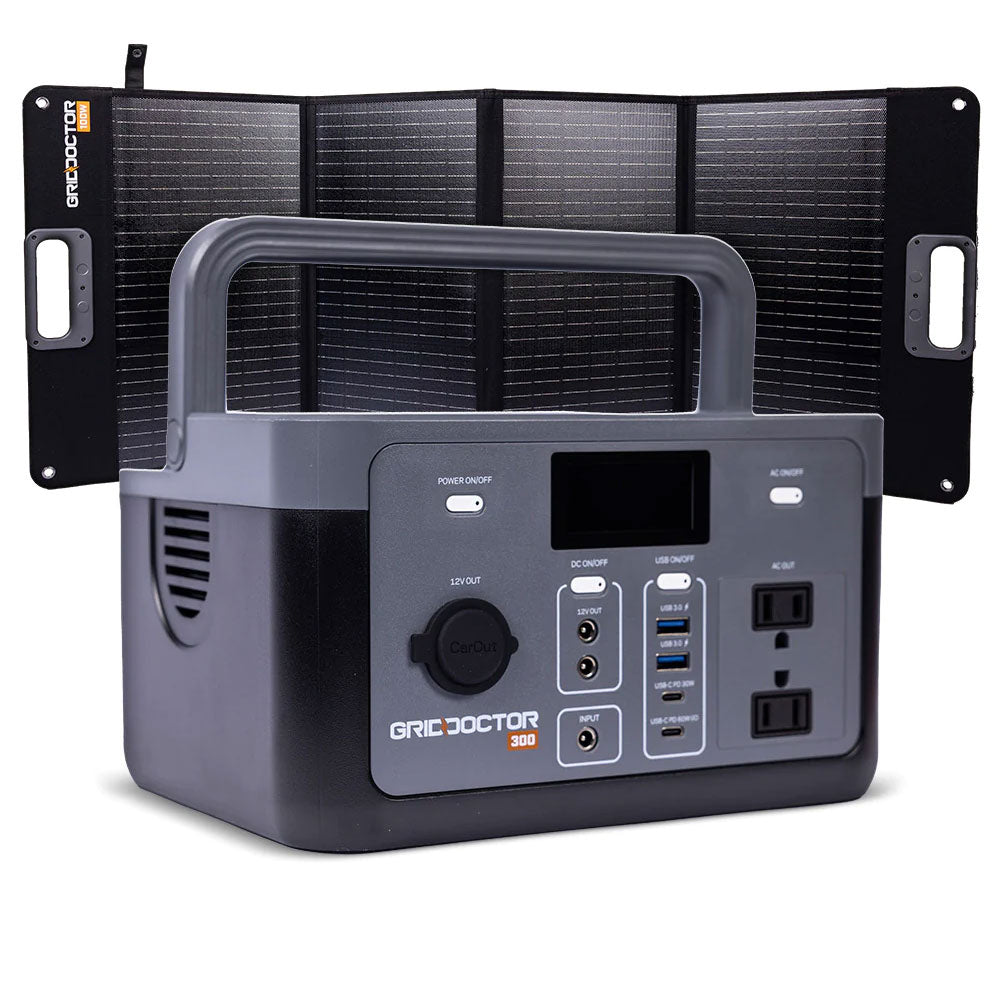
The Grid Doctor 300 solar generator bundled with a 100-watt solar panel, a compact power station for charging small devices; check the current spec sheet for details.
Why it's here: Listed as the small end: phones, lights and a radio, not a fridge. Sizing disappointment usually starts here.
The Grid Doctor 300 solar generator sold through Emergency Essentials, a compact power station for charging phones, lights and small devices; check the current spec sheet.
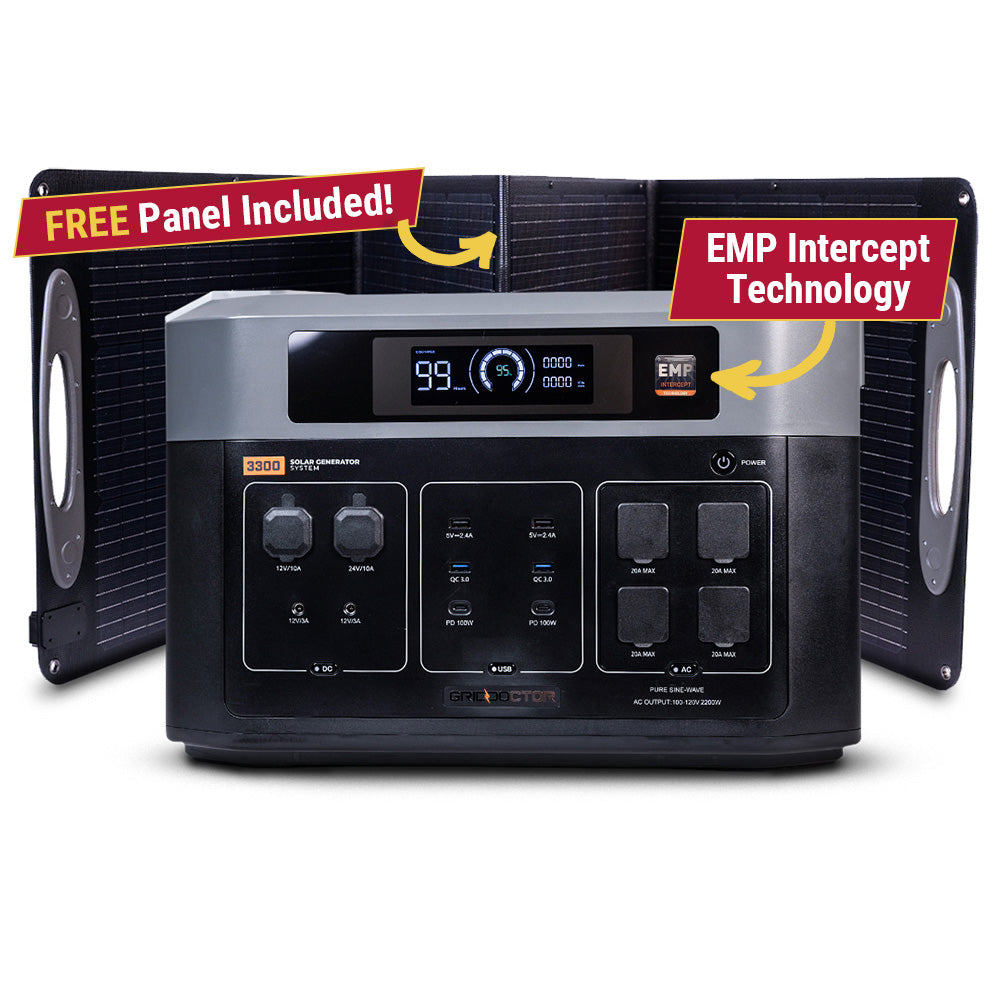
The Grid Doctor 3300 solar generator system sold with EMP shielding, a large portable power station for home backup and off-grid use; check the current spec sheet for details.
Why it's here: Listed with its EMP shielding as a stated feature, not a verified one. Judge it on the power specs first.
Claim audit: 15 consequential claims checked against the article's sources; unsupported wording revised where it could not be substantiated.
Claim-by-claim audit (15 checked)
“Short winter days, low sun angle, and weeks of overcast skies can cut solar production to a fraction of what you saw in June, so plan around your worst month rather than a summer f…” (rewritten to what the article can stand behind)
“Snow sitting on panels makes it worse, and panels mounted flat instead of angled steeply will hold snow far longer than panels tilted closer to vertical for winter sun.” (reasoning shown in the article)
“Battery manufacturers generally derate usable capacity as temperatures drop, so check the cold weather specs for your bank.” (rewritten to what the article can stand behind)
“A simple insulated battery box, or moving the bank to a semi-conditioned space, can preserve a meaningful chunk of capacity.” (reasoning shown in the article)
“Frozen water lines are one of the failures that comes up most often in first-winter accounts I've read.” (rewritten to what the article can stand behind)
“Any stretch of pipe that's above ground, under-insulated, or routed through an unheated crawlspace is a candidate for freezing solid, and worse, for splitting when it thaws.” (reasoning shown in the article)
“If you're on a [drilled or driven well](/blog/drilling-or-driving-a-well-off-grid-what-it-actually-costs-and-takes), the well itself is usually buried below frost line and fine.” (reasoning shown in the article)
“Even partially buried or insulated cisterns can freeze at the surface and crack fittings, so check that your setup accounts for expansion.” (reasoning shown in the article)
“That means more creosote buildup, more thermal cycling on the flue, and less margin for error on clearances that seemed fine when the stove barely got warm.” (reasoning shown in the article)
“A first winter is a likely time for chimney trouble, simply because nobody burns a stove that hard until the actual cold arrives.” (rewritten to what the article can stand behind)
“A stovepipe that was clean in November can build a dangerous creosote layer by February if you're burning green or unseasoned wood, running the stove low and smoldering overnight, …” (reasoning shown in the article)
“Biological breakdown depends on temperature, so composting toilets and pit systems tend to work more slowly in cold weather.” (rewritten to what the article can stand behind)
“A property that's a pleasant fifteen minute drive to town in October can become completely inaccessible after a real snow event, and if that coincides with a medical issue, a fuel …” (cited → weather.gov)
“It's easy to underestimate how long "snowed in" can last, and to overestimate how quickly help can reach a remote property.” (rewritten to what the article can stand behind)
“Fixing these things in October, when the ground isn't frozen and the roads are clear, is dramatically easier and cheaper than fixing them in January during the emergency they event…” (reasoning shown in the article)
Before you go
One useful off-grid email a week.
Practical gear rundowns, honest how-tos, and plain-English guides from someone doing the homework in the open.
I am building a place for off-grid people to swap real answers: a forum by topic, classifieds for gear and services, and real estate for off-grid land and homes. It is new, so the early members shape what it becomes. A free account lets you post in all three.
No ER ten minutes away means you have to be your own triage nurse. Here's how to tell a bad bee sting from the real emergency, and what to actually stock.
In many off-grid disasters, the fire or flood itself isn't the decisive factor, it's the hour you waited too long to leave. Here's how to set real, numeric triggers before you need them.
Tax sale and sheriff's auction land looks like a bargain, but redemption periods, hidden liens, and unseen parcels turn a lot of cheap acreage into an expensive lesson. Here's how to vet a listing before you bid.