A porch light that dies every night by 2 a.m. is worse than no porch light at all, because it trains you to stop trusting it. That's the trap a lot of off-grid households fall into with security lighting and cameras: they buy gear built for suburban houses with a bottomless grid connection, bolt it onto a modest solar battery bank, and wonder why the system either drains the batteries flat or shuts itself off right when it matters most.
Lighting and cameras are part of the same layer of defense covered in securing a remote property before you ever need a gun, but they deserve their own honest look, because the power budget changes everything about how you design them. A camera that works great on a wall outlet behaves completely differently running off a 100 amp-hour battery in December. This post is about making choices that hold up through a real off-grid winter, not just a demo in a bright showroom.
Why grid-designed gear fails off-grid
Most consumer security cameras and floodlights are engineered around an assumption: continuous, unmetered power. Manufacturers don't optimize for standby draw because standby draw doesn't cost the buyer anything on a grid connection. Off-grid, standby draw is the whole game. A camera pulling 4 watts continuously doesn't sound like much until you multiply it by 24 hours and add three more cameras plus a router plus a recorder, and now you've got a load that never sleeps, competing with your fridge and your lights for the same finite battery bank.
The other mismatch is connectivity. Many cloud-based cameras phone home frequently, uploading clips, checking firmware, chatting with an app server somewhere. If your comms setup is satellite internet or a cellular hotspot with a data cap, that background chatter adds up fast and can blow through a data allowance in days. If you're relying on the layered comms stack described in mesh radios, VoIP, and satellite mail, you already know bandwidth off-grid is a budgeted resource, not an infinite tap.
Lighting: the case for motion, not "dusk to dawn"
Dusk-to-dawn fixtures are the default for grid homes because nobody thinks about the electric bill for a 15 watt LED. Off-grid, running any fixture for eight to twelve hours a night is a real draw, and it's mostly wasted, because most of those hours nothing happens near that light.
A better approach:
Motion-activated LED floodlights with a PIR sensor, wired to fire for 60 to 90 seconds and then shut off. This cuts nightly draw to only the minutes something is actually moving, instead of the full hours a dusk-to-dawn fixture runs.
Solar-integrated fixtures with their own dedicated panel and battery, separate from your main bank. These are worth it for perimeter lighting far from the cabin, a barn corner or a gate, where running wire back to your main system is impractical anyway. The tradeoff is they're weather-dependent; a fixture that hasn't seen sun in four cloudy days will be dim or dead exactly when you need it. Treat solar path lights as a bonus layer, not your only one.
Low, warm-color light over blue-white floodlight. A blinding white floodlight ruins your own night vision the moment it fires, which matters if you're the one walking out to check on it. A dimmer, warmer light lets you actually see what triggered it without staring into a wall of glare.
Placement matters more than brand. Mount lights so the sensor faces the approach you actually care about (driveway, gate, main path) rather than pointing at open sky or a tree line where wind sets it off all night. False triggers from vegetation or livestock aren't just annoying, they burn through battery cycles for no reason, and they teach you to ignore the light, which defeats its purpose entirely.
Cameras: local storage beats cloud dependence
The single biggest design decision for off-grid camera systems is where the footage lives. Cloud-based systems (the kind that send a push notification and store a 15 second clip on a company's server) depend entirely on your internet connection staying up and your data plan having room. When your comms go down, exactly when a lot of security incidents happen (storms, downed lines, someone who knows to cut a wire first), your cloud camera goes dark too.
A local system, recording to an SD card or a small NVR (network video recorder) sitting in your own cabin, keeps working as long as your local power holds, independent of any outside connection. You lose the "check it from your phone in town" convenience, but you gain a system that doesn't rely on a company's servers, doesn't leak footage to a third party, and doesn't need a data plan.
If you do want remote viewing, look at cameras that support local network access over your own Wi-Fi or a wired connection rather than only a cloud app. This ties directly into the privacy questions raised in satellite internet and your privacy and in keeping your off-grid internet private with DNS and VPNs: every camera that phones home is another device sending metadata off your property, and every cloud account is another login that can be compromised.
Power budgeting for cameras, in real numbers
A rough way to think about camera power draw: check the nameplate wattage of the specific camera you're considering, and remember infrared night vision or a cold-weather heater will push actual draw higher. Over 24 hours that's roughly 48 to 150 watt-hours per camera per day. Four cameras on the low end is still adding up to 200 watt-hours a day just for a modest network, before you count the NVR or router keeping it all connected.
Compare that to what your system can realistically spare. If you're running a modest off-grid setup and you've worked through the sizing questions in how much solar do you actually need to live off-grid, you already know every appliance competes for the same generation and storage. Security gear that runs unattended, around the clock, in the background, needs to be accounted for in that budget the same way a refrigerator is, not treated as an afterthought you plug in after the "real" loads are sized.
A few ways to keep the draw manageable:
Choose cameras with a wired PoE (power over ethernet) connection over Wi-Fi where you can. A wired PoE camera avoids the power a Wi-Fi radio spends transmitting and reconnecting, so compare the rated draw of both options before choosing.
Use motion-triggered recording instead of continuous recording. Check whether your NVR software supports this, since recording only on motion reduces the storage needed on your SD card or NVR drive.
Put cameras and lighting on their own small dedicated battery and panel if your main bank is already tight, the same logic as the solar path lights above, just applied to a fixed camera position with a slightly bigger panel to handle infrared night draw.
Turn off infrared LEDs or heaters on cameras you don't need to run overnight in mild weather; both are common but avoidable power sinks.
Cold weather changes the math
Batteries lose usable capacity in the cold, a lead-acid or lithium battery that reads fine in July can deliver noticeably less in January. That's true for your main bank and doubly true for small dedicated battery packs running solar lights or remote cameras, which often use smaller, cheaper cells with less cold tolerance to begin with. A solar floodlight that ran all night in September may flicker out by 11 p.m. once the nights get long and cold. Plan for that drop rather than being surprised by it, and if a fixture is genuinely important (the one covering your main gate, say), wire it into your main system where you have real capacity and real monitoring, rather than trusting a standalone unit through the coldest months.
Where cameras fit into the bigger picture
Cameras and lights are a deterrent and a record, not a defense by themselves. A camera doesn't stop anyone from doing anything; it tells you something happened, ideally in time to act, and gives you a record afterward. That's genuinely useful, but it's one layer among several, alongside the physical barriers, sightlines, and habits covered in the layered defense post, and alongside a real plan for what you do if you're the only one home, discussed in home alone, off-grid: a solo defense plan when backup is an hour away. No amount of camera coverage replaces a plan for what happens after the camera sees something.
It's also worth being honest with yourself about maintenance. A camera with a cracked lens gasket that's fogged over, or a floodlight with a dead battery nobody's checked in four months, is worse than no camera at all, because you think you're covered when you're not. Build a simple habit, maybe tied to the same seasonal check you do on your water system or your generator, of walking the property and testing every light and camera. Wipe lenses, check battery voltage on standalone units, confirm the NVR is actually recording and not just showing a blank "no signal" tile it's been ignoring for weeks.
A realistic starting setup
For a small off-grid property, a reasonable first build looks like this: two or three motion-activated LED floodlights on your main power system, positioned at the driveway approach, the main entry, and one blind corner you've identified as a weak point. One or two wired or PoE cameras covering the same approaches, recording locally to an NVR or a dedicated small computer inside the cabin, on its own low-draw setup. Skip the cloud subscription unless you have genuinely reliable, uncapped connectivity, and skip continuous recording in favor of motion-triggered clips to save both power and storage.
Expand from there as your power budget allows, adding a solar-only light at a distant gate, a second camera at a shed or barn, but resist the pull to buy a big multi-camera kit before you've confirmed your system can carry the load through your worst month, not your best one. If you're still working out your general property layout and where the vulnerable points actually are, it's worth reading through the FAQ and the rest of the security and self-defense posts on the blog before you commit to hardware, since the physical layout decisions (fencing, sightlines, choke points) should come before you decide where to point a camera.
Good outdoor lighting and camera coverage off-grid isn't about buying the most feature-rich gear on the shelf. It's about picking things that fail gracefully, that tell you the truth about their own status, and that fit inside the power and connectivity budget you actually have, not the one a marketing page assumes you have.
The rest of the shortlist
Recommended off-grid gear
Affiliate disclosure: Some links on this site are affiliate links, including Amazon links: as an Amazon Associate I earn from qualifying purchases. Buying through one costs you nothing extra, and it never changes what I recommend.
Products appear here only when they match this article's subject. Selection is based on documented specs and owner reports, never on compensation; pages with no relevant gear carry none.
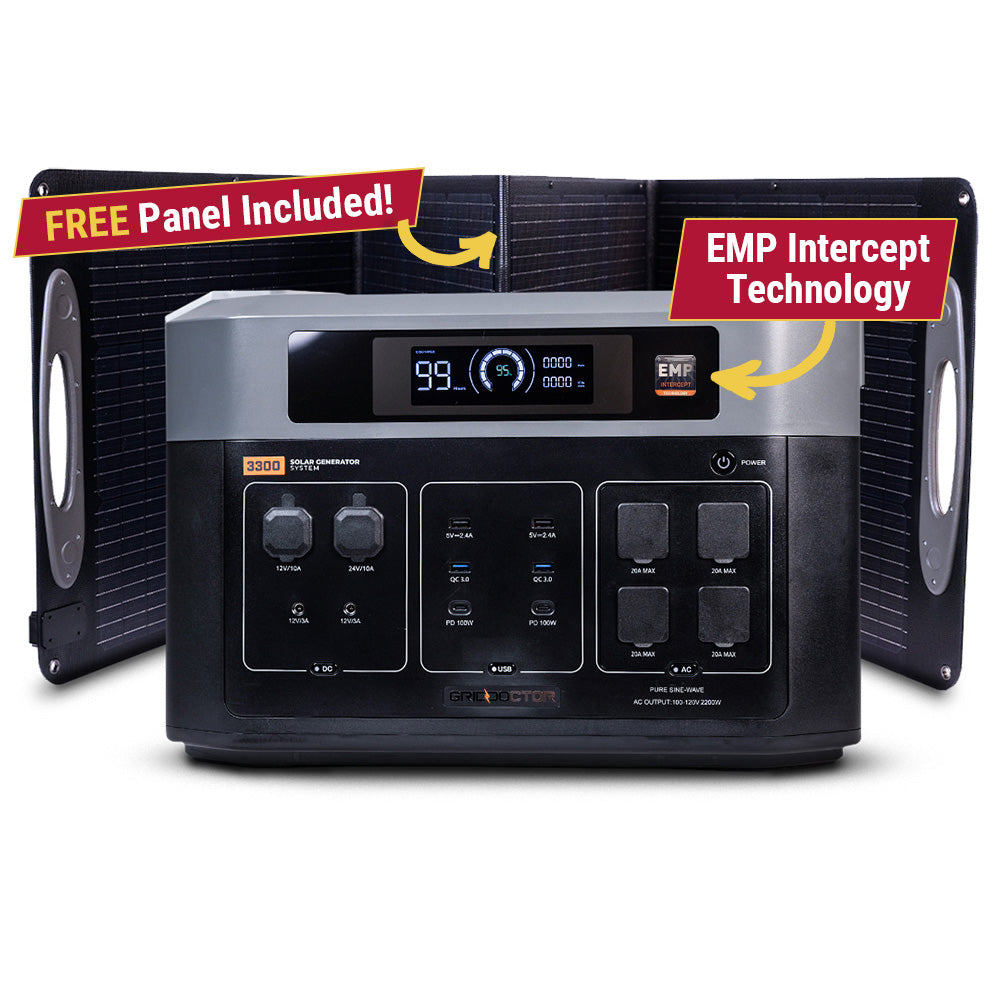
The Grid Doctor 3300 solar generator system sold with EMP shielding, a large portable power station for home backup and off-grid use; check the current spec sheet for details.
Why it's here: Listed with its EMP shielding as a stated feature, not a verified one. Judge it on the power specs first.
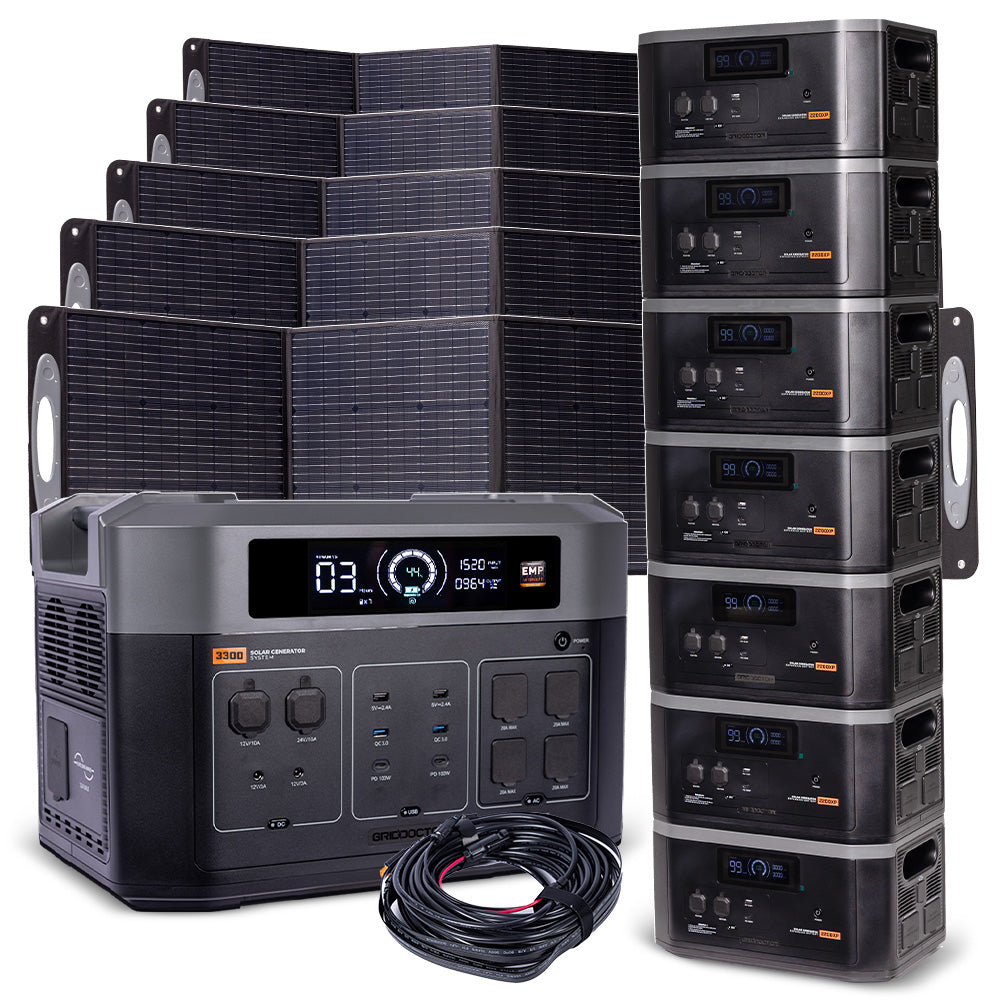
The Grid Doctor 3300 Power Tower, a large portable power station for home backup and off-grid systems; check the current spec sheet for capacity and output details.
Why it's here: Listed so form factor is part of the decision: this capacity class in a shape that stands rather than sits.
The Grid Doctor 3300-watt EMP-shielded solar generator sold through Emergency Essentials, a large power station for home backup and off-grid use; check the current spec sheet.
Why it's here: Listed through a second retailer so availability and pricing on this unit are not down to one storefront.
Firsthand testing: Researched from primary sources and owner reports; not yet field-tested by me. I flag anything I have personally used.
Primary references: Government data & agencies 2 · Manufacturer & industry 1 (listed below)
Firsthand evidence: none yet; this guide is desk research, and it says so where that limits it
Claim audit: 7 consequential claims checked against the sources below on Aug 28, 2026; wording the sources could not carry was removed (claim-by-claim)
“A rough way to think about camera power draw: check the nameplate wattage of the specific camera you're considering, and remember infrared night vision or a cold-weather heater wil…” (rewritten to what the article can stand behind)
“Batteries lose usable capacity in the cold, a lead-acid or lithium battery that reads fine in July can deliver noticeably less in January.” (cited → energy.gov)
“A wired PoE camera avoids the power a Wi-Fi radio spends transmitting and reconnecting, so compare the rated draw of both options before choosing.” (rewritten to what the article can stand behind)
“This cuts nightly draw to only the minutes something is actually moving, instead of the full hours a dusk-to-dawn fixture runs.” (rewritten to what the article can stand behind)
“Check whether your NVR software supports this, since recording only on motion reduces the storage needed on your SD card or NVR drive.” (rewritten to what the article can stand behind)
“Placement matters more than brand. Mount lights so the sensor faces the approach you actually care about (driveway, gate, main path) rather than pointing at open sky or a tree line…” (cited → ncpc.org)
“every camera that phones home is another device sending metadata off your property, and every cloud account is another login that can be compromised.” (cited → consumer.ftc.gov)
Before you go
One useful off-grid email a week.
Practical gear rundowns, honest how-tos, and plain-English guides from someone doing the homework in the open.
I am building a place for off-grid people to swap real answers: a forum by topic, classifieds for gear and services, and real estate for off-grid land and homes. It is new, so the early members shape what it becomes. A free account lets you post in all three.
Grounding gets skipped on more DIY solar builds than anyone admits. Here's what actually needs a ground rod, why, and how to tell if your system is wired safely.
Signing up with the local volunteer fire department is one of the fastest, most honest ways to become a real neighbor in a rural area. Here's what it actually involves.
A practical, no-nonsense look at what it actually takes to live off the grid, from power and water to food storage, mistakes to avoid, and honest trade-offs.