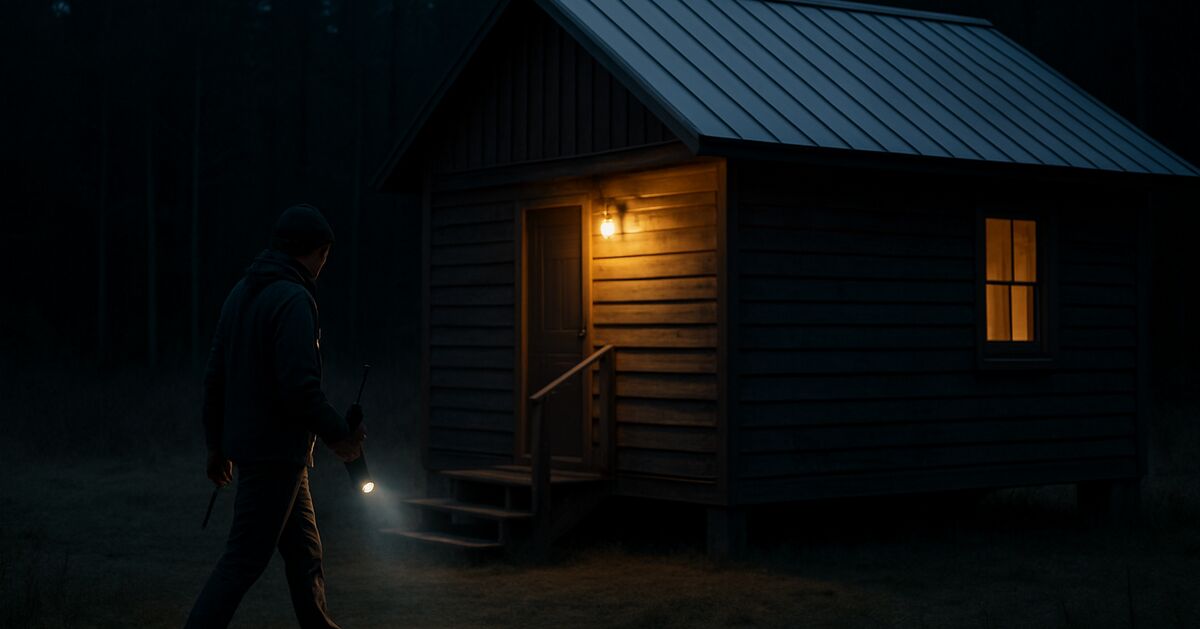
The scariest part of an emergency off-grid usually isn't the threat itself. It's doing the math in your head and realizing that whatever help exists is thirty, sixty, ninety minutes away, and tonight you happen to be the only adult on the property.
That's a different problem than "securing a remote property" in the general sense. Layered defense, cameras, lighting, dogs, all of that still matters, and if you haven't read the piece on securing a remote property before you ever need a gun, start there for the foundation. This post is about the narrower, harder question: what changes when you're the only one home, and how do you actually plan for that instead of just hoping it doesn't happen on your night.
Plenty of people end up living off-grid alone, at least some of the time. Partners work shifts that don't overlap. Spouses travel for supply runs or off-grid income. Adult kids move out. People choose to homestead alone on purpose. Whatever the reason, if you spend real nights by yourself on isolated land, you need a plan built for one person, not a plan built for a household that assumes someone else is always around to help, call for help, or just be a second set of eyes.
Why "solo" changes the whole calculation
A lot of home security advice, off-grid or not, quietly assumes a second person exists. Someone to grab the phone while you check a noise. Someone to watch the kids while you deal with a downed line or a wandering animal. Someone to notice you didn't come back from checking the barn.
Take that person away and a few things shift hard:
Response time isn't just slow, it's zero until you make it happen yourself. There's no one already in the house to act while you're incapacitated or distracted.
You can't split attention and defense. If you're dealing with a threat, you're also the one who has to communicate, retreat, and make every decision.
Small injuries become bigger problems. A twisted ankle running from a dog encounter, a cut hand securing a door, these are inconveniences with a partner around and real emergencies alone.
Psychological pressure is higher. Fear compounds when you know, factually, that nobody is coming in the next five minutes no matter what you do.
None of that means solo off-grid life is reckless. It means the plan has to be honest about what you don't have, instead of copying advice built for a two-adult household.
Start with the boring stuff: your own baseline awareness
Most defensive planning jumps straight to hardware. Locks, lights, cameras, dogs, firearms. All useful, but the actual first layer is you noticing things before they become a problem, and that skill degrades fast when you're alone and tired.
A few habits that matter more when you're solo than they do with backup around:
Walk your own perimeter at a consistent time, even when nothing's wrong. You're building a baseline of "normal" so anything off actually registers.
Don't let chores become autopilot after dark. The evening feed run, the last check on the generator, the walk to the woodpile are predictable and done with your attention elsewhere, which is exactly when something out of place can slip past you.
Keep exterior lighting predictable to you and unpredictable to anyone else. Motion lights that you know the pattern of, but a stranger doesn't, tell you a lot about what triggered them.
Trust the gut flinch. Alone, there's no partner to talk you out of an overreaction or into calm. Treat that first uneasy feeling as data, not paranoia, and check it out from a position of advantage rather than ignoring it.
Communication has to work without a second voice
When there are two adults, one person can call for help while the other handles the situation. Alone, you have to be able to do both, or you have to accept that calling for help happens after, not during. That's a real limitation and it's worth designing around instead of pretending it away.
A way to trigger an alert hands-free or with minimal effort. A panic button on a radio, a wearable with an SOS function, or even a loud, distinct whistle you keep on you at all times, not in a drawer.
A check-in system with someone off-property. A daily text, call, or radio check at a set time, with an agreed escalation if you miss it. This is a highly useful thing a solo off-grid resident can set up, and it's one that gets skipped because it feels like a hassle until the day it isn't.
Multiple ways to reach that person. If you're relying on boosting a weak cell signal or a single radio, have a second method as backup, because the emergency that threatens you may also be the one that takes out your primary link, a storm, a fire, a fall that breaks the radio you were carrying.
A written, physical copy of who to call and in what order, posted somewhere obvious. Under stress you may struggle to recall phone numbers, even ones you know well, so don't rely on memory.
Physical layout: designing for one set of hands
A lot of standard security advice, multiple exits monitored, someone posted at a door while another checks a room, assumes multiple people executing it. Solo, you need a layout and routine that one person can actually manage under stress.
Practical adjustments:
Simplify your locking routine so it's fast and doesn't require thought. Complicated multi-step security that works fine when you're calm becomes a liability when you're not.
Keep a designated safe room or fallback position, ideally one with a solid door, a way to communicate, and a way out that isn't the same path an intruder would use. You don't need a bunker, you need a spot you've actually thought through in advance rather than improvised in the moment.
Store a defensive tool, whatever that is for you, somewhere you can reach without walking past a window or door repeatedly to get to it. Alone, every extra movement in view is exposure you don't have backup covering.
Practice your own plan physically, not just mentally. Walk it. Time it. The version in your head is likely faster and smoother than what your body actually does at 2 a.m., which is why timing it matters.
Animals: a real asset, with a real caveat
A dog can be a useful part of a solo off-grid setup: ears that work in the dark, a nose that notices things you can't, and a presence that may deter someone considering trouble. If you're weighing predator and security value together, the piece on protecting livestock and pets from predators is worth reading alongside this one, since a lot of the same awareness habits overlap.
The caveat: a dog is not a substitute for a plan, and a dog can also become a casualty or a complication in a genuine incident. Know your dog's real temperament under stress, not the temperament you hope for. Some dogs bark and hold. Some bark and hide. Some engage in ways that put them at risk. Plan around the actual animal you have.
Firearms, if you carry them, need a solo-specific routine
This isn't a piece about which firearm to own, that's a personal decision tied to training, comfort, and local law. But if you do keep one for defense, solo living changes the practical routine around it:
It needs to be accessible from wherever you actually spend time at night, not just centrally located for a household. If you sleep in one room and work in another, you may need more than one safe, reachable option.
Maintenance and proficiency matter more when there's no one to double check you. Set your own recurring schedule for cleaning, function checks, and practice, and actually keep it, because nobody else will notice if you don't.
Think through the after: if you ever have to use it, you are also the one who has to call for help, render aid if needed, and manage the aftermath completely alone until backup arrives. That's a heavier load than most training scenarios cover, and it's worth thinking through in a calm moment rather than for the first time in a crisis.
The medical dimension nobody wants to think about
A defensive incident that leaves you hurt, even minorly, is a different emergency alone than it is with a partner. There's no one to apply pressure, no one to drive you out, no one to make the call while you focus on staying conscious.
This is exactly why building real skill, not just a stocked kit, matters so much for solo off-grid life. The posts on medical self-reliance beyond the first-aid kit and building an off-grid first-aid kit for when help is hours away are worth working through specifically with the "what if I'm the only one able to act" scenario in mind. Practice one-handed bandaging. Know how to apply a tourniquet to yourself if it ever comes to that. Keep supplies staged in more than one location so an injury in the barn doesn't mean limping to a kit in the house.
Build the plan, then write it down
The theme running through all of this is that solo off-grid security isn't a scaled-down version of household security, it's a different plan with different assumptions. Write yours down. Include your check-in schedule, your fallback room, your communication backups, your escalation contacts, and your own honest read on what you can and can't manage alone.
If you're still working out the broader shape of your setup, the FAQ and about pages cover how this site approaches off-grid planning generally, and the blog index has the related pieces on communications, predator defense, and medical skill-building referenced above. If you want to talk through specifics of your situation, the contact page is there.
Living alone off-grid isn't automatically a bad idea, and many people do it for years without trouble. But the plan that keeps you safe has to be built for the nights when it really is just you, because those nights come whether you've planned for them or not.
Claim audit: 7 consequential claims checked against the article's sources; unsupported wording revised where it could not be substantiated.
Claim-by-claim audit (7 checked)
“Plenty of people end up living off-grid alone, at least some of the time.” (rewritten to what the article can stand behind)
“A lot of home security advice, off-grid or not, quietly assumes a second person exists.” (rewritten to what the article can stand behind)
“Don't let chores become autopilot after dark. The evening feed run, the last check on the generator, the walk to the woodpile are predictable and done with your attention elsewhere…” (rewritten to what the article can stand behind)
“Under stress you may struggle to recall phone numbers, even ones you know well, so don't rely on memory.” (rewritten to what the article can stand behind)
“A dog can be a useful part of a solo off-grid setup: ears that work in the dark, a nose that notices things you can't, and a presence that may deter someone considering trouble.” (rewritten to what the article can stand behind)
“The version in your head is likely faster and smoother than what your body actually does at 2 a.m., which is why timing it matters.” (rewritten to what the article can stand behind)
“Living alone off-grid isn't automatically a bad idea, and many people do it for years without trouble.” (rewritten to what the article can stand behind)
Before you go
One useful off-grid email a week.
Practical gear rundowns, honest how-tos, and plain-English guides from someone doing the homework in the open.
I am building a place for off-grid people to swap real answers: a forum by topic, classifieds for gear and services, and real estate for off-grid land and homes. It is new, so the early members shape what it becomes. A free account lets you post in all three.
No ER ten minutes away means you have to be your own triage nurse. Here's how to tell a bad bee sting from the real emergency, and what to actually stock.
In many off-grid disasters, the fire or flood itself isn't the decisive factor, it's the hour you waited too long to leave. Here's how to set real, numeric triggers before you need them.
Tax sale and sheriff's auction land looks like a bargain, but redemption periods, hidden liens, and unseen parcels turn a lot of cheap acreage into an expensive lesson. Here's how to vet a listing before you bid.