A milk cow or a pair of dairy goats can change what your homestead eats every single day, but nobody warns you that the milking routine, not the animal, is what makes or breaks the whole project. You can pick the sweetest goat in the county, and if your setup fights you twice a day, you'll dread it by week three. This is about building a milking routine that actually holds up off-grid, without a commercial parlor, without grid power, and without turning your barn into a science experiment gone wrong.
This isn't a repeat of picking your first livestock or getting through the first six months. This is the specific, practical question that comes right after you've committed to a milking animal: how do you actually milk, cool, and clean up, twice a day, forever, with no wall outlet in the barn.
Start with the stand, not the animal
A common pattern I see is people obsessing over breed and temperament and completely underbuilding the milking stand. That's backwards. A calm animal on a bad stand turns fidgety fast, and a slightly flighty animal on a good stand settles down within a week.
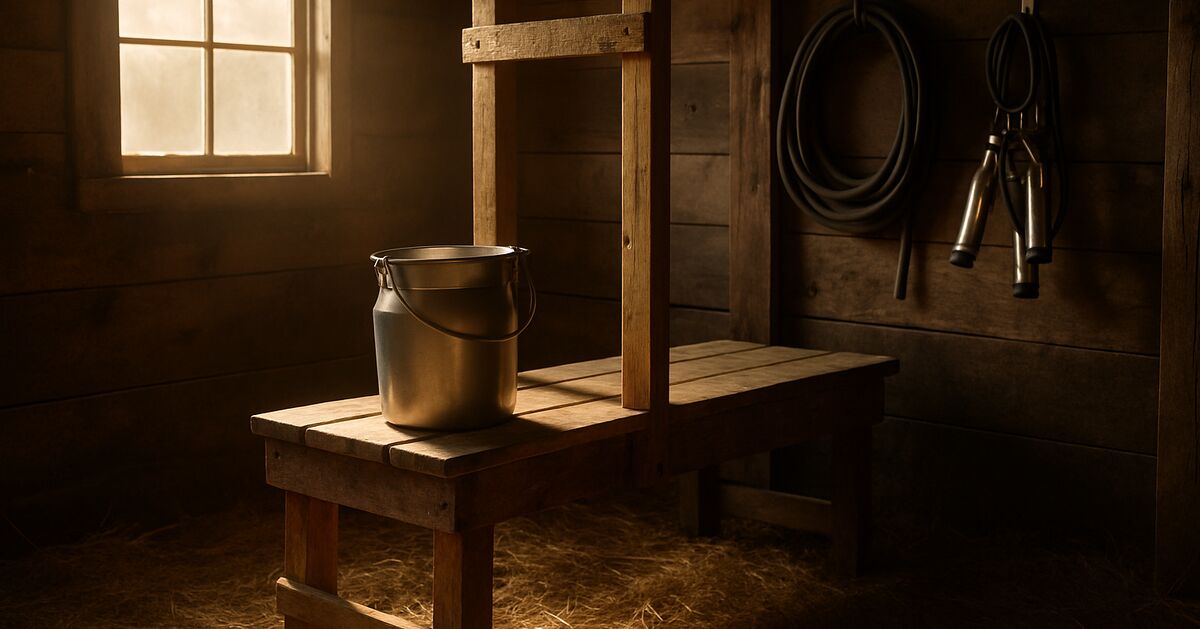
For goats, a simple stanchion with a headlock and a raised platform (18 to 24 inches) does most of the work for you. The height means you're not hunched over a bucket on the ground, which matters a lot when you're doing this twice a day for years. The headlock means the goat can eat grain while you milk, which is the single best behavior trick in dairy goat keeping: food equals standing still.
For a family cow, you need something sturdier: a stanchion or headgate bolted to real posts, not screwed to a pallet wall. Cows lean. A stand that shifts under 1,200 pounds of leaning cow is a safety problem, not just an annoyance.
Build the stand before the animal arrives if you can. Animals learn the routine faster when it's consistent from day one, and you'll find design flaws (too narrow, too short, no grain trough) far more cheaply on an empty stand than mid-milking with a full udder in front of you.
Hand milking vs. a portable milker
Hand milking one or two goats is entirely reasonable and plenty of people do it for a decade without ever wanting a machine. Once you're practiced, a goat often takes only a handful of minutes, less if you're fast. A single family cow generally takes noticeably longer, depending on how heavy she's milking and how good your hands are.
Where it gets harder is scale, arthritis, or cold. If you're milking three or more goats, or a cow with a big udder, or if your hands ache by the end (very common, nobody talks about it enough), a portable vacuum milker is worth serious consideration. Many run off small 12-volt pumps, so check the amp draw on the model you're considering against what your battery bank can carry. Pair that with the guidance in 12V vs 24V vs 48V battery banks if you're speccing out a dedicated barn circuit, because a milker, a small fridge for milk storage, and barn lighting together are a real, calculable load, not an afterthought.
A note on stainless vs. plastic milking buckets: stainless is more expensive and it is worth it. Plastic scratches, scratches harbor bacteria, and bacteria means off-flavored milk and shorter shelf life no matter how careful you are with everything else.
The cooling problem is the real problem
Here's the part that trips up a lot of people moving to off-grid dairy: raw milk comes out near body temperature and needs to get down to refrigeration temperature quickly, so check your local extension's recommended cooling time and target temperature. On grid power that's just a fridge. Off-grid, that hour matters and you need a plan.
The classic solution is an ice bath: a milk can or covered pail set into a larger tub of ice water, stirred occasionally, chills fast if you have ice on hand. That means you need an ice-making or ice-storage plan, which usually means a chest freezer run efficiently off solar, making ice blocks in rotation. This dovetails directly with the load planning in how much solar do you actually need to live off-grid, because a small chest freezer is one of the cheapest, most forgiving loads to run off a modest array, far easier than trying to run a whole-house fridge.
If you don't want to manage ice, a 12-volt fridge or a well-insulated root cellar space that stays reliably below 45°F can work for smaller quantities, especially goat milk in small jars, but a root cellar alone usually isn't cold enough for milk safety in warm months. Don't talk yourself into "the cellar's pretty cool" as your only plan; test it with a thermometer over a full week before you trust animals' worth of milk to it.
Water is the other constraint
Milking, and especially milk equipment cleanup, uses more water than people expect. You need genuinely hot water to rinse milkfat residue off equipment before a full wash, since fat sets and clings in cold water. Cold water alone tends to leave a fatty film, which is why extension milking guides call for a warm rinse first.
That means you need a hot water source at the barn or a very short carry from the house. A small on-demand propane water heater dedicated to the barn is a common solution, or a insulated jug system refilled from the house twice a day if the distance is short. Either way, plan this before you commit to a milking schedule, because "I'll just carry hot water from the house" sounds fine until it's 15 degrees out and you're doing it twice a day, every day, including the days you're sick or it's pouring rain.
If your water storage is already tight, revisit sizing your off-grid water storage with milking added to your daily draw. Cleanup for a single milking goat can add a few gallons a day in my own setup; a cow's equipment takes more. It adds up over a month in a way that catches new dairy keepers off guard.
Sanitation without a dairy inspector looking over your shoulder
Commercial dairies exist under strict cleaning protocols for good reason: milk is an excellent medium for bacteria to multiply fast. You don't need commercial-grade stainless everything, but you do need a real routine, not a casual one.
The basics that actually matter:
Rinse equipment in cool water immediately after milking, before the milkfat sets.
Wash in hot soapy water, a bottle brush that reaches every corner, no exceptions on the corners.
Sanitize with a diluted bleach solution or a dairy-safe sanitizer, air dry completely, do not towel dry with a cloth that's touched anything else.
Store milking equipment somewhere it can't collect barn dust between uses, a covered shelf or cabinet, not an open hook by the stall.
This is a very similar mindset to the handwashing and hygiene stations approach: the goal is a repeatable station, not a one-off effort. If the sanitation station is annoying to use, you'll skip steps on the tired days, and tired days are exactly when contamination risk goes up.
Building the twice-daily routine so it doesn't own your life
Milking twice a day, roughly 12 hours apart, is non-negotiable once an animal is in full production; skipping or badly delaying a milking causes discomfort for the animal and can lead to mastitis. That's the part people underestimate before they commit. It's not a chore you can skip for a weekend trip without a plan.
Build the routine around your actual life, not an idealized one. If you're not a morning person, don't set your schedule for a 5 a.m. milking just because that's what a book said; a 7 and 7 schedule works just as well as 5 and 5, as long as the interval stays consistent. Consistency matters more than the specific hour.
Have a real backup plan for when you're sick, injured, or need to travel. This is where the trading networks and neighbor relationships matter: a neighbor who can handle a milking or two is worth more than almost any piece of gear you'll buy. If you haven't built that kind of local reciprocity yet, it's worth reading through how mutual aid and trade circles actually get built before you're relying on one under pressure.
What actually goes wrong in year one
A few patterns show up again and again with new small-scale milkers:
Underbuilt stands that get "temporary" fixes for years. Fix the stand right the first time.
No cooling plan beyond "the fridge." Then the fridge is a whole-house fridge running off a marginal system, and milk cooling competes with keeping food safe, and something loses.
Skipping the pre-milking udder wash. A simple warm, damp cloth wipe before milking, every time, cuts contamination risk enormously and also helps trigger let-down. It takes 30 seconds and it's the step people cut first when they're rushed.
Underestimating water use. As above, it's a real daily draw, not a rounding error.
No plan for the "off" months. Milk production isn't flat all year; it peaks after freshening and tapers. New keepers sometimes panic mid-lactation dip, assuming something's wrong, when it's often just the normal curve. Talk to whoever you got the animal from about what a normal curve looks like for that specific animal or breed.
Is it worth it
For most families who actually use the milk (drinking, cheese, yogurt, feeding pigs the whey, feeding excess to barn cats), yes, decisively. A single dairy goat in good production can go a long way toward a family's fresh milk needs, though yields vary widely by breed and stage of lactation. A family cow is a bigger commitment in every direction, more feed, more space, more milk than most households can use without a plan for the extra (cheese, butter, feeding other livestock), but also more forgiving in terms of once-a-day options later in lactation if you're willing to let a calf nurse part-time.
The honest answer is that milking rewards people who like routine and punishes people who don't. If you already enjoy the rhythm of daily chores, this fits naturally into homestead life. If chores feel like a burden most days, a milking animal will amplify that feeling fast, twice a day, for as long as she's in milk.
Before you commit, it's worth spending time with someone else's milking routine first, an afternoon visit, a week of helping a neighbor, anything that gets your hands on a real udder and a real stand before you're building your own from scratch. Questions that seem abstract on paper, how sore will my hands get, how long does cleanup really take, how bad is the smell, get answered fast in person. If you're still working out whether this fits your broader plan, our FAQ and blog index cover a lot of the adjacent decisions, from water storage to solar sizing, that all feed into whether a milking routine is realistic on your specific piece of ground.
Milk is one of the most satisfying things a homestead can produce daily, real cream, real cheese, a taste that store milk never quite matches. Just go in with your stand built, your cooling plan tested, and your water sorted, and the twice-daily routine becomes a genuine pleasure instead of a fight.
Claim audit: 14 consequential claims checked against the article's sources; unsupported wording revised where it could not be substantiated.
Claim-by-claim audit (14 checked)
“Once you're practiced, a goat often takes only a handful of minutes, less if you're fast.” (rewritten to what the article can stand behind)
“A single family cow generally takes noticeably longer, depending on how heavy she's milking and how good your hands are.” (rewritten to what the article can stand behind)
“Many run off small 12-volt pumps, so check the amp draw on the model you're considering against what your battery bank can carry.” (rewritten to what the article can stand behind)
“Plastic scratches, scratches harbor bacteria, and bacteria means off-flavored milk and shorter shelf life no matter how careful you are with everything else.” (reasoning shown in the article)
“Here's the part that trips up a lot of people moving to off-grid dairy: raw milk comes out near body temperature and needs to get down to refrigeration temperature quickly, so chec…” (rewritten to what the article can stand behind)
“If you don't want to manage ice, a 12-volt fridge or a well-insulated root cellar space that stays reliably below 45°F can work for smaller quantities, especially goat milk in smal…” (reasoning shown in the article)
“You need genuinely hot water to rinse milkfat residue off equipment before a full wash, since fat sets and clings in cold water.” (rewritten to what the article can stand behind)
“Cold water alone tends to leave a fatty film, which is why extension milking guides call for a warm rinse first.” (rewritten to what the article can stand behind)
“Cleanup for a single milking goat can add a few gallons a day in my own setup; a cow's equipment takes more.” (rewritten to what the article can stand behind)
“Commercial dairies exist under strict cleaning protocols for good reason: milk is an excellent medium for bacteria to multiply fast.” (cited → fda.gov)
“Milking twice a day, roughly 12 hours apart, is non-negotiable once an animal is in full production; skipping or badly delaying a milking causes discomfort for the animal and can l…” (cited → extension.oregonstate.edu)
“A simple warm, damp cloth wipe before milking, every time, cuts contamination risk enormously and also helps trigger let-down.” (cited → extension.psu.edu)
“Milk production isn't flat all year; it peaks after freshening and tapers.” (cited → extension.psu.edu)
“A single dairy goat in good production can go a long way toward a family's fresh milk needs, though yields vary widely by breed and stage of lactation.” (rewritten to what the article can stand behind)
Before you go
One useful off-grid email a week.
Practical gear rundowns, honest how-tos, and plain-English guides from someone doing the homework in the open.
I am building a place for off-grid people to swap real answers: a forum by topic, classifieds for gear and services, and real estate for off-grid land and homes. It is new, so the early members shape what it becomes. A free account lets you post in all three.
No ER ten minutes away means you have to be your own triage nurse. Here's how to tell a bad bee sting from the real emergency, and what to actually stock.
In many off-grid disasters, the fire or flood itself isn't the decisive factor, it's the hour you waited too long to leave. Here's how to set real, numeric triggers before you need them.
Tax sale and sheriff's auction land looks like a bargain, but redemption periods, hidden liens, and unseen parcels turn a lot of cheap acreage into an expensive lesson. Here's how to vet a listing before you bid.