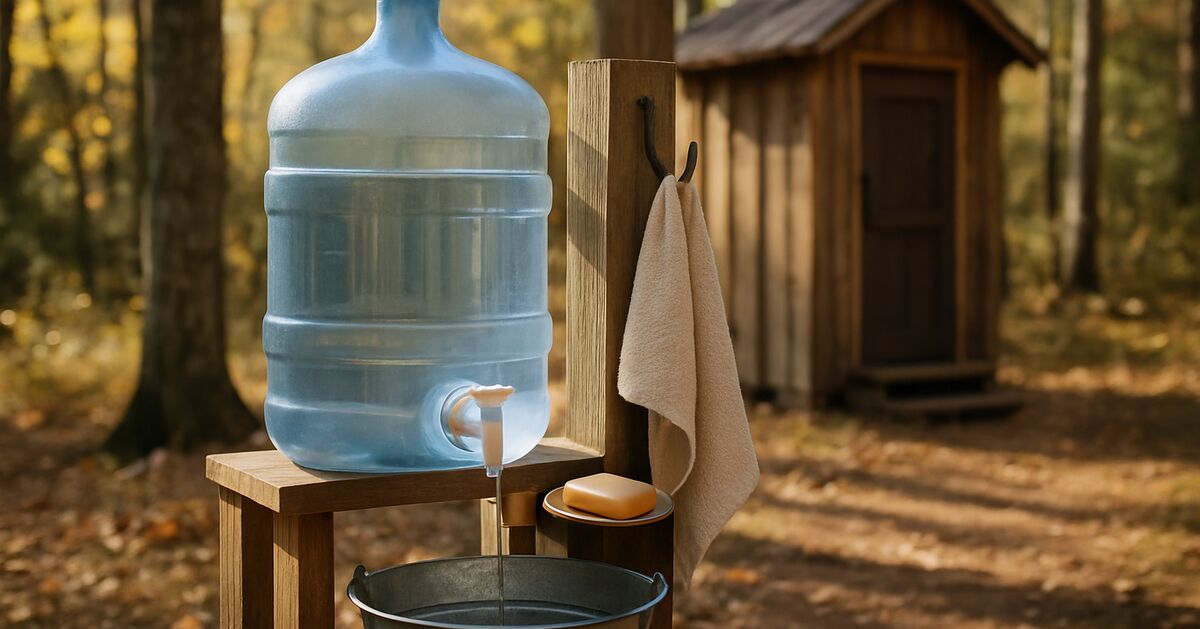
The single biggest sanitation failure off-grid isn't the toilet. It's the sink that never gets used because it's inconvenient, cold, or forty feet from the kitchen.
Much off-grid sanitation writing focuses on the dramatic stuff: outhouses, composting toilets, greywater fields. All important. But the humble act of washing hands after the outhouse, before cooking, after handling raw meat or animal chores, is a well established way to cut the spread of illness, and it applies just as much off-grid. And it's the thing that quietly falls apart when there's no faucet doing the thinking for you.
This post is about building hygiene stations that people (including reluctant teenagers and tired adults at 11pm) will actually use, and doing it in a way that doesn't blow your water budget or turn into another greywater headache.
Why this matters more off-grid, not less
In a normal house, handwashing is frictionless. Turn a handle, water appears, soap is right there, warm water even. Off-grid, every one of those steps has to be deliberately engineered, or people skip it.
The stakes are also a little higher. You're likely dealing with:
A well or hauled water supply you don't want to waste
An outhouse or composting toilet instead of a flush system, which carries its own pathogen load right at the door
More hands-on animal chores (feeding, milking, mucking) that put bacteria and parasites directly on your skin
A kitchen that may not have hot water on demand
Longer distances to a clinic if something like giardia, salmonella, or a bad skin infection takes hold
None of this is scary if you plan for it. It's only a problem when the hygiene station is an afterthought, stuck outside in the cold, fifty feet from where people actually need it.
The three-station rule
Rather than one central sink trying to do everything, think in terms of three separate hygiene stations, each placed exactly where the dirty task happens:
1. Outhouse or toilet station. Right at the door of the outhouse or composting toilet, not back in the main cabin. This is non-negotiable. If someone has to walk a hundred feet in the rain to wash up after using the outhouse, they won't do it consistently, and that's exactly the moment hand-to-mouth contamination happens.
2. Kitchen station. Separate from dishwashing, ideally a small basin or foot-pump sink just for hands, near the food prep area. This keeps raw-food bacteria off your cooking water supply.
3. Barn or chore station. If you keep livestock, a basin near the coop or barn door, not back at the house, so people wash before they track chore grime into living space.
If you've read our piece on greywater basics for a cabin or homestead, you already know that everything you pour down a drain has to go somewhere sensible. The same logic applies here in miniature: each hygiene station needs its own simple, sane way to handle the wastewater it produces, even if that's just a bucket that gets tossed on non-edible landscaping twice a day.
What a good station actually needs
You don't need plumbing. You need four things within arm's reach of each other:
Water. A gravity-fed jug, a foot-pump unit, or a simple tap on an elevated container. Five gallons lasts a surprising number of handwashes if you're not running it like a kitchen faucet.
Soap. Liquid or bar, doesn't matter, but it needs a holder so it isn't sitting in a puddle turning to mush.
A way to dry hands. A roll of cloth towels you launder is more sustainable than paper towels you have to keep hauling in. Have a dedicated hook and a rotation schedule.
A drain or catch. Even a five-gallon bucket with a bit of gravel in the bottom to keep it from splashing works, as long as someone empties it regularly and it doesn't turn into a mosquito breeder.
A common trap is trying to build one elaborate permanent station and never getting around to it, instead of three cheap, ugly stations that actually exist and get used starting week one. Ugly and functional beats beautiful and theoretical every time.
Foot pumps are underrated
A lot of off-grid households default to pour-over jugs for hygiene stations, which works, but it means using one hand to pour and the other to scrub, which people do badly and half-heartedly, especially kids.
A simple foot-pump sink (a small pedal that draws water up from a jug or tank through a length of tubing to a spout) frees both hands for actual scrubbing, and it makes the station feel like a real sink instead of a chore. These units are inexpensive, have very few parts to fail, and use less water per wash than a pour-over because you control the flow with your foot instead of tipping a whole jug.
If you're handy, you can build one from a foot pump (the kind sold for inflating air mattresses, reversed) and a bucket. If you'd rather not fuss with it, pre-built camp and marine versions exist cheaply and hold up fine outdoors if you bring them in before a hard freeze.
Warm water without a water heater
Cold-water handwashing works, but in our experience people are more willing to wash long enough when the water is warm, especially in winter after outhouse trips.
A few low-effort ways to get warm water at a station without running a water heater:
Keep a black-painted jug in a sunny window or on a south-facing sill during the day. Sun on a dark container will take the edge off the water, though how much depends on the season and exposure.
Keep a small kettle on the wood stove during heating season and top off the station jug from it once or twice a day.
If your kitchen already has warm water from a stove-top reservoir or an on-demand propane heater, run a short line to the nearest station rather than trying to heat water separately at each spot.
Don't over-engineer this. The goal is "warm enough that people don't dread it," not spa temperature.
The freeze problem
Any hygiene station outside or in an unheated space needs a winter plan, or you'll walk out to a solid block of ice in January. This is really just a smaller version of the challenges covered in our post on keeping off-grid water safe through a hard freeze. For hygiene stations specifically:
Bring outdoor stations' water supply in at night, even if the basin itself stays put
Insulate the jug or tank with a foam sleeve or old blanket if it has to stay outside
Use smaller volumes in winter so you're not letting a big tank sit and freeze solid, refill more often instead
Consider moving the outhouse station's water supply just inside the door rather than fully outdoors, with the basin right by the exit
A frozen hygiene station gets skipped entirely, which defeats the whole purpose, so this is worth solving properly rather than shrugging off for three months.
Soap, sanitizer, and what actually kills germs
Plain soap and a decent scrub (twenty seconds, hitting between fingers and under nails) is still the gold standard and beats hand sanitizer for anything involving visible dirt, animal contact, or after using the bathroom. Sanitizer is a fine backup for quick moments (before eating a snack mid-chore) but shouldn't replace actual washing at the key checkpoints.
Keep a bottle of unscented sanitizer at each station as a backup for when water runs low or someone's hands aren't visibly dirty, but treat soap and water as the default, not the exception.
Building the habit, not just the station
Physical setup only gets you halfway. The other half is making the routine stick, especially with kids or visitors who aren't used to off-grid rhythms. A few things that actually work:
Put the station where it's physically impossible to avoid on the path from outhouse to kitchen
Make handwashing part of a chore chain rather than a separate ask ("wash up" is the last step of "collect eggs," not a separate reminder)
Keep the water level visible so people notice when a jug needs refilling instead of finding it empty mid-wash
Replace soap before it runs out, not after, an empty dispenser trains people to skip the step entirely
If you're setting up systems for kids, this pairs well with thinking through age-appropriate routines the way you would for any other recurring task on the property.
Where this fits in your bigger sanitation plan
Hygiene stations are the connective tissue between your other sanitation systems. They don't replace a well-sited outhouse, a working composting toilet, or a sound greywater plan, they're what makes those systems actually safe to use day to day. A perfectly built outhouse with no handwashing station right outside is still a real illness risk, just a hidden one.
If you're still in the planning stage of your property and haven't nailed down the rest of your sanitation layout, it's worth reading through our pieces on building a proper off-grid outhouse and composting toilets alongside this one, since station placement really depends on where those systems end up.
A simple starter setup
If you want to get something working this week rather than planning the perfect system for six months, here's a bare-minimum version that costs very little and works:
Two five-gallon jugs with spigots, one for the outhouse station, one for the kitchen
A cheap bar of soap on a draining dish at each
A cloth towel on a hook, swapped every few days
A five-gallon bucket underneath to catch water, dumped onto non-edible ground daily
That's it. Upgrade to foot pumps, warm water, and permanent basins as time and budget allow, but don't let the upgraded version stop you from having the basic version running immediately.
The bottom line
Handwashing is boring compared to solar arrays and water catchment, which is exactly why it gets skipped in the planning process and then causes real problems once you're actually living the life. Treat it as its own small system, not an afterthought bolted onto the kitchen sink, and you remove one of the easier causes of avoidable illness on a new property.
If you're still working through the rest of your sanitation and water planning, our blog has the deeper dives on outhouses, composting toilets, and greywater, and our FAQ covers a lot of the smaller questions people run into once they're actually living the setup day to day. And if there's a sanitation angle you're stuck on that we haven't covered yet, our contact page is open for that too.
Claim audit: 11 consequential claims checked against the article's sources; unsupported wording revised where it could not be substantiated.
Claim-by-claim audit (11 checked)
“But the humble act of washing hands after the outhouse, before cooking, after handling raw meat or animal chores, is a well established way to cut the spread of illness, and it app…” (rewritten to what the article can stand behind)
“More hands-on animal chores (feeding, milking, mucking) that put bacteria and parasites directly on your skin” (cited → medlineplus.gov)
“If someone has to walk a hundred feet in the rain to wash up after using the outhouse, they won't do it consistently, and that's exactly the moment hand-to-mouth contamination happ…” (reasoning shown in the article)
“This keeps raw-food bacteria off your cooking water supply.” (reasoning shown in the article)
“A common trap is trying to build one elaborate permanent station and never getting around to it, instead of three cheap, ugly stations that actually exist and get used starting wee…” (rewritten to what the article can stand behind)
“These units are inexpensive, have very few parts to fail, and use less water per wash than a pour-over because you control the flow with your foot instead of tipping a whole jug.” (reasoning shown in the article)
“Cold-water handwashing works, but in our experience people are more willing to wash long enough when the water is warm, especially in winter after outhouse trips.” (rewritten to what the article can stand behind)
“Sun on a dark container will take the edge off the water, though how much depends on the season and exposure.” (rewritten to what the article can stand behind)
“Plain soap and a decent scrub (twenty seconds, hitting between fingers and under nails) is still the gold standard and beats hand sanitizer for anything involving visible dirt, ani…” (cited → medlineplus.gov)
“A perfectly built outhouse with no handwashing station right outside is still a real illness risk, just a hidden one.” (reasoning shown in the article)
“Treat it as its own small system, not an afterthought bolted onto the kitchen sink, and you remove one of the easier causes of avoidable illness on a new property.” (rewritten to what the article can stand behind)
Before you go
One useful off-grid email a week.
Practical gear rundowns, honest how-tos, and plain-English guides from someone doing the homework in the open.
I am building a place for off-grid people to swap real answers: a forum by topic, classifieds for gear and services, and real estate for off-grid land and homes. It is new, so the early members shape what it becomes. A free account lets you post in all three.
No ER ten minutes away means you have to be your own triage nurse. Here's how to tell a bad bee sting from the real emergency, and what to actually stock.
In many off-grid disasters, the fire or flood itself isn't the decisive factor, it's the hour you waited too long to leave. Here's how to set real, numeric triggers before you need them.
Tax sale and sheriff's auction land looks like a bargain, but redemption periods, hidden liens, and unseen parcels turn a lot of cheap acreage into an expensive lesson. Here's how to vet a listing before you bid.