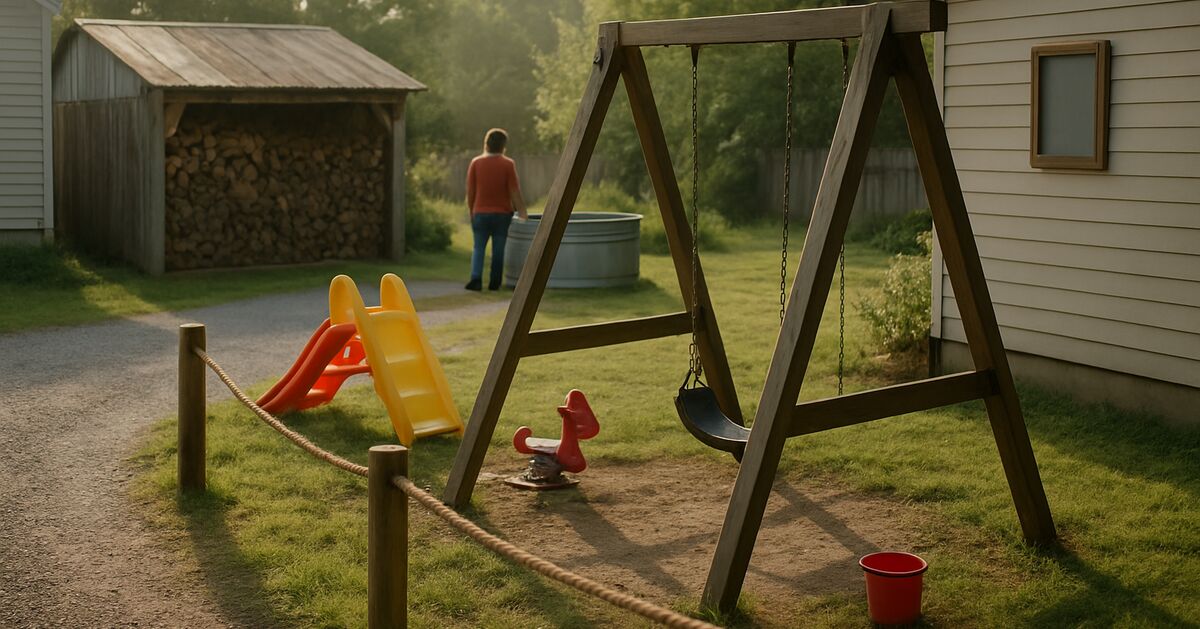
A five-gallon bucket with two inches of rainwater in it is deep enough to drown a toddler, and so is a stock tank or half-full rain barrel. So has a stock tank, a half-full rain barrel, and the puddle at the bottom of an unused root cellar. This is the kind of hazard that never shows up on a store-bought baby-proofing checklist, because those checklists were written for a house with a fenced yard, a shallow bathtub, and a driveway a car can't reach without you hearing it. Off-grid land runs on a completely different hazard map, and it's worth drawing that map on purpose instead of finding it the hard way.
This isn't a rehash of general child safety-proofing or the newborn gear question. It's specifically about the physical hazards that show up once you own acreage, run your own power and water, and keep tools, animals, and equipment that a suburban childproofing guide was never written to address.
Start with what's actually dangerous, not what feels dangerous
New parents on grid power tend to obsess over outlet covers and cabinet locks, and those still matter. But the hazards worth prioritizing on off-grid land fall into a narrower list: water (tanks, ponds, cisterns, irrigation ditches), moving vehicles and equipment on a property with no clear boundary between "yard" and "work area," fuel and chemical storage, open flame and wood heat, and firearms or livestock-handling tools kept within reach.
The pattern is simple. Grid homes separate living space from mechanical space. Off-grid homes often don't. Your propane tank, your genset, your woodpile, your ATV, and your kid's sandbox can all be visible from the same window, sometimes within twenty feet of each other. That proximity is the actual risk multiplier, more than any single hazard on its own.
Water: the one that kills fastest and gets the least attention
The CDC notes that drowning can happen in seconds and in very small amounts of water, and that young children are especially vulnerable because they can lose their balance headfirst into a container and be unable to right themselves. On a homestead, the list of "small amounts of water" is longer than most people plan for:
Open rain barrels and cisterns, especially ones without secured lids
Stock tanks and livestock water troughs
Ponds, seasonal ditches, and irrigation channels
Five-gallon buckets left out after cleaning or mixing feed
Kiddie pools left filled overnight
The catchment basin under a gutter or downspout
The fix isn't complicated, it's just easy to skip when you're busy. Every open water container over a few inches deep needs a lid, a fence, or constant supervision, and toddlers need active adult eyes within arm's reach any time they're near any of it, no exceptions for "just for a minute." If you're setting up rainwater catchment or sizing your storage tanks, build the child-safety lid or fence into the plan from day one rather than retrofitting it after a scare. A locking or heavy lid that an adult struggles to remove is a feature, not an inconvenience.
The driveway and the yard have no edges
In town, a fence and a sidewalk tell everyone, including a four-year-old, where the yard ends and the danger starts. On raw land, that line often doesn't exist. Your kid's play space and your truck's turnaround might be the same gravel pad. A visitor's car, a delivery driver, or your own tractor backing up to the woodshed all become real risks precisely because there's no curb, no fence, and often no warning.
Practical steps that actually work here:
Put a physical barrier, even a simple rope-and-post fence, between any area kids play unsupervised and any area vehicles or equipment move through. If you're new to fencing a property in stages, fencing a homestead in stages covers what to prioritize first, and a kid-safe perimeter around the house pad is a strong candidate for that first phase.
Establish a rule, and drill it, that no vehicle moves without a visual headcount of every child on the property first. This sounds excessive until you've had a near-miss with a backing truck.
Keep a designated, fenced or clearly marked play area close to the house, and treat it as the default "kids are here" zone so everyone driving or operating equipment knows where to look.
Tools, fuel, and chemicals: storage height isn't enough
A locked cabinet works for cleaning supplies in a kitchen. It doesn't fully cover an off-grid property, where fuel, chainsaw bar oil, chain lube, propane fittings, degreaser, and battery acid for your solar bank all tend to live in a shop, shed, or mudroom kids pass through daily. OSHA guidance covers fume and residue exposure as well as direct contact with chemicals and fuels, which is why "up high" doesn't solve the problem if the space isn't ventilated or if a curious toddler can climb.
A workable approach:
Store fuel (gas, diesel, propane cylinders) in a separate, ventilated structure away from the main living space, not just up on a shelf inside it.
Keep battery acid, corrosives, and anything used to service your solar battery bank in a locked, low-traffic area. If you're managing a battery bank at all, the same discipline that keeps it alive through a real off-grid winter should extend to keeping curious hands away from it.
Treat your workshop as an adults-only space with a real door and a real latch, not an open bay kids wander through. If you're building out a proper workshop, plan the child-safety boundary into the layout itself rather than adding a gate later. See building a proper off-grid workshop for layout ideas that make an adults-only zone easy to enforce.
Store sharp hand tools, axes, and knives on a wall rack in the shop, not in a mudroom bin kids dig through looking for their boots.
Wood heat and open flame
If you're heating with wood, you already know the stove surface gets hot enough to cause an immediate contact burn. NFPA 211 sets clearance and installation standards for wood stoves and other solid fuel-burning appliances, so follow those clearances rather than guessing. For families with young kids, don't assume a stove-guard rail sold for suburban fireplaces suits a wood or rocket stove running hard through a cold snap; check the manufacturer's guard specifications and heat ratings before relying on it.
Beyond the stove itself:
Keep matches, lighters, and fire starters in a single high, latched location, not scattered near the stove, the propane cooktop, and the outdoor fire ring.
If you're running a wood stove for heat and a separate setup for cooking, which is worth doing anyway (see cooking heat vs. space heat), teach kids early which one is "always hot, never touch" and which one only gets hot when someone's actively cooking.
Outdoor burn piles and fire rings need the same rule as open water: an adult with eyes on it the entire time a child is nearby, and a real extinguishing plan before you light it, not after.
Livestock, tack, and predator country
Animals change the calculus in ways a suburban childproofing list never anticipates. A gentle horse can still panic and kick. A rooster can spur at a toddler's face and eye level, which is reason enough to keep small children out of the coop. Electric fence chargers deliver a jolt that is startling to an adult, so treat energized fencing as off-limits for small children. And in areas with real predator pressure, an unattended toddler near a barn at dusk is a genuinely different risk than the same child in a suburban backyard.
Set clear zones: livestock pens are not play spaces, full stop, and kids old enough to help with chores should be taught (not just told once) the specific animal-handling rules for your operation before they're allowed in with animals unsupervised. If you're just getting into keeping animals, pairing your hazard plan with a real quarantine and disease-control routine protects both the animals and the kids who'll be around them.
Build the plan, don't just buy the gear
The suburban childproofing industry sells outlet covers and corner guards because that's what fits a house. Off-grid families need a property-level plan instead of a room-level one. That means walking your actual land, at your kid's actual eye level if you can manage it, and asking where the water sits, where the vehicles move, where the fuel lives, and where the animals are kept. Then build barriers and rules around those specific spots rather than relying on generic gear.
It also means revisiting the plan as your kids grow and as your systems change. The hazard map for a crawling one-year-old is different from the map for a curious six-year-old who wants to help with chores, which is different again for a young teen given more independence around the property (a topic covered in depth in our piece on raising teens off-grid). Redo the walk-through every season and every time you add a new piece of equipment, a new animal, or a new water system.
Finally, put the plan in writing and share it with anyone who spends time on the property, including grandparents, visitors, and any hired help. A locked fuel shed only works if the babysitter knows it's locked for a reason and doesn't prop the door for airflow on a hot day. If you're formalizing this alongside a broader family safety routine, our guide to kid-safe emergency plans is a natural companion, since the same walk-through habit that catches a hazard can also catch a gap in your emergency response.
None of this requires expensive gear or a total redesign of your homestead. It requires an honest inventory of what's actually dangerous on your specific piece of land, done at the level of a toddler's curiosity rather than an adult's assumptions, and revisited often enough that it keeps up with a growing kid. That's the whole system, and it's a piece some off-grid families build only after a scare instead of before one. Build it before.
If you want more of this kind of property-specific planning, our blog index has related pieces on hazard planning, and our FAQ covers common questions new off-grid parents ask. You can always get in touch or read more about this site if you're just starting to plan a move.
The rest of the shortlist
Recommended off-grid gear
Affiliate disclosure: Some links on this site are affiliate links, including Amazon links: as an Amazon Associate I earn from qualifying purchases. Buying through one costs you nothing extra, and it never changes what I recommend.
Products appear here only when they match this article's subject. Selection is based on documented specs and owner reports, never on compensation; pages with no relevant gear carry none.
The InstaFire Vesta self-powered indoor heater and stove bundled with 24 cans of canned heat fuel, for power-outage heating and cooking; check the current spec sheet.
The InstaFire Vesta self-powered indoor heater and stove bundled with canned heat cooking fuel, for power-outage heating and cooking; check the current spec sheet.
“A five-gallon bucket with two inches of rainwater in it is deep enough to drown a toddler, and so is a stock tank or half-full rain barrel.” (rewritten to what the article can stand behind)
“But the hazards worth prioritizing on off-grid land fall into a narrower list: water (tanks, ponds, cisterns, irrigation ditches), moving vehicles and equipment on a property with …” (rewritten to what the article can stand behind)
“The CDC notes that drowning can happen in seconds and in very small amounts of water, and that young children are especially vulnerable because they can lose their balance headfirs…” (cited → cdc.gov)
“OSHA guidance covers fume and residue exposure as well as direct contact with chemicals and fuels, which is why "up high" doesn't solve the problem if the space isn't ventilated or…” (rewritten to what the article can stand behind)
“If you're heating with wood, you already know the stove surface gets hot enough to cause an immediate contact burn.” (rewritten to what the article can stand behind)
“NFPA 211 sets clearance and installation standards for wood stoves and other solid fuel-burning appliances, so follow those clearances rather than guessing.” (rewritten to what the article can stand behind)
“For families with young kids, don't assume a stove-guard rail sold for suburban fireplaces suits a wood or rocket stove running hard through a cold snap; check the manufacturer's g…” (rewritten to what the article can stand behind)
“A rooster can spur at a toddler's face and eye level, which is reason enough to keep small children out of the coop.” (rewritten to what the article can stand behind)
“Electric fence chargers deliver a jolt that is startling to an adult, so treat energized fencing as off-limits for small children.” (rewritten to what the article can stand behind)
Before you go
One useful off-grid email a week.
Practical gear rundowns, honest how-tos, and plain-English guides from someone doing the homework in the open.
I am building a place for off-grid people to swap real answers: a forum by topic, classifieds for gear and services, and real estate for off-grid land and homes. It is new, so the early members shape what it becomes. A free account lets you post in all three.
No ER ten minutes away means you have to be your own triage nurse. Here's how to tell a bad bee sting from the real emergency, and what to actually stock.
In many off-grid disasters, the fire or flood itself isn't the decisive factor, it's the hour you waited too long to leave. Here's how to set real, numeric triggers before you need them.
Tax sale and sheriff's auction land looks like a bargain, but redemption periods, hidden liens, and unseen parcels turn a lot of cheap acreage into an expensive lesson. Here's how to vet a listing before you bid.