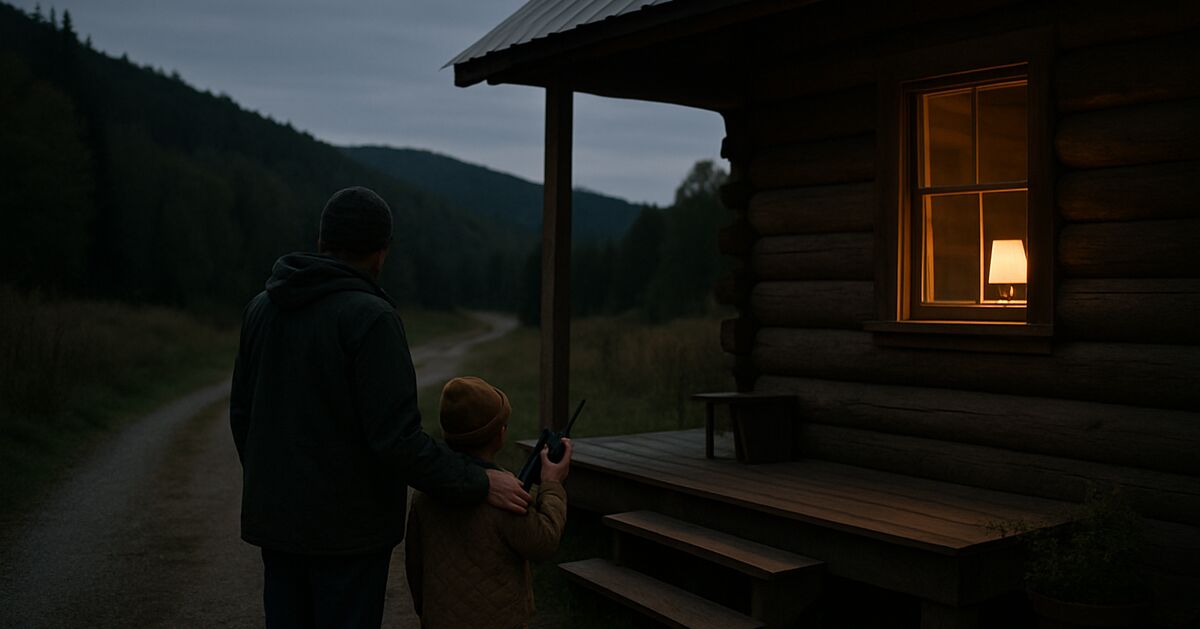
A five year old who can calmly say her name, her parents' names, and "we live past the second cattle guard on Miller Road" to a stranger has a better chance in an emergency than a nine year old who's never once practiced what to do if Mom doesn't come back from the barn.
That's the part of off-grid family life that doesn't get talked about enough. Everyone plans the solar array and the food storage and the well. Fewer people sit down and actually build an emergency plan for their kids, one that matches the specific risks of living somewhere without a neighbor next door, without cell service, and often without a fast way to call for help. This isn't about raising anxious children. It's about giving them a small, calm script for the handful of situations that actually matter, so that if something happens, they know what to do instead of freezing or panicking.
Why off-grid emergencies are different for kids
In town, a kid's emergency plan is mostly "call 911 and stay on the porch." Off-grid, that plan falls apart fast. There may be no cell signal at all, or only a weak one in one spot on the property (something worth solving with a signal booster setup if you haven't already). Response times for fire, medical, or law enforcement in remote areas are often far longer than the few minutes typical in town, so check what they actually are where you live. There's often no landline, no doorbell camera, no next-door neighbor to run to.
That changes what a kid actually needs to know. Instead of "know your address and call for help," an off-grid kid needs to know: where the nearest working radio or phone is, what to do if no one answers, who the nearest actual human help is and how far, and which of a short list of dangers requires action versus which just requires staying put and waiting.
The goal isn't to cover every possible scenario. It's to cover the five or six that are realistic on your specific property, and drill them until they're boring.
Start with the "stop and get help" basics
Before anything property-specific, every kid old enough to talk needs the fundamentals down cold:
Full name, parents' full names, and the closest description of where they live (road name, mile marker, nearest town) that a dispatcher or stranger could use
How to use whatever your actual communication device is: a two-way radio, a satellite messenger, a landline if you have one, or a cell phone in the one spot it works
That yelling for help loudly and repeatedly is not embarrassing, it's the job
The difference between "wait here" and "go get an adult" and how to tell which situation calls for which
Practice this the same boring way schools practice fire drills: not as a scary lecture, but as a quick, repeated routine. A concrete procedure gives a child something to do, while a general warning leaves them guessing. "If X happens, you do Y, then Z" sticks. "Be careful out there" does not.
Fire: the number one off-grid household risk
Wood stoves, propane, kerosene lamps, and generators each add an open flame or fuel source to the house, so an off-grid home often has more ignition points to manage. If you're heating with wood, the plan has to connect to what you already know about chimney and flue maintenance, since a neglected flue is one fire scenario your kids could end up witnessing.
Kids need a specific, rehearsed fire plan, not a general one:
Two ways out of every room they sleep in, and they should be able to point to both, in the dark, without prompting
A single outdoor meeting point everyone knows, visible from the house
The rule that they never go back inside for anything, including pets or toys
Know where the fire extinguisher is and that it's an adult's job to use it, not theirs, unless they're a teenager you've specifically trained on it
Run an actual drill, at night, at least once. It's uncomfortable and kids often find it fun. That's fine. The discomfort of practicing beats the alternative.
What to do if a parent is hurt and can't respond
This is the scenario most families skip because it's unpleasant to think about, and it's exactly the one that matters most in a remote setting. A parent falling off a ladder, getting kicked by livestock, or having a bad reaction to a bee sting is a realistic possibility on a working property, and if the other adult isn't nearby, a kid needs a script.
For kids roughly six and up, that script can be simple:
Check if the person is breathing and awake. Don't attempt to move them.
Go get the other parent or nearest adult immediately. If alone, use the radio, phone, or satellite device exactly as trained.
If no one answers and no adult is reachable, go to the nearest neighbor or the road, whichever is faster, and flag someone down.
Know where the first-aid kit is and that a teenager can bring it, but shouldn't attempt anything beyond what they've been shown (applying pressure to a wound, for example, is teachable; anything more is not their job).
Older kids and teens can go further. If you've got a fourteen year old capable of learning it, basic first-aid training designed for young people (many Red Cross and 4-H programs offer age-appropriate courses) is worth the drive into town. It's also worth teaching kids the specific difference between "stay calm and wait, help is coming" situations and "we need to act now" situations like heavy bleeding or a person not breathing, since knowing which category they're in changes everything about how they should behave.
Strangers at the gate
This one makes parents uncomfortable to plan for, but rural and off-grid properties do get unexpected visitors: lost hunters, someone whose truck broke down, door-to-door salespeople who drove further than they meant to, and occasionally someone with less benign intentions. Kids need a plan that doesn't require them to judge intent, because that's not a fair thing to ask of a child.
The simplest workable rule: kids do not answer the door or approach a vehicle at the gate alone, ever, regardless of how friendly it looks. If they're the only one home, they don't open the door, they don't engage, and they know where to go (a locked room, a neighbor's, wherever your specific plan says) until an adult is reachable. This connects to the broader work of securing a remote property with layered defense, where the first layers (sightlines, gates, dogs, lighting) exist specifically so a kid alone at home has more time and more options before anyone reaches the door.
Teach this the same unemotional way you'd teach "don't touch the stove." It's not about strangers being scary people. It's just a rule: kids don't handle unexpected visitors, adults do.
Getting lost or separated on the property
Off-grid land is often large, wooded, or has terrain that swallows sound and sightlines fast. A kid wandering off to look at something interesting and losing track of the way back is easy to imagine, especially in the first year or two before kids build a real mental map of the property.
The common "hug a tree" advice taught in many wilderness safety programs is simple: stop moving. A kid who stays in one place is dramatically easier to find than one who keeps walking, especially if they're scared and moving randomly. Teach the rule as "hug a tree": once you realize you're lost, pick a spot, stay there, and make noise (yelling, banging two sticks, blowing a whistle) at intervals.
This is also where a cheap whistle on a cord earns its keep. Every kid old enough to be outside unsupervised should have one, and should know the signal you've agreed on at home, such as three sharp blasts meaning "I need help." It sounds almost too simple, but simple is what a scared eight year old can actually execute.
Mark clear property boundaries kids understand (a fence line, a creek, a specific tree) as the "you don't go past this without an adult" line, and revisit it as they get older and range further.
Weather and isolation-specific plans
If your property is prone to being cut off by snow, flooding, or washed-out roads (something worth reading up on if you haven't already, in the piece on winter isolation planning), your kids' emergency plan needs a version for "we can't get out and no one can get in for a while." That mostly means making sure they understand where supplies are, that isolation itself isn't an emergency, and that the household has a plan for exactly this, so a snowed-in week feels like an inconvenience rather than a crisis to a child.
Kids handle "this is just how it is sometimes, and we're prepared for it" far better than they handle uncertainty. The calm comes from repetition and from adults visibly not panicking, more than from any script.
Age-appropriate layering, not one big talk
A three year old's whole plan might be "yell loud and go find Dad." A seven year old can learn the radio and the meeting point. A ten year old can learn basic first aid and property boundaries. A teenager can be a genuine second responder, capable of driving a UTV to a neighbor's, running the radio, or applying real first aid.
Revisit the plan every six to twelve months, not because kids forget everything, but because their capabilities change fast and the plan should grow with them. A script that felt right for a six year old is outdated and probably underestimating a nine year old.
Where this fits into the bigger picture
None of this replaces the physical safety work: a stocked first-aid kit, a working radio or satellite communicator, good sightlines around the house, a properly maintained stove and chimney, secure fencing. If you're still building out that foundation, the start here gear guide is a good place to work through the essentials category by category, and the wider blog archive has deeper pieces on most of the systems mentioned above.
What this adds is the human layer on top of the gear: making sure the people small enough to need protecting also know, in plain and rehearsed terms, what to do when the adults can't immediately step in. That's not a single conversation. It's a habit, revisited often, kept calm, and built to match the specific risks of your specific piece of land.
If you've got a plan that's worked for your family, or questions about building one for your situation, feel free to reach out through the contact page. And if you're curious about the rest of how this site approaches off-grid family life, the about page has the background on why I write about this stuff the way I do.
Claim audit: 14 consequential claims checked against the article's sources; unsupported wording revised where it could not be substantiated.
Claim-by-claim audit (14 checked)
“Response times for fire, medical, or law enforcement in remote areas are often far longer than the few minutes typical in town, so check what they actually are where you live.” (rewritten to what the article can stand behind)
“A concrete procedure gives a child something to do, while a general warning leaves them guessing.” (rewritten to what the article can stand behind)
“Wood stoves, propane, kerosene lamps, and generators each add an open flame or fuel source to the house, so an off-grid home often has more ignition points to manage.” (rewritten to what the article can stand behind)
“If you're heating with wood, the plan has to connect to what you already know about [chimney and flue maintenance](/blog/chimney-and-flue-safety-for-wood-stoves-creosote-clearances…” (rewritten to what the article can stand behind)
“Two ways out of every room they sleep in, and they should be able to point to both, in the dark, without prompting” (cited → nfpa.org)
“A single outdoor meeting point everyone knows, visible from the house” (cited → nfpa.org)
“The rule that they never go back inside for anything, including pets or toys” (cited → nfpa.org)
“A parent falling off a ladder, getting kicked by livestock, or having a bad reaction to a bee sting is a realistic possibility on a working property, and if the other adult isn't n…” (rewritten to what the article can stand behind)
“If you've got a fourteen year old capable of learning it, basic first-aid training designed for young people (many Red Cross and 4-H programs offer age-appropriate courses) is wort…” (cited → redcross.org)
“A kid wandering off to look at something interesting and losing track of the way back is easy to imagine, especially in the first year or two before kids build a real mental map of…” (rewritten to what the article can stand behind)
“The common "hug a tree" advice taught in many wilderness safety programs is simple: stop moving.” (rewritten to what the article can stand behind)
“A kid who stays in one place is dramatically easier to find than one who keeps walking, especially if they're scared and moving randomly.” (reasoning shown in the article)
“Every kid old enough to be outside unsupervised should have one, and should know the signal you've agreed on at home, such as three sharp blasts meaning "I need help."” (rewritten to what the article can stand behind)
“Kids handle "this is just how it is sometimes, and we're prepared for it" far better than they handle uncertainty.” (cited → healthychildren.org)
Before you go
One useful off-grid email a week.
Practical gear rundowns, honest how-tos, and plain-English guides from someone doing the homework in the open.
I am building a place for off-grid people to swap real answers: a forum by topic, classifieds for gear and services, and real estate for off-grid land and homes. It is new, so the early members shape what it becomes. A free account lets you post in all three.
No ER ten minutes away means you have to be your own triage nurse. Here's how to tell a bad bee sting from the real emergency, and what to actually stock.
In many off-grid disasters, the fire or flood itself isn't the decisive factor, it's the hour you waited too long to leave. Here's how to set real, numeric triggers before you need them.
Tax sale and sheriff's auction land looks like a bargain, but redemption periods, hidden liens, and unseen parcels turn a lot of cheap acreage into an expensive lesson. Here's how to vet a listing before you bid.