The difference between an off-grid homestead that runs smoothly and one that limps from breakdown to breakdown usually isn't the tools people own. It's whether those tools live somewhere they can actually be found, charged, and used without a fight. A proper workshop is one of the highest-leverage things you can build off-grid, and it's also one of the most commonly skipped, because it doesn't feel urgent until the day your pump seal fails in a snowstorm and you're digging through three totes in the dark looking for a 7/16 wrench.
This isn't about building a fancy woodshop with dust collection and a lumber rack. It's about designing a working space that respects the three things off-grid life makes scarce: power, heat, and time. Get those three right and everything else, the pegboard, the bench height, the paint color, is just personal taste.
Why a dedicated shop space matters more off-grid than it does on-grid
On the grid, if you're missing a tool or a part, you drive to the hardware store. Off-grid, that trip might be an hour each way, or a day if the road's snowed in. That changes the math on workshop design entirely. Every hour you save by having things organized and powered correctly is an hour you're not burning fuel driving to town, or worse, an hour you're not stuck waiting for good weather to make that drive.
A workshop off-grid also has to do double duty. It's not just where you fix things, it's often where you store the spare parts and consumables that keep your fuel and parts inventory from turning into chaos, where you charge batteries for everything from drills to fence chargers, and sometimes where you retreat to do work that needs a stable surface and decent light when the cabin itself is full of kids, dogs, or dinner prep.
If you're still in the planning stages and want a sense of what a homestead actually needs in its first year, our piece on what actually happens in the first six months of starting a small off-grid homestead touches on how workshop needs sneak up on people faster than almost anything else.
Siting the shop: close enough to matter, far enough to not be a nuisance
Where you put your workshop shapes how much you'll actually use it. Too far from the house and you'll skip small jobs rather than trudge out in the rain. Too close and noise, dust, or fumes become a daily irritation for the household.
A few siting principles that hold up in practice:
Within 100 feet of the main structure, if the land allows it. Close enough for a quick trip, far enough that grinder noise and gas fumes don't drift through the kitchen window.
Downwind of the house, especially if you'll ever run a generator, weld, or do anything with solvents inside it.
On the same power and water infrastructure path as the house where possible, so you're not trenching a second run of conduit or pipe across the property.
Accessible by vehicle, even if that's just a garden cart path. You will, at some point, need to haul a dead battery, a stuck alternator, or forty pounds of fencing wire in and out of that building.
If your parcel has awkward topography, the same sun and slope logic that applies to siting a cabin applies here too. A workshop with a south-facing roof can carry its own small solar array, which matters a lot once you get into the power section below. If you haven't already, it's worth reading how solar exposure and slope factor into siting decisions before you commit to a spot.
Power: the workshop's real bottleneck
In our experience, a lot of off-grid workshop frustration traces back to power rather than tools. A drill press, bench grinder, and shop vac pulling from the same small inverter at the same time will trip a breaker faster than you can say "I thought this was a 2000 watt unit." Planning power correctly is, in our view, one of the biggest things separating a shop that works from one that frustrates you daily.
Start with a separate circuit, not a shared one. Running your workshop off the same inverter and battery bank as your refrigerator and lights means every time you fire up a compressor, your house lighting flickers or your inverter throws a fault. If your budget allows, a small dedicated battery bank and inverter for the shop, even a modest 12V or 24V setup, keeps household loads and tool loads from fighting each other. The tradeoffs between 12V, 24V, and 48V systems apply just as much to a workshop bank as they do to a house bank, and workshop tools (especially anything with a motor) often want more surge capacity than lighting circuits do.
Know your surge loads, not just your running loads. Motor tools like a bench grinder can pull several times their running wattage for a fraction of a second on startup, so check the nameplate and manufacturer figures for yours. Air compressors are worse. If your inverter can't handle the surge, it'll fault out mid-cut, which is not just annoying, it's how blades bind and hands get hurt. Undersizing inverter surge capacity is an easy mistake to make and an easy one to avoid at the planning stage.
Corded tools versus battery tools is a real strategic choice off-grid. Cordless tools save you the hassle of running extension cords and drawing continuous inverter power, but every battery you own is another thing that needs charging discipline, especially in winter when your solar production drops. A mixed fleet, corded for high-draw stationary tools like a table saw, cordless for portable work like drilling fence posts, tends to work best. Whatever you choose, keep chargers on a power strip somewhere you pass often, since a battery you forget to charge is a battery you can't use.
Lighting deserves its own circuit too. LED shop lights sip power compared to old fluorescent fixtures, but if you wire them into the same circuit as your welder or grinder, a tripped breaker plunges you into darkness mid-task. Keep lighting on a separate low-draw circuit fed straight off the battery bank if you can, so a tool fault never takes your light with it.
If your workshop roof gets decent sun, a small stand-alone panel and charge controller dedicated just to that building is one of the more satisfying off-grid upgrades you can make. It's a contained system, easy to troubleshoot, and it takes real load off your main house bank. For guidance on wiring it safely once you've sized it, the fundamentals in our post on wiring an off-grid solar system safely apply just as well to a shop sub-system as a house system, fuses, breaker sizing, and wire gauge don't change because the building is smaller.
Heat: keeping a shop usable in winter
An unheated shop in a cold climate becomes a place where hands go numb, glues won't cure, batteries underperform, and you avoid going out there at all, which defeats the purpose of having it. But heating a shop is a different problem than heating a living space, because sawdust, fuel vapors, and open flame heaters are a genuinely dangerous combination.
A small, well-vented wood stove works if you have the space and the patience to tend a fire before you can start working. Propane heaters rated for garage or shop use heat a cold space quickly, but follow the manufacturer's instructions on ventilation, carbon monoxide detection, and clearance from anything flammable, including settled sawdust. Electric heaters avoid combustion and venting entirely, but they draw a lot of power, so they are often impractical unless your shop has its own array or you run the generator while you work.
Whatever you choose, don't try to make your shop heater double as your cooking heat or your house heat source. The reasoning is the same one we lay out in our piece on cooking heat versus space heat: a stove or heater sized and placed for one job does that job badly if you ask it to do two.
Storage and layout: findable beats fancy
The best off-grid workshops aren't the ones with the most tools. They're the ones where every tool has exactly one home, so you're not hunting during an emergency repair. A few layout habits that pay off:
Shadow board your most-used hand tools. A painted outline on pegboard tells you instantly what's missing, which matters when a tool walks off to the barn and never comes back.
Keep consumables (fuses, hose clamps, gasket material, sandpaper) in labeled, stackable bins, not loose in drawers. When you're mid-repair on a failed water pump, you don't want to be sorting through a junk drawer.
Put your most emergency-critical tools closest to the door. The wrench set and multimeter you'd grab at 2 a.m. for a dead well pump should not be behind three totes of Christmas decorations.
Keep a small "go bag" of hand tools separate from the main shop kit for jobs that happen away from the bench, fence repair, livestock emergencies, vehicle breakdowns. Duplicating a few basics is cheaper than losing an hour searching for your only pair of pliers.
A shop bench at a comfortable working height, roughly hip to waist level for most tasks, plus good task lighting over it, tends to help accuracy and safety more than another specialty tool. If chronic pain or joint issues are part of your daily reality, it's worth applying some of the same thinking from our post on designing a home that still works when your knees don't to your workshop layout, lower shelving for heavy items, a stool at the bench, and good lighting so you're not straining to see fine work.
The workshop as a communication and safety hub
A workshop is also a natural place to keep your radio base station, spare batteries for handhelds, and a basic first-aid kit separate from your main house kit, since cutting and grinding work carries obvious injury risk right at the bench. If you haven't built out a layered comms setup yet, the reasoning in our mesh radios, VoIP, and satellite mail piece applies well to keeping a charged handheld radio on the shop wall, since that's often where you are when something urgent happens elsewhere on the property.
Common mistakes worth avoiding
A few patterns show up again and again in shops that don't work well:
Wiring the whole shop off one circuit with no separation between lighting, tool loads, and charging stations.
Skipping ventilation planning because "it's just a small stove" or "the door's usually open anyway."
Storing tools by category (all wrenches together) instead of by task or frequency of use, which sounds tidy but slows you down under pressure.
Building the shop far from the house for quiet, then never actually walking out there for small jobs, which means small problems become big ones.
Underestimating surge loads and buying an inverter sized only for running wattage.
None of these are expensive mistakes to avoid, they're mostly about thinking it through before you start nailing up pegboard. If you're still working out your overall property layout and want more grounding in what to prioritize first, our home page and FAQ both cover a lot of the foundational planning questions people ask before they build anything at all. And if you want to talk through your specific setup or send us photos of a workshop layout you're not sure about, our contact page is always open. For more angles on tools, storage, and self-reliance systems, the blog index has the rest of what we've written on the subject.
A workshop won't fix a bad tool or a broken part on its own. But a well-powered, well-organized one will get you to the fix faster, safer, and with a lot less swearing in the cold. That's worth more than it gets credit for until you've lived without one.
The rest of the shortlist
Recommended off-grid gear
Affiliate disclosure: Some links on this site are affiliate links, including Amazon links: as an Amazon Associate I earn from qualifying purchases. Buying through one costs you nothing extra, and it never changes what I recommend.
Products appear here only when they match this article's subject. Selection is based on documented specs and owner reports, never on compensation; pages with no relevant gear carry none.
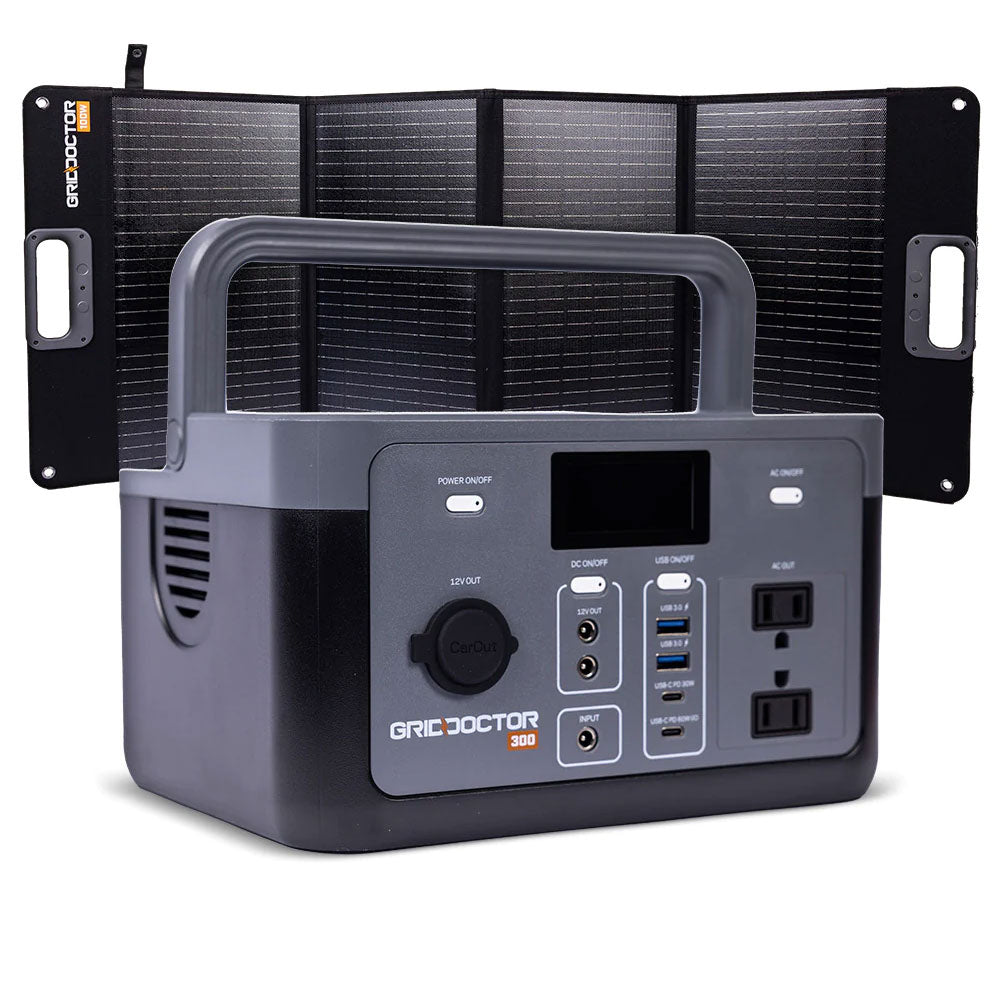
The Grid Doctor 300 solar generator bundled with a 100-watt solar panel, a compact power station for charging small devices; check the current spec sheet for details.
Why it's here: Listed as the small end: phones, lights and a radio, not a fridge. Sizing disappointment usually starts here.
The Grid Doctor 300 solar generator sold through Emergency Essentials, a compact power station for charging phones, lights and small devices; check the current spec sheet.
Claim audit: 13 consequential claims checked against the article's sources; unsupported wording revised where it could not be substantiated.
Claim-by-claim audit (13 checked)
“In our experience, a lot of off-grid workshop frustration traces back to power rather than tools.” (rewritten to what the article can stand behind)
“Planning power correctly is, in our view, one of the biggest things separating a shop that works from one that frustrates you daily.” (rewritten to what the article can stand behind)
“Motor tools like a bench grinder can pull several times their running wattage for a fraction of a second on startup, so check the nameplate and manufacturer figures for yours.” (rewritten to what the article can stand behind)
“If your inverter can't handle the surge, it'll fault out mid-cut, which is not just annoying, it's how blades bind and hands get hurt.” (reasoning shown in the article)
“Undersizing inverter surge capacity is an easy mistake to make and an easy one to avoid at the planning stage.” (rewritten to what the article can stand behind)
“Whatever you choose, keep chargers on a power strip somewhere you pass often, since a battery you forget to charge is a battery you can't use.” (rewritten to what the article can stand behind)
“LED shop lights sip power compared to old fluorescent fixtures, but if you wire them into the same circuit as your welder or grinder, a tripped breaker plunges you into darkness mi…” (reasoning shown in the article)
“But heating a shop is a different problem than heating a living space, because sawdust, fuel vapors, and open flame heaters are a genuinely dangerous combination.” (reasoning shown in the article)
“Propane heaters rated for garage or shop use heat a cold space quickly, but follow the manufacturer's instructions on ventilation, carbon monoxide detection, and clearance from any…” (rewritten to what the article can stand behind)
“Electric heaters avoid combustion and venting entirely, but they draw a lot of power, so they are often impractical unless your shop has its own array or you run the generator whil…” (rewritten to what the article can stand behind)
“For guidance on wiring it safely once you've sized it, the fundamentals in our post on [wiring an off-grid solar system safely](/blog) apply just as well to a shop sub-system as a …” (cited → nfpa.org)
“A workshop is also a natural place to keep your radio base station, spare batteries for handhelds, and a basic first-aid kit separate from your main house kit, since cutting and gr…” (rewritten to what the article can stand behind)
“A shop bench at a comfortable working height, roughly hip to waist level for most tasks, plus good task lighting over it, tends to help accuracy and safety more than another specia…” (rewritten to what the article can stand behind)
Before you go
One useful off-grid email a week.
Practical gear rundowns, honest how-tos, and plain-English guides from someone doing the homework in the open.
I am building a place for off-grid people to swap real answers: a forum by topic, classifieds for gear and services, and real estate for off-grid land and homes. It is new, so the early members shape what it becomes. A free account lets you post in all three.
No ER ten minutes away means you have to be your own triage nurse. Here's how to tell a bad bee sting from the real emergency, and what to actually stock.
In many off-grid disasters, the fire or flood itself isn't the decisive factor, it's the hour you waited too long to leave. Here's how to set real, numeric triggers before you need them.
Tax sale and sheriff's auction land looks like a bargain, but redemption periods, hidden liens, and unseen parcels turn a lot of cheap acreage into an expensive lesson. Here's how to vet a listing before you bid.