Plenty of off-grid builders spend months studying watts and gallons and not one afternoon thinking about how the IRS, the county assessor, and a future buyer will look at what they've built. That's a mistake, because the financial side of off-grid equipment doesn't end when the system gets wired up. It keeps affecting your money for as long as you own the place, through depreciation, tax credits, assessment rules, and eventually resale value. This is the part of off-grid finance that almost nobody explains clearly, so let's walk through it piece by piece.
Solar tax credits: what actually qualifies and what doesn't
The federal residential clean energy credit has been the single biggest financial lever available to off-grid builders for years, and it's worth understanding precisely rather than vaguely. As of recent tax law, the credit applies to solar electric equipment, and in many cases battery storage systems, installed on a home you own and use as a residence. It does not require you to be grid-tied. A stand-alone off-grid solar system on your primary or even a secondary residence has generally qualified, which surprises people who assume the credit is only for grid-connected rooftop arrays.
What counts toward the credit typically includes:
Solar panels and mounting hardware
Charge controllers and inverters
Battery storage (subject to capacity minimums in some years of the law)
Labor costs for installation, including wiring and assembly
Some balance-of-system components directly tied to the solar installation
What generally does not count:
Generators, even if they charge your battery bank
Wiring for the rest of the house unrelated to the solar system
Batteries used solely for a system that isn't solar-charged
Land, foundation work unrelated to mounting, or a shed you build to house the equipment (though sometimes a dedicated equipment structure has a case argued by a tax preparer, this is genuinely a gray area)
The credit is a percentage of your total qualifying cost, and it has stepped down over time and is scheduled to phase out entirely, so the exact percentage depends on the year you place the system in service, not the year you bought the parts. That distinction matters more than people realize. If you buy panels in December but don't get the system operational until March, the tax year that counts is the one where the system actually starts producing power. If you're timing a big purchase around this credit, get the placed-in-service date nailed down with whoever does your taxes before you assume a number.
Keep every receipt, invoice, and even photos of the install. If you're ever audited, "I bought some panels and did it myself" without paperwork is a rough position to defend. A simple folder, physical or digital, with dated invoices for panels, controllers, batteries, inverter, wire, breakers, and labor (even if the labor was a friend you paid in cash and issued a basic receipt for) will save you a world of stress later. This is exactly the kind of document that belongs in whatever system you're using for digital identity and important paperwork backups, because losing this paperwork means losing the ability to prove your credit claim if it's ever questioned.
Depreciation: the word that changes with your situation
Depreciation means different things depending on whether the property is your home or a business asset, and off-grid folks often blur this line without realizing it.
For a purely personal residence, depreciation generally isn't the mechanism at all, the tax credit is, but confirm how this applies to you with a tax preparer. Personal-use equipment isn't depreciated the way business equipment is.
If part of your off-grid operation is a legitimate business, a small farm selling eggs and produce, a workshop doing paid repair work, a rental cabin, ask a tax preparer whether the business-use portion of your systems can be depreciated as a business asset. This is a real distinction with real dollars attached, and it's also an area where mixing personal and business use without documentation gets messy fast. If you're running any kind of income-generating operation from your property, whether that's the workshop or a milking operation feeding a farm stand, talk to a tax preparer who has actually handled agricultural or small-business depreciation before, not just a general preparer. The rules around Section 179 expensing and bonus depreciation shift often enough that guessing costs real money.
The practical takeaway: know which bucket your system falls into before you file anything. Mixing it up either overstates a deduction you can't defend, or leaves money on the table you were entitled to claim.
Property tax treatment: does your system raise your assessment?
This is where local rules diverge wildly, and it ties directly into broader questions about property taxes on off-grid land. Many states have specific carve-outs exempting renewable energy equipment from being counted toward your assessed property value, precisely because lawmakers wanted to encourage adoption without punishing homeowners with a tax hike for going solar. Other states have no such exemption, and a large, obviously permanent solar array can bump your assessment the same way a new garage would.
Wells, septic systems, and cisterns are treated even more inconsistently. In some counties, assessors may treat a drilled well as adding value because it makes the land more usable, so ask yours how they handle it. In others, assessors don't have a mechanism to capture that value at all unless you tell them.
The only reliable way to know your exposure is to call your county assessor's office directly and ask two specific questions: does this state exempt renewable energy systems from property tax assessment, and does that exemption require an application or paperwork filing, or is it automatic. Some states require you to file for the exemption within a set window after installation, and if you miss it, you may be stuck paying the higher assessment until the next reassessment cycle. This single phone call, made before or right after installation, can save real money over the years you own the property.
Insurance angles that double as financial protection
Your homeowner's or land insurance policy also needs updating whenever you add a significant system, and this isn't just about premium cost, it's about whether a claim gets paid at all. A policy written before you installed a battery bank and inverter setup may not cover that equipment if it's damaged by fire, lightning, or a falling tree, because the insurer never knew it existed. Call your agent every time you add a major system, get it added as scheduled property or confirm it falls under your existing dwelling coverage, and keep the paper trail. This matters just as much as the tax side, because an uninsured $15,000 battery bank lost to a lightning strike is a much bigger financial hit than a missed tax credit.
Resale value: what actually adds money when you sell
Eventually, a good number of off-grid properties get sold, whether because life circumstances change or the original owners decide to relocate. What you built affects resale value in ways that aren't always intuitive.
A well-documented, properly permitted solar and battery system gives an appraiser and a buyer something concrete to value, rather than a system they would have to inspect or rebuild from scratch. Buyers also pay attention to age and battery chemistry. A five-year-old lead-acid bank is a liability in a buyer's eyes, since they're mentally budgeting a replacement. A newer lithium bank with documented maintenance and winter performance is a selling point.
A drilled well with documented flow rate and water quality tests gives a buyer proof of what they're getting, which is one reason understanding water rights before you buy matters just as much when you're the one selling. Buyers will ask for the same documentation you should have asked the previous owner for.
What doesn't reliably add value: unpermitted structures, systems without documentation, and anything that looks improvised rather than engineered. A gorgeous solar array wired without visible breakers, fuses, or a permit history makes cautious buyers nervous, even if the system works fine. This is one more reason wiring your system to code from the start isn't just a safety issue, it's a resale issue.
Keep a running asset log
The single best habit you can build, starting now if you haven't already, is a running log of every major system on the property: install date, cost, major components, warranty information, and any repairs or replacements. This does four things at once. It supports your tax filings if questioned. It gives your insurance agent exactly what they need to schedule coverage correctly. It gives a future buyer (or your own family, if something happens to you) a clear picture of what's actually on the property. And it gives you, five years from now, a way to answer the question every off-grid owner eventually asks themselves: is this system actually paying for itself, or did I just assume it would.
None of this is complicated once you know to do it. It's just invisible until the moment you need it, whether that's an IRS letter, a claim adjuster, an assessor's notice, or a buyer's inspector. A few hours of paperwork now is genuinely one of the highest-value things you can do for the long-term finances of an off-grid property, right alongside the more obvious work of budgeting for the real annual cost of self-reliance. If you're still working through the broader planning questions, our FAQ and blog index both have more on the practical side of getting a property ready, and if something here doesn't match your situation, you're welcome to get in touch with specifics.
The rest of the shortlist
Recommended off-grid gear
Affiliate disclosure: Some links on this site are affiliate links, including Amazon links: as an Amazon Associate I earn from qualifying purchases. Buying through one costs you nothing extra, and it never changes what I recommend.
Products appear here only when they match this article's subject. Selection is based on documented specs and owner reports, never on compensation; pages with no relevant gear carry none.
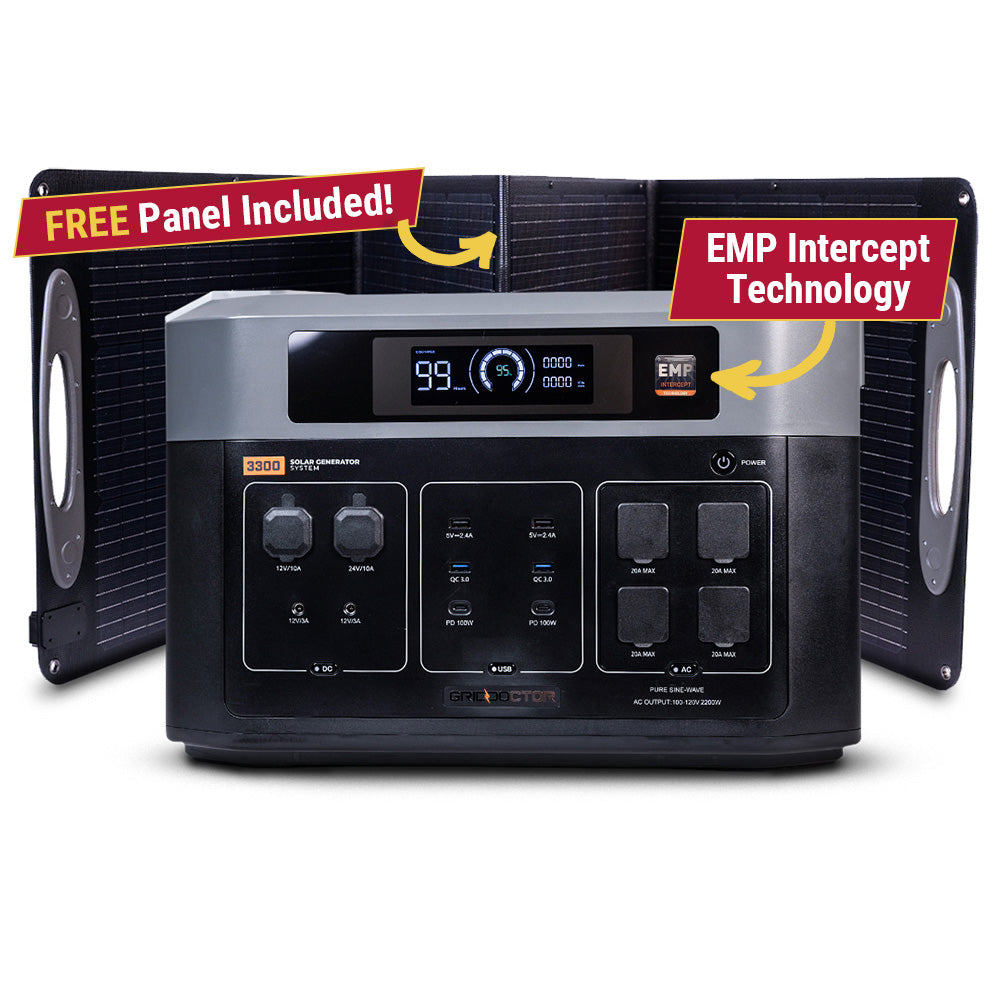
The Grid Doctor 3300 solar generator system sold with EMP shielding, a large portable power station for home backup and off-grid use; check the current spec sheet for details.
Why it's here: Listed with its EMP shielding as a stated feature, not a verified one. Judge it on the power specs first.
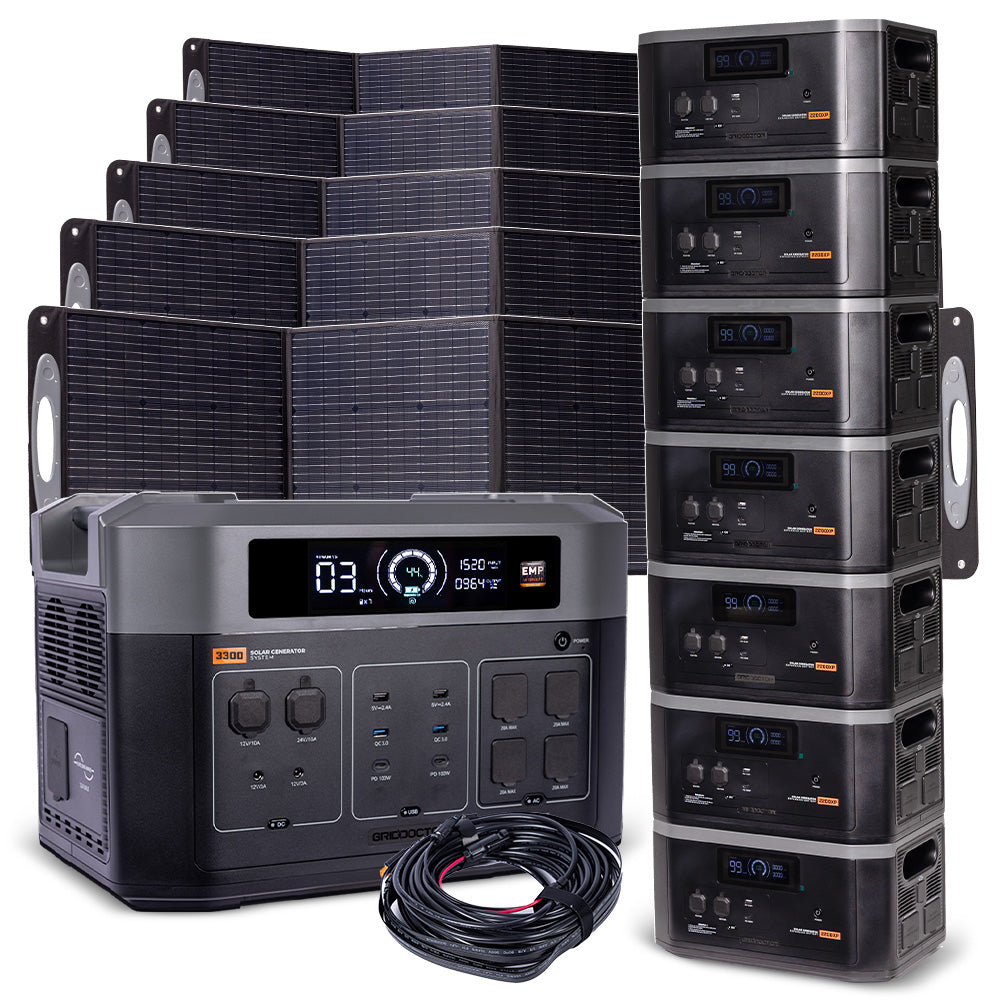
The Grid Doctor 3300 Power Tower, a large portable power station for home backup and off-grid systems; check the current spec sheet for capacity and output details.
Why it's here: Listed so form factor is part of the decision: this capacity class in a shape that stands rather than sits.
The Grid Doctor 3300-watt EMP-shielded solar generator sold through Emergency Essentials, a large power station for home backup and off-grid use; check the current spec sheet.
Why it's here: Listed through a second retailer so availability and pricing on this unit are not down to one storefront.
Claim audit: 11 consequential claims checked against the article's sources; unsupported wording revised where it could not be substantiated.
Claim-by-claim audit (11 checked)
“As of recent tax law, the credit applies to solar electric equipment, and in many cases battery storage systems, installed on a home you own and use as a residence.” (cited → irs.gov)
“A stand-alone off-grid solar system on your primary or even a secondary residence has generally qualified, which surprises people who assume the credit is only for grid-connected r…” (cited → irs.gov)
“The credit is a percentage of your total qualifying cost, and it has stepped down over time and is scheduled to phase out entirely, so the exact percentage depends on the year you …” (cited → irs.gov)
“For a purely personal residence, depreciation generally isn't the mechanism at all, the tax credit is, but confirm how this applies to you with a tax preparer.” (rewritten to what the article can stand behind)
“If part of your off-grid operation is a legitimate business, a small farm selling eggs and produce, a workshop doing paid repair work, a rental cabin, ask a tax preparer whether th…” (rewritten to what the article can stand behind)
“Many states have specific carve-outs exempting renewable energy equipment from being counted toward your assessed property value, precisely because lawmakers wanted to encourage ad…” (cited → dsireusa.org)
“In some counties, assessors may treat a drilled well as adding value because it makes the land more usable, so ask yours how they handle it.” (rewritten to what the article can stand behind)
“Some states require you to file for the exemption within a set window after installation, and if you miss it, you may be stuck paying the higher assessment until the next reassessm…” (cited → dsireusa.org)
“A policy written before you installed a battery bank and inverter setup may not cover that equipment if it's damaged by fire, lightning, or a falling tree, because the insurer neve…” (reasoning shown in the article)
“A well-documented, properly permitted solar and battery system gives an appraiser and a buyer something concrete to value, rather than a system they would have to inspect or rebuil…” (rewritten to what the article can stand behind)
“A drilled well with documented flow rate and water quality tests gives a buyer proof of what they're getting, which is one reason [understanding water rights before you buy](/blog/…” (rewritten to what the article can stand behind)
Before you go
One useful off-grid email a week.
Practical gear rundowns, honest how-tos, and plain-English guides from someone doing the homework in the open.
I am building a place for off-grid people to swap real answers: a forum by topic, classifieds for gear and services, and real estate for off-grid land and homes. It is new, so the early members shape what it becomes. A free account lets you post in all three.
No ER ten minutes away means you have to be your own triage nurse. Here's how to tell a bad bee sting from the real emergency, and what to actually stock.
In many off-grid disasters, the fire or flood itself isn't the decisive factor, it's the hour you waited too long to leave. Here's how to set real, numeric triggers before you need them.
Tax sale and sheriff's auction land looks like a bargain, but redemption periods, hidden liens, and unseen parcels turn a lot of cheap acreage into an expensive lesson. Here's how to vet a listing before you bid.