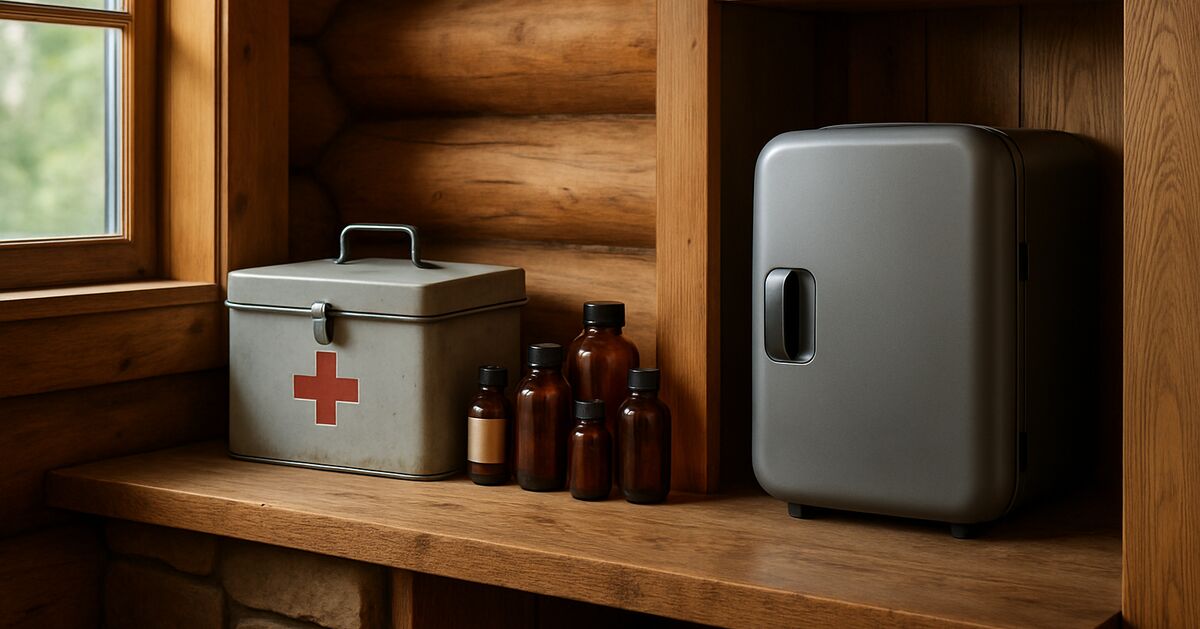
If you have ever pulled a bottle of ibuprofen out of a hot truck cab in July and wondered whether it still works, you have already bumped into one of the least talked-about problems of off-grid health prep: medication doesn't age the same way out here as it does in a climate-controlled house in town. Heat, cold, humidity, and light all shorten the useful life of the things in your first-aid kit and medicine cabinet, and when the nearest pharmacy is an hour or more away, that matters a lot more than it does for someone who can restock on a whim.
This isn't a rehash of what to put in a first-aid kit or how to treat a burn. Plenty of good information exists on building the kit itself, including my own guide to building an off-grid first-aid kit for when help is hours away. This article is about what happens after you've built that kit: how to keep everything in it actually usable, month after month, in a cabin or homestead that doesn't have the steady 68-degree indoor climate most medication labels assume.
Why storage conditions matter more off-grid
Medications are labeled for stability under specific conditions, usually some version of "room temperature," and that range assumes an indoor shelf rather than a cabin with wide temperature swings. That range assumes a home or pharmacy shelf, not a cabin that hits 95 degrees in a July heat wave or drops below freezing on a January night when the wood stove burns down overnight.
Heat is the bigger enemy for most drugs. Heat speeds chemical breakdown, and some products, including epinephrine auto-injectors, insulin, liquid antibiotics, and nitroglycerin tablets, are commonly labeled as especially temperature sensitive, so check each label rather than assuming years of shelf life. Cold is a problem too, though a different one. Freezing is also a risk for liquids and auto-injectors, so follow the manufacturer's storage instructions and do not rely on anything that has frozen.
Humidity is the quieter threat. Off-grid homes without central air conditioning or dehumidification often run damp, especially near a well pump, a root cellar, or in shoulder seasons before the wood stove is going steadily. Moisture gets into pill bottles through the cap threads and speeds up the breakdown of anything not sealed in a blister pack. It also ruins the adhesive on bandages and the seal on ointment tubes over time.
Light, especially direct sunlight through a cabin window, degrades some medications too, which is part of why so many come in amber or opaque bottles in the first place. Leaving that bottle on a sunny windowsill undoes some of that protection.
What actually happens when medication degrades
It's worth being specific here rather than just saying "it goes bad," because the failure modes matter for how you plan around them.
The main risk with degraded tablets is usually lost potency, and FDA guidance is still not to use medicines past their expiration date. Aspirin is often said to develop a vinegar-like smell as it breaks down, and either way a bottle that smells off is one to replace rather than rely on in an emergency.
Liquid medications and suspensions are riskier. Heat and freeze-thaw cycles can cause separation, clumping, or loss of potency that isn't always visible. This is a real concern for anything you're storing for a child or for a chronic condition, since under-dosing due to degraded potency can be just as much a problem as the medication being technically "expired."
Injectables are the highest-stakes category. Epinephrine auto-injectors carry their own storage instructions, so read the label that comes with yours and follow its temperature limits closely. If you or anyone in your household carries one for a severe allergy, this is not a place to get casual about storage, because a degraded auto-injector during an anaphylactic emergency, with the nearest ER 45 minutes away, is a genuine life safety issue.
Insulin is similar. Insulin comes with manufacturer storage ranges for both unopened and in-use vials or pens, and those instructions are what to plan your cold storage around. Anyone managing diabetes off-grid needs a real cold-chain plan, not a shelf in the pantry.
Building storage that actually protects what you have
The good news is that solving this problem doesn't require a generator running around the clock. It requires thinking about your medicine cabinet the way you'd think about a root cellar: pick the most stable microclimate on the property and use it deliberately.
A few practical approaches that hold up in real off-grid conditions:
An interior closet or cabinet away from exterior walls stays more temperature-stable than anything near a window or an uninsulated wall. If your cabin has a root cellar or an underground storage space similar to what's described in guides on root cellars without a basement, that same cool, stable environment is often a better home for heat-sensitive medications than the kitchen.
Sealed containers with desiccant packets cut down on humidity damage. The little silica packets that come in vitamin bottles and jerky bags are worth saving specifically for this purpose, or you can buy them cheaply in bulk.
A dedicated small 12V fridge or a chest-style 12V/DC cooler is the real answer for anything requiring refrigeration, like insulin or certain reconstituted antibiotics. This is a legitimate line item to plan into your power budget, not an afterthought, and it's worth reading through how much solar you actually need to live off-grid with this specific load in mind, since a small compressor fridge running continuously adds up over a day even though it doesn't look like much on paper.
Insulated, not just weatherproof, containers for auto-injectors and inhalers that need to travel with you, whether that's a small insulated pouch in a truck or a lunchbox-style cooler by the door for grab-and-go situations.
Avoid the bathroom entirely if you can help it, even in a conventional house, because the humidity swings from showering are worse than almost anywhere else in a home. Off-grid, where bathing water may be heated in batches and the space may not vent as well as a code-built bathroom, this is doubly true.
Rotation and expiration: what the dates actually mean
The expiration date on a medication bottle is a guarantee of full potency through that date under proper storage conditions, not a cliff where the drug suddenly becomes useless the next day. You may see references to military shelf-life extension testing on certain stockpiled drugs, but FDA guidance for household medicines is still not to use them past the printed date. But "stored properly" is doing a lot of work in that sentence, and it assumes the cool, dry, stable conditions this whole article is about. A bottle of amoxicillin that's spent three summers in a hot cabin doesn't get the benefit of that research.
The practical takeaway for someone living off-grid is to treat expiration dates as one input, not gospel, but to be honest with yourself about your actual storage conditions. If you know your cabin has a legitimately temperature-stable interior space and you keep things sealed and dry, you can reasonably stretch some non-critical medications past their printed dates. If your storage has been rough, hot summers and freezing winters with real swings, don't gamble on anything you'd need to actually work in an emergency: epinephrine, insulin, prescription heart medications, or antibiotics for a serious infection.
Build a rotation habit around this reality. Twice a year, ideally when you're already doing a seasonal task like checking your chimney and flue before winter or doing a spring well check, go through the medicine cabinet. Check dates, check for the vinegar smell in aspirin, check liquids for separation or discoloration, and replace anything questionable. Keep a written list taped inside the cabinet door of what's in there and when it was purchased, since memory is unreliable and off-grid life has a way of making six months feel like six weeks.
Prescription medications and the refill problem
Storage aside, the bigger practical issue for many people moving off-grid is simply staying on top of refills when the pharmacy isn't five minutes away and mail service may be slower or less predictable. A few things worth setting up before you move, not after:
Ask your prescriber and insurer whether a 90-day supply is an option for your stable, long-term medications, since it cuts the number of pharmacy trips.
Look into mail-order pharmacy services through your insurance, which can ship 90-day supplies directly, though you'll want reliable delivery to wherever you're having mail sent. If you've set up rural mail forwarding as part of your move, coordinate that with your pharmacy's expectations. My article on property records and mail forwarding is a useful companion piece if you're still working out your mail situation.
Build in a real buffer, not just a week or two. If winter road closures are a possibility on your property, and you should read the specifics in my piece on winter isolation planning, you want at least a month of buffer stock for anything you take daily, ideally more for critical medications.
Talk to your doctor directly about your situation. Some will consider slightly larger supplies or earlier refills once they understand you're an hour or more from a pharmacy, especially if you frame it as an access issue rather than a request for extra medication.
A short list of things not to skip
A few final specifics worth calling out because they're easy to overlook:
Check your fire extinguisher and first-aid kit at the same time you check medications, since they tend to live in similar marginal storage spots (mudrooms, unheated entries) and degrade on similar timelines.
Don't store medications in the same cabinet as cleaning chemicals or fuel additives. It sounds obvious, but in a small cabin where storage space is tight it is easy to do, and keeping medications away from strong-smelling chemicals avoids any question of contamination.
If you're building out your broader medical capability, this storage question fits into a bigger picture. My earlier piece on building real medical skills before you need them is worth reading alongside this one, since knowing how to use a medication correctly matters just as much as knowing it's still good.
Finally, if you're still assembling your kit and your storage plan from scratch, the start-here page has my organized gear guides that can point you toward specific coolers, containers, and 12V fridge options that hold up well in off-grid conditions. And if you've got a specific medication or storage situation you're trying to plan around, my contact page is the place to reach out, since a lot of these answers really do depend on your specific climate, cabin, and household.
Getting this right isn't glamorous, and it's easy to let it slide once the excitement of the first-aid kit build wears off. But a kit full of medication that's silently lost its potency is arguably worse than an empty one, because it gives you false confidence right when you need the real thing most.
Claim audit: 14 consequential claims checked against the article's sources; unsupported wording revised where it could not be substantiated.
Claim-by-claim audit (14 checked)
“Medications are labeled for stability under specific conditions, usually some version of "room temperature," and that range assumes an indoor shelf rather than a cabin with wide te…” (rewritten to what the article can stand behind)
“Heat speeds chemical breakdown, and some products, including epinephrine auto-injectors, insulin, liquid antibiotics, and nitroglycerin tablets, are commonly labeled as especially …” (rewritten to what the article can stand behind)
“Freezing is also a risk for liquids and auto-injectors, so follow the manufacturer's storage instructions and do not rely on anything that has frozen.” (rewritten to what the article can stand behind)
“Moisture gets into pill bottles through the cap threads and speeds up the breakdown of anything not sealed in a blister pack.” (cited → medlineplus.gov)
“Light, especially direct sunlight through a cabin window, degrades some medications too, which is part of why so many come in amber or opaque bottles in the first place.” (cited → medlineplus.gov)
“The main risk with degraded tablets is usually lost potency, and FDA guidance is still not to use medicines past their expiration date.” (rewritten to what the article can stand behind)
“Aspirin is often said to develop a vinegar-like smell as it breaks down, and either way a bottle that smells off is one to replace rather than rely on in an emergency.” (rewritten to what the article can stand behind)
“Epinephrine auto-injectors carry their own storage instructions, so read the label that comes with yours and follow its temperature limits closely.” (rewritten to what the article can stand behind)
“Insulin comes with manufacturer storage ranges for both unopened and in-use vials or pens, and those instructions are what to plan your cold storage around.” (rewritten to what the article can stand behind)
“**Avoid the bathroom entirely** if you can help it, even in a conventional house, because the humidity swings from showering are worse than almost anywhere else in a home.” (cited → medlineplus.gov)
“You may see references to military shelf-life extension testing on certain stockpiled drugs, but FDA guidance for household medicines is still not to use them past the printed date…” (rewritten to what the article can stand behind)
“Ask your prescriber and insurer whether a 90-day supply is an option for your stable, long-term medications, since it cuts the number of pharmacy trips.” (rewritten to what the article can stand behind)
“Some will consider slightly larger supplies or earlier refills once they understand you're an hour or more from a pharmacy, especially if you frame it as an access issue rather tha…” (rewritten to what the article can stand behind)
“It sounds obvious, but in a small cabin where storage space is tight it is easy to do, and keeping medications away from strong-smelling chemicals avoids any question of contaminat…” (rewritten to what the article can stand behind)
Before you go
One useful off-grid email a week.
Practical gear rundowns, honest how-tos, and plain-English guides from someone doing the homework in the open.
I am building a place for off-grid people to swap real answers: a forum by topic, classifieds for gear and services, and real estate for off-grid land and homes. It is new, so the early members shape what it becomes. A free account lets you post in all three.
No ER ten minutes away means you have to be your own triage nurse. Here's how to tell a bad bee sting from the real emergency, and what to actually stock.
In many off-grid disasters, the fire or flood itself isn't the decisive factor, it's the hour you waited too long to leave. Here's how to set real, numeric triggers before you need them.
Tax sale and sheriff's auction land looks like a bargain, but redemption periods, hidden liens, and unseen parcels turn a lot of cheap acreage into an expensive lesson. Here's how to vet a listing before you bid.