When planning off-grid sanitation, it is common to think in two categories: blackwater from the toilet, and everything else lumped together as "greywater." That lumping is where a lot of off-grid properties get into real trouble within the first year.
Laundry water and dishwashing water are not the same as shower or handwashing water, and treating them like they are is one of the most common mistakes we see when we walk a new property. They carry more grease, more fine particulate, more soap and detergent chemistry, and in the case of laundry, a slug of water all at once instead of a slow trickle. If your system wasn't designed for that, you'll smell the problem, or worse, you'll see it pooling on the surface, long before you understand why.
Why laundry and dish water need their own plan
A basic greywater system built for a bathroom sink or shower handles low-volume, relatively low-grease water arriving in small doses throughout the day. A washing machine, by contrast, can discharge tens of gallons in one shot, often with a heavy detergent load, lint, and sometimes bleach or fabric softener; check your machine's rated water use per cycle. Dishwater carries food grease, oils, and bits of organic matter that a simple gravel bed will clog with over time.
Send that water into the same shallow trench you use for sink runoff and you'll get one of two outcomes. Either the trench clogs with grease and lint and starts backing up or pooling, or the surge volume overwhelms the soil's ability to absorb it and you get surface breakout, which is both a mess and a genuine health hazard if kids or pets are around.
This matters more off-grid than it would on municipal sewer, because there's no treatment plant catching your mistakes downstream. Whatever you send into the ground stays local, in your soil, near your well, near your garden. Our greywater basics guide covers the fundamentals of a simple greywater system. This post is about the two sources that break those simple systems, and what to actually do differently for them.
The lint and grease problem
Lint is the quiet killer of greywater systems. It doesn't look like much in the wash water, but over months it accumulates in gravel beds, mulch basins, and pipe elbows, and it doesn't break down the way organic matter does. Once a bed is choked with lint, you're often looking at digging it out and starting over, not a quick fix.
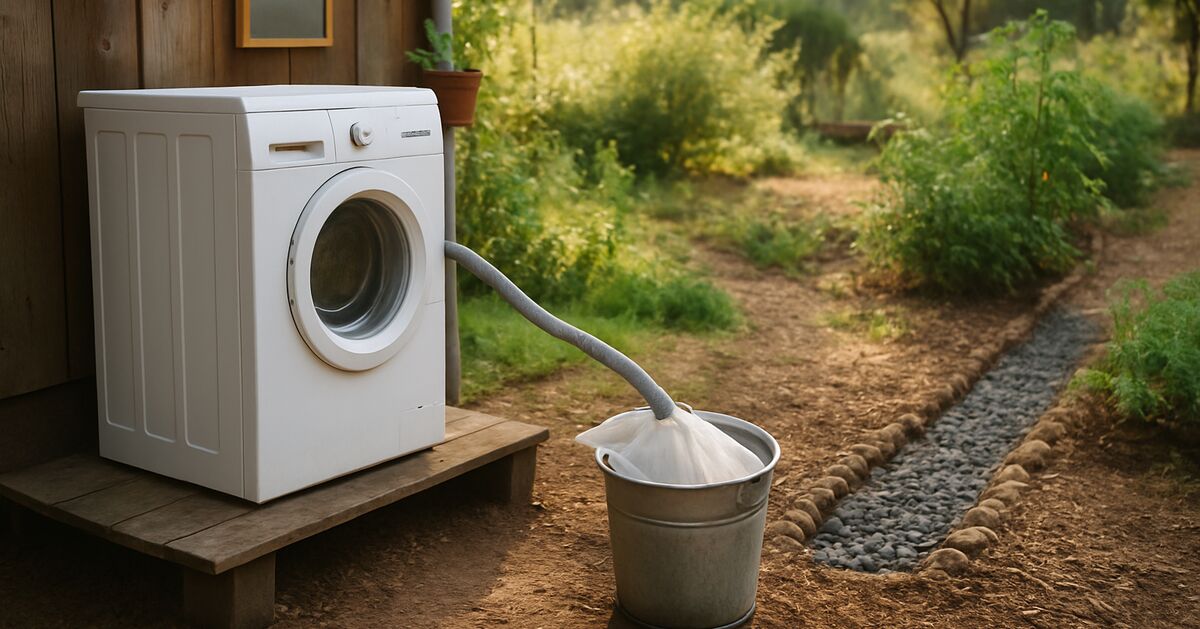
The fix is simple and cheap: a lint trap or filter sock on the washing machine discharge line before the water goes anywhere near your leach field or mulch basin. A five gallon bucket with a mesh paint strainer bag zip-tied over the outlet works. So does a commercial inline lint filter meant for septic systems. Check it every few loads and empty it. Keeping lint out of the bed is one of the cheapest ways to extend the working life of a laundry greywater system.
Grease from dishwashing is a similar story but worse, because grease coats soil particles and reduces their ability to absorb water at all. A dedicated grease trap, even a simple homemade one using a bucket with a submerged outlet pipe so grease floats and stays trapped while water passes underneath, makes a real difference. Scrape plates into the compost or trash before washing rather than letting food scraps go down the drain at all. It sounds obvious, but it's the single most-skipped step we see.
Detergent chemistry actually matters here
Not all soap is created equal once it's going into your soil. Off-grid greywater systems, especially ones irrigating a garden or feeding a mulch basin near fruit trees, need low-sodium, phosphate-free, biodegradable detergents. Regular laundry detergent is often loaded with sodium, which builds up in soil over time and can damage plant roots and degrade soil structure. Boron, found in some detergents, is toxic to plants at fairly low concentrations and doesn't break down.
Powdered detergents can leave more filler and residue than liquid ones, so check the label if your system relies on soil infiltration. If you're sending laundry water to a leach field rather than a lined evaporation basin, switch to a liquid, biodegradable, low-sodium detergent and skip fabric softener entirely. Softener coats fabric and pipe alike with waxy residue that greywater soil doesn't process well.
Bleach is its own conversation. Bleach is a disinfectant, so heavy or frequent use can suppress the soil microbes a greywater system depends on; keep it occasional and well diluted. If you need to bleach heavily (cloth diapers, a health situation, whatever the reason), route that specific load to a separate holding tank for haul-off or a dedicated blackwater-adjacent disposal rather than your regular greywater bed.
Sizing for the surge
Because laundry water arrives in a big single dose rather than trickling, the receiving system needs enough volume and surface area to handle that surge without backing up. A mulch basin or leach trench sized only for daily shower and sink flow will overflow the day you run two loads of laundry back to back.
A practical rule we use when planning: size the laundry-specific greywater receiving area to handle at least one and a half times your washing machine's largest single load, so the ground has room to absorb the surge rather than pond on the surface. If you're on clay-heavy soil, that number needs to go up further, since clay absorbs slowly no matter how much surface area you give it. A percolation test before you dig is worth the hour it takes.
Diverter valves are your friend here too. A simple three-way valve on the laundry discharge line lets you send water either to the greywater system or to a holding tank for hauling, which matters in situations like heavy bleach loads, sick household members, or freezing weather when the ground can't absorb anything at all.
Cold weather changes everything
If you're in a climate with a real winter, laundry and dish greywater in January behaves nothing like it does in July. Frozen ground doesn't absorb water. A mulch basin that works beautifully three seasons a year can turn into an ice rink in winter, and that surface ice creates the same slip and contamination hazard as any other standing greywater.
One option for winter laundry and dish water is an indoor holding tank, hauling it out for disposal on a schedule rather than running it to an outdoor bed that's frozen solid anyway. Others route winter greywater to a subsurface infiltration system buried below frost line, which costs more to install but keeps working year-round. Whichever way you go, plan for it before the first freeze, not during it. If you're still working out your broader cold-weather systems, our post on surviving a real off-grid winter style planning applies here too, water systems of every kind behave differently once temperatures drop.
Common mistakes we actually see
A few patterns come up again and again on properties we visit:
Running the washing machine straight into the same shallow trench as the kitchen sink, with no lint filter, leading to clogged, foul-smelling ground within a year.
Using regular liquid dish soap or dishwasher pods loaded with phosphates in a system that's supposed to feed a garden. Phosphates are a plant nutrient, so repeated loads on one small area can concentrate over time; check your soap labels.
No grease trap at all on kitchen greywater, resulting in a slick, anaerobic mess a few feet down that smells like a swamp.
Undersized receiving beds that worked fine for a single person and failed the moment a second adult or a baby (more laundry, always more laundry) moved in.
Treating laundry water like it's clean enough for direct garden irrigation without any settling or filtering step first. Even "safe" detergent residue and lint need a buffer zone before touching food crops.
Building it right from the start
If you're still in the planning stage of your property, this is a good moment to think about laundry and dish water as their own small subsystem, not an afterthought bolted onto your main greywater plan. A simple, durable setup looks like this: lint filter or bag on the washer discharge, grease trap on the kitchen line, both feeding into a sized mulch basin or gravel-filled trench separate from your bathroom greywater, with a diverter valve for winter or bleach-heavy loads that lets you route to a holding tank instead.
None of this is expensive or exotic. It's mostly forethought, a few buckets, some mesh bags, and a valve. The cost of getting it wrong, a dead patch of yard, a smell you can't get rid of, a clogged system you have to dig out and rebuild, is far higher than the cost of doing it right the first time.
Handling bathroom greywater, your composting toilet, and laundry and dish water as separate systems helps keep a property clean and your water protected; check your state and county rules, since greywater reuse is regulated differently everywhere.
What the rules actually say about this water
Greywater from sinks, showers, and laundry is usually the majority of household wastewater by volume, and how it may be handled varies more by state than almost any other off-grid subject. Several states have well-developed permitted greywater rules with straightforward conditions: subsurface or mulch-basin discharge rather than sprinklers, no ponding or runoff, and no storage beyond a short period because greywater turns septic quickly. Many others make no distinction at all and treat every drop as sewage requiring an approved system.
Kitchen water sits in its own category almost everywhere, because grease and food solids behave much more like blackwater in a drain field. Plenty of jurisdictions that permit laundry and bathroom greywater reuse specifically exclude the kitchen, and building a system that mixes them is a good way to fail an inspection or foul a field.
Check the position for your own county before plumbing anything to the outdoors. The laws pages record what public sources say about greywater, septic, and wells for each state and county, with the sources listed and the unconfirmed parts marked as unconfirmed, and the printable county questions sheet is built for the call that settles it properly.
Designing for the season you will forget
A greywater scheme that irrigates beautifully in July needs somewhere legal for the water to go in January, when the ground is frozen or the garden is dormant. The usual answer is a valve that diverts to the approved system for the winter, and it is far easier to build that in at the start than to retrofit it in a hard freeze.
The same seasonal thinking applies to the plumbing itself. Anything holding water outdoors must be below the frost line, drainable, or heat traced, and heat trace needs power, so the case to design for is a freeze and an outage together. Lesson three of the free course covers freeze protection across the whole water system, and lesson nine covers the wastewater side including how composting toilets do and do not change the greywater question.
Finally, size the system for the water you actually produce rather than for a rule of thumb. The water usage calculator breaks a household down line by line, and laundry is usually a larger share of it than people expect, particularly where a household is washing work clothes rather than office clothes.
Claim audit: 15 consequential claims checked against the article's sources; unsupported wording revised where it could not be substantiated.
Claim-by-claim audit (15 checked)
“Laundry water and dishwashing water are not the same as shower or handwashing water, and treating them like they are is one of the most common mistakes we see when we walk a new pr…” (cited → extension.usu.edu)
“A washing machine, by contrast, can discharge tens of gallons in one shot, often with a heavy detergent load, lint, and sometimes bleach or fabric softener; check your machine's ra…” (rewritten to what the article can stand behind)
“Either the trench clogs with grease and lint and starts backing up or pooling, or the surge volume overwhelms the soil's ability to absorb it and you get surface breakout, which is…” (reasoning shown in the article)
“Once a bed is choked with lint, you're often looking at digging it out and starting over, not a quick fix.” (reasoning shown in the article)
“Keeping lint out of the bed is one of the cheapest ways to extend the working life of a laundry greywater system.” (rewritten to what the article can stand behind)
“Grease from dishwashing is a similar story but worse, because grease coats soil particles and reduces their ability to absorb water at all.” (reasoning shown in the article)
“Regular laundry detergent is often loaded with sodium, which builds up in soil over time and can damage plant roots and degrade soil structure.” (cited → extension.usu.edu)
“Boron, found in some detergents, is toxic to plants at fairly low concentrations and doesn't break down.” (cited → extension.usu.edu)
“Powdered detergents can leave more filler and residue than liquid ones, so check the label if your system relies on soil infiltration.” (rewritten to what the article can stand behind)
“Bleach is a disinfectant, so heavy or frequent use can suppress the soil microbes a greywater system depends on; keep it occasional and well diluted.” (rewritten to what the article can stand behind)
“A mulch basin or leach trench sized only for daily shower and sink flow will overflow the day you run two loads of laundry back to back.” (reasoning shown in the article)
“If you're on clay-heavy soil, that number needs to go up further, since clay absorbs slowly no matter how much surface area you give it.” (reasoning shown in the article)
“One option for winter laundry and dish water is an indoor holding tank, hauling it out for disposal on a schedule rather than running it to an outdoor bed that's frozen solid anywa…” (rewritten to what the article can stand behind)
“Phosphates are a plant nutrient, so repeated loads on one small area can concentrate over time; check your soap labels.” (rewritten to what the article can stand behind)
“Handling bathroom greywater, your composting toilet, and laundry and dish water as separate systems helps keep a property clean and your water protected; check your state and count…” (rewritten to what the article can stand behind)
Before you go
One useful off-grid email a week.
Practical gear rundowns, honest how-tos, and plain-English guides from someone doing the homework in the open.
I am building a place for off-grid people to swap real answers: a forum by topic, classifieds for gear and services, and real estate for off-grid land and homes. It is new, so the early members shape what it becomes. A free account lets you post in all three.
No ER ten minutes away means you have to be your own triage nurse. Here's how to tell a bad bee sting from the real emergency, and what to actually stock.
In many off-grid disasters, the fire or flood itself isn't the decisive factor, it's the hour you waited too long to leave. Here's how to set real, numeric triggers before you need them.
Tax sale and sheriff's auction land looks like a bargain, but redemption periods, hidden liens, and unseen parcels turn a lot of cheap acreage into an expensive lesson. Here's how to vet a listing before you bid.