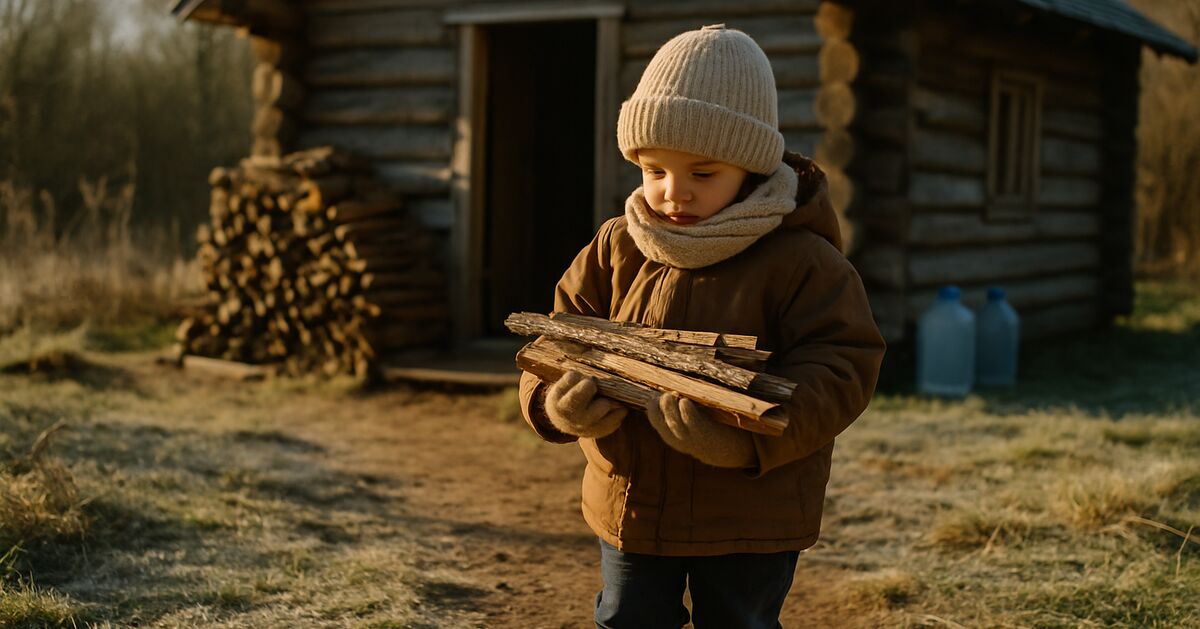
The first time your six-year-old hauls a full water jug into the kitchen without spilling it, something shifts. Not just in your workload, but in how the kid sees themselves. Off-grid life runs on labor that has to come from somewhere, and if you're doing all of it yourself while your children play nearby, you're missing one of the best parts of raising kids this way: they can actually help, and they know it matters.
This isn't about chore charts with stickers or make-believe responsibilities to build character. Off-grid households have real work that needs doing every single day: water hauled, kindling split, animals fed, batteries checked, coops closed against predators. The question isn't whether kids should help. It's which jobs fit which ages, how to teach them safely, and how to avoid the two failure modes that trip up most families: assigning tasks kids aren't ready for, or underestimating what they're capable of and doing it all yourself out of habit.
Why off-grid chores are different from suburban chores
In a grid-tied house, "chores" often means optional tidiness: making a bed, emptying a dishwasher that would run fine without help. Off-grid, a decent share of daily chores are load-bearing. If nobody checks the animals, they don't get fed. If nobody fills the header tank, nobody showers. If nobody brings in wood, the stove goes cold at 2 a.m.
That reality is actually a gift for kids, if you frame it right. Real consequences may teach diligence in a way a sticker chart does not, though that is our read rather than a settled finding. But it also means you have to be honest about risk. A suburban kid forgetting to take out the recycling costs you an awkward smell. An off-grid kid forgetting to latch the coop can cost you the whole flock to a predator overnight, a problem covered in more depth in our piece on protecting livestock and pets from predators when you're off-grid. So chores need to be matched not just to what a kid can physically do, but to what they can be trusted to do without daily reminders, and what happens if they forget.
Ages 3 to 5: helper jobs, not owner jobs
At this age, kids can absolutely participate, but they shouldn't own anything where failure has consequences. Think of these as apprenticeship tasks done alongside an adult, not solo assignments.
Carrying small, light items: a few pieces of kindling, an empty water jug, eggs (this one teaches astonishing focus)
Sorting: recyclables, canning jar lids, screws by size
Watering a specific plant or two with a small watering can
Collecting eggs with supervision, learning to be gentle and quiet around the coop
"Helping" split kindling by handing pieces to an adult and stacking the split wood
The goal here isn't productivity, it's exposure. A three-year-old who's been quietly stacking kindling since before they can remember will find splitting wood normal and unscary at eight, instead of a strange new task assigned out of nowhere.
Keep this age group away from: standing water they could fall into, any tool with an edge, livestock larger than a chicken, and anything near the wood stove or generator. Curiosity outpaces judgment badly at this stage.
Ages 6 to 9: first real solo jobs
This is where kids can start owning a task end to end, meaning they do it without you standing over them, and something actually depends on them doing it right. Pick one or two jobs, not five, and let them get good before adding more.
Good first solo jobs:
Filling and carrying a manageable water container (a gallon jug, not a five-gallon bucket) from tap to kitchen
Feeding chickens or rabbits on a fixed morning routine, with a visual checklist by the coop door
Bringing in a specific number of wood pieces each evening for the next morning's fire
Checking and reporting battery bank readings if you've got a simple monitor with a clear display, not adjusting anything, just reading and telling an adult
Sweeping the porch, cabin floor, or workshop
At this age, the teaching method matters more than the task. Walk through it with them for a week, doing it together every day at the same time. Then let them do it while you watch from a distance. Then let them do it alone, but check the result afterward without hovering. Inconsistent follow-through from adults, checking obsessively one day and forgetting for two weeks the next, signals to a kid that the job is optional, which defeats the whole purpose.
This is also a good age to start folding chores into the rhythm of a homeschool day, since so much of off-grid learning happens outside a workbook. If you haven't already, it's worth reading our piece on homeschooling off-grid and building a real school day without wifi for how chore time and lesson time can actually reinforce each other instead of competing.
Ages 10 to 13: tool use and independent judgment
This is the age where kids can start using real tools with training, and where you can hand off jobs that require judgment, not just repetition. The shift here is from "do this exact thing" to "solve this problem."
Reasonable jobs for this age group:
Splitting kindling with a hatchet, after real instruction on stance, grip, and where hands go
Hauling a five-gallon water bucket with proper lifting form
Full coop and small livestock care: feed, water, egg collection, noticing when something looks wrong
Checking propane levels, noticing a wood pile getting low, and telling an adult before it becomes a crisis instead of after
This is also the right age to start teaching basic small engine awareness, even if they're not doing repairs yet. A kid who knows what a generator sounds like when it's running fine, and what it sounds like when something's off, is genuinely useful before they're big enough to hold a wrench. If you're building out a household repair routine, our guide to building a small engine repair kit for generators and pumps is worth doing together as a project, not just a solo adult task. Letting a 12-year-old organize the spare spark plugs and belts by size teaches inventory thinking that will serve them for life.
One caution: kids this age often want to prove they're capable of more than they are. Resist the urge to hand off ax work or fire-tending solo just because they ask confidently. Confidence and competence are different things, and it is worth assuming the gap between them is where injuries are most likely.
Ages 14 and up: real capability, real trust
By the teen years, a capable kid raised this way can genuinely run a morning routine solo: animals fed, water hauled, wood stacked, stove lit safely, battery bank checked. This is also the age to start teaching maintenance, not just operation. Understanding why the solar array needs to face a certain direction, or why the water tank has to be a certain size for the household, turns chores into systems knowledge. Our explainer on how much solar you actually need to live off-grid is a genuinely good read for a teenager who's been living with the system for years but never learned the reasoning behind it.
Teens are also old enough to take real ownership of an emergency-relevant skill. If your family has already worked through age-appropriate safety information, building on it with something concrete, like knowing the shutoffs, knowing where the fire extinguishers live, and understanding basic first response, connects directly to what we cover in kid-safe emergency plans for off-grid children. A fifteen-year-old who has spent years doing real chores has already practiced the habits an emergency calls for, which a sheltered kid has not.
The mistakes that undercut the whole system
A few patterns wreck chore systems even in families with good intentions.
Redoing their work in front of them. If you quietly refill the water jug after your eight-year-old already did it, because it wasn't quite full enough, you've taught them the job doesn't matter and you'll fix it anyway. Let small imperfections stand. Correct gently, later, not by silently redoing it.
Rescuing them from natural consequences too fast. If the coop chore gets forgotten and the chickens go a few hours without fresh water on a mild day, that's a teaching moment, not a crisis. Constant adult rescue removes the exact feedback that makes the system work.
Adding jobs without removing old ones. Kids can get buried under an accumulating list where nothing ever comes off. Review the job list seasonally. Winter chores and summer chores aren't the same, and neither are chores for a six-year-old and a ten-year-old who used to be six.
Assigning jobs based on age alone, not the individual kid. Siblings develop at wildly different rates. One nine-year-old might handle a hatchet responsibly; another might need another year. Match the task to the kid in front of you, not a chart.
Chores as the backbone of family resilience
The deeper reason to build a real chore system isn't efficiency, though it does help. Off-grid life asks a lot of the adults, and in our view a household where only the adults carry the load is harder to sustain. Kids who grow up doing real work develop real confidence, real risk judgment, and a real stake in the place they live. That's worth more than a tidy chart on the fridge.
If you're still working out the broader rhythm of family life off-grid, from schooling to safety planning, our blog has a growing library on the subject, and our FAQ covers a lot of the questions families ask before and after the move. If you want to know more about how this site approaches off-grid living generally, our about page lays out where we're coming from, and you're always welcome to get in touch with topics you'd like to see covered.
Chores won't replace planning, and they're not a substitute for the safety systems your household needs. But a well-built chore system, matched honestly to what your kids can actually do at each age, turns "off-grid life is a lot of work" into "off-grid life is work we all share." That's a much better sentence to be living inside.
Claim audit: 10 consequential claims checked against the article's sources; unsupported wording revised where it could not be substantiated.
Claim-by-claim audit (10 checked)
“An off-grid kid forgetting to latch the coop can cost you the whole flock to a predator overnight, a problem covered in more depth in our piece on [protecting livestock and pets fr…” (reasoning shown in the article)
“Real consequences may teach diligence in a way a sticker chart does not, though that is our read rather than a settled finding.” (rewritten to what the article can stand behind)
“Curiosity outpaces judgment badly at this stage.” (cited → medlineplus.gov)
“Inconsistent follow-through from adults, checking obsessively one day and forgetting for two weeks the next, signals to a kid that the job is optional, which defeats the whole purp…” (rewritten to what the article can stand behind)
“Confidence and competence are different things, and it is worth assuming the gap between them is where injuries are most likely.” (rewritten to what the article can stand behind)
“A fifteen-year-old who has spent years doing real chores has already practiced the habits an emergency calls for, which a sheltered kid has not.” (rewritten to what the article can stand behind)
“Kids who grow up doing real work develop real confidence, real risk judgment, and a real stake in the place they live.” (cited → canr.msu.edu)
“Siblings develop at wildly different rates.” (cited → medlineplus.gov)
“Off-grid life asks a lot of the adults, and in our view a household where only the adults carry the load is harder to sustain.” (rewritten to what the article can stand behind)
“Constant adult rescue removes the exact feedback that makes the system work.” (reasoning shown in the article)
Before you go
One useful off-grid email a week.
Practical gear rundowns, honest how-tos, and plain-English guides from someone doing the homework in the open.
I am building a place for off-grid people to swap real answers: a forum by topic, classifieds for gear and services, and real estate for off-grid land and homes. It is new, so the early members shape what it becomes. A free account lets you post in all three.
No ER ten minutes away means you have to be your own triage nurse. Here's how to tell a bad bee sting from the real emergency, and what to actually stock.
In many off-grid disasters, the fire or flood itself isn't the decisive factor, it's the hour you waited too long to leave. Here's how to set real, numeric triggers before you need them.
Tax sale and sheriff's auction land looks like a bargain, but redemption periods, hidden liens, and unseen parcels turn a lot of cheap acreage into an expensive lesson. Here's how to vet a listing before you bid.