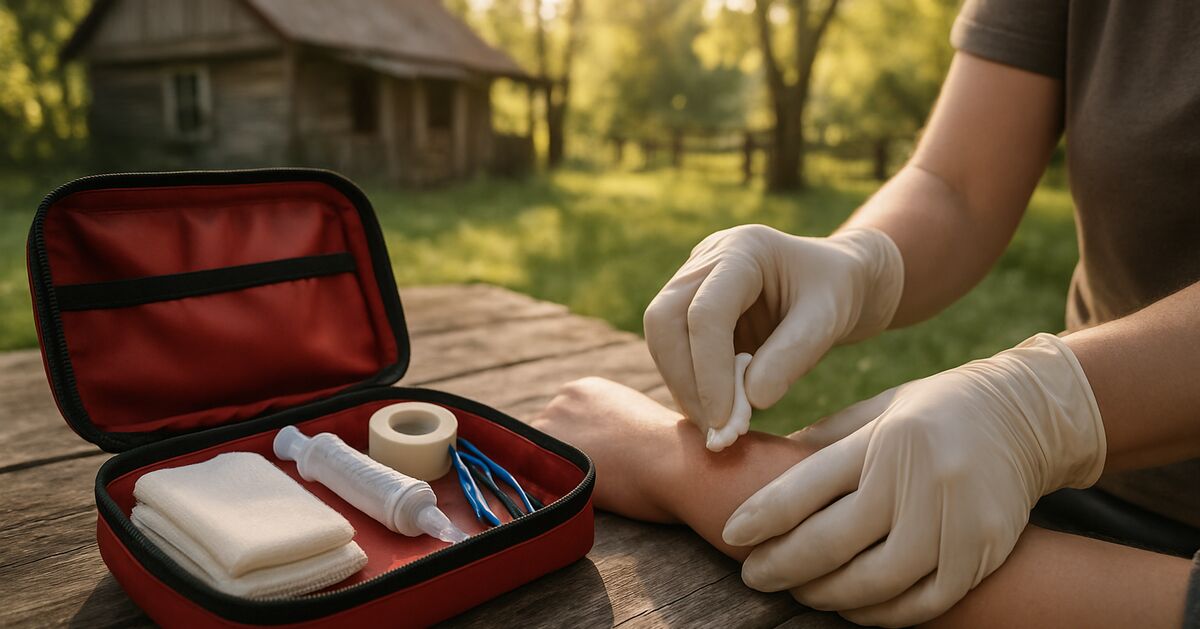
A rusty hinge catches your forearm while you're wrestling a gate into place. Or the chainsaw kicks. Or your kid trips on the porch step and opens a gash on their chin. None of these are rare events on a working homestead, and none of them are dramatic enough to justify a two-hour drive to urgent care every single time. But every one of them needs to be handled correctly in the first ten minutes, or it turns into an infection that does force that drive, days later, when it's worse.
Wound care off-grid isn't glamorous and it isn't complicated either, but it's a skill set that's easy to leave unpracticed until you're standing over a bleeding hand wondering what to do first. This is the piece that fills that gap: how to clean a wound properly, when you can close it yourself, when you absolutely cannot, and how to watch it over the following days so you catch trouble before it catches you.
Stop the bleeding before you do anything else
This sounds obvious, but the instinct to grab antiseptic or start poking at a wound to "see how bad it is" gets people into trouble. Direct pressure, held firmly and continuously for a full five minutes by a clock (not by feel, because thirty seconds always feels like five minutes when you're anxious), stops the overwhelming majority of bleeding you'll encounter on a homestead. Use a clean cloth, gauze, or even a shirt if that's what's on hand. Don't peek every ten seconds to check. Peeking breaks the clot that's trying to form.
If blood is spurting rather than oozing, or soaking through dressing after dressing despite firm pressure, that's arterial bleeding and it's an emergency that needs pressure, elevation, and if it's on a limb and not controlled, a tourniquet applied high and tight, followed by transport to real medical care. This is exactly the territory covered in more depth in our post on building real medical skills off-grid, and if you haven't taken a Stop the Bleed style course, it's one of the highest-value few hours you can spend before you need it, not after.
Most wounds you'll deal with, though, are not arterial. They're the garden-variety cuts, punctures, and scrapes that stop bleeding within a few minutes of pressure and then need to be cleaned and managed correctly so they heal instead of festering.
Cleaning matters more than closing
Here's the part people skip because it's the least satisfying step: irrigation. Copious, forceful irrigation with clean water is widely emphasized in first-aid training as one of the most useful things you can do to reduce infection risk, arguably more than any ointment applied afterward.
The method that works well off-grid:
Use potable water. If you're on well water you've tested and trust, that's fine. If you have any doubt about your water source, boil and cool it first, or use bottled water.
Irrigate under pressure, not just a gentle rinse. A syringe (a 20cc or 30cc syringe with no needle works well, and is worth having in your kit) pushing water into the wound at some force does far more to flush out dirt, bark, metal shavings, and bacteria than pouring water over it.
Aim for a real volume. For a moderate cut, that might mean a full liter of clean water run through it, not a capful.
Remove visible debris with clean tweezers, but don't dig for things you can't see. Buried splinters or metal fragments that resist easy removal are a "get it looked at" situation, not a "keep poking" situation.
Soap is fine around the wound edges but stings badly and can irritate tissue directly inside the wound, so keep it to the surrounding skin. Hydrogen peroxide and full-strength iodine are medicine-cabinet classics, but many first-aid instructors advise against repeated use on healing tissue, so keep them to the very first cleaning of a dirty wound if you use them at all. Clean water and mechanical flushing do the real work.
When you can close it yourself, and when you shouldn't
This is the question that actually matters off-grid, because "should I put a butterfly bandage on this or should I drive three hours to get stitches" has a real answer, and it's not always the one people want to hear.
Reasonable to close at home with butterfly strips, skin closure tape, or (if you're trained) staples or sutures:
Clean-edged cuts under about an inch or so, not gaping open under tension
Wounds where the skin edges naturally want to sit back together
Cuts on flat areas away from joints, where movement won't constantly pull the closure apart
Wounds you've thoroughly irrigated and that show no embedded debris
Needs a real medical provider, even if it means the long drive:
Any wound where you can see fat, muscle, tendon, or bone
Cuts on the face, especially near the eye, lip, or ear, where cosmetic and functional outcome matters
Deep puncture wounds, especially from something dirty (nails, livestock horns, fish hooks), because these trap bacteria deep in tissue where irrigation can't fully reach
Bites from animals or humans, which should be evaluated by a provider because of infection risk and the question of whether to close them at all
Wounds with a lot of tissue loss or ragged, crushed edges
Anything on the hands, which have a lot of tendons and nerves close to the surface and a lot riding on getting them right
Wounds that have been open for many hours, since a provider should decide whether closing them is safe or whether they should be left open to heal
If you're genuinely unsure, treat it as clean as you can, dress it, and get it seen. A wound that gets checked and turns out fine cost you a drive. A wound that needed stitches and didn't get them can cost you a limb function or a much longer recovery.
Rabies and tetanus risk from animal encounters deserve their own attention beyond wound mechanics, which is why our post on zoonotic and animal-borne illness off-grid is worth reading alongside this one if livestock or wildlife are part of your daily routine.
Tetanus is the quiet risk nobody thinks about until it's too late
Puncture wounds from rusty nails, wire, and soil-contaminated tools are the classic tetanus setup, and it's genuinely one of the more preventable serious risks in rural life. The CDC recommends a tetanus booster every 10 years for routine protection, and sooner (within 5 years) if you've had a dirty or deep wound. If you can't remember your last tetanus shot, that's worth fixing on your next supply run into town, before you need it urgently. Tetanus is not something you treat at home. It is something you prevent with a vaccine you got months or years before the wound ever happened.
Dressing and monitoring: the part that actually determines the outcome
Getting the wound clean and closed is only part of the job. The rest happens over the following five to seven days, and it's where off-grid life actually has an advantage, because you're right there to watch it closely, if you know what you're watching for.
Daily wound checks should look for:
Increasing redness that spreads outward from the wound edges (a little pink right at the edge is normal; a red streak creeping up an arm or leg is not, and is a reason to seek medical attention promptly)
Warmth and swelling that's getting worse rather than better after day 2 or 3
Pus or cloudy drainage, as opposed to clear or slightly blood-tinged fluid
A foul smell
Increasing pain rather than gradually decreasing pain
Fever, chills, or feeling generally unwell, which can indicate the infection has moved beyond the local site
A wound that's healing normally gets less painful, less red, and less swollen each day. A wound trending the other direction, even slowly, is telling you something's wrong, and this is exactly the situation where having a stocked kit with the right supplies covered in our guide to building an off-grid first-aid kit for when help is hours away pays off, because you want clean dressings, saline, and a working thermometer on hand, not scrambling to improvise them.
Change dressings daily, or more often if they get wet or dirty. Keep the wound covered while it's actively healing, dry and clean once a scab has fully formed. Resist the urge to pick at scabs, obviously, but also resist the opposite urge to smother a wound in ointment and multiple bandage layers when it's doing fine on its own.
Stocking for wounds specifically
A general first-aid kit often shortchanges wound care in favor of headache pills and bandaids. For real off-grid wound management, prioritize:
Sterile saline solution or the ability to make clean irrigation water in volume
A 20cc or larger irrigation syringe
Non-stick sterile gauze pads in several sizes
Steri-strips or butterfly closures
Medical tape that won't irritate skin over multiple days of wear
Clean tweezers and small scissors
Nitrile gloves, several pairs, because you don't want to work on a wound with the same dirty hands that caused it
A basic suture or staple kit only if you or someone on the property has actual training to use it correctly, since a poorly placed suture can trap infection and do more harm than an open wound
If antibiotics are part of your emergency stock, that's a conversation to have with a prescribing doctor ahead of time, not a decision to make alone at the moment of injury. Our post on stocking and using well-water and off-grid medications safely over time covers how to keep those supplies viable and organized so they're actually usable when the day comes.
The judgment call is the real skill
None of this replaces professional care when a wound genuinely needs it. What it does is give you the tools to handle the routine cuts and scrapes that come with working land and animals every day, without turning each one into a crisis or a wasted trip to town. The skill isn't memorizing a flowchart, it's building enough hands-on comfort with cleaning, closing, and watching a wound that you can make a calm, accurate call about which category you're in.
That comfort comes from practice, from asking questions at your next wilderness first-aid class, and honestly from just doing it a few times under low-stakes conditions before you're doing it under pressure. If you're still building out your broader emergency planning, our FAQ and about pages have more on how we think about self-reliance topics like this one, and the blog index has the rest of the health and first aid series if you want to keep building the skill set piece by piece. If you have a specific situation you want more detail on, our contact page is open.
Cuts happen. Living rurally doesn't make you more accident-prone, it just makes the consequences of a poorly handled wound bigger, because the backup plan is farther away. Handle the first ten minutes right, watch it honestly for the week after, and many wounds will stay exactly where they belong: a minor story, not a medical emergency.
“Direct pressure, held firmly and continuously for a full five minutes by a clock (not by feel, because thirty seconds always feels like five minutes when you're anxious), stops the…” (cited → stopthebleed.org)
“If blood is spurting rather than oozing, or soaking through dressing after dressing despite firm pressure, that's arterial bleeding and it's an emergency that needs pressure, eleva…” (cited → stopthebleed.org)
“Copious, forceful irrigation with clean water is widely emphasized in first-aid training as one of the most useful things you can do to reduce infection risk, arguably more than an…” (rewritten to what the article can stand behind)
“Hydrogen peroxide and full-strength iodine are medicine-cabinet classics, but many first-aid instructors advise against repeated use on healing tissue, so keep them to the very fir…” (rewritten to what the article can stand behind)
“The CDC recommends a tetanus booster every 10 years for routine protection, and sooner (within 5 years) if you've had a dirty or deep wound.” (cited → cdc.gov)
“Getting the wound clean and closed is only part of the job.” (rewritten to what the article can stand behind)
“Wounds that have been open for many hours, since a provider should decide whether closing them is safe or whether they should be left open to heal” (rewritten to what the article can stand behind)
“Bites from animals or humans, which should be evaluated by a provider because of infection risk and the question of whether to close them at all” (rewritten to what the article can stand behind)
“a red streak creeping up an arm or leg is not, and is a reason to seek medical attention promptly” (rewritten to what the article can stand behind)
“Resist the urge to pick at scabs, obviously, but also resist the opposite urge to smother a wound in ointment and multiple bandage layers when it's doing fine on its own.” (rewritten to what the article can stand behind)
“A basic suture or staple kit only if you or someone on the property has actual training to use it correctly, since a poorly placed suture can trap infection and do more harm than a…” (reasoning shown in the article)
Before you go
One useful off-grid email a week.
Practical gear rundowns, honest how-tos, and plain-English guides from someone doing the homework in the open.
I am building a place for off-grid people to swap real answers: a forum by topic, classifieds for gear and services, and real estate for off-grid land and homes. It is new, so the early members shape what it becomes. A free account lets you post in all three.
No ER ten minutes away means you have to be your own triage nurse. Here's how to tell a bad bee sting from the real emergency, and what to actually stock.
In many off-grid disasters, the fire or flood itself isn't the decisive factor, it's the hour you waited too long to leave. Here's how to set real, numeric triggers before you need them.
Tax sale and sheriff's auction land looks like a bargain, but redemption periods, hidden liens, and unseen parcels turn a lot of cheap acreage into an expensive lesson. Here's how to vet a listing before you bid.