A dull tool is a dangerous tool. That sounds backward until you've actually used one. A sharp axe bites cleanly into wood and stays where you aim it. A dull axe glances off, skips sideways, and sends the edge toward your shin or your foot instead. The same logic applies to a chainsaw chain that's lost its edge: you end up forcing the saw, and forcing a saw gives you less control over where the bar goes. Off-grid, where the nearest hardware store or saw shop might be an hour or more away, keeping your tools sharp and functioning isn't a hobby project for a rainy afternoon. It's part of your safety plan.
This is the piece nobody talks about when they're excited about buying their first set of off-grid tools. Everyone focuses on what to buy. Almost nobody talks about what it takes to keep those tools working for years without a trip to town. So let's get into the actual maintenance: what dulls tools, how to sharpen them by hand, what a real maintenance kit looks like, and the small habits that save you from a ruined edge or a ruined tool halfway through a job.
Why sharpening matters more off-grid than anywhere else
In town, a dull chain or a chipped axe is a minor inconvenience. You toss the tool in the truck, drive it to a shop, and pick it up sharpened in a day or two. Off-grid, that round trip might eat half a day of driving, assuming the shop is even open, and in the meantime, the wood doesn't get cut, the fence post doesn't get set, and the job you needed done today gets pushed to next week.
There's also a safety dimension that's easy to underestimate. A sharp tool requires less force to do its job. Less force means more control. When a blade is dull, you instinctively push harder, and pushing harder means less precision and a higher chance the tool slips. Saw manuals generally warn against running a dull or unevenly filed chain, since a chain that grabs instead of cutting cleanly is harder to control; check your own saw's safety section for the specifics. If you're heating with wood and running a saw regularly (see the wood stove and heating comparisons for context on how much cutting that really means over a season), chain maintenance isn't optional, it's a weekly task.
What actually dulls an edge
Understanding what causes dullness helps you prevent it instead of just reacting to it.
Dirt and grit. Wood that's been on the ground, or bark with embedded dirt, will dull an edge far faster than clean, elevated wood. This is one of the best arguments for bucking logs up off the dirt whenever you can.
Knots and hardwood. Dense knots and hardwoods like oak or hickory are harder on an edge than softwoods like pine or fir, since the edge has to work through denser fiber. If you know you're cutting hardwood today, expect to sharpen sooner.
Impact with rocks or nails. This is the fast, catastrophic kind of dulling, a chip or a bent tooth rather than gradual wear. Always check firewood and fence posts for embedded metal or rocks before you cut.
Rust. Moisture sitting on an unprotected edge corrodes the metal at a microscopic level, which ruins the edge geometry even if the tool never touched wood. This is a bigger deal in humid climates or if tools are stored in an unheated shed through winter.
Improper storage. Tools rattling around loose in a truck bed or tool box will nick each other. Edges need their own protected space.
The hand-sharpening kit worth keeping on hand
You don't need a machine shop. A small, well-chosen kit handles nearly everything.
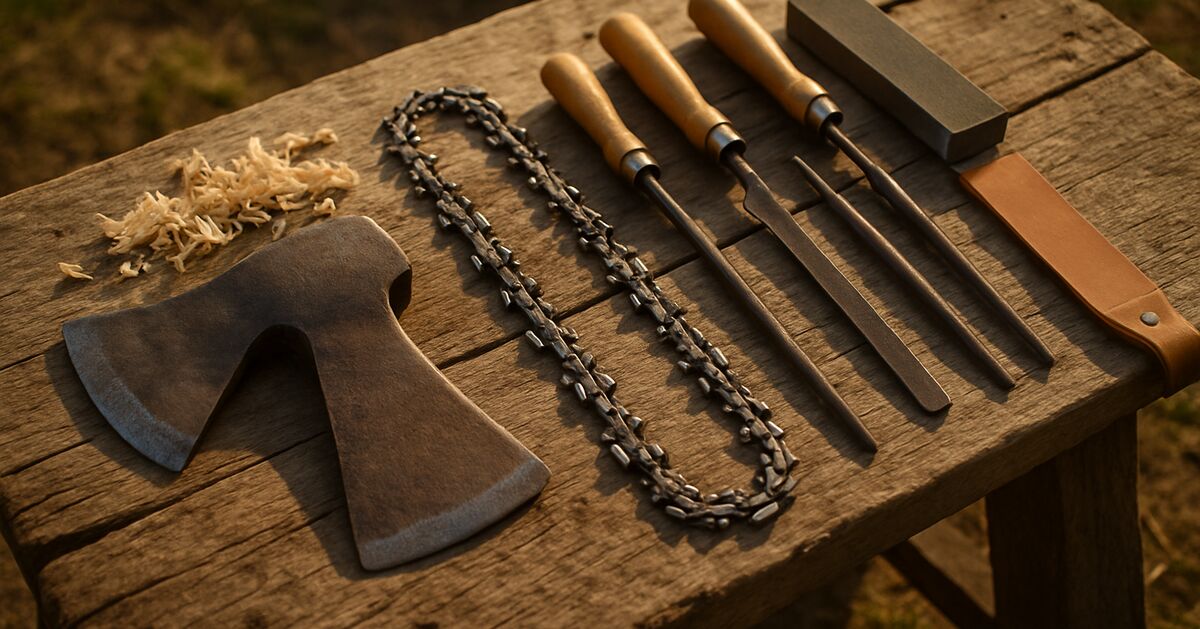
A flat mill file (10 to 12 inch, single-cut) for axes, hatchets, machetes, and mower blades.
A round chainsaw file in the correct diameter for your chain's pitch (usually 5/32", 3/16", or 7/32", check your saw's manual, this is not a "close enough" measurement).
A file guide or filing jig to hold the correct angle on chainsaw teeth. Freehand filing works but takes practice; a guide gets you consistent results faster.
A flat depth gauge tool for chainsaw rakers (the depth gauges that control how deep each tooth bites). These need occasional filing down too, and it's a step people forget.
A combination sharpening stone (coarse/fine, oil or water stone depending on preference) for knives, chisels, and drawknives.
A puck-style axe stone (round, two-grit) for touching up axe edges in the field without a full file job.
A strop or piece of leather with honing compound for the final polish on knife edges, useful for kitchen knives and hunting knives alike.
A small handheld clamp or vise to hold the tool steady while you work. Sharpening a moving target is how you cut yourself or ruin the angle.
Safety glasses and a leather glove for the hand holding the tool. Filing throws small metal shavings, and a file can slip across your knuckles, which is worth guarding against.
All of this fits in a small tool box or canvas roll and weighs almost nothing. It's a worthwhile addition alongside the core kit covered in the off-grid tool kit guide, and honestly it belongs in the same conversation, because a tool kit without maintenance gear is only half a plan.
Sharpening an axe by hand
An axe edge is a convex curve, not a flat bevel like a knife, and that shape is what lets it split wood without binding. The goal in sharpening is to maintain that curve, not flatten it.
Clamp the axe head securely or brace it on your knee with a thick glove. Start with the coarse side of the file or stone, working from the middle of the edge outward toward the toe and heel in smooth arcs, following the existing curve of the bevel. Work one side, then flip and do the other, trying to keep the number of strokes roughly even so you don't shift the edge off-center.
Once the edge feels even and free of nicks, switch to the fine stone or the fine side of the puck stone to polish out the coarse scratches. Finish by stropping lightly if you want a fine working edge, though for splitting wood a slightly less polished edge that's more durable is often preferable to a razor edge that chips on knots.
Test sharpness carefully: a sharp axe should shave a thin curl off a piece of softwood or catch on a fingernail when drawn lightly across it (never test by touching the edge directly with your thumb along its length). In my routine I touch up an axe after a few hours of hard use and do a fuller sharpening when the edge stops biting cleanly, sooner with knotty or dirty wood.
Filing a chainsaw chain correctly
Chainsaw chains dull quickly, especially cutting near the ground where the chain contacts dirt. A chain that's cutting slowly, producing fine sawdust instead of coarse chips, or pulling to one side is telling you it needs attention.
Every cutting tooth on the chain has the same angle, and consistency matters more than any single tooth being perfect. Clamp the guide bar in a vise if possible, or brace it securely, and use a filing guide set to the angle specified for your chain, which is marked on the guide or in your chain's spec sheet. File from the inside of the tooth outward, using smooth, consistent strokes and the same number of strokes on every tooth. Work all the way around the chain, then check that the rakers (the depth gauges just ahead of each cutter) aren't sitting too high, which prevents the tooth from biting into the wood. A raker gauge tool tells you exactly how much to file them down, and this step gets skipped far too often, resulting in a chain that stays "technically sharp" but cuts poorly anyway.
A properly filed chain should pull itself into the wood with light pressure and throw clean chips, not dust. If you're forcing the saw at all, stop and file again rather than pushing through it, both for the saw's sake and for your own safety.
Knives, hatchets, and everyday edges
Fixed-blade knives and hatchets used for kitchen work, hunting, or general camp tasks benefit from the same basic process: coarse stone to reset the edge if it's been nicked or badly dulled, fine stone to refine it, and a strop to polish and align the very edge. For knives, maintaining a consistent angle matters more than the exact number, so a cheap angle guide clipped onto the spine while you learn is genuinely helpful.
Kitchen knives get heavy use in an off-grid household, especially if you're doing your own food preservation and cooking without shore power (a topic covered in the off-grid cooking guide), so a quick few strokes on a stone every week or two keeps them from ever getting seriously dull, which is far easier than trying to rescue a badly neglected edge later.
Rust prevention and storage
Sharpening only gets you halfway. An edge that rusts between uses loses its geometry regardless of how well it was filed. A few habits prevent most of this:
Wipe blades dry after use, especially after cutting green or wet wood.
Apply a light coat of oil (mineral oil for anything that touches food, boiled linseed oil or a commercial tool oil for axes and saws) before long-term storage.
Store edged tools in sheaths, blade guards, or hung on a rack rather than tossed in a drawer or bin together.
Keep a small silica packet or a stick of chalk in a closed tool box to cut down on ambient moisture.
In genuinely humid climates, consider a small dehumidifier or a solar-vented tool shed rather than sealing tools in an airtight but damp box.
Building the habit, not just the kit
The honest truth is that having the right files and stones doesn't help much if sharpening only happens when a tool is already too dull to use. The people who keep tools running well off-grid, year after year, tend to build a short maintenance check into their routine: a quick look at the axe and a couple of strokes on the chainsaw chain at the end of a cutting day, a few minutes with the kitchen knives once a week, a fuller sharpening session monthly during heavy-use seasons.
It also helps to keep a small log, even an informal one, of when tools were last sharpened and roughly how many hours of use they've seen. That way you're maintaining on a schedule rather than waiting for a tool to fail on you mid-job, which off-grid usually means at the worst possible time.
If you're still assembling your basic gear and haven't settled on brands or specific models yet, my gear guides cover specific axe, saw, and stone recommendations by category. And if you've got a maintenance question specific to your climate or your tool setup, reach out directly; it's the kind of thing worth getting right before you're an hour from the nearest shop with a saw that won't cut straight.
Keeping tools sharp isn't glamorous work, and it won't show up in anyone's list of exciting off-grid projects. But it's one of those quiet, unglamorous habits that separates a homestead that runs smoothly for years from one that's forever fighting broken and dull equipment. For more on the broader project of getting set up right, the full blog archive has guides on nearly every other piece of the puzzle, and the about page has the story of why I started writing all of this down in the first place.
Claim audit: 13 consequential claims checked against the article's sources; unsupported wording revised where it could not be substantiated.
Claim-by-claim audit (13 checked)
“A dull tool is a dangerous tool.” (cited → ehs.msu.edu)
“A dull axe glances off, skips sideways, and sends the edge toward your shin or your foot instead.” (reasoning shown in the article)
“The same logic applies to a chainsaw chain that's lost its edge: you end up forcing the saw, and forcing a saw gives you less control over where the bar goes.” (rewritten to what the article can stand behind)
“Saw manuals generally warn against running a dull or unevenly filed chain, since a chain that grabs instead of cutting cleanly is harder to control; check your own saw's safety sec…” (rewritten to what the article can stand behind)
“Wood that's been on the ground, or bark with embedded dirt, will dull an edge far faster than clean, elevated wood.” (cited → extension.illinois.edu)
“Dense knots and hardwoods like oak or hickory are harder on an edge than softwoods like pine or fir, since the edge has to work through denser fiber.” (rewritten to what the article can stand behind)
“Moisture sitting on an unprotected edge corrodes the metal at a microscopic level, which ruins the edge geometry even if the tool never touched wood.” (cited → extension.illinois.edu)
“Filing throws small metal shavings, and a file can slip across your knuckles, which is worth guarding against.” (rewritten to what the article can stand behind)
“In my routine I touch up an axe after a few hours of hard use and do a fuller sharpening when the edge stops biting cleanly, sooner with knotty or dirty wood.” (rewritten to what the article can stand behind)
“Chainsaw chains dull quickly, especially cutting near the ground where the chain contacts dirt.” (reasoning shown in the article)
“Clamp the guide bar in a vise if possible, or brace it securely, and use a filing guide set to the angle specified for your chain, which is marked on the guide or in your chain's s…” (rewritten to what the article can stand behind)
“For knives, maintaining a consistent angle matters more than the exact number, so a cheap angle guide clipped onto the spine while you learn is genuinely helpful.” (rewritten to what the article can stand behind)
Before you go
One useful off-grid email a week.
Practical gear rundowns, honest how-tos, and plain-English guides from someone doing the homework in the open.
I am building a place for off-grid people to swap real answers: a forum by topic, classifieds for gear and services, and real estate for off-grid land and homes. It is new, so the early members shape what it becomes. A free account lets you post in all three.
No ER ten minutes away means you have to be your own triage nurse. Here's how to tell a bad bee sting from the real emergency, and what to actually stock.
In many off-grid disasters, the fire or flood itself isn't the decisive factor, it's the hour you waited too long to leave. Here's how to set real, numeric triggers before you need them.
Tax sale and sheriff's auction land looks like a bargain, but redemption periods, hidden liens, and unseen parcels turn a lot of cheap acreage into an expensive lesson. Here's how to vet a listing before you bid.