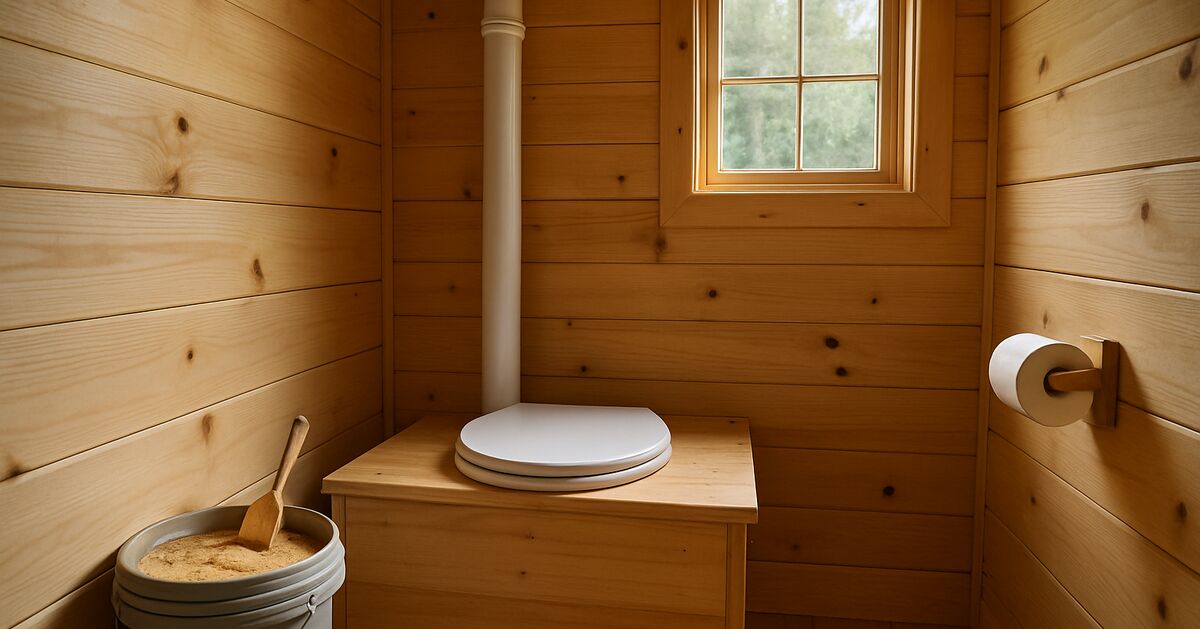
The first time an off-grid sanitation system fails, it almost never fails because the toilet broke. It fails because someone walks past the outhouse, or opens the composting bin, or catches a whiff near the greywater discharge, and thinks: this cannot be right. Odor is the early warning system. Pathogens are the actual danger. It's easy when planning an off-grid setup to focus on the hardware (which toilet, which pit, which tank) and never build a real plan for the two things that determine whether that hardware works over years, not weeks: managing smell and managing biological risk.
This isn't a rehash of pit design or composting toilet mechanics. Think of this as the maintenance and biology layer that sits underneath whatever system you've already chosen, whether that's a pit outhouse, a composting toilet, or a greywater run to a mulch basin. The hardware gets you started. Understanding what's actually happening biologically is what keeps you from having a bad year three winters in.
Why odor happens (and why it's not really about "smell")
Odor in any human waste system comes from anaerobic decomposition, bacteria breaking down organic matter without oxygen, which produces ammonia, hydrogen sulfide, and a cocktail of volatile organic compounds. That's the sulfur-and-ammonia smell you associate with a bad outhouse or a neglected composting bin.
The fix tends to be the same regardless of system type: introduce oxygen, manage moisture, and manage the carbon-to-nitrogen ratio. Anaerobic conditions happen when waste sits wet, compacted, and undisturbed. Aerobic decomposition, the kind that happens in a well-run composting toilet or a properly vented pit, produces far less odor and breaks material down faster and more completely.
This matters because odor isn't just unpleasant. It's diagnostic. A pit outhouse that suddenly starts smelling worse than usual after two quiet years is telling you something changed: moisture got in, the pile compacted, or airflow got blocked. A composting toilet that reeks of ammonia is telling you the nitrogen-rich liquid fraction isn't separating or evaporating the way it should. Learn to read the smell instead of just trying to mask it.
The biology you're actually managing
Human waste carries pathogens: bacteria like E. coli and Salmonella, viruses, and parasites, all of which can survive in soil and water for weeks to months depending on conditions. This is the entire reason septic systems, pit design setbacks, and composting toilet processing times exist. You're not just hiding waste, you're giving time and biological processes enough runway to neutralize what's dangerous in it before it can reach a water source, a garden bed, or a person's hands.
Three things kill or deactivate most pathogens over time:
Time. Left alone, most human pathogens die off within weeks to a few months in dry, aerated conditions. This is why composting toilet manufacturers specify minimum holding times before the solid fraction is considered safe to handle, and why a proper outhouse pit needs to age before it's ever reopened or repurposed.
Heat. Thermophilic composting (piles that get hot, 130-160°F) kills pathogens far faster than cold composting. Small off-grid systems often do not reach those temperatures, so treat "finished" compost from a composting toilet as unsanitized and keep it on ornamental beds and fruit tree drip lines rather than a vegetable garden, following your manufacturer's and state health guidance on cure time.
Dryness. Pathogens need moisture to survive. A dry, well-ventilated pit or bin is inherently safer than a wet one. This is the single biggest lever you control day to day.
None of this is exotic knowledge, but almost nobody explains it to new off-grid households, which is why so many people either panic unnecessarily (treating all handled compost like radioactive waste) or get careless (using barely-processed material on food crops because "it looked fine"). If you're building any kind of medical or health-risk baseline for your property, this belongs right alongside the topics covered in medical self-reliance off-grid, since untreated waste is a direct route for illness to reach people and water.
A realistic maintenance rhythm, not a crisis response
Most odor and pathogen problems trace back to the same root cause: sanitation gets treated as a "set it up once" project instead of a system with a maintenance rhythm. Here's what that rhythm actually looks like broken down by system type.
Composting toilets. If you're running something like a Nature's Head Composting Toilet, the rhythm is built into the design: agitate the solids chamber regularly to keep material aerated, empty the liquids container on its own schedule (liquids fill up far faster than solids), and add a scoop of dry cover material, coconut coir is the standard, after each solid use. One predictable mistake is letting the liquids container run past full, since concentrated urine off-gasses ammonia once it sits. The other common mistake is not agitating enough, which lets the pile compact and go anaerobic in pockets even though the surface looks fine.
Pit outhouses. The rhythm here is about lime or ash application (a thin dusting after each use is commonly used to dry the surface and reduce odor), keeping a vent stack clear and painted dark to encourage the solar chimney effect that pulls odor up and out, and closing the lid between uses to cut down on moisture from humidity and rain intrusion. If you haven't already read through the structural side of this, the pit design and siting post covers the parts of the build that make maintenance easier or harder for the life of the structure.
Greywater systems. Odor here usually means grease or food solids are building up in a line or basin instead of breaking down. The fix is upstream: better straining at the sink, and downstream: making sure the discharge area actually drains rather than pooling. Standing greywater is a mosquito and pathogen risk in a way that flowing or absorbed greywater isn't.
Building an odor and pathogen log (yes, actually write this down)
This sounds excessive until you've lived through a second or third off-grid winter. Write down, even briefly, when you empty or service each system, what it smelled like, and any changes you made. Over a year or two this turns into genuinely useful data: you'll start to see that odor spikes correlate with a specific week of heavy rain, or a specific point in the composting cycle, or a specific number of days since the last agitation. That pattern recognition is what separates someone who's forever firefighting sanitation problems from someone who heads them off a week in advance.
This same logging habit shows up across other parts of running a property well, and it's a theme worth building early. The first-year skills gap post gets into this more broadly: a lot of what trips up new off-grid households isn't ignorance of the big systems, it's not tracking the small recurring maintenance tasks until something forces the issue.
Handling the "it's worse in summer" problem
Heat accelerates decomposition, which sounds good until you realize it also accelerates the anaerobic kind if moisture and airflow aren't managed. Off-grid sanitation systems get harder to manage in the hottest months: pit outhouses need more frequent lime application, composting toilets need more attention to the fan and vent (if yours has one, run it continuously in summer, not just when in use), and greywater discharge areas need more attention to drainage since they're more likely to pool and breed mosquitoes when evaporation can't keep pace with the volume you're producing.
If you're in a hot climate, consider treating summer sanitation maintenance as its own seasonal checklist, similar to how you'd think about winterizing water lines. Build that expectation in now rather than being surprised by it every June.
What actually protects you and your family
Setting aside all the mechanics, the practical health protections come down to a short list that's worth committing to memory:
Wash hands after any contact with waste systems, even brief ones. Handwashing is the barrier that most directly interrupts hand-to-mouth transfer, and it deserves its own dedicated setup, which is why a proper handwashing and hygiene station belongs right next to whatever toilet system you're running, not thirty feet away in the cabin.
Never use fresh or barely-processed human waste compost on anything you'll eat raw. Ornamentals and trees, yes, after adequate cure time. Lettuce, no.
Keep waste systems away from your water source by real distance, not a guess. If you haven't nailed down your setback distances and soil type, that's worth doing before you finalize any system, not after.
Treat any standing water near a greywater or waste system as a mosquito and pathogen risk, and drain or cover it.
Keep a dedicated pair of gloves and a brush for waste system maintenance only, and don't let them migrate into general household use.
None of this requires special training. It requires consistency, which is really the whole theme of good off-grid sanitation. The systems themselves, pit, composting toilet, greywater basin, are all proven and simple. What fails people is treating them as install-and-forget instead of ongoing biological processes that need light, regular attention.
When to rethink your setup entirely
If you've been consistent with maintenance and you're still fighting persistent odor or you suspect contamination near a water source, that's a sign the system itself may be undersized or poorly sited for your household's actual output, not a sign you need to try harder with the same setup. A pit sized for two people struggling under a family of five isn't a discipline problem, it's a capacity problem. Similarly, a composting toilet that keeps getting overwhelmed might mean you need a larger unit or a second liquids container, not more frequent emptying of an undersized one.
This is a good area to think through before you're deep into a build rather than after. If you're still in the planning stages, browsing through the broader sanitation and off-grid living coverage on the blog or checking our FAQ for the questions other readers have already asked can save you from sizing decisions you'll regret in year two. And if you're working through a specific setup question that isn't covered anywhere on the site yet, our contact page is there for exactly that.
Good sanitation off-grid isn't glamorous and it isn't complicated. It's biology, moisture control, and consistency, applied over years instead of days. Get that rhythm right and the rest, the pit, the toilet, the greywater bed, just works quietly in the background the way it's supposed to.
Claim audit: 11 consequential claims checked against the article's sources; unsupported wording revised where it could not be substantiated.
Claim-by-claim audit (11 checked)
“Human waste carries pathogens: bacteria like E. coli and Salmonella, viruses, and parasites, all of which can survive in soil and water for weeks to months depending on conditions.” (cited → epa.gov)
“Left alone, most human pathogens die off within weeks to a few months in dry, aerated conditions.” (cited → epa.gov)
“Thermophilic composting (piles that get hot, 130-160°F) kills pathogens far faster than cold composting.” (cited → epa.gov)
“Small off-grid systems often do not reach those temperatures, so treat "finished" compost from a composting toilet as unsanitized and keep it on ornamental beds and fruit tree drip…” (rewritten to what the article can stand behind)
“Odor in any human waste system comes from anaerobic decomposition, bacteria breaking down organic matter without oxygen, which produces ammonia, hydrogen sulfide, and a cocktail of…” (reasoning shown in the article)
“Pathogens need moisture to survive.” (reasoning shown in the article)
“If you're building any kind of medical or health-risk baseline for your property, this belongs right alongside the topics covered in [medical self-reliance off-grid](/blog/off-grid…” (rewritten to what the article can stand behind)
“One predictable mistake is letting the liquids container run past full, since concentrated urine off-gasses ammonia once it sits.” (rewritten to what the article can stand behind)
“The rhythm here is about lime or ash application (a thin dusting after each use is commonly used to dry the surface and reduce odor), keeping a vent stack clear and painted dark to…” (rewritten to what the article can stand behind)
“Standing greywater is a mosquito and pathogen risk in a way that flowing or absorbed greywater isn't.” (reasoning shown in the article)
“Handwashing is the barrier that most directly interrupts hand-to-mouth transfer, and it deserves its own dedicated setup, which is why a proper [handwashing and hygiene station](/b…” (rewritten to what the article can stand behind)
Before you go
One useful off-grid email a week.
Practical gear rundowns, honest how-tos, and plain-English guides from someone doing the homework in the open.
I am building a place for off-grid people to swap real answers: a forum by topic, classifieds for gear and services, and real estate for off-grid land and homes. It is new, so the early members shape what it becomes. A free account lets you post in all three.
No ER ten minutes away means you have to be your own triage nurse. Here's how to tell a bad bee sting from the real emergency, and what to actually stock.
In many off-grid disasters, the fire or flood itself isn't the decisive factor, it's the hour you waited too long to leave. Here's how to set real, numeric triggers before you need them.
Tax sale and sheriff's auction land looks like a bargain, but redemption periods, hidden liens, and unseen parcels turn a lot of cheap acreage into an expensive lesson. Here's how to vet a listing before you bid.