My Patriot Supply
My Patriot Supply seeds collection
The My Patriot Supply seeds collection, including heirloom survival seed vaults and sprouting seeds, for gardeners and homesteaders growing their own food.
Researched, not personally tested

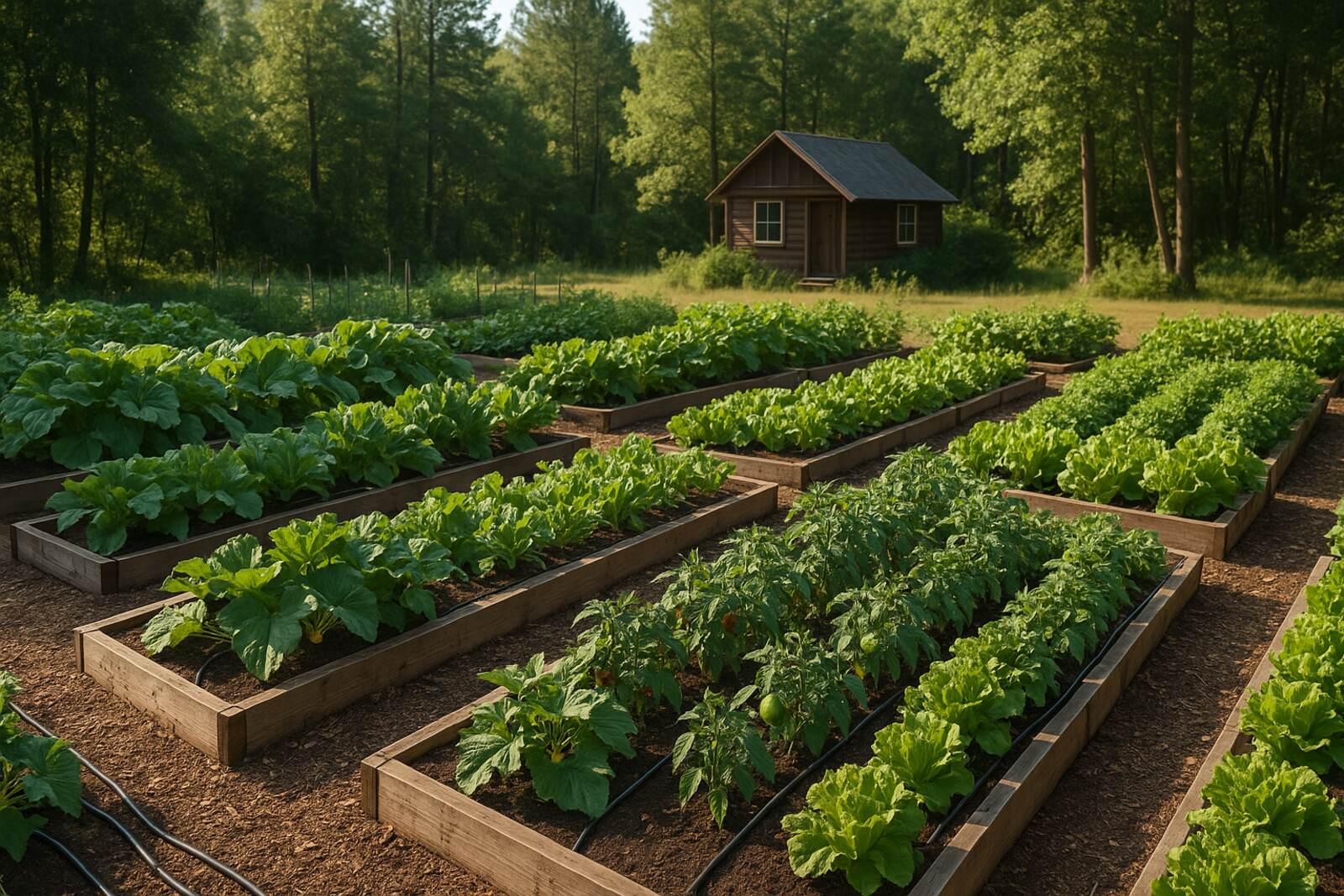
How much garden does it actually take? Enter your household and the level you're aiming for, from summer salads to serious calories, and get square feet, beds, compost, and yield.
This calculator needs JavaScript turned on. With it off, the guide below walks through the math by hand.
Total sq ft (including paths) = people x sq ft per person by goal (100 summer vegetables, 300 real share, 700 most produce, 2,000 serious calories) x method factor (1.0 intensive beds, 1.6 conventional rows) / season factor (0.8 short, 1.0 average, 1.2 long). Planted area = total / method factor. Beds = planted area / 32 sq ft (4x8), rounded up. Compost = planted area / 162 cubic yards (a 2-inch yearly dressing). Yield = planted area x 0.5 lb per sq ft x season factor.
2 people aiming for a real share of their produce, intensive beds, average season: 600 sq ft total, all of it planted, 19 4x8 beds, 3.7 cubic yards of compost a year, and roughly 300 lb of produce.
These are the exact numbers the calculator on this page runs, stated so you can check them. Planning estimates, not engineering; sizing that matters gets confirmed by a professional against local conditions and code. Spotted a problem with the method? Tell me.
"How big a garden do we need?" is really four different questions wearing one coat, and the honest answer runs from a couple hundred square feet to half an acre depending on which one you are asking. This calculator makes you pick, salads, a real share of your produce, most of it, or actual calories, and then sizes the ground, the beds, the compost, and the expected harvest to match.
Fresh summer vegetables for the table takes about 100 square feet per person: tomatoes, greens, peppers, herbs, the things that taste like victory in July. A meaningful share of your year's produce takes around 300 per person, adding storage crops and enough surplus to preserve. Most of your produce, eaten and put up across the year, wants 700 or more. And gardening for calories, the potatoes-corn-beans-squash game, starts near 2,000 square feet per person and rises, which is why homesteads that feed themselves look like small farms: because they are.
The method multiplier reflects paths and layout, intensive raised beds put more of the footprint to work than conventional rows. The season factor is the length of your growing window; a zone 4 garden simply gets fewer harvest-weeks than a zone 7 one, though season extension, row cover, low tunnels, a modest greenhouse, claws a lot of it back.
A garden that produces every year is fed every year. The rough rule is an inch or two of compost across the growing area annually, which for a serious garden is measured in cubic yards, not bags. That either means buying it by the truckload or, better, making it, which is one of the quiet arguments for chickens: the chicken calculator's flock turns kitchen scraps and bedding into exactly this. Soil building is the difference between year-five gardens that outproduce year-one gardens and the reverse.
The most common garden failure is not pests or weather, it is July, when the enthusiasm of April meets the weeding of midsummer. Plant half of what the calculator says the first year and keep it thriving; a small garden tended well outproduces a big one abandoned to the weeds, and it teaches you your land, what drains, what shades, what the deer have opinions about (the fencing calculator prices those opinions). Scale up bed by bed as your systems, compost, water, preservation, prove out.
Water is the other silent constraint: figure the garden into your supply with the water calculator and rainwater calculator, drip irrigation stretches every gallon. The Food & Growing archive takes it from here: what to plant first, season extension, and how to preserve the pile this calculator says is coming.
For fresh summer vegetables, about 100 square feet per person. For a meaningful share of your year's produce, 300. For most of your produce including preserving, 700 or more. Growing serious calories, potatoes, corn, beans, storage crops, starts around 2,000 square feet per person.
A reasonable planning number is half a pound per square foot per season for a mixed intensive garden, so a 600 square foot garden yields around 300 pounds of produce. Well-run beds with good soil, steady water, and succession planting can double that; first-year gardens usually come in under it.
An inch or two across every growing bed annually, which is one cubic yard per 160 to 320 square feet. A serious 1,000 square foot garden wants 3 to 6 yards a year, which is why productive homesteads compost deliberately, and why chickens and gardens are natural partners.
Affiliate disclosure: Some links on this site are affiliate links, including Amazon links: as an Amazon Associate I earn from qualifying purchases. Buying through one costs you nothing extra, and it never changes what I recommend.
The My Patriot Supply seeds collection, including heirloom survival seed vaults and sprouting seeds, for gardeners and homesteaders growing their own food.
Researched, not personally tested
Size the panels, battery, inverter, and controller for what you want to run.
Open the tool →How long your batteries last on a given load, and the usable capacity you really have.
Open the tool →The copper wire size and fuse a DC run needs to be safe and hold voltage drop down.
Open the tool →How much water your household uses and how big a storage buffer to hold.
Open the tool →The heat a space needs, a wood-stove size, and cords of firewood per winter.
Open the tool →A realistic budget range for the systems you need, plus the ongoing yearly cost.
Open the tool →How much rain you can catch from your roof, given your local rainfall.
Open the tool →Coop and run size, nesting boxes, feed, water, and eggs for your flock.
Open the tool →The generator size your loads need, and the gas, propane, or diesel it burns per day.
Open the tool →Gallons per month for your propane appliances, the right tank, and refills per year.
Open the tool →What your building really loses, in BTU, cords, propane gallons, and kWh, and what tightening it up saves.
Open the tool →The right tilt for your panels by latitude, year-round or adjusted by season.
Open the tool →What a small wind turbine would honestly produce at your average wind speed.
Open the tool →Head and flow to watts: what your stream could generate around the clock.
Open the tool →The flow, head, pump size, and pressure tank your well setup needs.
Open the tool →Tank size and drainfield footprint for your household and soil, before you call the engineer.
Open the tool →Yards, tons, truckloads, and dollars for a gravel drive or access road.
Open the tool →Posts, wire, gates, and a real materials budget for the fence around your acreage.
Open the tool →The staples, cans, and buckets a real months-long pantry takes, and the shelf space to hold it.
Open the tool →