Victron
SmartSolar MPPT 100/50 Charge Controller
A best-in-class MPPT controller that squeezes real extra watts out of your array on cloudy days.
Researched, not personally tested

Tell it what you want to run and it estimates the solar array, battery bank, inverter, and charge controller to power it. See your numbers first, no signup.
Check what you will use, then adjust the watts and hours per day. The defaults are typical starting points.
📷 Read a label with your phoneThis calculator needs JavaScript turned on. With it off, the guide below walks through the math by hand.
Array watts = daily Wh / (peak sun hours x 0.75 system efficiency). Battery Wh = daily Wh x backup days / usable fraction (0.8 lithium, 0.5 lead-acid); bank voltage is 12V under 2,000 Wh, 24V under 6,000 Wh, 48V above. Inverter = the largest of (biggest single load x 1.3), (sum of checked loads x 0.6), or 300W, rounded up to a standard size; charge controller amps = (array watts / bank voltage) x 1.25.
Default appliances total 1,333 Wh/day. At 4.5 sun hours: 1,333 / (4.5 x 0.75) = 395W, shown as ~400W (2 x 200W panels). Battery for 2 days on lithium: 1,333 x 2 / 0.8 = 3,333 Wh, shown as ~3,300 Wh (~140 Ah at 24V). Inverter floor is 300W here; controller (395 / 24) x 1.25 = ~25A MPPT.
These are the exact numbers the calculator on this page runs, stated so you can check them. Planning estimates, not engineering; sizing that matters gets confirmed by a professional against local conditions and code. Spotted a problem with the method? Tell me.
The single biggest mistake people make when sizing an off-grid solar system is starting with the panels. They ask "how many panels do I need" before they know how much power they actually use. Flip that around. Every reliable sizing method, including the one behind the calculator on this page, starts with your daily load list measured in watt-hours (Wh).
The math for each device is simple: watts x hours used per day = watt-hours per day. Add up every device you plan to run and you get your total daily energy demand. This one number drives everything else: the size of your solar array, the size of your battery bank, and the rating of your inverter.
Here is a worked example for a small cabin used on weekends, with a few basics running most days:
Total: roughly 1,050 Wh per day, call it 1,100 Wh once you round for a small margin. That is the number you would plug into a sizing calculator. Notice the fridge, even though it is a "small" appliance, is the single biggest draw on the list. That is typical. Refrigeration, water pumping, and anything with a heating element (coffee makers, space heaters, hair dryers) tend to dominate off-grid load lists, so be honest about what you will actually run, not just what you own.
If you are still in the planning stages and want a broader primer on how these systems fit together, the start here guide is a good next stop before you get deep into component specs.
Once you know your daily Wh demand, the next variable is peak sun hours, which is the standard way solar output is measured. One peak sun hour equals one hour of sunlight at an intensity of 1,000 watts per square meter. It is not the same as hours of daylight. A location might get 14 hours of daylight in summer but only deliver 6 peak sun hours, because early morning and late evening light is weak and doesn't carry much energy.
Peak sun hours vary a lot by location and, more importantly, by season. A site in the Southwest US might average 6 to 7 peak sun hours in summer and only 3 to 4 in December. A site in the Pacific Northwest or New England can see winter numbers drop even lower, especially with cloud cover and short days stacked together.
This seasonal swing is where a lot of DIY sizing goes wrong. People size their system using an annual average, get a system that works great in July, and then find themselves running a generator every other day in January. The correct approach, and the one the calculator uses, is to size for your worst realistic month, not the average and not the best case. If you only use the cabin in summer, size for summer. If it is a year-round home or off-grid workspace, size for the season with the lowest sun hours you will actually be there.
You can find peak sun hour data for your specific location and month from NREL's PVWatts tool or similar solar resource maps. Punch in your latitude and you will get a month-by-month breakdown rather than a single number, which is what you want for realistic sizing.
With daily Wh demand and worst-month peak sun hours in hand, you can work out the array size. The basic formula is:
Required array wattage = daily Wh demand ÷ peak sun hours, then adjusted upward for system losses.
That "adjusted upward" part matters and it is where a lot of simple online calculators quietly cut corners. Real systems lose energy to a handful of unavoidable factors: wiring resistance, connector losses, charge controller inefficiency, battery charging inefficiency, temperature effects on panel output, dust and dirt on the panels, and panels rarely operating at their full rated output in real-world angles and conditions. Stacked together, these losses typically run around 20 to 25 percent of your theoretical output. A well-built system with quality components and short wire runs might land toward the low end; a system with long cable runs, cheaper controllers, or a lot of dust and heat will land toward the high end. Using 25 percent as a reasonable planning number, the formula becomes:
Required array wattage = (daily Wh demand ÷ peak sun hours) ÷ 0.75
Back to the cabin example: 1,100 Wh per day, worst month averaging 4 peak sun hours. That's 1,100 ÷ 4 = 275W of theoretical array need, divided by 0.75 = about 367W. In practice you would round up to the nearest standard panel configuration, likely landing around 400W of panel capacity to give yourself a bit of buffer for cloudy stretches and battery charging headroom.
This is exactly the calculation happening behind the scenes on this page's calculator: your Wh number, divided by your location's worst-month sun hours, inflated by the loss factor, rounded to a sensible array size. If you want to go deeper into panel types, wiring configurations, and real-world output data, the solar power section of the blog has more detailed breakdowns.
Batteries store the energy your panels collect so you can use it after dark or during a run of cloudy days. Battery sizing depends on three things: your daily Wh demand, how many days of autonomy you want (days you can run on stored power with no sun), and depth of discharge (DoD), which is how much of the battery's capacity you can actually use.
Days of autonomy is a judgment call. One day of autonomy means your battery bank can cover a full day's use with zero solar input, which is cutting it close if a storm rolls through. Two to three days is a more comfortable margin for many off-grid setups, and more if you live somewhere with frequent multi-day cloudy stretches or if the load includes anything safety-critical like medical equipment or a sump pump.
Depth of discharge is where battery chemistry makes a huge difference:
The practical sizing formula: required battery capacity (Wh) = (daily Wh demand x days of autonomy) ÷ usable DoD.
For the cabin example with 1,100 Wh/day and 2 days of autonomy: 1,100 x 2 = 2,200 Wh of energy needed. With a lithium battery at 90 percent usable DoD, that's about 2,444 Wh, which might mean one or two batteries depending on the model. With lead-acid at 50 percent usable DoD, you'd need 4,400 Wh of rated capacity, roughly double, to deliver the same usable energy. This is why so many off-grid builders have shifted toward lithium despite the higher sticker price: the usable capacity per dollar and the lifespan often work out favorably over time, though budget and application still matter.
The inverter converts the DC power stored in your batteries into the AC power most household devices and appliances expect. Size it based on the combined wattage of everything you might run at the same time, not your daily Wh total. Add up the running watts of your loads, and then check the surge or starting watts of anything with a motor or compressor (fridges, pumps, power tools), since these can draw 2 to 3 times their running wattage for a second or two on startup. Your inverter's continuous rating should comfortably cover your simultaneous running loads, and its surge rating needs to handle the biggest single startup spike layered on top.
A reasonable rule of thumb is to size the inverter with 20 to 25 percent headroom above your calculated simultaneous load, both for safety margin and because you will inevitably add devices later.
The charge controller's job is to regulate power flowing from the panels to the battery bank so you don't overcharge or damage the batteries. It is sized primarily by the amperage your array can produce, not by your daily Wh number. There are two main types: PWM controllers, which are simpler and cheaper but less efficient, generally fine for small systems; and MPPT controllers, which cost more but extract meaningfully more usable power from your panels, especially in cold weather or with higher-voltage panel strings. For anything beyond a very small setup, MPPT is usually worth the extra cost. The controller's amperage rating needs headroom above your array's maximum output current, again with a safety margin, since manufacturers typically recommend sizing at 125 percent of the calculated max current.
The calculator on this page uses the same core method laid out here: load list, worst-month sun hours, realistic system losses, and battery chemistry-specific depth of discharge. It will get you a solid, honest starting estimate for planning and budgeting. For anything safety-critical, such as a full-time off-grid home, medical equipment, or a system you're not comfortable troubleshooting yourself, it is worth having a professional installer or engineer review the final design before you buy equipment.
How many solar panels do I need for an off-grid cabin?
It depends entirely on your daily watt-hour usage and your location's worst-month sun hours, not a fixed number. A small weekend cabin with basic lights, device charging, and a small fridge often lands somewhere around 300 to 500 watts of panel capacity, but a full-time cabin with more appliances can need several times that. Run your own numbers through the load list method above rather than copying someone else's setup.
Is lithium worth the extra cost over lead-acid for off-grid batteries?
For most builds, yes, largely because of usable capacity and lifespan. Lead-acid batteries typically only allow 50 percent discharge for reasonable lifespan, while lithium can usually go to 80 to 100 percent, meaning you need a much smaller lithium bank to store the same usable energy. Lithium also tends to last several times longer in cycle count. The upfront cost is higher, but the cost per usable kWh over the life of the battery often favors lithium.
Do I really need to size for winter if I only use my off-grid system in summer?
No, if you are genuinely certain you will never use the system outside summer months, size for your actual season of use. But be honest about that assumption. Many people who plan on "summer only" end up visiting in shoulder seasons or leaving equipment running year-round, and an undersized system that only works in July can leave you without power the rest of the year.
Most small off-grid homes need 1,200 to 4,000 watts of panels. The real answer is your daily electricity use divided by your local sun hours: a household using 4 kWh a day with 4.5 sun hours needs about 1,100 watts of panels, plus 25 to 30 percent margin for cloudy stretches and system losses.
Multiply your daily use by the days of backup you want, then divide by the usable fraction of the battery: about 80 percent for lithium, 50 percent for lead-acid. A 4 kWh per day household wanting 2 days of autonomy on lithium needs roughly 10 kWh of rated battery capacity.
Size the inverter to everything that can realistically run at the same moment, plus surge headroom for the hardest-starting motor, usually the well pump or a compressor. Most small off-grid homes land between 2,000 and 4,000 watts continuous; oversizing wastes idle power, which matters on a battery bank.
Affiliate disclosure: Some links on this site are affiliate links, including Amazon links: as an Amazon Associate I earn from qualifying purchases. Buying through one costs you nothing extra, and it never changes what I recommend.
A best-in-class MPPT controller that squeezes real extra watts out of your array on cloudy days.
Researched, not personally tested
The My Patriot Supply collection of solar generators, portable power stations, panels and expansion batteries for off-grid and backup power needs.
Researched, not personally tested
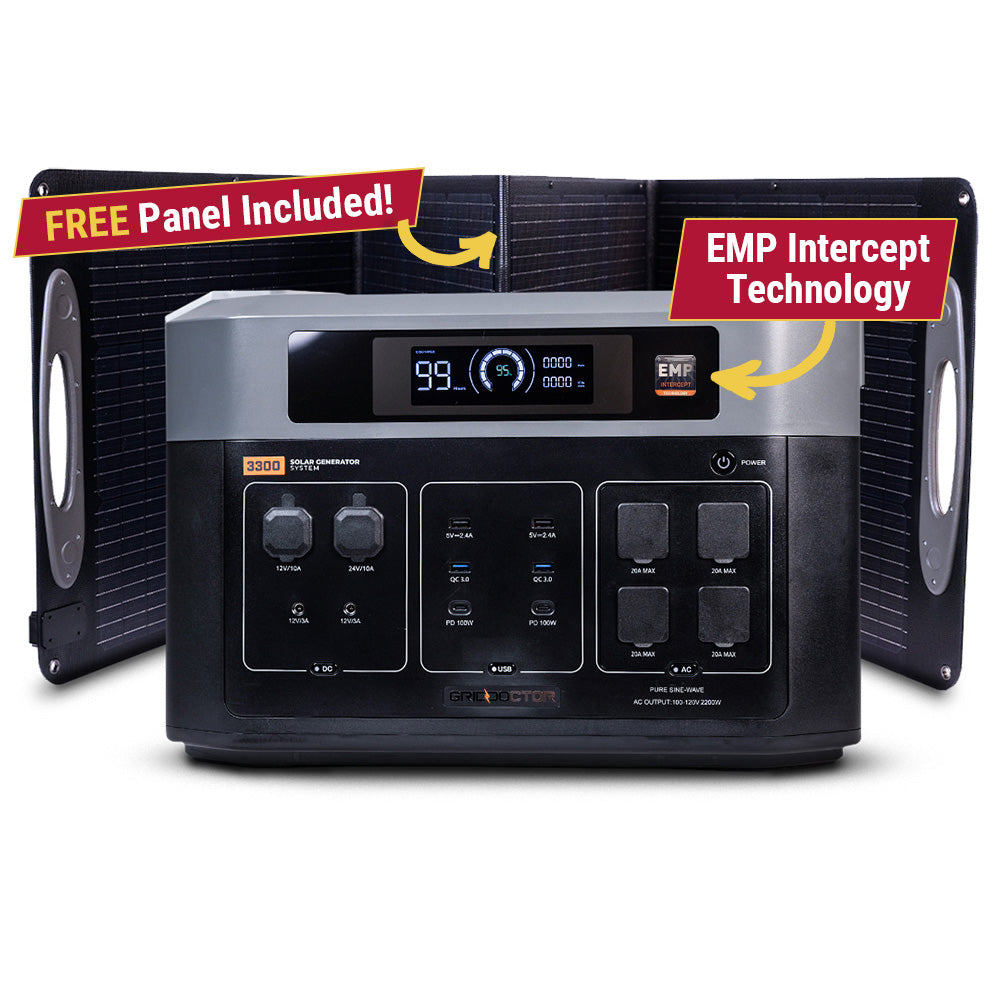
The Grid Doctor 3300 solar generator system sold with EMP shielding, a large portable power station for home backup and off-grid use; check the current spec sheet for details.
Researched, not personally tested

The Grid Doctor 3300-watt EMP-shielded solar generator sold through Emergency Essentials, a large power station for home backup and off-grid use; check the current spec sheet.
Researched, not personally tested
How long your batteries last on a given load, and the usable capacity you really have.
Open the tool →The copper wire size and fuse a DC run needs to be safe and hold voltage drop down.
Open the tool →How much water your household uses and how big a storage buffer to hold.
Open the tool →The heat a space needs, a wood-stove size, and cords of firewood per winter.
Open the tool →A realistic budget range for the systems you need, plus the ongoing yearly cost.
Open the tool →How much rain you can catch from your roof, given your local rainfall.
Open the tool →Coop and run size, nesting boxes, feed, water, and eggs for your flock.
Open the tool →The generator size your loads need, and the gas, propane, or diesel it burns per day.
Open the tool →Gallons per month for your propane appliances, the right tank, and refills per year.
Open the tool →What your building really loses, in BTU, cords, propane gallons, and kWh, and what tightening it up saves.
Open the tool →The right tilt for your panels by latitude, year-round or adjusted by season.
Open the tool →What a small wind turbine would honestly produce at your average wind speed.
Open the tool →Head and flow to watts: what your stream could generate around the clock.
Open the tool →The flow, head, pump size, and pressure tank your well setup needs.
Open the tool →Tank size and drainfield footprint for your household and soil, before you call the engineer.
Open the tool →Yards, tons, truckloads, and dollars for a gravel drive or access road.
Open the tool →Posts, wire, gates, and a real materials budget for the fence around your acreage.
Open the tool →How much garden it takes to feed your household at the level you're aiming for.
Open the tool →The staples, cans, and buckets a real months-long pantry takes, and the shelf space to hold it.
Open the tool →