
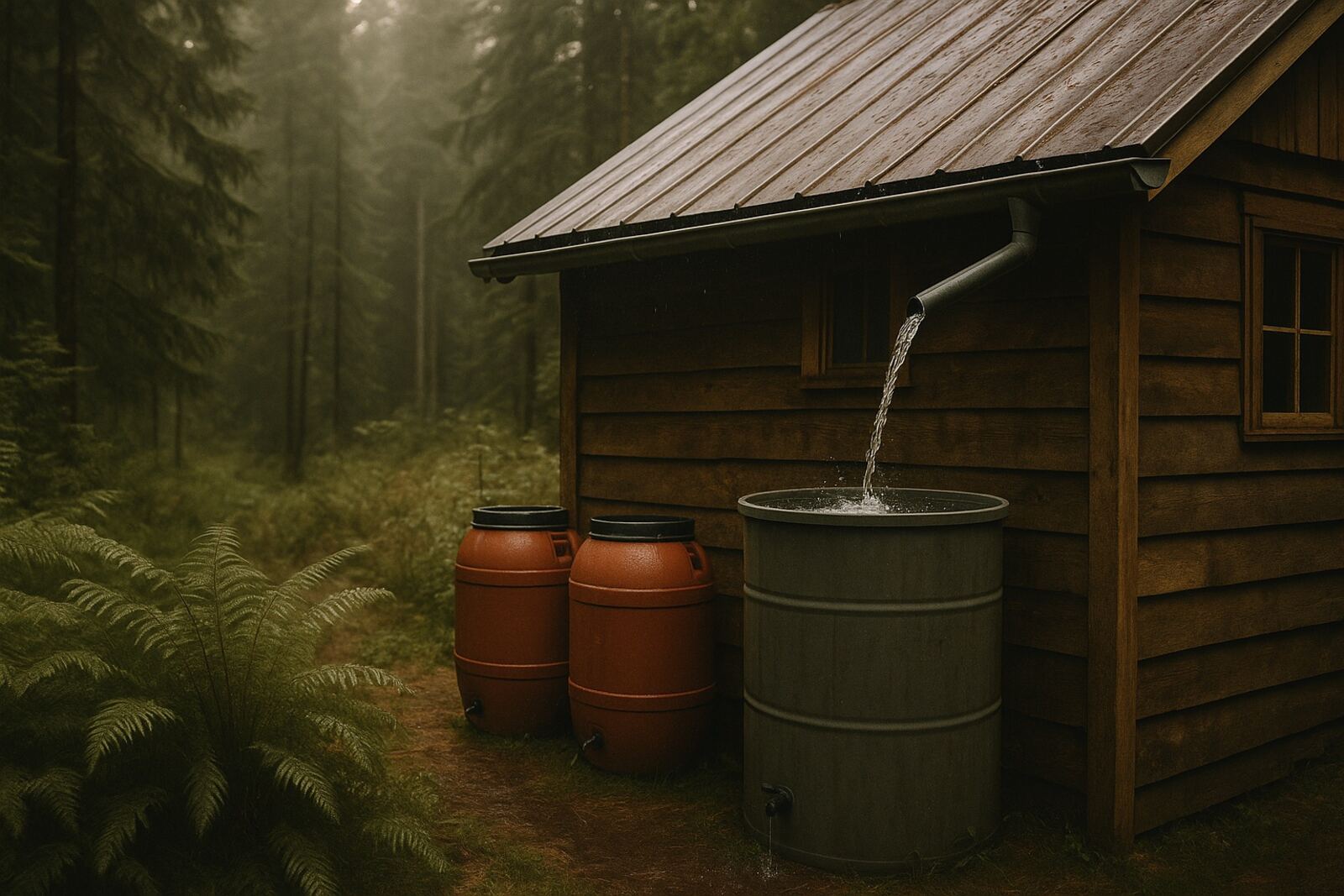
Rainwater harvesting calculator
Enter your catchment area and local rainfall and see how much water you can realistically collect, per year, per month, and per inch of rain.
Your catchment
Use the footprint of the roof (length x width), not the sloped area. Rainfall is your local average annual inches.
This calculator needs JavaScript turned on. With it off, the guide below walks through the math by hand.
How this calculator works
The formula
Gallons per inch of rain = roof footprint sq ft x 0.623 x collection efficiency (0.9, 0.8, or 0.7). Annual gallons = that figure x annual rainfall inches. Monthly average = annual / 12.
Worked example
A 1,000 sq ft roof at 80% efficiency collects 498 gallons per inch of rain. In a 38-inch climate that is about 18,939 gallons a year, roughly 1,578 gallons in an average month.
Assumptions
- 0.623 gallons per square foot per inch of rain (the geometric maximum)
- Collection efficiency of 90% (metal roof, tight system), 80% (typical, default), or 70% (shingle, more losses), covering first-flush diversion and splash-out
- Roof measured as footprint (length x width), not sloped area
- Rainfall is a single annual average; ZIP lookup can fill in your local figure
When it will be wrong
- Rain does not fall evenly; the monthly average hides dry spells, so storage should be sized to your longest realistic gap, not the average
- Drought years run well below the long-term normal
- A few states restrict rainwater collection volumes; check state rules before building large storage
- Untreated roof water is non-potable without filtration and disinfection
Where the numbers come from
- Rainwater Harvesting (Texas A&M AgriLife Extension)
- U.S. Climate Normals (NOAA National Centers for Environmental Information)
- Soak Up the Rain (U.S. Environmental Protection Agency)
These are the exact numbers the calculator on this page runs, stated so you can check them. Planning estimates, not engineering; sizing that matters gets confirmed by a professional against local conditions and code. Spotted a problem with the method? Tell me.
The core formula: catchment area times rainfall times 0.623
The math behind a rainwater catchment calculator is short enough to fit on a sticky note. Take your catchment area in square feet, multiply it by the rainfall in inches for whatever period you're looking at, multiply that by 0.623 (the number of gallons in one inch of rain falling on one square foot of surface), and then multiply the whole thing by your system's collection efficiency, usually somewhere between 0.75 and 0.90. That last step matters more than people expect, and I'll get into why in a minute.
Here's a plain example. A 1,500 square foot roof footprint, in a place that gets 30 inches of rain a year, run through the formula: 1,500 times 30 times 0.623 gives you a theoretical maximum of about 28,035 gallons a year. Multiply by a realistic efficiency of 0.80 and you land closer to 22,400 gallons actually captured. That's the number that matters for planning, not the theoretical one.
Two variables dominate this equation, and neither of them is anything you can buy your way around: roof area and local rainfall. A bigger roof catches more water, full stop, and there's no filter or tank upgrade that changes that. Local rainfall totals swing wildly by region, and even within a region they can vary a lot year to year. This is why I always tell people to pull actual historical rainfall data for their specific county or the nearest weather station, rather than relying on a regional average. A calculator is only as honest as the rainfall number you feed it. If you're building out a full off-grid water plan, it's worth spending time in the water section of the blog where I go deeper into finding reliable local rainfall records.
Collection efficiency and first-flush losses
You never capture 100 percent of the rain that falls on your roof, and it's worth understanding exactly where that water goes so you're not disappointed when your real numbers come in lower than the theoretical max. Some of it evaporates off the roof surface before it ever reaches a gutter, especially on hot days with light rain. Some of it splashes past the gutters entirely during heavy downpours, particularly if the gutters are undersized or pitched wrong. Some gets absorbed by roofing material itself, more so with materials like wood shakes than with metal.
Then there's the first flush, which is the initial surge of water off the roof at the start of any rain event. That first flush carries dust, pollen, bird droppings, leaf debris, and whatever else has been sitting on your roof since the last storm. A well-designed system diverts this first batch of water away from the storage tank entirely, usually the first 10 to 20 gallons per 1,000 square feet of roof, sometimes more if it's been a long dry stretch. That water is a loss on paper, but it's a loss you want, because it keeps the worst contaminants out of your tank and dramatically reduces the sediment and treatment burden down the line.
Add it all up and 75 to 90 percent efficiency is the realistic range for a competently built residential system. Systems with poor gutter maintenance, undersized diverters, or a lot of overhanging trees tend to sit at the low end. Clean metal roofs with well-maintained gutters and a properly sized first-flush diverter tend toward the high end. If your calculator result doesn't ask you for an efficiency estimate, be suspicious of the number it hands you.
Sizing storage to your dry spells, not just your annual total
This is the part that tripped me up when I first started running these numbers for my own property, and it comes up again and again from readers new to rainwater harvesting. The annual total is almost irrelevant to storage sizing. What actually matters is how long the dry spells are between rain events in your area, and how much water your household burns through during that stretch. If you live somewhere that gets steady rain spread evenly across twelve months, you can get away with a relatively modest tank, because the system is constantly topping itself back up. If you live somewhere with a long dry season, six months with next to no rain followed by six months of heavy rain, you need a tank big enough to carry you through the entire dry stretch on stored water alone, because the rain simply isn't coming to bail you out.
The way to think about it: figure out your longest realistic dry spell in days, multiply that by your household's daily water use, and that's your minimum storage target, not your annual catchment total. A household using 50 gallons a day through a 90 day dry season needs at least 4,500 gallons of storage just to bridge that gap, completely independent of how much total rain falls over the year. Plenty of people build systems that catch far more water annually than they need, but still run dry in August because the tank itself was too small to hold a buffer.
Potable versus non-potable use and what treatment actually matters
Rainwater harvesting splits pretty cleanly into two tiers, and it's important to be honest with yourself about which one you're actually building toward. Non-potable use covers irrigation, livestock watering, toilet flushing, and general outdoor use. For these purposes, a screened catchment system with a first-flush diverter and a closed storage tank is genuinely sufficient. You're not drinking it, so the bar is lower and the hardware is simpler.
Potable use, meaning water you drink, cook with, or bathe in, is a different animal entirely and requires a real treatment train. At minimum this means sediment filtration to strip out particulate matter, followed by a stage that addresses biological contaminants, usually either an ultraviolet purification unit or a fine-pore ceramic or membrane filter rated for bacteria and protozoa, and often a final activated carbon stage to handle taste, odor, and any residual organic compounds. Some setups add a coarse pre-filter ahead of the sediment stage just to protect the finer filters downstream from clogging prematurely.
Skipping steps here is where people get into trouble. Roof surfaces collect bird droppings, which can carry bacteria and parasites, and a first-flush diverter alone doesn't guarantee a bacteria-free supply, since even later rainfall can carry some contamination in. If drinking water is the goal, plan for the full treatment train from day one rather than bolting it on later, and get the water tested periodically once the system is running. This is a topic I keep coming back to in the water category, since it's where the stakes are highest and the shortcuts are most tempting.
The practical hardware that makes or breaks a system
The equipment list for rainwater harvesting is short, but each piece earns its place. Gutters and downspouts need to be sized for your roof's actual peak flow rate, not just a generic residential standard, or you'll lose water over the edges during heavy storms. Leaf and debris screens sit at the gutter and downspout entry points to keep large debris out before it ever reaches the diverter, and they need regular clearing or they become the weak point in the whole system. The first-flush diverter comes next, typically a length of vertical pipe that fills up with the initial dirty flow and then, once full, allows cleaner water to pass through to storage. Some designs use a floating ball valve to seal the diverter chamber automatically, others rely on a slow-drain orifice that empties the diverter between rain events so it's ready for the next one.
An overflow line is easy to overlook but essential, since a full tank with nowhere for excess water to go can back up into gutters or cause structural stress. It should be routed well away from the foundation. As for tank types, above-ground poly tanks are the most common for straightforward budgets, steel tanks handle larger volumes and can be more space-efficient in some layouts, and underground cisterns take up no visible yard space and keep water cooler, though they cost more to install and are harder to inspect and maintain. None of these choices are permanent commitments, and if you're weighing options against your own numbers, running a few scenarios through the calculators and tools on this site is a fast way to see how tank size, roof area, and rainfall data play against each other before you commit to hardware.
Check your local rules before you build anything
Most places in the country treat rainwater harvesting as an unremarkable, encouraged practice, sometimes with rebates attached. But a handful of states and municipalities have historical water rights laws that restrict or regulate how much rainwater a property owner can legally collect, tied to downstream water rights that predate modern rainwater harvesting practice entirely. These rules vary a lot by jurisdiction and change periodically, so before you invest in tanks and plumbing, it is worth a phone call to your local water authority or a quick search of your state's specific statutes. It's a rare complication, but not a hypothetical one, and it's far cheaper to check ahead of time than to find out after the tank is installed.
Matching what you can catch to what you actually use
The last step in any rainwater plan is holding your catchment potential up against your real household consumption and being honest about the gap. Run your roof area and local rainfall through the formula, subtract for realistic efficiency losses, and compare that number against your actual daily and seasonal water use, not an idealized minimalist estimate. If the numbers don't match, the fix is usually one of three things: a bigger catchment surface, larger or additional storage tanks, or a serious look at reducing household water use through fixtures and habits. In practice, many setups end up needing some combination of all three. The calculator above is built to let you play with these variables side by side until the picture comes into focus for your specific property.
Common questions
How much rainwater can I really expect to collect each year?
Take your roof's footprint in square feet, multiply by your area's annual rainfall in inches, multiply by 0.623, then multiply by an efficiency factor of roughly 0.75 to 0.90 depending on your setup. That final number, not the theoretical maximum, is what you should plan around.
Do I need a first-flush diverter if I'm only using the water for irrigation?
It's still worth having one. Even for non-potable uses, diverting the dirtiest initial runoff keeps sediment, debris, and organic buildup out of your tank, which reduces maintenance and extends the life of your storage and any downstream filtration.
What size tank do I actually need?
Size it to your longest dry spell, not your annual total. Multiply your expected daily water use by the number of days in your area's longest realistic gap between meaningful rain events, and that figure is your minimum storage target.
Common questions
How much rainwater can I collect from my roof?
About 0.62 gallons per square foot of roof footprint per inch of rain, times a real-world efficiency around 80 percent. A 1,000 square foot roof in a 38 inch rainfall climate collects roughly 18,800 gallons a year, which comfortably covers a conservation-minded household's non-potable needs.
Is rainwater harvesting legal?
In nearly all of the United States, yes, and many states actively encourage it. A few western states with prior-appropriation water law limit storage volumes (Colorado caps residential storage at 110 gallons), so check your state. Nowhere is a rain barrel on a cabin a federal issue.
What size rain tank should I install?
Size storage to bridge your longest dry spell, not your average month. Take your daily use, multiply by the dry weeks your climate actually delivers, and add margin: for many climates that lands between 1,000 and 5,000 gallons for a household relying on rain as a primary source.
More off-grid tools
Solar sizing calculator
Size the panels, battery, inverter, and controller for what you want to run.
Open the tool →Battery bank & runtime
How long your batteries last on a given load, and the usable capacity you really have.
Open the tool →Wire gauge & fuse
The copper wire size and fuse a DC run needs to be safe and hold voltage drop down.
Open the tool →Water storage & usage
How much water your household uses and how big a storage buffer to hold.
Open the tool →Firewood / heating
The heat a space needs, a wood-stove size, and cords of firewood per winter.
Open the tool →Off-grid cost estimator
A realistic budget range for the systems you need, plus the ongoing yearly cost.
Open the tool →Chicken flock & coop
Coop and run size, nesting boxes, feed, water, and eggs for your flock.
Open the tool →Generator sizing & fuel
The generator size your loads need, and the gas, propane, or diesel it burns per day.
Open the tool →Propane usage & tank size
Gallons per month for your propane appliances, the right tank, and refills per year.
Open the tool →Heat loss & insulation
What your building really loses, in BTU, cords, propane gallons, and kWh, and what tightening it up saves.
Open the tool →Solar panel tilt angle
The right tilt for your panels by latitude, year-round or adjusted by season.
Open the tool →Wind turbine estimator
What a small wind turbine would honestly produce at your average wind speed.
Open the tool →Micro-hydro potential
Head and flow to watts: what your stream could generate around the clock.
Open the tool →Well pump sizing
The flow, head, pump size, and pressure tank your well setup needs.
Open the tool →Septic & greywater sizing
Tank size and drainfield footprint for your household and soil, before you call the engineer.
Open the tool →Driveway gravel & cost
Yards, tons, truckloads, and dollars for a gravel drive or access road.
Open the tool →Fencing materials & cost
Posts, wire, gates, and a real materials budget for the fence around your acreage.
Open the tool →Garden size & self-sufficiency
How much garden it takes to feed your household at the level you're aiming for.
Open the tool →Food storage planner
The staples, cans, and buckets a real months-long pantry takes, and the shelf space to hold it.
Open the tool →